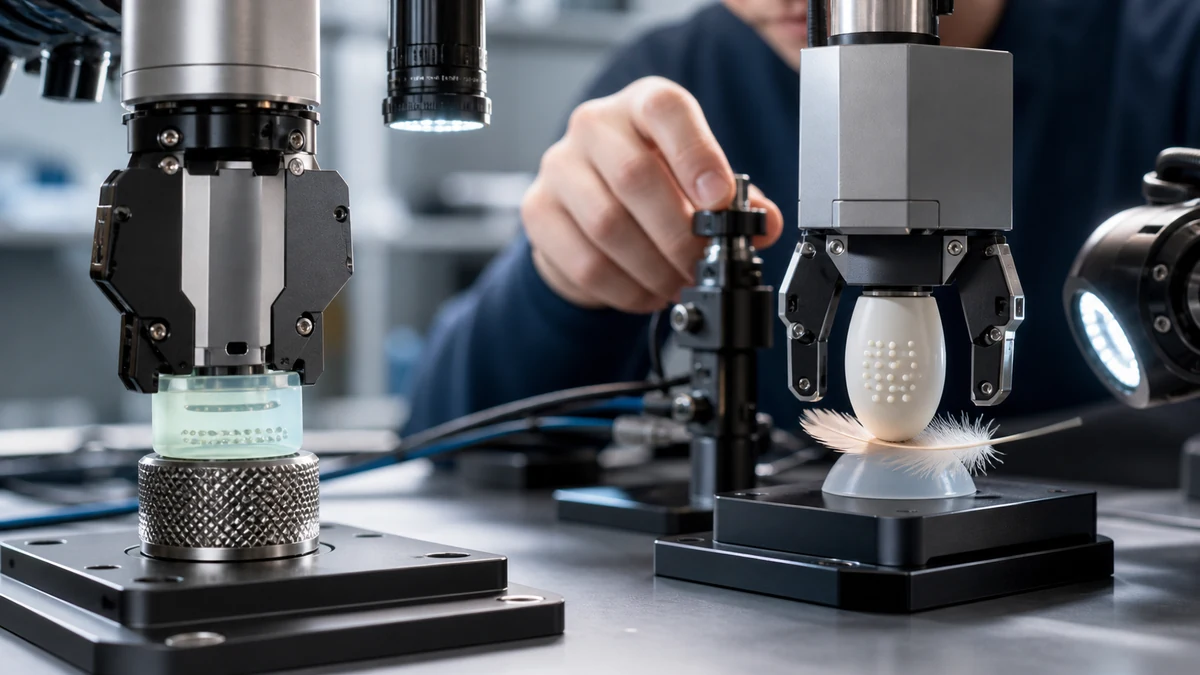
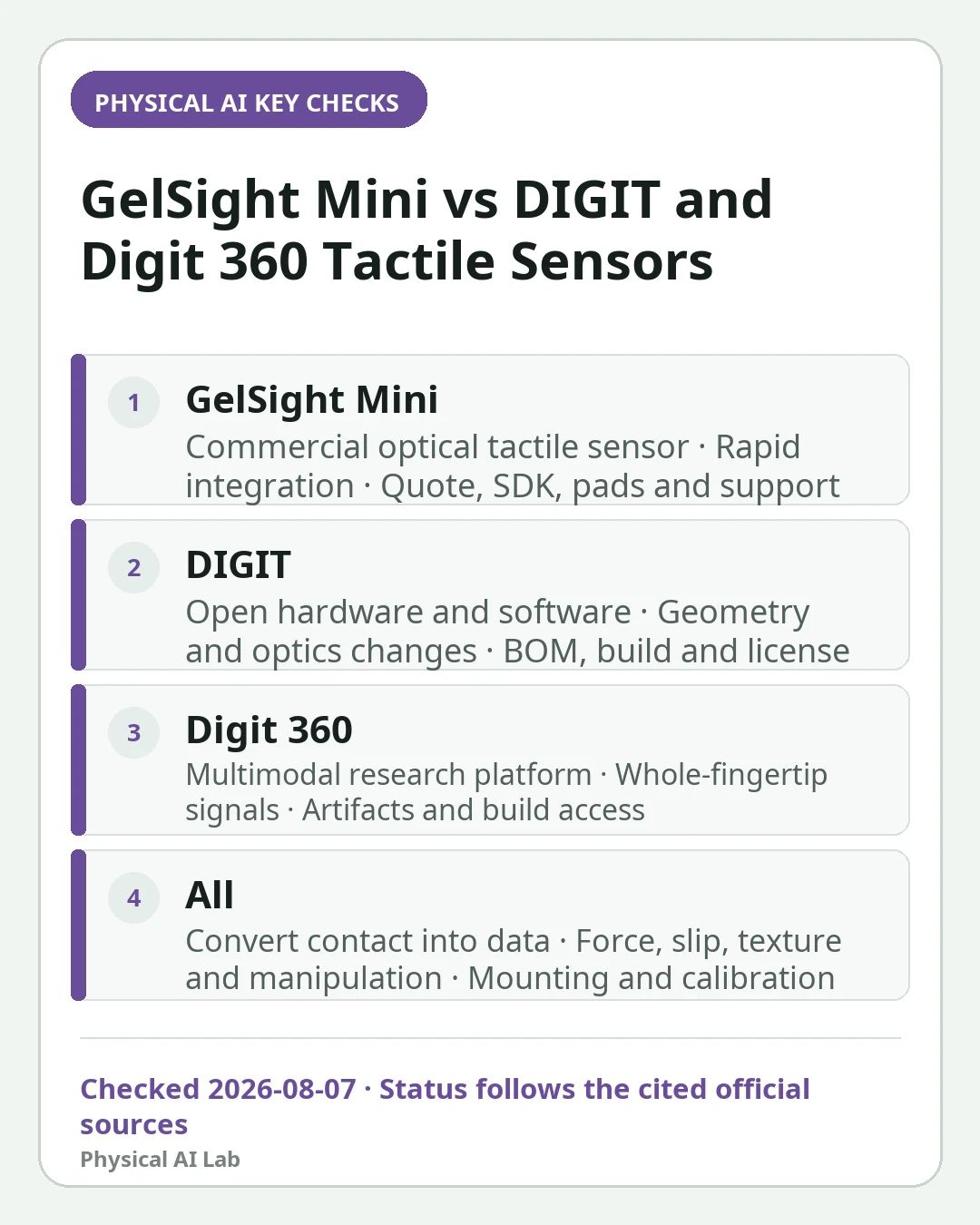
Shortlist GelSight Mini when the team needs a commercially available optical tactile device for repeatable experiments, DIGIT when it needs to build and modify an open hardware design, and Digit 360 when the research question requires a newer multimodal fingertip and data representation. Their access paths and sensing modalities differ, so one resolution or taxel number cannot rank them fairly.
Use the robot tactile-sensor guide for technology categories, visual-tactile fusion for algorithms, and the force-torque sensor guide for external reference measurement. The final choice starts with the force, slip, texture or in-hand manipulation task and the hardware and data contract needed to reproduce it.
Distinguish a commercial device, open design and research platform
The official GelSight Mini datasheet is the source for the current commercial device's interfaces and product information. If procurement, replaceable units and vendor support matter, bind the evaluation to an actual quote, lead time, warranty, SDK version and replacement-elastomer path.
DIGIT and Digit 360 have similar names but should not be presented as one simple upgrade line. Reproducing and modifying an open design requires different labor and risk from ordering a supported sensor, while a multimodal research platform may expose signals and artifacts that are not a stocked commercial product.
Create an access gate before comparing model accuracy. A platform that best fits the scientific question may still miss a project deadline if its hardware, components, assembly knowledge or stable software cannot be obtained by every participating lab.
| Platform | Access form | Best initial fit | Access questions |
|---|---|---|---|
| GelSight Mini | Commercial optical tactile device | Rapid bench and integration iteration | Quote, SDK, replacement elastomer, support |
| DIGIT | Open hardware and software design | Modify geometry, materials or optics | BOM, fabrication, license, reproducibility |
| Digit 360 | New multimodal research platform | Whole-fingertip multimodal research | Released artifacts, build access, support scope |
| All | Convert contact into data | Force, slip, texture and manipulation | Mount, calibration, timing and ground truth |
Verify what DIGIT and Digit 360 actually release
The DIGIT design repository is the official starting point for open hardware design, fabrication resources and related code. When a lab forks it, record the commit, substituted BOM items, print settings, optics, elastomer process and assembly variation so results can be compared across builds.
The Digit 360 repository and Meta touch-perception announcement are official sources for the research direction and released artifacts. Read repository state separately from a research announcement, and do not convert publication into a claim of stocked units, delivery dates or warranty.
Inspect exact licenses for hardware files, code, weights and data instead of assuming one repository label covers everything. Preserve submodule versions and external dependencies, because a reproducible sensor requires more than the visible housing geometry.
Match modality and contact geometry to the task
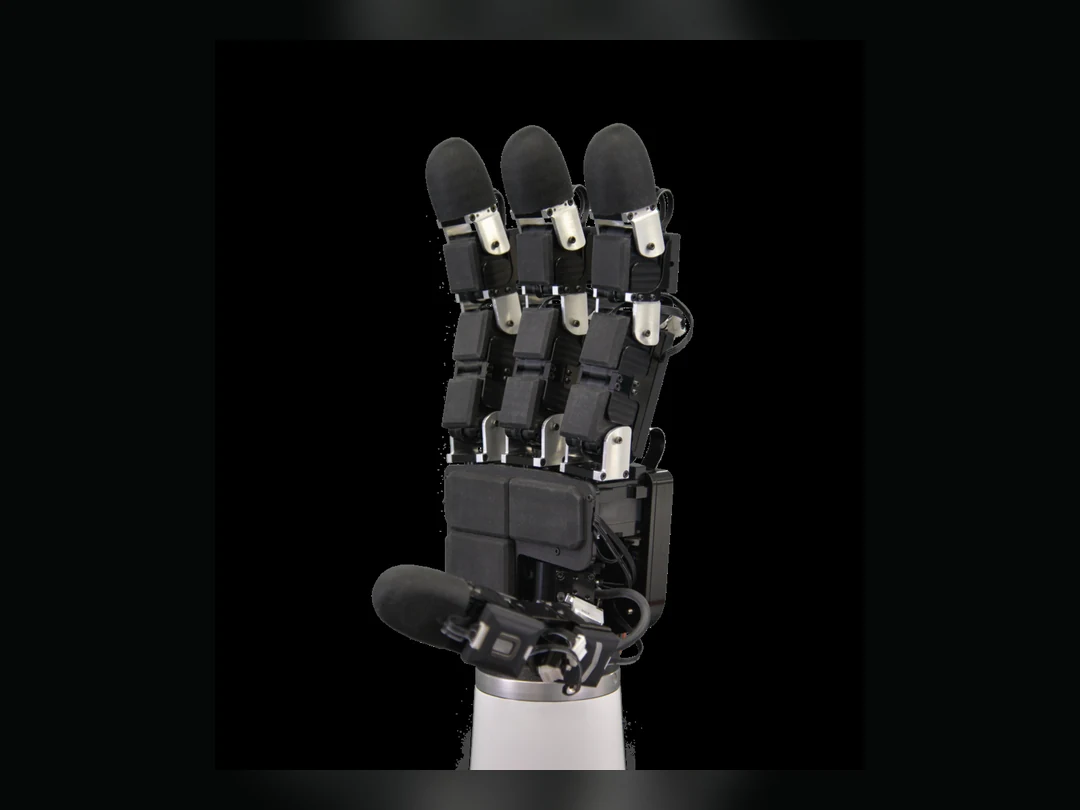
An optical tactile image can expose surface deformation, contact patch and texture but depends on elastomer, illumination and camera calibration. A multimodal fingertip can combine different signal classes, yet the bandwidth, noise, saturation and synchronization of every channel must be qualified separately.
Flat pads, curved fingertips, field of view and an insensitive rim change which objects and contact poses can be reached. Evaluate the sensor in the actual gripper finger with its nail, cable, protective lip, approach angle and collision envelope rather than selecting from a sensor-only demonstration.
Write the inference target in physical language. Contact/no-contact, normal force, shear, incipient slip, surface identity and object pose are different labels with different references. A representation useful for one does not automatically produce calibrated values for another.

Version the elastomer, optics, calibration and wear
A change in elastomer hardness or thickness, coating, illumination, lens, exposure, focus or contact surface can break the mapping between an image and physical force or geometry. Put sensor serial, pad lot, use hours, replacement date, cleaning and calibration result in dataset metadata.
Create force ground truth with an independent force-torque reference and controlled fixture, then freeze definitions for normal, shear, slip and texture labels. Hold out a new pad, object and sensor so a model cannot succeed by learning scratches, lighting variation or object identity shortcuts.
Measure drift and hysteresis over loading cycles and after cleaning or pad replacement. A high initial score is not sufficient when the deployed gripper must retain a stable threshold across wear, temperature and repeated contact.
Connect ROS 2 and learning through one data contract
When a driver publishes images or multiple channels, define topic, frame, timestamp source, encoding, calibration ID, contact state and dropped-frame behavior. Measure clock offset and latency distribution before approximate-time synchronization with cameras, joints or a force-torque reference.
The Sparsh repository is an official code source for tactile-representation research. A pretrained representation still needs transfer validation when sensor geometry, modality, preprocessing or task changes; matching field names do not prove matching physical quantities.
Preserve raw data beside derived features when consent and storage policy allow it. A schema migration should be reversible, identify the transformation code and retain enough metadata to distinguish hardware drift from a model or preprocessing change.
Benchmark the same task with the same ground truth
Use the same gripper or mechanically comparable fixture to evaluate contact detection, normal or shear estimation, slip onset, texture, pose correction and in-hand manipulation as separate tasks. Record calibration time, damaged pads, dropout, inference latency and recurring cost alongside task success.
Do not combine pixel count, taxel count or model accuracy from different modalities into one ranking. Field of view, elastomer, force range, bandwidth, label definition, split and ground truth must be comparable before a numeric difference can support selection.
Report confidence intervals and per-condition failure, not only an aggregate score. A sensor can excel on textured rigid objects yet fail on transparent, soft or lightly contacting objects that dominate the target application.
| Benchmark | Ground truth | Core metrics | Holdout |
|---|---|---|---|
| Contact and force | Force-torque fixture | Error, hysteresis and drift | New pad and sensor |
| Slip onset | Object motion and force trace | Detection delay and false alarm | New material and grasp force |
| Texture | Surface ID and controlled scan | Retrieval and confusion | Unseen surface and speed |
| Manipulation | Task success and pose | Success, intervention and latency | New object, lighting and wear |
Include hardware access and lifecycle cost in the decision
For a commercial device, verify price, lead time, replacement pads, SDK and operating-system support, warranty and unit-to-unit consistency. For an open design, cost the BOM, fabrication time, assembly skill, test fixtures, yield, licenses and maintainer activity. For a research platform, confirm that released artifacts and a reproducible hardware path match the project schedule.
The decision record contains target task, required modality, sensor and pad version, mount, calibration, driver, schema, model, benchmark and known gaps. Re-run affected benchmarks after a pad, optics, firmware, repository commit or gripper change so old and new data retain a defensible meaning.
A mixed fleet may be reasonable: a supported commercial sensor for repeatable production experiments and an open platform for method development. If so, keep separate domain labels and cross-sensor calibration rather than silently pooling every tactile frame into one training set.
Frequently asked questions
Are GelSight Mini and DIGIT the same sensor?
No. Both are associated with optical tactile sensing, but GelSight Mini is a commercial product while DIGIT centers on an open design. Hardware, support, build variance and data pipelines differ.
Is Digit 360 simply the next commercial version of DIGIT?
Do not assume that. Digit 360 is presented as a newer multimodal research platform; check the actual released artifacts, hardware-access route and product status separately.
Does a larger pixel or taxel count identify the best tactile sensor?
No. Modality, field of view, elastomer, bandwidth, calibration, force range, labels and task ground truth differ, so the counts are not automatically comparable.
Official sources checked
- GelSight Mini datasheet
- Meta DIGIT design repository
- Meta Digit 360 repository
- Meta touch perception and dexterity announcement
- Meta Sparsh repository
Last checked: August 7, 2026