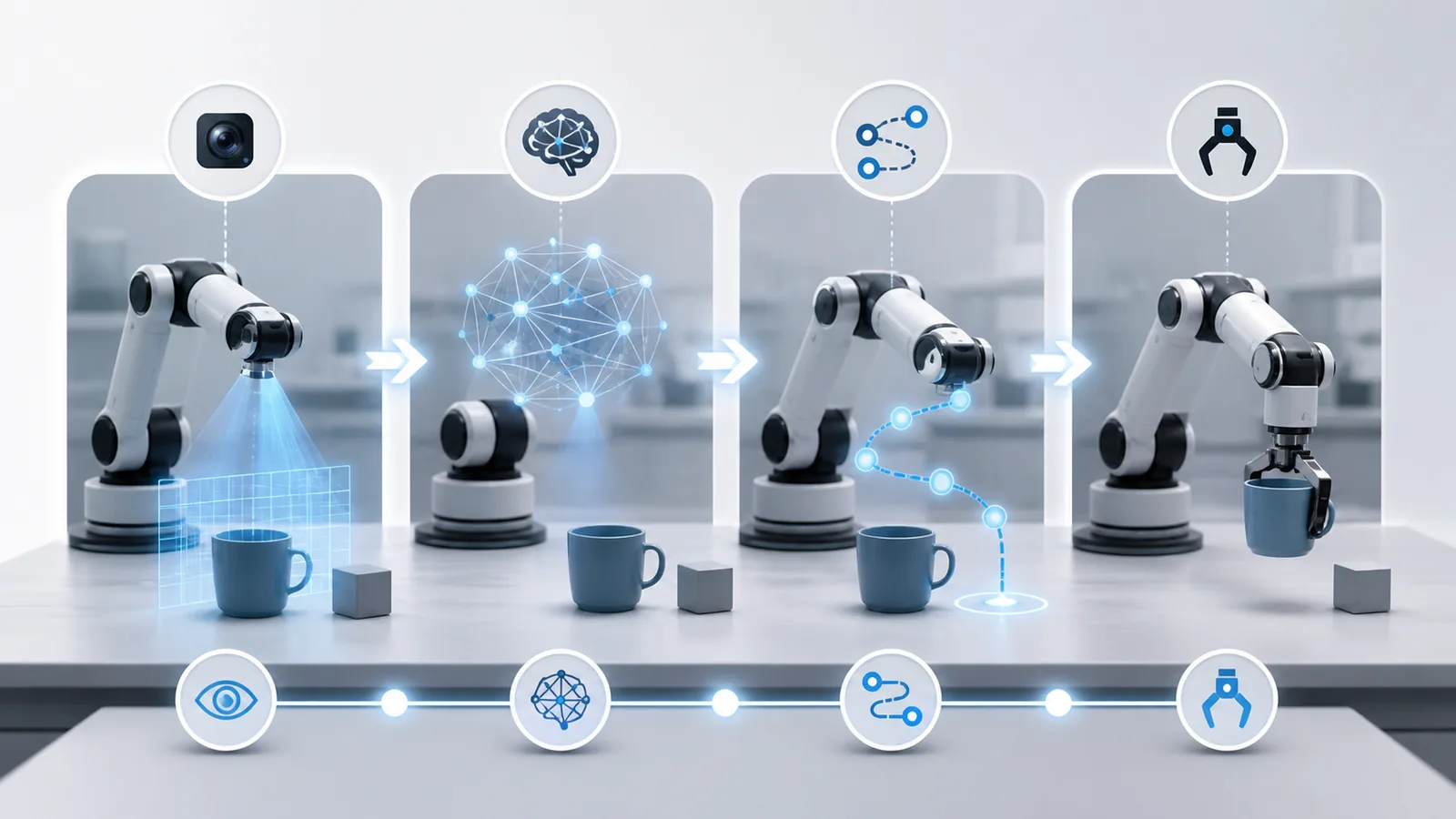
A vision-language-action model, usually shortened to VLA, is a robot model that uses visual observations and language instructions to predict actions. The promise is simple: tell a robot what to do in ordinary words, let it see the scene, and have it produce movements that advance the task.
The engineering reality is more precise. A VLA model must decide what visual details matter, ground words in particular objects, represent actions for a specific robot and react when the world changes. Its output runs on hardware with strict latency, reach, force and safety limits.
VLA is therefore best understood as a policy component inside a larger robotic system. It can improve task generalization, but it does not remove the need for calibration, control, recovery logic and independent safety functions.
VLA meaning: vision, language and action
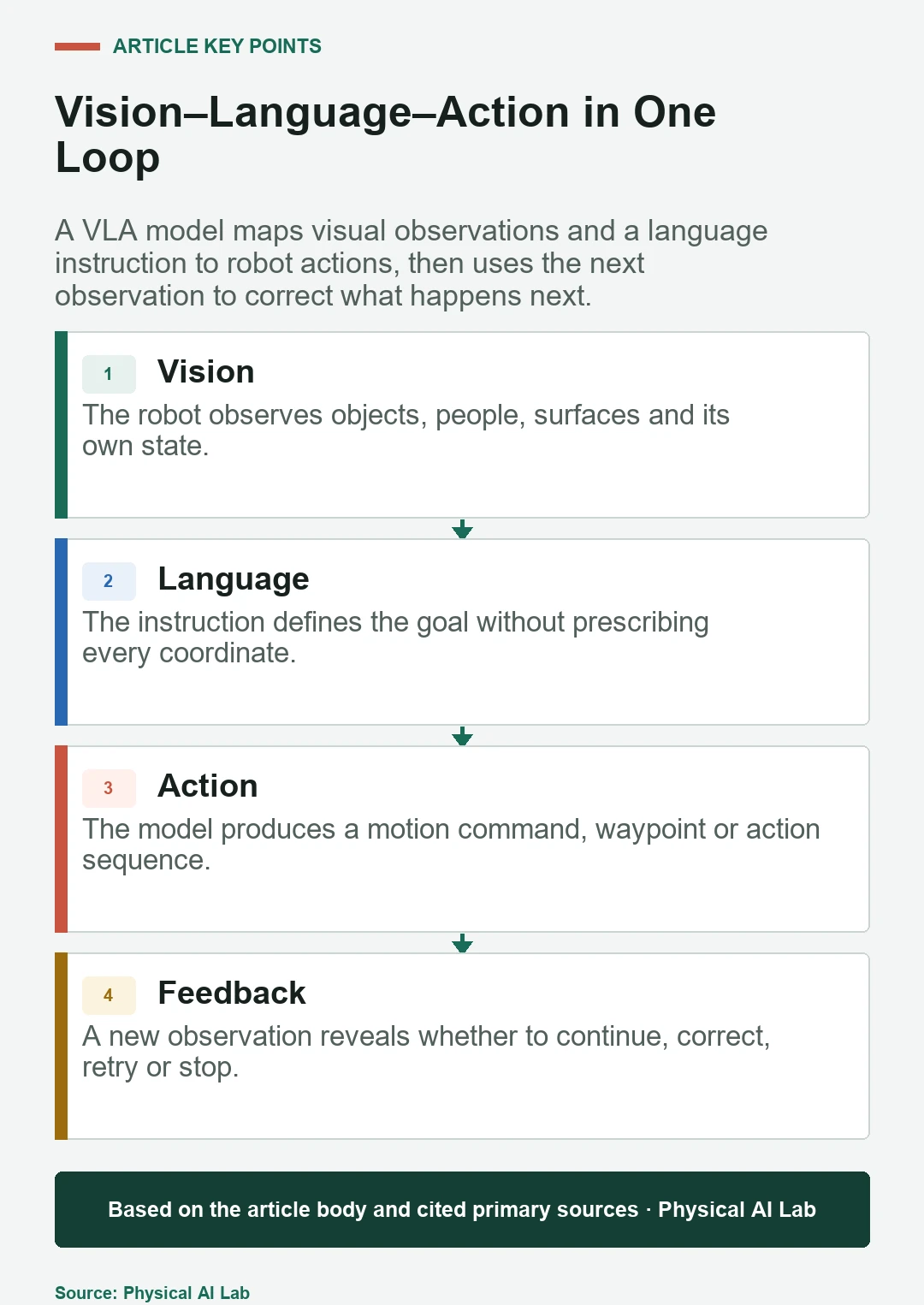
Vision describes the current scene through images or video, sometimes combined with depth and robot state. Language specifies a goal, constraint or correction. Action is the model output that changes the robot or its end effector over time.
The idea is a concrete part of physical AI: information must be grounded in the world and converted into motion. A VLA model that describes the right action but cannot execute it reliably is not enough for deployment.
How a VLA model works
A typical system encodes one or more camera frames, tokenizes the instruction, combines those representations and predicts an action or action chunk. The model may also receive proprioception such as joint positions, gripper state or previous actions.
In a receding-horizon setup, the robot executes a short part of a predicted action sequence, observes again and updates its prediction. The execution horizon and query interval depend on the policy and controller.
Action representations determine what the model can control
Actions can be represented as joint targets, joint velocities, end-effector motion, gripper commands or discrete tokens. Relative end-effector deltas can transfer across workspaces more easily, while joint-level actions expose embodiment-specific detail.
Action frequency and horizon matter as much as format. Long chunks can be efficient but may ignore a sudden change. Very short predictions increase compute and network demands. Teams need to state the representation, frequency and controller below the policy when comparing results.
| Action form | Strength | Main constraint |
|---|---|---|
| Joint targets | Direct embodiment control | Robot-specific dimensions and limits |
| End-effector deltas | Task-space interpretation | Requires inverse kinematics and frame consistency |
| Discrete action tokens | Fits sequence modeling | Quantization can reduce precision |
| Action chunks | Efficient multi-step prediction | Needs replanning when the scene changes |
Training data: demonstrations, robot logs and web knowledge
VLA training commonly combines robot trajectories with language labels and visual observations. Teleoperation provides high-quality actions but is expensive. Autonomous logs scale after deployment but contain the biases and failures of the current system.
Web-scale vision-language pretraining can help models recognize concepts and follow instructions, but internet images do not contain the forces, coordinate frames and executable actions required by a robot. Robot data remains essential for grounding knowledge in control.
Generalization is not one capability
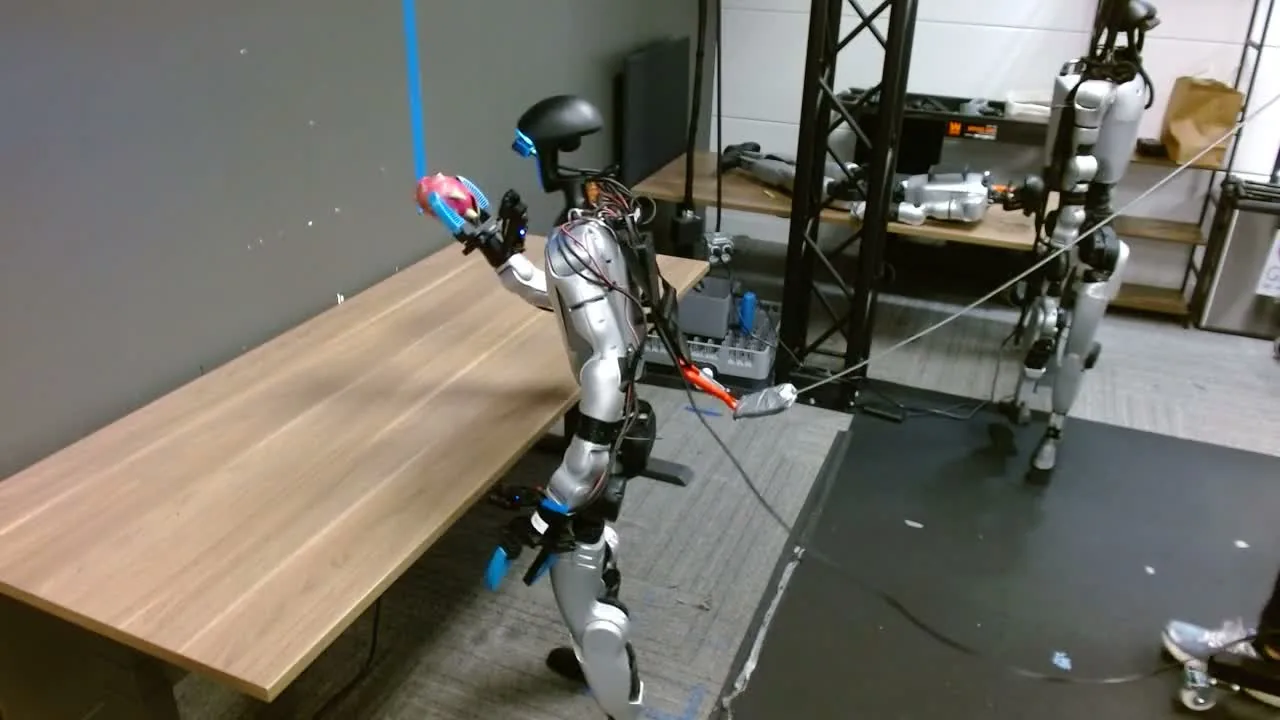
A model may generalize to a new object while failing in new lighting, or follow a paraphrased instruction while failing from a different camera angle. Object, scene, instruction, task and embodiment generalization should be evaluated separately.
Claims are strongest when the training split and evaluation split are disclosed. A new color of a familiar object is a different challenge from a new tool category or an unseen multi-stage task. One success label should not hide those distinctions.
VLA, robot foundation models and embodied reasoning
VLA describes an input-output pattern. A robot foundation model describes broad pretraining intended for adaptation across many tasks or robots. A model can be both, but neither label proves that it transfers well.
Some systems separate embodied reasoning from low-level action generation. The Gemini Robotics model page, for example, distinguishes embodied reasoning from VLA control. A reasoning model can interpret a long-horizon goal and propose subgoals, while a VLA policy executes short actions. The division can improve inspectability, although coordination and latency must be measured.
Latency, calibration and control remain critical
Camera timestamps, transforms and robot state must agree. A highly capable model operating on delayed images can command a grasp where the object used to be. End-to-end latency should be measured at typical and worst-case load.
The policy also needs a stable controller below it. Position and velocity limits, collision checking and command smoothing can constrain outputs before they reach actuators. These layers should be documented because they strongly influence observed performance.
Failure detection and human intervention
A VLA may continue producing plausible actions after losing track of the task. Systems need progress monitors that compare expected and measured state, detect repeated ineffective motion and stop when confidence or safety margins fall below a threshold.
Human intervention should be counted as part of performance. Record whether a person reset an object, changed the instruction, teleoperated a recovery or aborted the run. A low visible failure rate can conceal a high support burden.
- Log every policy observation and action with synchronized robot state.
- Define no-progress, out-of-distribution and safety stop conditions.
- Separate autonomous recovery from human-assisted recovery.
- Retain failed episodes for analysis and targeted data collection.
How to evaluate a VLA model
Use a fixed task suite with held-out objects, poses, backgrounds and instruction forms. Report task completion, partial progress, completion time, intervention rate and safety events. Include confidence intervals when trial counts permit them.
Test disturbances deliberately: move the target after planning, obstruct a route, vary lighting and introduce a look-alike object. The goal is not to surprise the model unfairly, but to map the operating envelope a deployment can rely on.
| Test axis | Example holdout | Report |
|---|---|---|
| Object | Unseen shape or category | Success by object group |
| Instruction | Paraphrase or added constraint | Goal and constraint compliance |
| Scene | New background, clutter or lighting | Success and intervention |
| Disturbance | Object moved during execution | Detection and recovery rate |
Deployment architecture
A practical architecture separates task input, perception and policy inference, motion validation, robot control, safety supervision and logging. The boundaries help teams test each failure path and update the model without silently changing safety behavior.
Policies trained heavily in simulation also need a sim-to-real validation plan. Camera appearance is only one gap; contact, controller response, delays and object dynamics can all change the action distribution.
Questions to ask before selecting a VLA
Ask which robots, sensors, tasks and action rates were used in training. Confirm whether weights, fine-tuning code and data formats are available, and whether the license permits the intended use. Model size alone says little about integration cost.
Then ask for evidence on your task: how much data is needed, what compute runs onboard, how failures are detected and how outputs are constrained. A smaller model with predictable latency and clear recovery can be more valuable than a broad model that is difficult to operate.
Frequently asked questions
What does VLA stand for in robotics?
VLA stands for vision-language-action. It describes models that use visual observations and language instructions to generate robot actions.
Is a VLA model a large language model?
It may reuse a language or vision-language backbone, but it also learns an action representation and must operate within a robot control loop.
Can one VLA control every robot?
Not automatically. Robots differ in sensors, kinematics, action dimensions and control rates. Cross-embodiment transfer requires compatible representations and validation.
Does VLA remove the need for motion planning?
No. Some systems predict motion directly, while others pass goals to planners or controllers. Collision checking, limits and safety supervision are still needed.
How much robot data does a VLA need?
It depends on pretraining, task diversity and embodiment. The useful question is the amount and coverage needed to meet a measured target on a held-out task suite.
What a VLA Label Does Not Prove
VLA capabilities vary by model, embodiment and integration. Evaluate the complete robot system under the intended operating conditions.