A technician guides a leader arm through a connector insertion. The follower reproduces the motion, but one camera frame arrives late and the force signal uses a different clock. The trajectory looks smooth in playback while the learning example teaches contact at the wrong moment. That synchronization fault is the kind of failure a data-collection cell must expose.

The work scene begins with a human demonstration
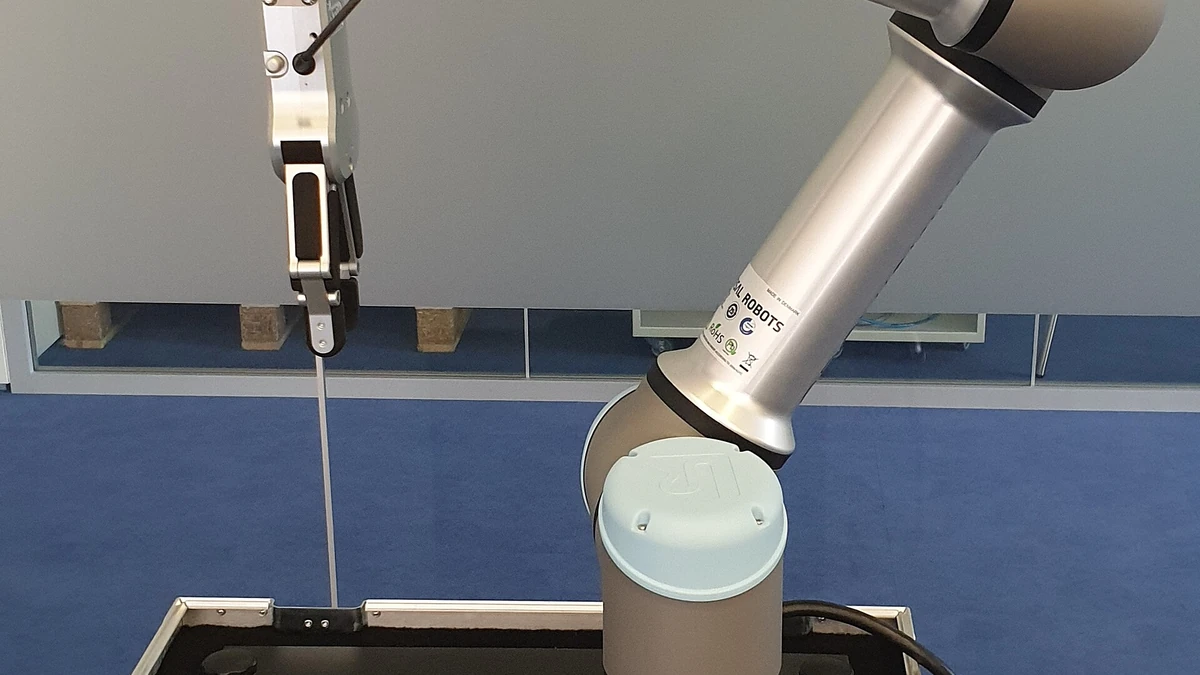
Universal Robots’ announcement describes UR AI Trainer as a leader–follower setup: an operator moves a leader arm and a follower records the demonstrated task. The GTC demonstration used a UR3e leader and UR7e follower, with force or torque feedback contributing to the operator’s sense of contact. That demonstration bill of materials should not be assumed to be every commercial package configuration. The operator’s action is an input, not an automatically correct label.
Misalignment is the first data failure trigger
A useful episode needs calibrated coordinate frames, tool and object identity, a common clock, camera exposure and pose, force zero, task start and end, and outcome labels. Dropped frames, clock drift, swapped workpieces, a changed tool-center point, or an operator correcting the follower can silently change the lesson. A collection UI should flag these events at capture time rather than asking a curator to infer them later. Most corrupted demonstrations remain visually plausible.
| Hazard | Control during collection | Evidence |
|---|---|---|
| Clock drift | Shared time base and drift alert | Raw timestamps and alignment residual |
| Frame mismatch | Versioned coordinate transforms | Calibration run and object reference |
| Hidden intervention | Operator event button and safety-log join | Intervention label and video segment |
| Task bias | Coverage matrix across objects and operators | Distribution report |
| Rights leakage | Consent, access, redaction, retention | Episode-level policy record |
Trace motion, force, and video as one episode
The companies describe synchronized motion, force, and visual streams feeding robot-learning data. Public material does not disclose sampling rate, sensor accuracy, or calibration error, so those values should not be invented. Store raw timestamps and transformation versions alongside aligned samples. The robot data-factory guide explains why a trajectory file without provenance is hard to audit, reproduce, or combine across cells. Synchronization needs raw evidence that survives later processing.
Recover by preserving interventions and failed attempts
Successful demonstrations are not enough. Keep near misses, hesitations, retries, safety stops, operator overrides, partial recoveries, and final abandonment with a reason. They reveal the boundary of the task and can support a recovery policy or evaluation set. Deleting every imperfect episode creates a dataset that teaches only clean starts and hides the state from which the deployed robot will most need help. Failure and intervention data define where autonomy should ask for help.
- episode start
- episode end
- task outcome
- operator correction
- safety stop
Rights and task coverage remain residual risks
Factory video and motion can reveal a worker’s identity, skill, body pattern, production method, and proprietary part geometry. Consent, employment rules, task ownership, license, permitted models, retention, redaction, export, and deletion need to follow the episode. Universal Robots’ reference to more than 100,000 industrial deployments describes its broader hardware context—not AI Trainer installations or data contributors. Data governance attaches to physical work, not just files.
Accept the dataset before accepting the learned policy
Universal Robots and Scale AI said they planned to make an industrial dataset available later in 2026, but did not publish dataset size, license, or policy-performance results at the announcement. Before training, audit coverage, imbalance, synchronization, duplicates, calibration, rights, and holdout separation. After training, test a policy independently under object, operator, lighting, tool, and failure variations. A data recorder and a deployable policy are different products.
Collection quality is necessary but cannot establish deployment performance.
| Owner | Immediate response | Longer correction |
|---|---|---|
| Cell operator | Stop and mark the episode | Repeat under the same setup |
| Data engineer | Quarantine corrupted streams | Repair sync or transformation pipeline |
| Safety owner | Review stop and near miss | Change procedure or cell limits |
| Governance owner | Restrict disputed data | Resolve consent, license, or deletion |
| ML evaluator | Keep failure out of training if invalid | Add valid boundary cases to evaluation |
Questions readers ask next
How are operator motion, robot state, force signals and camera frames synchronized well enough to form a reusable demonstration episode?
A safe stop should preserve the pre-fault sensor window, stop reason, operator action, follower state, and recovery outcome before the cell resets. That record distinguishes a data-system error from a true task failure and prevents a clean restart from erasing the most informative segment.
Official source trail: