An AI agent can request ‘move this material to the next available cell,’ but a factory still needs to translate that intent into an authorized job, validate current equipment state, reserve a route, enforce safety, and report completion or failure. KUKA AMP is intended to organize that gap rather than send raw language to motors.
The starting problem is semantic intent without device-safe action
KUKA’s platform announcement describes AMP as an open, composable platform between AI agents and robot hardware, connecting semantic, action, and data layers. An agent goal must become an approved capability with parameters, preconditions, and a timeout. A robot or AMR must return state in terms the agent can interpret. Neither direction authorizes bypassing a PLC, safety controller, drive, or local protection. A capability registry should also identify the equipment version, active tooling, permitted work zone, payload envelope, and the person or system allowed to invoke it. Otherwise the same semantic command can have different physical consequences after a tool or program change. Semantic convenience cannot remove a physical permission boundary.
Early solutions connected systems but left brittle mappings
Traditional integrations connect MES, fleet managers, robot programs, and digital twins through project-specific tags and APIs. They can work reliably but become expensive when devices or processes change. A generic agent adds no value if it merely hides those mappings behind natural language. The operating layer needs explicit schemas, versioned capabilities, identity, permissions, and failure codes so flexibility does not erase determinism. Adapter tests should include unknown enum values, missing fields, duplicated commands, out-of-order acknowledgements, and vendor-specific stop states. A clean happy-path translation is not enough evidence for cross-vendor operation. An abstraction is open only when its schemas and adapters are inspectable and portable.
AMP’s turning point is a shared meaning, action, and data layer
KUKA frames AMP across Day 0 deployment through Day N operation and optimization. That lifecycle could connect commissioning assumptions with live state and later changes. The useful turning point is traceability: which model or person requested a task, which capability definition accepted it, which digital-twin state was used, which controller executed it, and what feedback closed the loop. The multi-vendor coordination guide shows where openness and sovereign data become procurement questions. Day N optimization should be constrained by the acceptance baseline: a proposed route, cadence, or sequence change needs a simulated check, a physical trial, an approval owner, and a rollback trigger before it becomes normal production. Lifecycle value depends on retaining provenance across every state transition.
The current stack still ends in device controllers
A digital twin can propose feasibility; a fleet manager reserves AMR work; a robot controller executes a validated program; a safety layer limits physical action. AMP can orchestrate their messages without replacing their timing or certification role. Cloud-agent latency and edge real-time control also remain separate. When the agent is unavailable, current jobs need a defined hold, completion, or local fallback rather than an indefinite wait. State freshness should be explicit in every request. A twin that is seconds behind can reserve an occupied station or route a vehicle into a closed aisle even when its geometry is otherwise accurate. Real-time protection remains closest to the hardware.
- safety veto
- feedback code
- timeout
- cloud outage
- edge fallback
Cross-vendor proof, recovery, and economics remain open
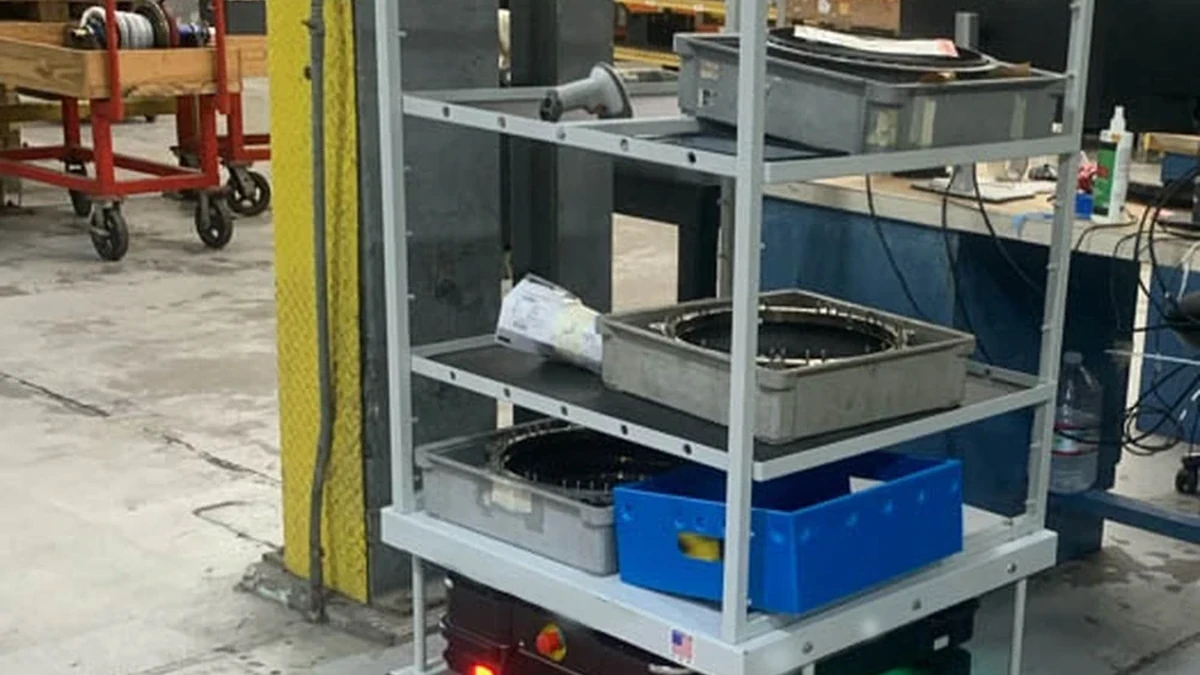
KUKA said an initial AMP version went live at its Toledo production site in July 2026 with AMR operations as the first scope. It also described a 335,000-square-foot site producing more than 300 bodies a day with 285 robots and more than 60,000 connected devices. Those are site-context figures, not the number of AMP-controlled assets or an improvement rate. Cross-vendor support, uptime, cost saving, stale-twin recovery, agent rollback, and mixed-fleet deadlock still need evidence. A useful deployment report would name active AMP-connected assets, eligible jobs, completed and rejected requests, interventions, deadlock recoveries, adapter faults, and the engineering time required per new device family. An early AMR deployment and a large factory context are not platform performance metrics.
Questions readers ask next
Which requests and state transitions belong in AMP, and which remain inside a robot controller, fleet manager or independent safety system?
The next concept to understand is a runtime safety shield: a layer that validates an AI-proposed action against capability, state, speed, force, space, and authorization constraints before a device controller accepts it. That boundary is central to evaluating any agentic factory platform.
Official source trail: