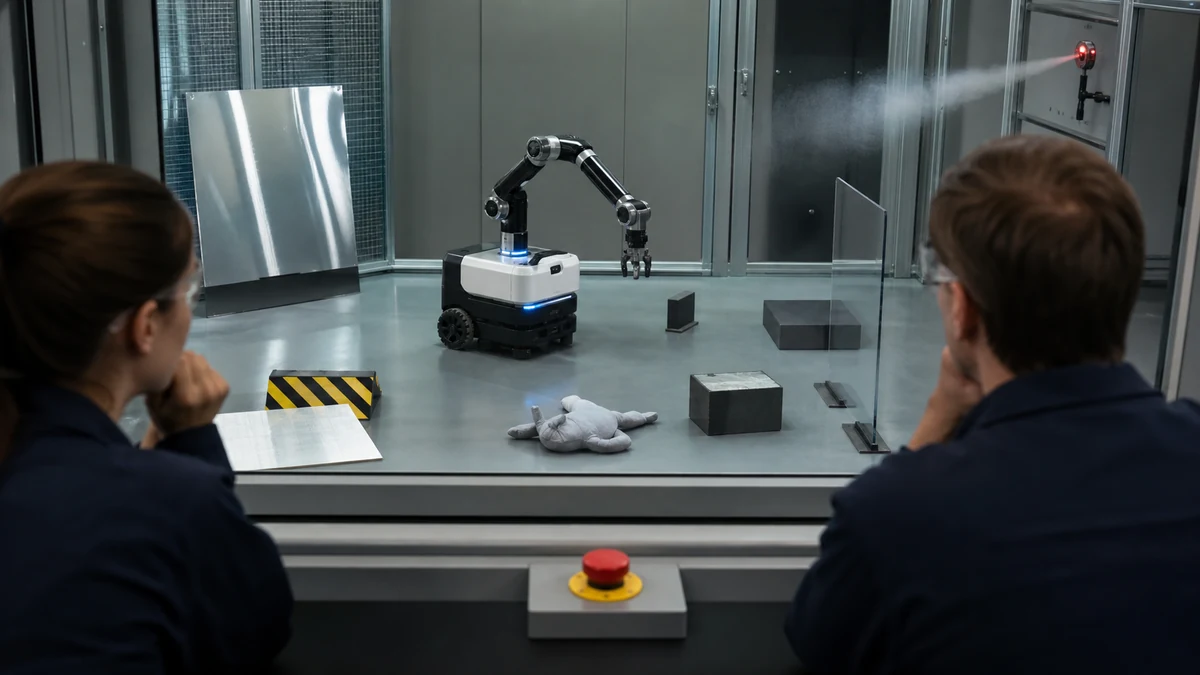
Physical AI red-team testing is an explicitly authorized defensive exercise that asks how a robot responds to misleading instructions, approved synthetic sensor faults, distribution shift, unsafe action requests, communication loss and failed recovery. It must not target public systems or provide operational exploit procedures; begin in simulation and permit physical tests only behind barriers with supervision, an emergency stop and reduced energy.
A runtime policy safety shield constrains actions, ROS 2 and DDS cybersecurity protects communications, and FMEA, HAZOP and STPA structure hazard analysis. Red teaming independently challenges whether those controls detect unexpected conditions and recover safely; it does not replace them.
Authorization and stop conditions are the first controls
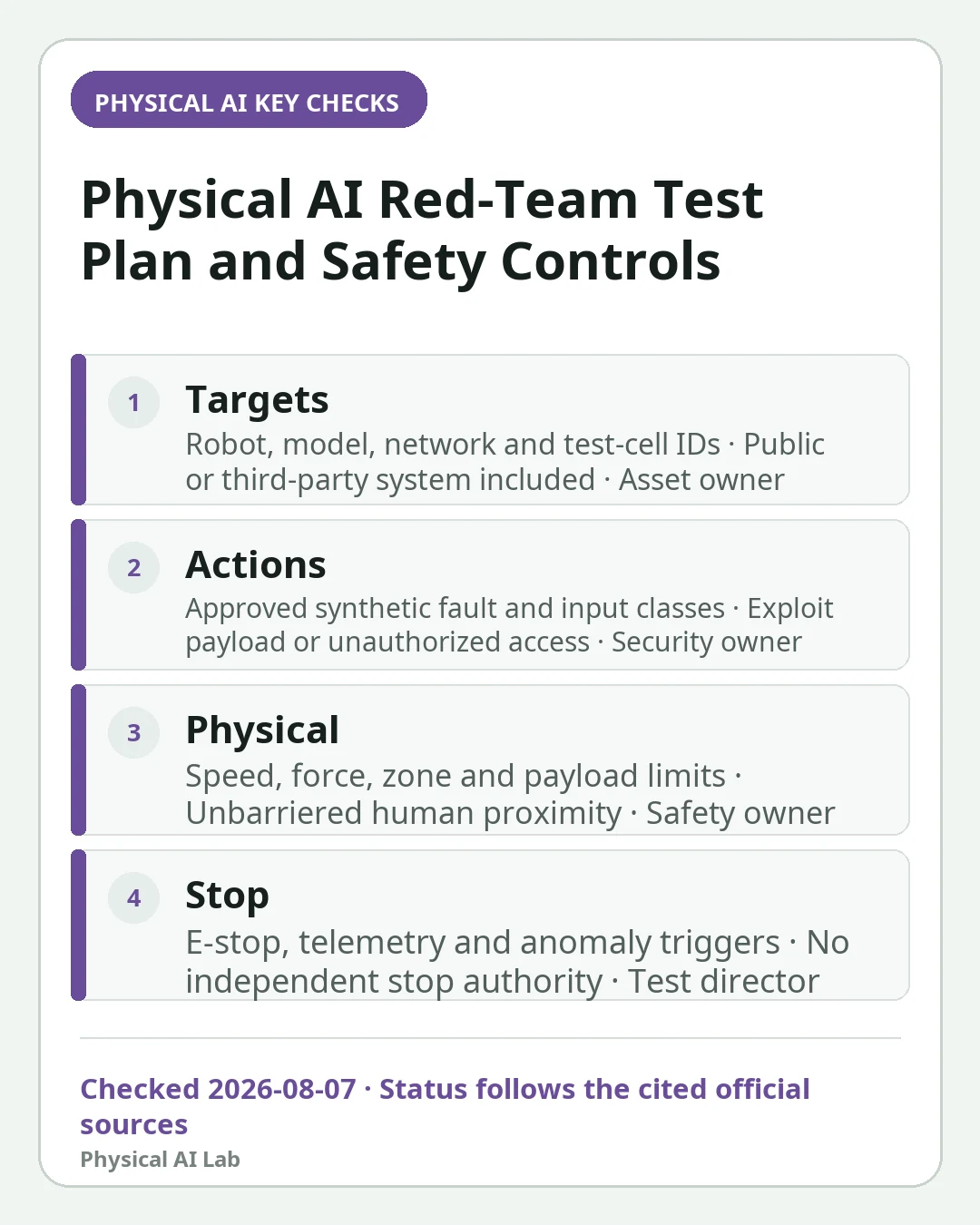
The NIST red teaming glossary frames the activity as authorized testing performed to expose flaws or vulnerabilities. Do not begin until written rules of engagement identify assets, owners, test identities, time window, allowed interfaces, data handling, prohibited actions and accountable approvers.
Unexpected motion, entry by a person, a protective-device alarm, loss of localization or telemetry, communications failure, or a temperature or power limit breach should stop the test. The site safety lead needs stop authority independent of the technical team, and barriers and emergency-stop paths must be function-tested before a run.
| Authorization item | Required statement | Unacceptable state | Approver |
|---|---|---|---|
| Targets | Robot, model, network and test-cell IDs | Public or third-party system included | Asset owner |
| Actions | Approved synthetic fault and input classes | Exploit payload or unauthorized access | Security owner |
| Physical | Speed, force, zone and payload limits | Unbarriered human proximity | Safety owner |
| Stop | E-stop, telemetry and anomaly triggers | No independent stop authority | Test director |
Map assets and hazards before selecting test layers
Draw the data path across sensors, the model, task instructions, policy, runtime guard, middleware, actuators, remote operator, logging and updates. At each trust boundary, connect a degraded or misleading input to a hazardous state and name the control expected to prevent that transition.
Red teaming is not synonymous with penetration testing. A penetration test may focus on technical access paths, while a Physical AI red team also examines ambiguous meaning, corrupted observations, action constraints, operator interaction and recovery. It also differs from routine safety validation and consumes, rather than replaces, hazard-analysis and standards evidence.
Progress from offline evidence to reduced-energy hardware
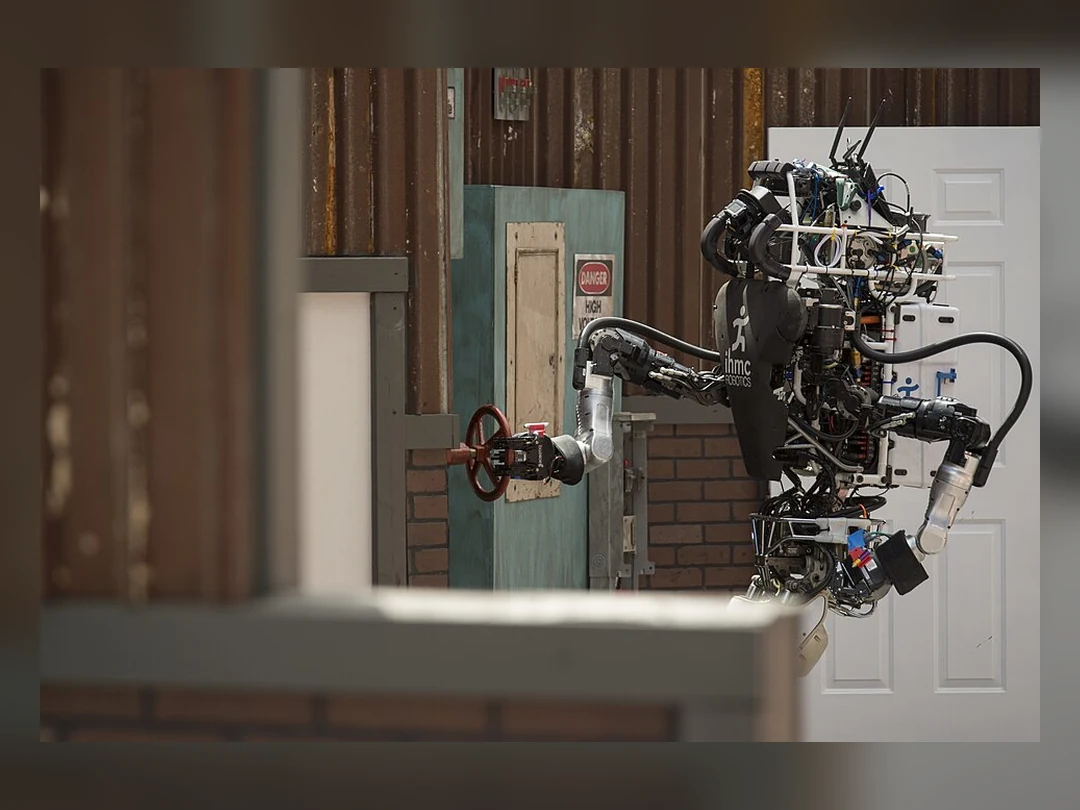
Start with static records and recorded replay to validate detection and rejection logic. Move approved synthetic perturbations and communication-loss events into simulation, then use hardware in the loop to observe real controller timing. Only bounded cases that passed those stages should reach an empty physical test cell at reduced speed and force.
Each escalation requires evidence from the previous stage and a renewed hazard review. Physical work needs a trained spotter, barriers, no payload or a benign dummy payload, independent emergency stop, clear evacuation access, supervised remote control and a lockout procedure after an abnormal stop.

Describe scenarios by defensive objective and expected response
NIST's 2025 adversarial machine learning report announcement describes a taxonomy of attack life-cycle stages and mitigations. For a robot plan, keep cases at the defensive class level: ambiguous or conflicting instructions, synthetic observation corruption through an approved harness, out-of-distribution environments, requests beyond action limits, communications loss and incomplete recovery.
A test case should record preconditions, the defensive objective, approved injection interface, expected reject, slow, hold or ask-for-help response, forbidden motion, stop condition and evidence. It should not publish adversarial strings, bypass sequences, credentials or steps usable against a real product, production robot or public service.
Instrument observables and preserve reproducible evidence
A final model output cannot explain a defense failure by itself. Correlate hashes and timestamps for raw and normalized observations with prompt and policy versions, uncertainty, safety-guard decisions, commands before and after guarding, controller state, operator intervention, network health and emergency-stop state on a common clock.
Minimize personal or security-sensitive data, restrict access and define retention. Score detection, containment, transition to a safe state, recovery and evidence completeness separately instead of collapsing every result into one pass or fail label.
| Test layer | Core observable | Example pass behavior | Evidence retained |
|---|---|---|---|
| Instruction | Interpretation, confidence, refusal reason | Asks for clarification | Input hash and decision log |
| Sensor | Age, quality and cross-check | Detects conflict and slows | Synthetic fault ID and timestamp |
| Action | Raw and guarded command, constraint | Blocks out-of-bound command | Policy and guard versions |
| Recovery | Heartbeat, state, operator handoff | Enters safe state by deadline | Event timeline and approvals |
Rate findings by physical consequence and control failure
Classify a finding by reproducibility, potential harm to people or assets, whether it was detected, exposure breadth and recovery difficulty. Do not dismiss a guard bypass because the contained test caused no damage, and do not present one simulation miss as proof that a field catastrophe is inevitable.
Match remediation to cause: input validation, sensor cross-checks, policy constraints, timeouts, operator handoff, privilege separation, logging or training data. MITRE ATLAS can support threat-informed classification and defensive discussion, but it does not replace site hazard analysis or authorization.
Close findings only after remediation and regression retest
Rerun the original test case after a fix and execute a nearby normal-behavior regression set. A finding closes only when its evidence ID, owner, due date, fixed version, retest result and approval of any residual risk are connected in the record.
Use the Govern, Map, Measure and Manage functions in the NIST AI Risk Management Framework to set retest triggers for model, sensor, site and supplier changes. Add triggers for severe incidents, remote-access changes and new tasks instead of relying only on a calendar interval.
Frequently asked questions
Does Physical AI red teaming mean hacking a real robot?
No. It is defensive testing within written authorization and containment. Public systems, third-party equipment and unapproved production assets must remain out of scope.
Can the first red-team test run on physical hardware?
No. Start with replay, simulation and hardware in the loop, then allow bounded reduced-energy tests in an empty cell with barriers, supervision and an independent emergency stop.
Does passing a red-team exercise replace robot safety certification?
No. Red teaming probes unexpected and adversarial conditions. It complements hazard analysis, standards-based validation, functional safety and cybersecurity testing.
Official sources checked
- NIST Adversarial Machine Learning report announcement
- NIST red teaming glossary
- NIST AI Risk Management Framework
- MITRE ATLAS
Last checked: August 7, 2026