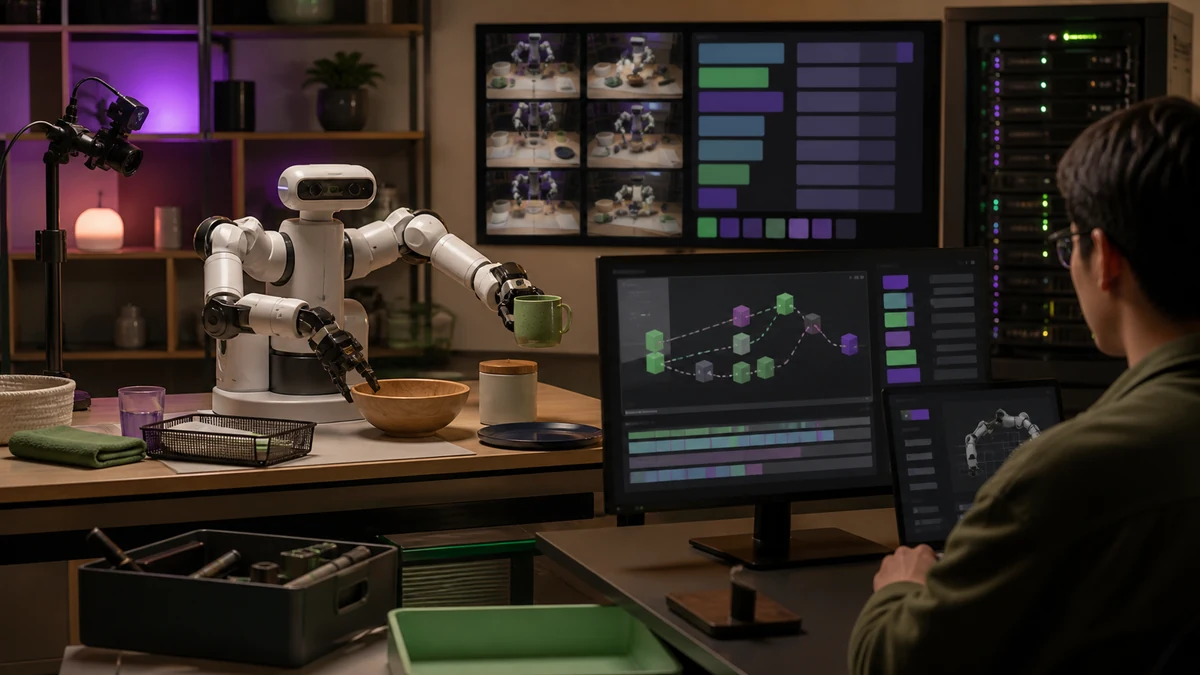
The practical SmolVLA workflow is: record a LeRobot dataset whose cameras, state and actions match the target robot; fine-tune `lerobot/smolvla_base`; save reproducible checkpoints; and evaluate them under fixed real-robot conditions. Hugging Face recommends roughly 50 task episodes as a starting point, not as a universal minimum or a promise of success.
LeRobot v0.6.1 was the latest official release when this page was checked on August 7, 2026. Commands and configuration fields can change between `main` and a packaged release, so pin the version you actually run. Never copy a camera key, action schema, serial port or checkpoint path from an example without mapping it to your own setup.
Pin LeRobot before touching the dataset
The official LeRobot releases page identifies v0.6.1 as the latest release on the check date. Create an isolated environment and install the checked SmolVLA release with `pip install "lerobot[smolvla]==0.6.1"`. Record the package version, Python and PyTorch versions, CUDA build, model revision and dataset revision in the experiment directory; even a pinned package should remain recorded with the full environment lock.
SmolVLA consumes multiple camera views, the robot's current sensorimotor state and a language instruction, then predicts an action chunk. The camera names and order, state dimensions, joint order, units, action dimensions, absolute-versus-delta convention and control rate must agree between recording, training and rollout. Use our LeRobot Dataset v3 guide for the storage layout; the important SmolVLA decision here is whether those features represent the robot you will actually command.
| Item to freeze | Evidence to save | Typical symptom when it is wrong |
|---|---|---|
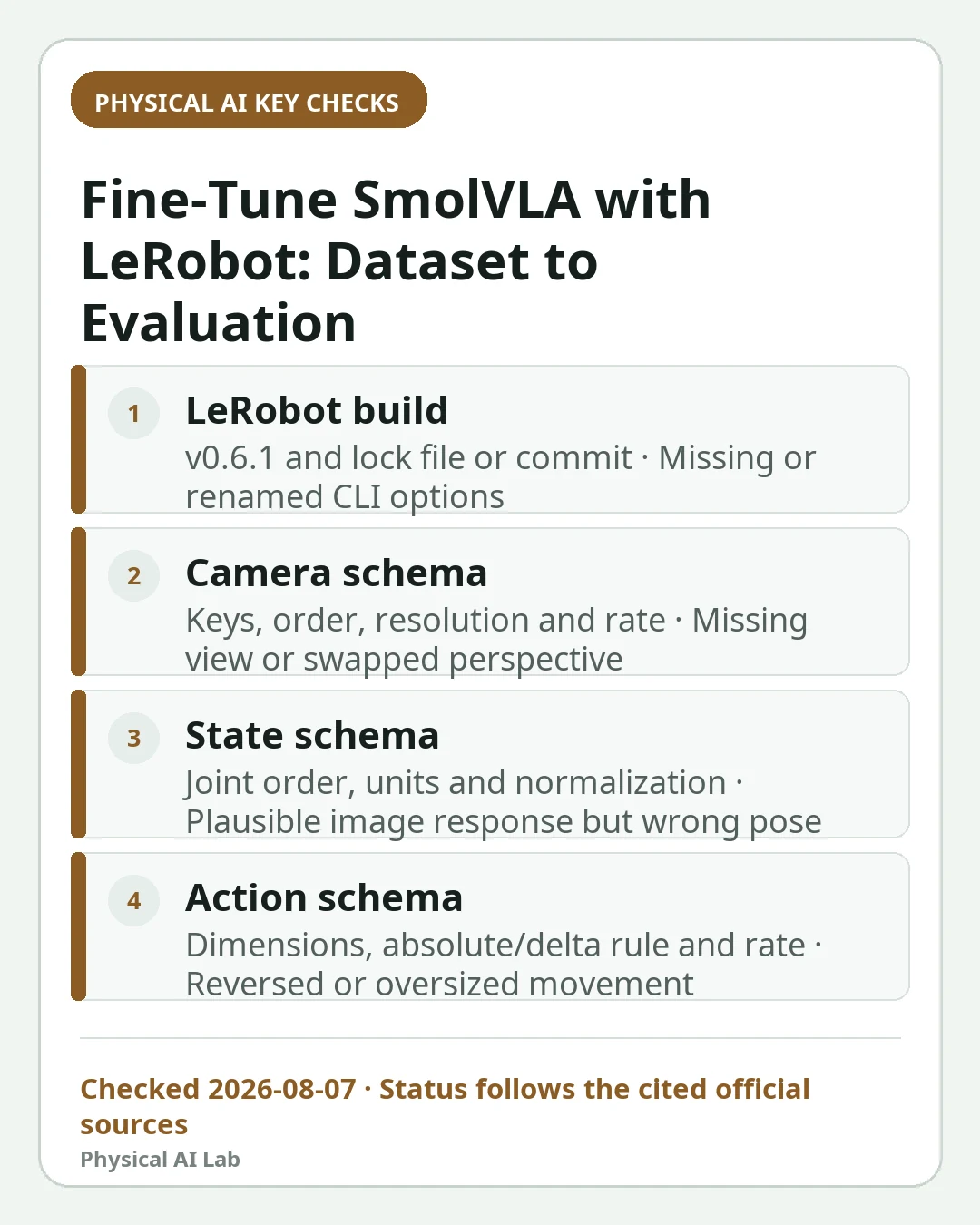
| LeRobot build | v0.6.1 and lock file or commit | Missing or renamed CLI options |
| Camera schema | Keys, order, resolution and rate | Missing view or swapped perspective |
| State schema | Joint order, units and normalization | Plausible image response but wrong pose |
| Action schema | Dimensions, absolute/delta rule and rate | Reversed or oversized movement |
| Instruction | Task wording used in the dataset | Conflicting behavior for the same scene |
Build variation into the episodes instead of chasing a magic count
The v0.6.1 SmolVLA usage document recommends about 50 episodes as a starting point. Its reference pick-and-place dataset used five cube positions with ten episodes for each position, and the authors say a similar 25-episode dataset performed poorly. That observation belongs to one task and collection setup; it does not establish 50 as a threshold for every robot.
List the variations that the deployed robot will face: object position and identity, lighting, clutter, starting joint pose, camera occlusion and recovery after a bad grasp. Count episodes by that grid rather than only by total. Successful demonstrations alone can produce a policy that has never seen how to recover from a partial grasp. For the broader choice between full tuning and parameter-efficient methods, use our VLA LoRA and adapter guide instead of turning this SmolVLA procedure into a generic tuning survey.
| Dataset check | Concrete test | Action when it fails |
|---|---|---|
| Variation coverage | Count episodes by position, object and lighting | Collect the missing combinations |
| Camera alignment | Visualize every named stream on a common timeline | Fix keys, ordering or timestamps |
| Action range | Plot per-joint limits and step changes | Correct units or delta conversion |
| Instruction consistency | Group demonstrations by semantic task | Remove contradictory labels |
| Validation split | Hold out objects or scenes, not random frames | Rebuild a leakage-resistant split |
Fine-tune the base checkpoint and make the run reproducible
The Hugging Face SmolVLA announcement describes a 450-million-parameter open model and points to `lerobot/smolvla_base`. The current guide's core call is `lerobot-train –policy.path=lerobot/smolvla_base –dataset.repo_id=HF_USER/MY_DATASET –batch_size=64 –steps=20000 –output_dir=outputs/train/my_smolvla –job_name=my_smolvla_training –policy.device=cuda –wandb.enable=true`. Replace the repository and output values and keep the resulting configuration with the checkpoint.
Batch size 64 and 20,000 steps are examples, not required settings. The guide's statement that 20,000 steps take roughly four hours on one A100 is also an example under its own software, image and I/O conditions. Other official hardware guidance gives different order-of-magnitude times for different batches and workloads. Lower the batch when memory is constrained, then record throughput, peak memory, training loss and validation behavior instead of promising a wall-clock duration.

Choose a checkpoint by behavior, not by the lowest loss
Save checkpoints at planned intervals and evaluate each on the same trial matrix. Include familiar task instances and held-out positions, objects or backgrounds. Keep the starting pose, object placement ranges, time limit and success definition stable. A lower training loss can coexist with worse grasp timing or brittle behavior under a camera shift, so it is not a deployment decision by itself.
Follow the measurement discipline in our robot VLA evaluation guide: report task success, partial completion, latency, recovery, human intervention and safety stops. Separate perception failures from action failures. A run that reaches the object but closes the gripper early should not be grouped with a run that never located the object; the next data or model change differs.
Run the first rollouts as controlled experiments
The official SmolVLA document shows `lerobot-rollout` with a robot type, serial port, robot ID, camera dictionary, task text and a fine-tuned `–policy.path`. Treat every hardware field as an example that must be replaced with the target setup. Use the exact camera keys expected by the trained preprocessing pipeline, verify the joint and action mapping without load, and keep the task text semantically consistent with the demonstrations.
Clear the workspace, cap speed, torque and action range, and keep a tested physical emergency stop within reach. A trained policy should pass through an independent command validator before reaching motors. Begin with one episode at low speed, inspect the log and video, then increase repetitions. SmolVLA is a policy checkpoint; it is not a safety-rated controller, collision-protection device or certification for unattended operation.
A deployable result includes the version and the failures
The official LeRobot repository evolves its training, dataset and evaluation interfaces quickly. Store v0.6.1, the exact SmolVLA model revision, dataset commit, resolved configuration, random seed, hardware and evaluation protocol with the selected artifact. When upgrading LeRobot, load and test the checkpoint in a new environment rather than silently replacing the runtime used for the accepted result.
Select the model that repeatedly completes the intended task, degrades predictably on held-out conditions, meets latency limits and can fail safely. The paper's asynchronous inference design explains how perception and action generation can be decoupled from execution, but architecture-level responsiveness does not remove the need to measure your hardware. Fifty episodes, 20,000 steps and an A100 estimate are planning anchors; matched schemas and reproducible failure evidence are what make the fine-tune usable.
Frequently asked questions
Do I need exactly 50 episodes to fine-tune SmolVLA?
No. It is the official guide's suggested starting point. Task variation, demonstration quality, camera count and embodiment complexity can require fewer or many more episodes.
Is 20,000 training steps enough?
Not necessarily. Compare saved checkpoints on a fixed real-robot trial set and decide from success, latency, recovery and safety-stop evidence rather than the step count alone.
Can I deploy smolvla_base without fine-tuning?
The official guide recommends fine-tuning on your own data for best performance in your setup. Do not connect a base model directly when camera, state or action schemas differ.
Official sources checked
- Hugging Face SmolVLA announcement
- Official LeRobot SmolVLA guide
- Official LeRobot repository
- LeRobot releases
- SmolVLA paper
2026-08-07