A humanoid robot video proves that a recorded event occurred under some set of conditions. It does not, by itself, prove continuous autonomy, repeatability, commercial readiness or safe operation outside the filmed scene. The useful question is not whether the clip looks impressive. It is which claim the available evidence can support.
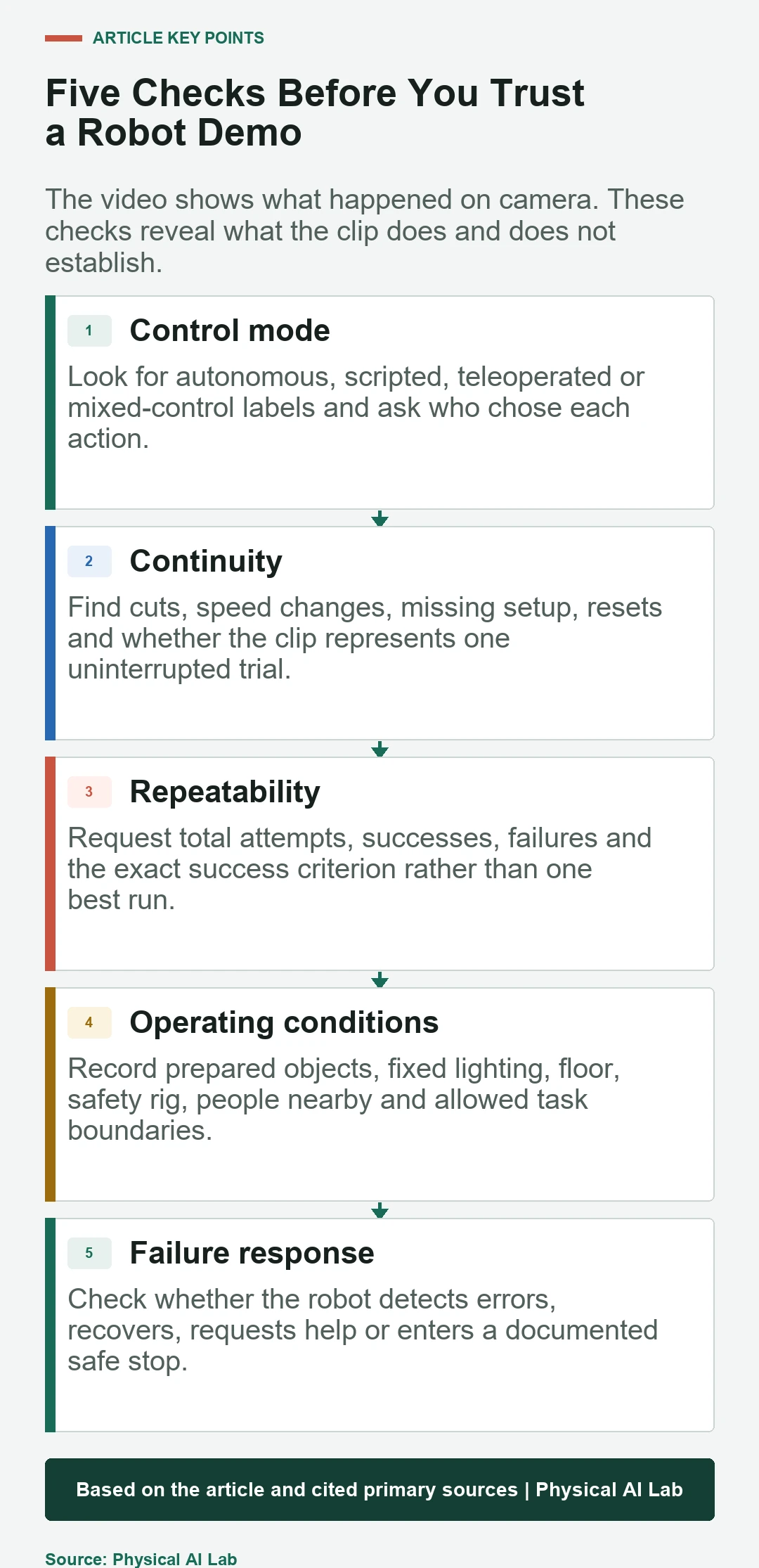
Start with five checks: control mode, edit boundaries, number of trials, operating conditions and failure response. A company can publish an important technical demonstration without answering every question, but viewers should keep their conclusion no broader than the disclosed test. The same rule applies to laboratory videos, product launches and social-media clips.
This method complements the broader guide to types of humanoid robots. A research demonstration, a pilot workflow and a supported product can all use similar bodies while representing different evidence levels. Reading the video correctly prevents a single successful run from being mistaken for a deployed capability.
A video is evidence of a bounded event
Define the narrowest statement the clip establishes. If a robot carries one container across a prepared floor, the evidence is that this robot completed that motion at least once in the filmed setting. The clip may support claims about balance, planning or manipulation, but only when the task, control system and trial conditions are identified.
Avoid jumping from one task to a general label such as autonomous, general purpose or production ready. Each label requires additional measurements. Autonomy needs a boundary for human input. Generality needs a task and object set. Production readiness needs uptime, recovery, maintenance, safety and integration evidence over a meaningful operating period.
Identify who or what selected the actions
The control mode may be scripted, teleoperated, autonomous or mixed. Scripted motion can still demonstrate excellent mechanics and control. Teleoperation can validate a task and collect robot action data. An autonomous policy can select actions from observations. Shared control may combine a human goal with onboard balance, collision avoidance or grasp stabilization.
Look for explicit language in the video, caption, paper or product page. Words such as autonomous, remotely operated, human-in-the-loop, preprogrammed and sped up carry different meanings. If control is not disclosed, record it as unknown. Smooth motion, hesitation or apparent intelligence cannot reliably reveal the control architecture on their own.
Treat cuts and playback changes as missing evidence
An edit is not automatically deceptive. Long experiments are often shortened, and cameras change angles to show important details. The problem arises when the edit removes the information needed for the claim: a reset, a human intervention, a failed grasp, a battery change or a long planning delay.
Check whether the clip states that it is continuous and real time. Watch object positions, robot posture, lighting and background people across cuts. Note time-lapse or slow-motion segments. If the full trial is unavailable, describe the result as an edited demonstration and do not infer how often the omitted transitions succeed.
Ask for repeated trials and a success definition
One best run cannot reveal variance. A stronger report states the number of attempts, the success count and what counted as success. A manipulation trial might require the object to reach a target without a drop, collision or human correction. A walking test might specify distance, floor type, falls and resets.
Percent success is useful only with its denominator and test distribution. Ten successes in ten nearly identical setups answer a different question from ninety successes across one hundred varied objects and placements. Confidence grows when the evaluation includes ordinary variation and publishes representative failures rather than only a highlight reel.
| Evidence | Minimum question | Stronger disclosure | What remains unknown |
|---|---|---|---|
| Single clip | Was it one complete trial? | Uncut, real-time recording | Repeatability |
| Success rate | How many attempts? | Success rule and trial distribution | Unseen environments |
| Autonomy claim | When could a person intervene? | Intervention count and control boundary | Behavior outside the test |
| Deployment clip | How long did it run? | Cycles, uptime, recovery and maintenance | Scale to other workflows |
Record the operating conditions and safety infrastructure
List the floor, lighting, object set, initial placement, workspace boundaries and people near the robot. Prepared conditions are normal in engineering. They become misleading only when a prepared test is presented as evidence for an unrestricted environment. A fixed container and known shelf do not establish arbitrary-object manipulation.
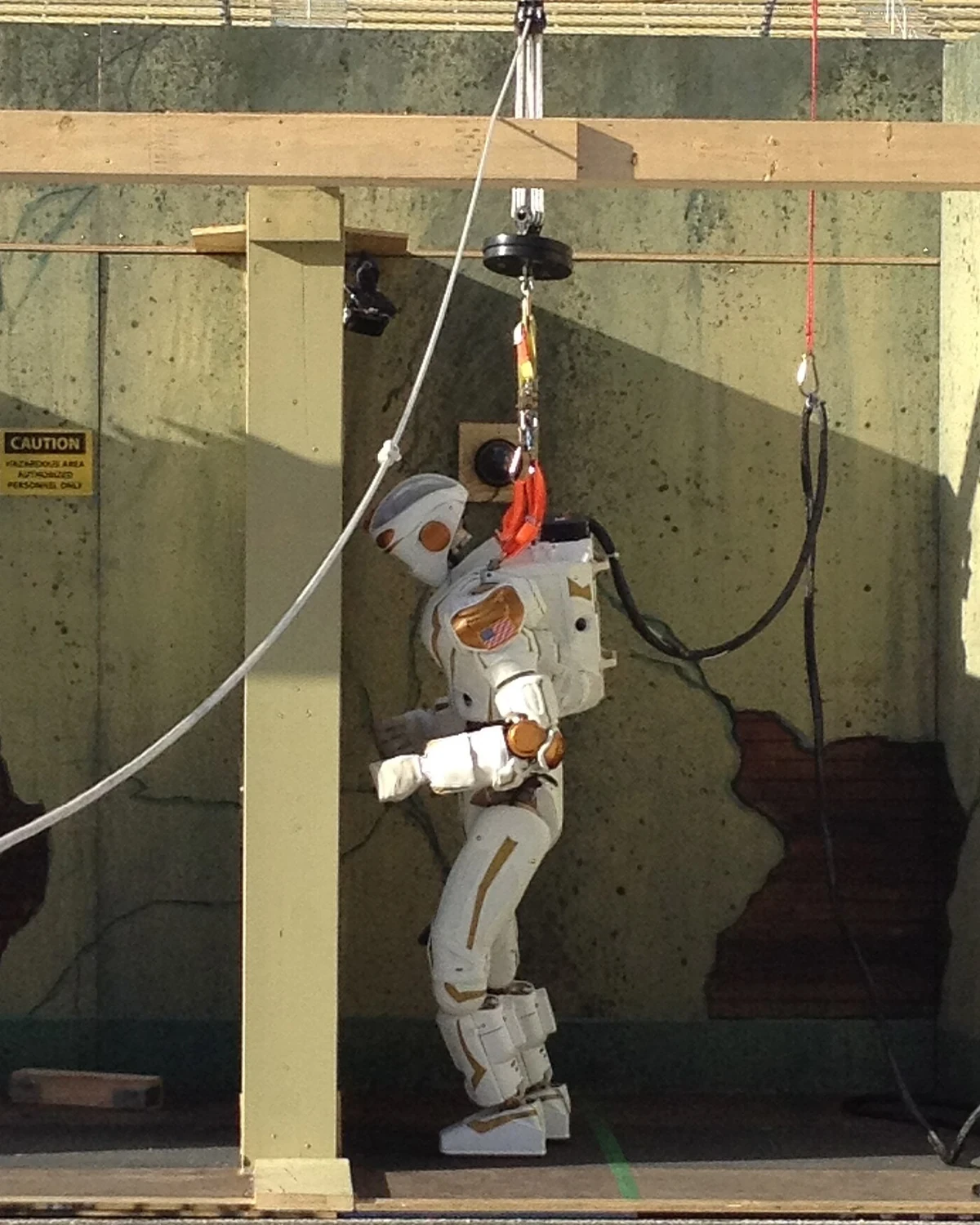
Also identify tethers, overhead rigs, spotters, mats, cages and emergency-stop operators. These measures can make testing responsible and repeatable. They change what the video establishes about falls, free movement and close human operation, so their role belongs in the evidence description.

Define the task before judging the robot
Break the demonstration into observable stages. A box-handling task may require perception, approach, grasp selection, lift, transport, placement and verification. Completing only the central motion is different from completing the end-to-end workflow. The start and finish conditions should make the difference visible.
The model label does not replace a task definition. A vision-language-action model may interpret an instruction and produce robot actions, but the demonstration still needs boundaries for objects, language, calibration, latency and recovery. Evaluate the system outcome rather than attributing every success to one model component.
Failure behavior can be more informative than success
A useful robot does not merely complete nominal trials. It detects weak grasps, blocked paths, unexpected contact and uncertain perception. It then retries, chooses an alternative, requests help or stops in a documented safe state. A video that includes failures can provide more engineering value than a flawless montage.
Separate policy recovery from hidden reset. If a person restores the object or repositions the robot, count that intervention. If the system recognizes the error and performs a new action, document the recovery time and whether it introduced another hazard. Recovery rate should be reported alongside task success, not folded invisibly into it.
Read product language at the right evidence level
Official pages may use words such as designed for, capable of, pilot, deployment and available. Designed for describes an engineering target. Capable of usually needs the named test. A pilot is a bounded customer evaluation. Deployment becomes more meaningful when the workflow, duration, fleet size and operator role are provided.
The Boston Dynamics Atlas page, for example, describes an industrial product and a path from evaluation through integration. Those operational details answer different questions from an agility clip. Apply the same distinction to every vendor: demonstration evidence and operating evidence are related but not interchangeable.
Use the five-part evidence card on every clip
Create one short record for each video: control mode, continuity, trials, conditions and failure response. Add the source, publication date and exact claim being evaluated. If a field is not disclosed, write unknown rather than guessing from motion style or production quality.
The record makes different clips comparable and preserves uncertainty. It also prevents later retellings from becoming stronger than the source. A video can remain valuable even with unknown fields; the missing information simply limits the conclusion that should be carried into procurement, research comparison or public discussion.
A compact review protocol keeps conclusions proportional
First write the claimed capability in one sentence. Second describe the observed task without marketing labels. Third fill the five evidence fields. Fourth state the strongest supported conclusion and list what would be required for a stronger one. This takes only a few minutes and produces a traceable assessment.
Use the protocol consistently across companies and research groups. Do not demand production uptime from an early research experiment, and do not treat a product launch clip as sufficient operational validation. The evidence threshold should match the claim and intended decision.
| Review field | Record | Do not infer |
|---|---|---|
| Control | Scripted, teleoperated, autonomous, mixed or unknown | Autonomy from smooth motion |
| Continuity | Uncut, edited, sped up or unspecified | Success through missing transitions |
| Trials | Attempts, successes, failures and criterion | Repeatability from one run |
| Conditions | Objects, environment, safety rig and boundaries | Operation in unrestricted settings |
| Recovery | Retry, intervention, stop or reset | Safe failure from a successful clip |
- Keep the original link and publication date.
- Quote the claim accurately without strengthening it.
- Mark undisclosed fields as unknown.
- Separate what was observed from what was inferred.
- Request repeated-trial evidence before operational decisions.
Frequently asked questions
Does a tether make a humanoid demonstration invalid?
No. A tether can be responsible safety equipment during development. It limits conclusions about unsupported balance or fall consequences, so its function should be disclosed.
Can I tell from motion whether a robot is teleoperated?
Motion can suggest questions but is not reliable proof. The dependable evidence is an explicit control description, operator documentation or a technical report.
How many trials are enough for a robot demo?
There is no universal number. Report the denominator, success rule and variation. More trials are needed when outcomes vary, failures are costly or the test distribution is broad.
Is an edited robot video useless?
No. Editing can communicate a result efficiently. It simply cannot support claims about continuous execution through omitted segments unless the full trial is also documented.
What is the first thing to check in a humanoid video?
Check the control mode and exact task claim first. Then examine continuity, repeated trials, operating conditions and failure response.
Evidence and Update Note
Robot capabilities and product status can change. Recheck the linked primary source, publication date, full demonstration context and current technical documentation before making safety or purchasing decisions.