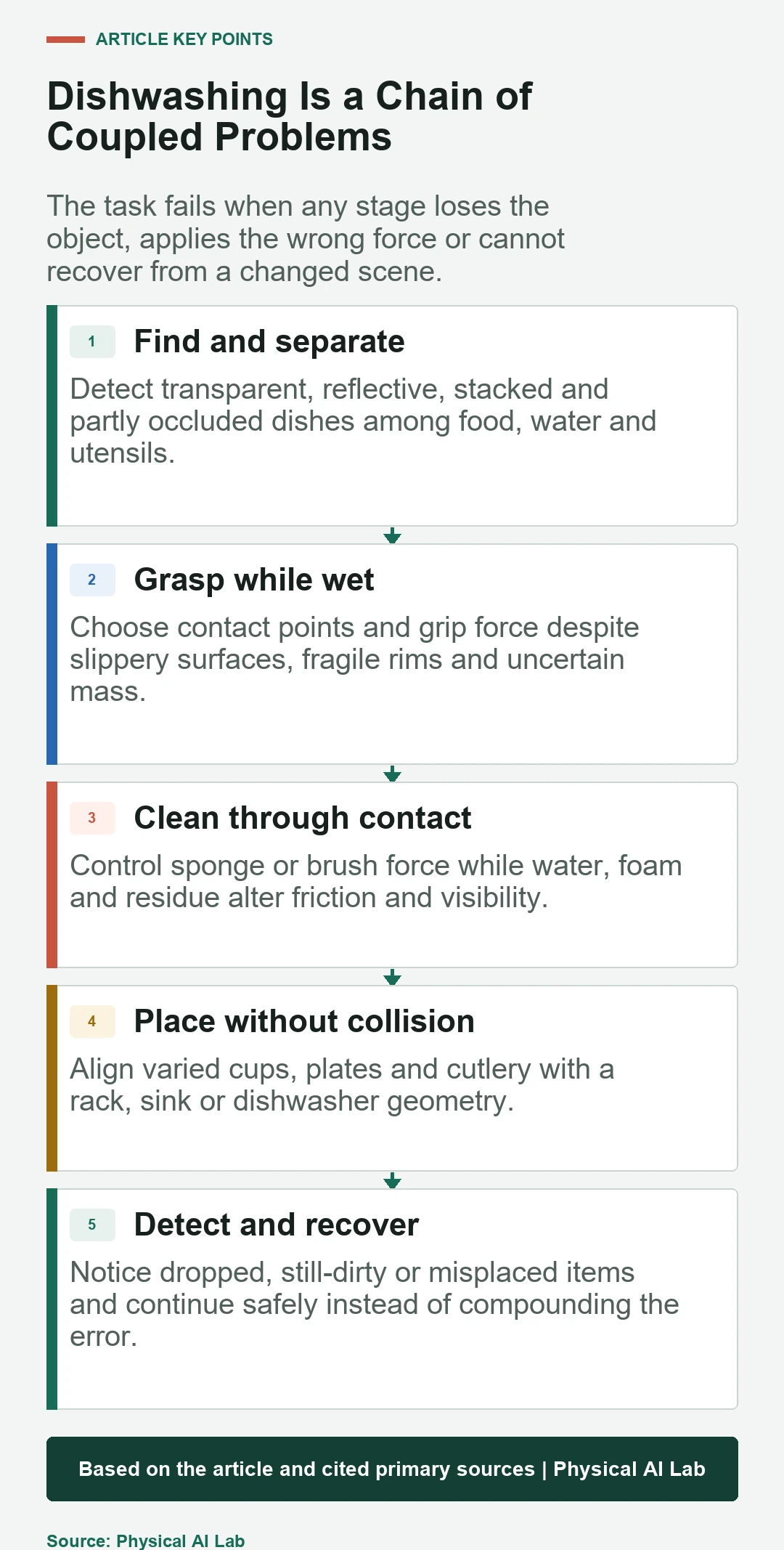
Dishwashing is difficult for a robot because it is not one motion. The robot must find objects in clutter, separate stacked items, grasp wet and fragile surfaces, apply contact force, place varied geometry and notice when cleaning or placement failed. Water, foam, reflections and moving objects change the scene while the task is underway.
A person solves these changes with rich touch, two hands, fast visual feedback and years of experience. A robot must recreate the relevant capability through cameras, tactile and force sensors, calibrated mechanics, planning and recovery logic. Success at one prepared sink does not automatically transfer to another kitchen, object set or dishwasher rack.
The task is a useful test of physical AI because perception and action cannot be separated. Every grasp changes the view and every contact changes the object’s state. The practical question is not whether a video shows dishwashing once, but which stages were autonomous and how the system handled ordinary variation.
A household sink is an unstructured workspace
Industrial automation usually reduces variation with fixtures, known parts and defined approach paths. A household sink contains transparent glasses, reflective metal, deformable sponges, food residue, utensils and objects that hide one another. Their positions change after every human or robot action.
Lighting and camera viewpoint also vary. Steam, water droplets and glare can degrade images. The robot needs a scene representation that remains useful after objects move, and it must distinguish a safe grasp from a sharp utensil, unstable stack or fragile rim. Environment design can simplify the problem, but ordinary homes offer limited standardization.
Wet and reflective objects complicate perception
Clear glass may provide weak depth-camera returns, polished cutlery can create highlights and patterned plates can confuse boundaries. Water changes appearance and makes residue difficult to separate from reflections. An object detector that works on a dry countertop may not provide a reliable pose in a crowded wet sink.
Perception must also estimate relationships: which plate is on top, whether a cup contains liquid, where a utensil is trapped and whether the rack has free space. These are task-relevant states rather than labels alone. Uncertainty should affect the next action instead of being hidden behind one confidence score.
Wet grasping needs force and slip feedback
A ceramic plate can be heavy, fragile and slippery at the same time. Too little normal force allows slip; too much can break the object or damage a thin rim. The safe range changes with material, soap, contact location and whether the object is supported by water or another dish.
Vision helps choose a grasp, but contact feedback helps maintain it. Tactile sensors, motor current, joint torque and wrist force can reveal contact and incipient slip. The difficulty is related to the broader problem of humanoid robot hands, where sensing and control must operate inside compact, durable hardware.
Cleaning is a contact-control task
Wiping or brushing requires the tool to maintain useful contact while following a curved or partly hidden surface. The robot must regulate force, adapt orientation and avoid pushing the dish into another object. A position-only trajectory can produce too little cleaning force or an unsafe collision when the geometry estimate is wrong.
The robot also needs a stopping condition. Time or stroke count is not proof that residue is gone. Visual inspection may be difficult under water and foam, while force data does not directly identify cleanliness. A deployable system may need multiple sensors or a conservative process with human verification for ambiguous cases.
| Stage | Main uncertainty | Useful feedback | Typical failure |
|---|---|---|---|
| Separate | Hidden geometry and stack stability | Vision, depth, contact | Two objects move together |
| Grasp | Friction, mass and fragility | Tactile, force, motor current | Slip or excessive force |
| Clean | Surface shape and residue | Force plus visual inspection | Missed area or collision |
| Place | Rack geometry and free space | Pose, contact and occupancy | Misalignment or unstable placement |
Rack loading is a constrained placement problem
Placing a plate in a dishwasher requires an approach path that avoids nearby tines and dishes, then a final pose that is stable and compatible with water flow. Cups, bowls, pans and cutlery need different orientations. The rack itself may slide or flex under contact.
A robot can simplify the task by using a known rack and a limited object set. The evidence should say so. General household loading would require recognition of unfamiliar items, occupancy planning, two-handed reorientation and a policy for objects that do not fit. These exclusions matter more than a generic household-robot label.
Long task sequences amplify small errors
Dishwashing can contain dozens of dependent steps. A slightly poor grasp may shift the object, which changes the camera view, which leads to a placement error later. The controller needs task memory: which items are dirty, in progress, clean, placed or dropped. Repeating a completed step can create new contamination or collision.
Long-horizon evaluation should report completion at both stage and task level. A robot that succeeds at ninety percent of isolated grasps may still have a low full-cycle rate when many grasps are required. Recovery policies and verification steps are therefore part of performance, not optional extras added after the main policy.
Teleoperation can hide or teach the hard decisions
A remote operator can choose grasp points, manage contact and recover from unexpected states. This may be the intended operating model or a method for collecting demonstrations. The Mobile ALOHA project explicitly separates whole-body teleoperation for data collection from learned autonomous skills, including a lightly rinsed pan task.
A household demo should disclose whether a person continuously commanded the robot, supplied only high-level goals or intervened on failures. That boundary affects labor cost and autonomy evidence. Human demonstrations remain valuable, but autonomous claims require separate rollouts with intervention and reset counts.
Structure can make a kitchen task tractable
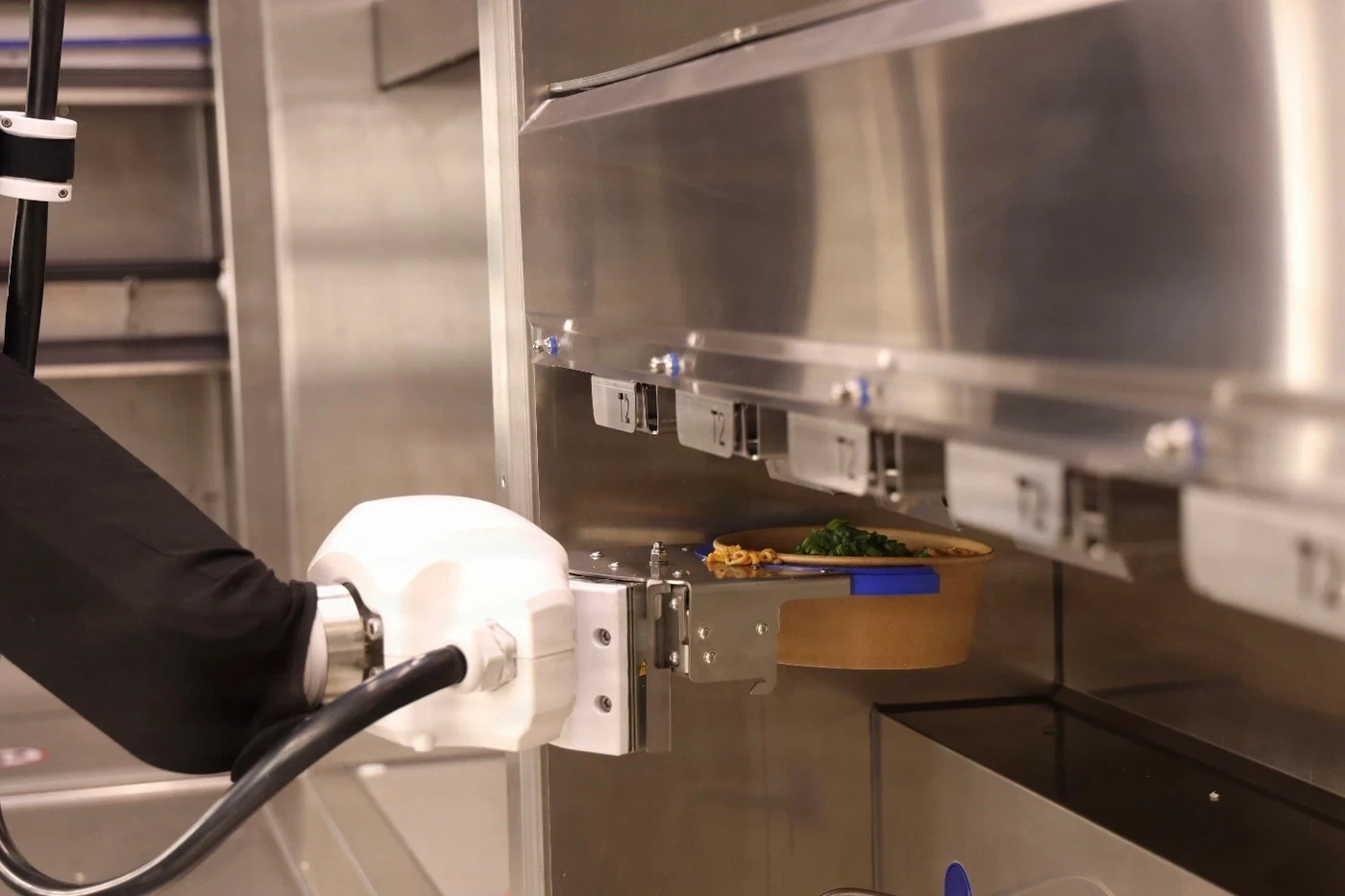
A commercial kitchen workstation can constrain containers, locations and workflow. Dedicated tools can replace a general hand, and sensors can be positioned around the task. This does not make the robot less intelligent; it is systems engineering that reduces uncertainty and increases repeatability.
The real-image example shows an autonomous arm in an organized meal-preparation system. It is not a dishwashing robot, but it illustrates the difference between a designed workcell and an arbitrary household sink. When comparing demos, record how much of the success comes from the robot and how much comes from the environment.
.jpg)
Evaluate dishwashing demos stage by stage
List the objects, starting arrangement, water and cleaning conditions, control mode and unedited task duration. Then mark whether the robot completed separation, grasping, cleaning, placement and verification. Count human interventions, drops, collisions, resets and items that required manual exclusion.
Use the broader robot video checklist so an edited success is not mistaken for repeated autonomy. A strong demonstration includes varied ordinary objects, publishes the denominator and shows what happens when a grasp or placement fails.
A deployment test should measure useful household service
Task success alone is not enough for a home. Measure breakage, water spills, surface damage, human proximity, cleanup after failure, noise, cycle time and the number of objects completed per intervention. Privacy and remote-video handling matter if human assistance is part of the service.
The best near-term design may be a narrower appliance, a structured rack or a robot that handles only selected items. Capability grows by making exclusions explicit and expanding them through measured tests. A promise to do every kitchen task is less useful than a documented operating envelope that improves over time.
| Deployment metric | Why it matters | How to report |
|---|---|---|
| Full-cycle completion | Captures dependent steps | Completed loads per attempted load |
| Intervention rate | Reveals hidden labor | Takeovers per object or hour |
| Damage and spill rate | Represents household risk | Events and severity per cycle |
| Object coverage | Defines generality | Named shapes, materials and exclusions |
| Recovery time | Affects service value | Time from detected error to safe continuation |
- Check whether the task is end to end.
- Separate wet grasping from simple dry pick-and-place.
- Count interventions, resets and excluded objects.
- Request repeated trials across realistic variation.
- Treat safe recovery as part of task success.
Frequently asked questions
Why can a robot vacuum but not wash dishes reliably?
Vacuuming usually involves planar navigation and a specialized cleaning mechanism. Dishwashing adds varied fragile objects, wet grasping, contact force, clutter, placement and long-horizon recovery.
Would a five-finger humanoid hand solve dishwashing?
Not by itself. The robot still needs perception, touch, force control, planning, durability and a policy for water, residue, placement and failures.
Is loading a dishwasher easier than hand washing?
It removes some cleaning contact but still requires separating wet objects, estimating pose, planning collision-free paths and placing varied items stably in the rack.
Can teleoperation make a dishwashing service practical?
Possibly, especially for exceptions. Its feasibility depends on intervention frequency, response time, network reliability, privacy and labor cost, all of which should be measured.
What should a dishwashing robot demo report?
Report control mode, objects, starting conditions, full-cycle attempts, interventions, drops, collisions, exclusions, cycle time and recovery behavior.
Household Demo Caution
Household robot capabilities, control modes and availability can change. Recheck the linked primary demonstrations and request full-cycle, repeated-trial evidence before treating a kitchen clip as a supported service.