Robot vision data augmentation changes an observation while training keeps the associated action as supervision. Brightness or sensor-noise changes may preserve action meaning, but crops, flips, rotations and synthetic viewpoints can alter geometry, visibility or coordinate conventions and make the original command wrong.
The acceptance question is therefore not whether an augmented image looks realistic. It is whether the entire observation-action record could still describe a physically consistent robot state under the declared camera model, controller frame and prediction horizon.
Use this guide with the robot action-data guide and action-normalization guide. Fit augmentation policy on training data, then report clean deployment and stress-test results separately.
Treat augmentation as a record transformation
A training example may contain synchronized images, proprioception, language, action, camera calibration, timestamps and masks. An augmentation pipeline must declare which fields it changes, which remain invariant and which become invalid. Updating pixels alone is safe only for a narrowly justified photometric transform.
Store transform family, sampled parameters and random seed or replay record. That evidence makes mislabeled examples reproducible and lets a reviewer compare failures with the original observation.

Separate photometric and geometric changes
Brightness, contrast, color temperature, blur and noise primarily change appearance, although aggressive values can erase task evidence. Crops, resizes, rotations, flips and perspective warps change image geometry and can move pixels relative to rays, keypoints and robot-frame targets.
Classify each transform before implementation and define a validity interval. A warehouse camera may tolerate illumination variation but not a crop that removes the gripper or contact surface.
| Transform | Usually changes | Label obligation | Main failure |
|---|---|---|---|
| Color or exposure | Appearance | Keep action only inside validated range | Task cue erased |
| Blur or noise | Sensor quality | Preserve time and visibility labels | Unrealistic corruption |
| Crop or resize | Field of view and intrinsics | Update intrinsics and spatial labels | Target removed |
| Flip or rotation | Orientation and handedness | Transform poses and action convention | Mirrored command |
| View synthesis | Camera ray and occlusion | Recompute geometry and visibility | Inconsistent scene |
Update camera intrinsics after crop and resize
A crop shifts the principal point, and resizing scales focal lengths and the principal point. A model that consumes pixels only can still learn an inconsistent mapping if its demonstrated action was generated from the original view while the object appears displaced in the new one.
When intrinsics, depth or rays are inputs, transform them explicitly. Reject samples whose required camera metadata is missing instead of silently reusing the original calibration.
Transform poses and actions under flips or rotations
Horizontal flipping is not automatically label preserving for a robot. Left and right joints, signed yaw, tool orientation, hand identity and world-frame translations may all require a defined transformation. A visually plausible mirror can command motion toward the wrong side.
Write the mapping algebraically for every action component and test round trips. If the embodiment or task has no valid symmetry, disable the transform rather than inventing a mirrored label.
Preserve temporal consistency across sequences
Policies often learn from frame stacks, action chunks or video windows. Sampling a different crop or color shift for every frame can create artificial camera motion, flicker and velocity cues that never occur in deployment.
Sample geometric parameters once per coherent sequence unless temporal corruption is the declared experiment. Apply timestamps, optical flow, tracking labels and visibility masks consistently.
Protect action visibility and contact evidence
A crop can remove the gripper, tool, object, contact point or obstacle that explains the demonstrated action. Occlusion augmentation can be useful, but only when the policy is expected to act safely with that evidence absent and the label still represents the desired response.
Measure retained target area, keypoint visibility and contact-region coverage. Route severe occlusions to an abstention or observation-quality label when continuing the original action would be unjustified.
Bound color, blur and sensor-noise ranges
Photometric augmentation should approximate supported cameras and operating conditions rather than maximize visual variety. Fit ranges from deployment captures, sensor specifications or a documented stress envelope. Preserve saturation, gamma and bit-depth behavior when they affect small features.
The DrQ study reports image-augmentation gains for pixel-based reinforcement learning in its evaluated settings. It does not establish that every distortion or robot task benefits, so reproduce the evidence on the target observation stack.
Keep train, validation and test pipelines distinct
Stochastic training augmentation can improve robustness, but applying it to the main deployment-like test changes the question. Report performance on an untouched test set and on separately named perturbation suites with fixed seeds and severity levels.
Fit ranges, normalization and any learned augmentation policy on training data only. The evaluation split must remain independent of decisions made while tuning transform probability or severity.
Use viewpoint synthesis with geometric evidence
Synthetic viewpoints require a scene representation, camera pose and occlusion reasoning strong enough to preserve task-relevant geometry. Hallucinated object edges or missing collisions can pair an impossible observation with an unchanged action.
Domain-randomization research, including the DexPilot system, provides task-specific evidence rather than a universal recipe. Validate each renderer, asset set and camera distribution against real held-out scenes.
Audit distribution shift introduced by augmentation
A transform can reduce one gap while creating another. Excess blur may teach the policy to ignore fine contact cues; aggressive crops may bias targets toward the image center; hue shifts may remove a color distinction used legitimately by the task.
Compare feature statistics, action-conditioned coverage and failure clusters before and after augmentation. Include no-augmentation and one-transform-at-a-time ablations under matched training compute.
Measure decoded robot consequences
Pixel loss or validation action error can hide physically important effects. Decode predictions into joint, end-effector or mobile-base units, then measure saturation, signed error, collision margin and task-relevant displacement across transform severity.
The RAD study and DROID project illustrate research and dataset contexts; a deployment still needs its own controller-rate replay and hardware acceptance tests.
| Audit layer | Measure | Warning | Decision |
|---|---|---|---|
| Image | Visibility and clipping | Evidence removed | Reduce or reject |
| Geometry | Intrinsics and pose residual | Stale calibration | Relabel |
| Sequence | Transform consistency | Artificial flicker | Share parameters |
| Action | Decoded physical error | Wrong sign or frame | Fix mapping |
| Hardware | Success and safety margin | Offline-only gain | Do not release |
Release an augmentation contract
Version transform code, probabilities, parameter ranges, camera conventions, label mappings, temporal scope, train-only statistics and evaluation suites with the dataset and checkpoint. A model cannot be reproduced from its weights when augmentation changed the effective supervision.
Close the review with the following checks.
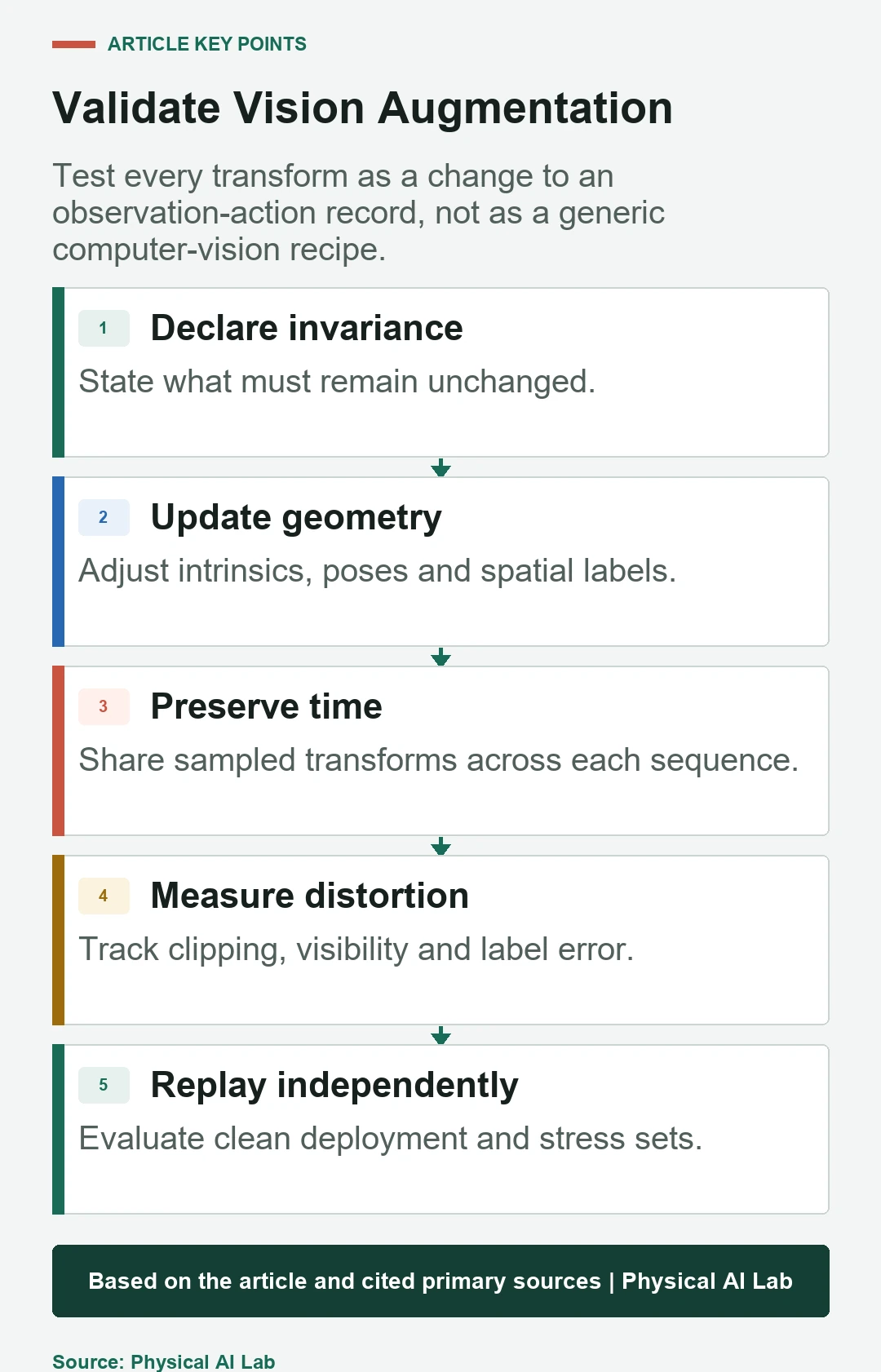
- Declare the invariant for every transform.
- Update geometry, poses and action labels together.
- Preserve coherent temporal windows.
- Keep a clean deployment-like test set.
- Replay decoded actions and stress cases before release.
Frequently asked questions
Can I use horizontal flips for robot images?
Only when the embodiment, task, coordinate frames and action labels have an exact tested symmetry mapping.
Should augmentation be applied to validation data?
Keep the primary validation and test sets clean; use fixed, separately reported stress suites for perturbations.
Does a crop require new camera intrinsics?
Yes when geometry or rays are used, and the action-label relationship must also remain physically consistent.
Is stronger augmentation always more robust?
No. Excessive distortion can erase causal task evidence or create a synthetic distribution farther from deployment.
What is the minimum hardware check?
Replay decoded commands under representative transforms and measure task outcome, error, saturation and safety margin.
Observation-Action Consistency Boundary
Robot vision augmentation is valid only when observation, camera geometry, action meaning and temporal context remain consistent. Visual realism alone is not evidence of a correct training label.