Robot action tokenization maps continuous commands into symbols that a sequence model can predict. The encoding may use uniform bins, quantile bins, learned codebooks or compressed sequences, but every option introduces a contract covering units, ranges, normalization, temporal horizon and decoding.
Token accuracy is not the operational target. A one-bin error can be harmless near zero for one joint and unsafe near contact for another, while clipped tails can disappear from aggregate loss. Evaluate reconstruction in physical units and through the target controller.
Use this guide with the VLA guide and robot action-chunking guide. Version the tokenizer and training statistics as model dependencies.
Define the continuous action contract first
List every dimension with commanded quantity, coordinate frame, unit, sign, valid range, control rate and actuator mask. Joint position, joint velocity, Cartesian delta, gripper state and mobile-base twist cannot share a tokenizer safely without explicit semantics.
Record whether actions are absolute or relative and where integration occurs. Two arrays of seven numbers can decode to entirely different motion under different controllers.

Choose uniform or quantile bins deliberately
Uniform bins preserve equal physical spacing and make maximum quantization error easy to interpret, but they can waste vocabulary on rarely used ranges. Quantile bins allocate similar training frequency to each token, improving utilization while making physical resolution uneven.
Fit bin edges on training data only and publish them. Compare decoded error per dimension and operating region, not only vocabulary perplexity.
| Encoding | Strength | Primary risk | Required audit |
|---|---|---|---|
| Continuous regression | Direct physical output | Scale imbalance | Unit-wise error |
| Uniform bins | Fixed physical resolution | Sparse tail tokens | Coverage and clipping |
| Quantile bins | Balanced token frequency | Uneven physical error | Bin widths |
| Learned codebook | Captures correlations | Dead or unstable codes | Usage and decode drift |
| Sequence compression | Fewer action tokens | Boundary artifacts | Reconstruction and latency |
Treat clipping as a measured failure mode
Values outside fitted ranges are often clipped to the first or last token. That keeps tensor shapes valid but converts distinct extreme commands into the same symbol and hides distribution shift from token loss.
Log clipping rate, magnitude and task context by dimension. Expand ranges, transform the distribution or reject the deployment when tail behavior is both frequent and consequential.
Measure reconstruction in physical units
Decode ground-truth actions through the tokenizer before training a policy. Report joint-angle, velocity, end-effector pose, gripper and mobile-base errors at the actual control rate. Include maximum and high-percentile values, not only a mean.
Run the reconstructed sequence through kinematics and controller limits. Small component errors can accumulate into large Cartesian drift or contact-force changes across a chunk.
Separate tokenization from action chunking
Tokenization represents values or sequences; action chunking predicts a horizon of future commands and chooses how they are executed or combined. A model can use continuous chunks, discrete per-step tokens or compressed chunk tokens.
Keep token count, chunk horizon, overlap, temporal ensemble and receding-horizon behavior as separate experimental variables. Otherwise a latency or success change cannot be attributed to the encoder.
Budget vocabulary and sequence length together
More bins can reduce scalar quantization error while increasing vocabulary size or prediction difficulty. Encoding each dimension and time step separately can multiply action-token count by dimensions and horizon, reducing room for visual or language context and increasing decoding latency.
Measure end-to-end prompt length, generated-token count, first-action latency and control deadline. A compact representation is useful only if its reconstruction remains sufficient for the task.
Understand FAST as temporal action compression
The FAST paper proposes frequency-space action-sequence tokenization and reports improved compression and training behavior across its evaluated robot datasets and models. The associated RSS paper provides the peer-reviewed method context.
FAST is not synonymous with action chunking. It encodes a sequence compactly, while the policy still needs a horizon, decoder and execution rule that must be evaluated on the target robot.
Bind normalization to the tokenizer
Many pipelines normalize action dimensions before binning or regression. Per-dataset, per-robot or global statistics change token boundaries and decoded magnitudes, so the same token identifier has no stable physical meaning without its statistics.
Use the cross-embodiment normalization guide to separate shared semantics from robot-specific scale. Freeze masks, quantiles, clipping policy and inverse transform with the checkpoint.
Handle grippers and mixed action types explicitly
A binary gripper command should not be quantized as though it were a smooth joint. Hybrid actions may combine categorical modes, continuous motion and termination signals, each with a loss and decoder appropriate to its semantics.
Audit rare mode tokens and conflicting demonstrations. A frequently correct arm trajectory paired with a late or inverted gripper token can still fail the whole manipulation episode.
Compare research implementations by contract
RT-1 uses tokenized robot actions in its reported transformer policy, and RT-2 represents robot actions as text tokens in the studied vision-language-action setting. The OpenVLA repository documents a separate implementation and action-token interface.
Do not transfer bin counts, ranges or decoding assumptions across systems by name. Inspect the released code and checkpoint-specific statistics, then reproduce the target action contract locally.
Test latency, saturation and hardware replay
Benchmark tokenization and autoregressive decoding on deployment hardware with the real context length. Measure median and tail latency, missed control deadlines, decode failures and saturation before enabling motion.
Replay reconstructed ground-truth commands in simulation or a protected hardware mode before policy outputs. Compare the continuous baseline, encoded ground truth and learned predictions so tokenizer error remains visible.
| Layer | Metric | Warning | Response |
|---|---|---|---|
| Coverage | Tail and clipping rate | Commands saturate | Refit range |
| Reconstruction | Physical-unit error | Task-scale drift | Change bins |
| Sequence | Tokens per horizon | Context or latency spike | Compress |
| Controller | Limit and deadline events | Invalid execution | Fix contract |
| Task | Success and safety margin | Token score misleads | Reject release |
Release a complete tokenizer bundle
Package tokenizer version, vocabulary, bin edges or codebook, normalization statistics, action masks, units, frames, control rate, horizon, decoder code and checksum with the model. A checkpoint without these artifacts is not a reproducible robot policy.
Close release review with the following checks.
- Document every action dimension and frame.
- Fit token ranges on training data only.
- Report clipping and decoded physical error.
- Measure token count and tail latency.
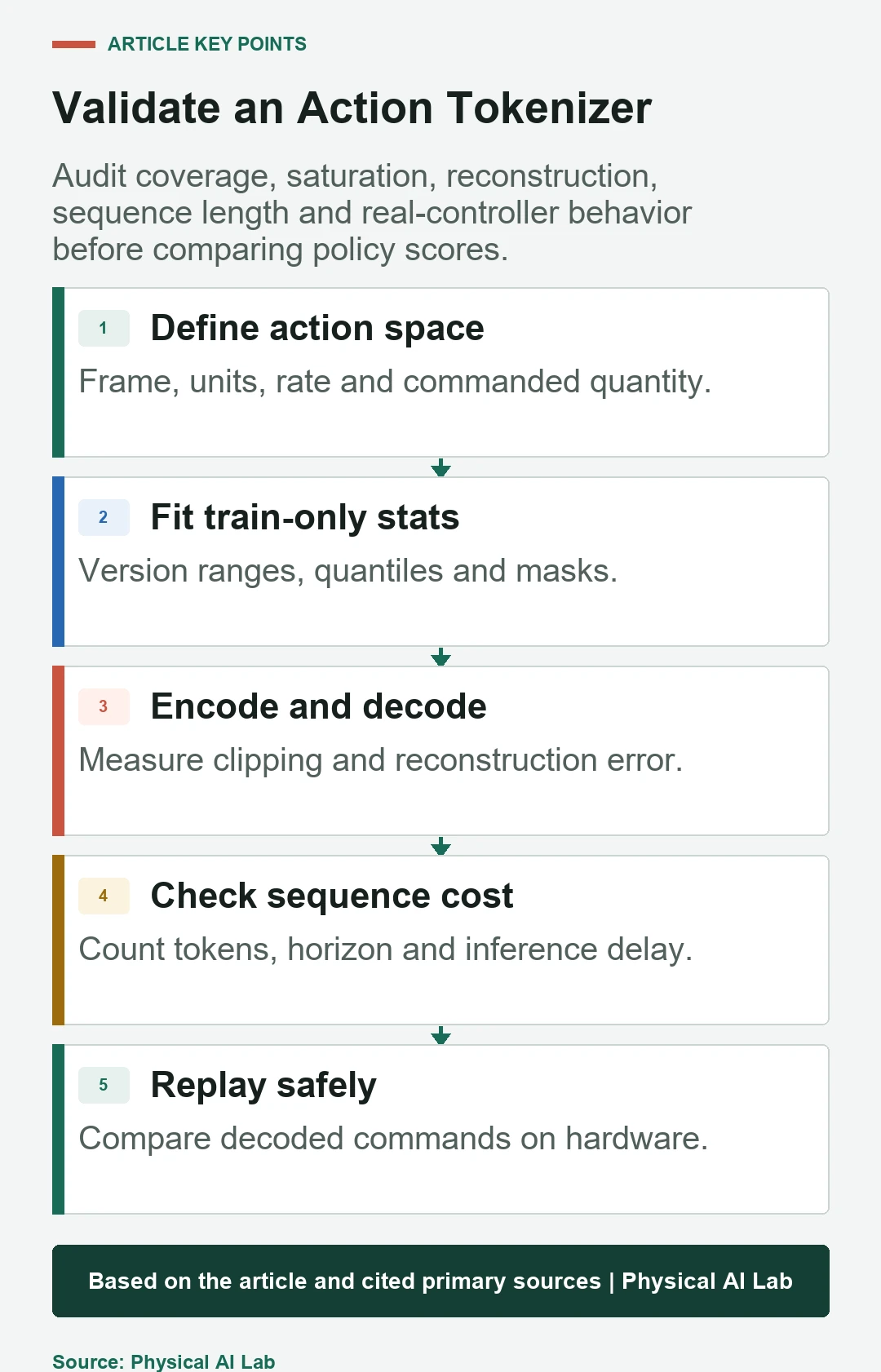
- Replay the exact packaged decoder before hardware release.
Frequently asked questions
Are discrete action tokens better than continuous regression?
Neither is universal; compare physical reconstruction, policy learning, latency and task outcomes under matched conditions.
How many bins should each action dimension use?
Choose from acceptable physical error, observed coverage and model capacity, then validate per dimension and task region.
Is FAST the same as action chunking?
No. FAST compresses action sequences; chunking defines a prediction and execution horizon.
Can tokenizer statistics be recomputed after training?
Not safely without revalidation because changed ranges or quantiles change the physical meaning of tokens.
What should be stored with a tokenized-action model?
Store vocabulary, edges or codebook, normalization, masks, frame and unit conventions, horizon, decoder and checksums.
Action-Encoding and Reconstruction Boundary
An action tokenizer is part of the robot control interface. Evaluate it through decoded physical motion, controller timing and task outcomes rather than token loss alone.