Robot VLA compression reduces memory, compute, bandwidth or energy while preserving the model’s ability to turn images and language into timely robot actions. Quantization changes numeric representation; distillation trains a smaller student from a teacher; architectural changes alter the computation itself.
The decisive benchmark is the exact deployment path from sensor input through decoded action under control deadlines and thermal load. Smaller files or lower offline loss do not guarantee faster kernels, lower tail latency or stable closed-loop behavior.
Use this guide with the VLA fine-tuning guide and action-tokenization guide. Freeze an uncompressed baseline before changing precision.
Freeze the deployment baseline
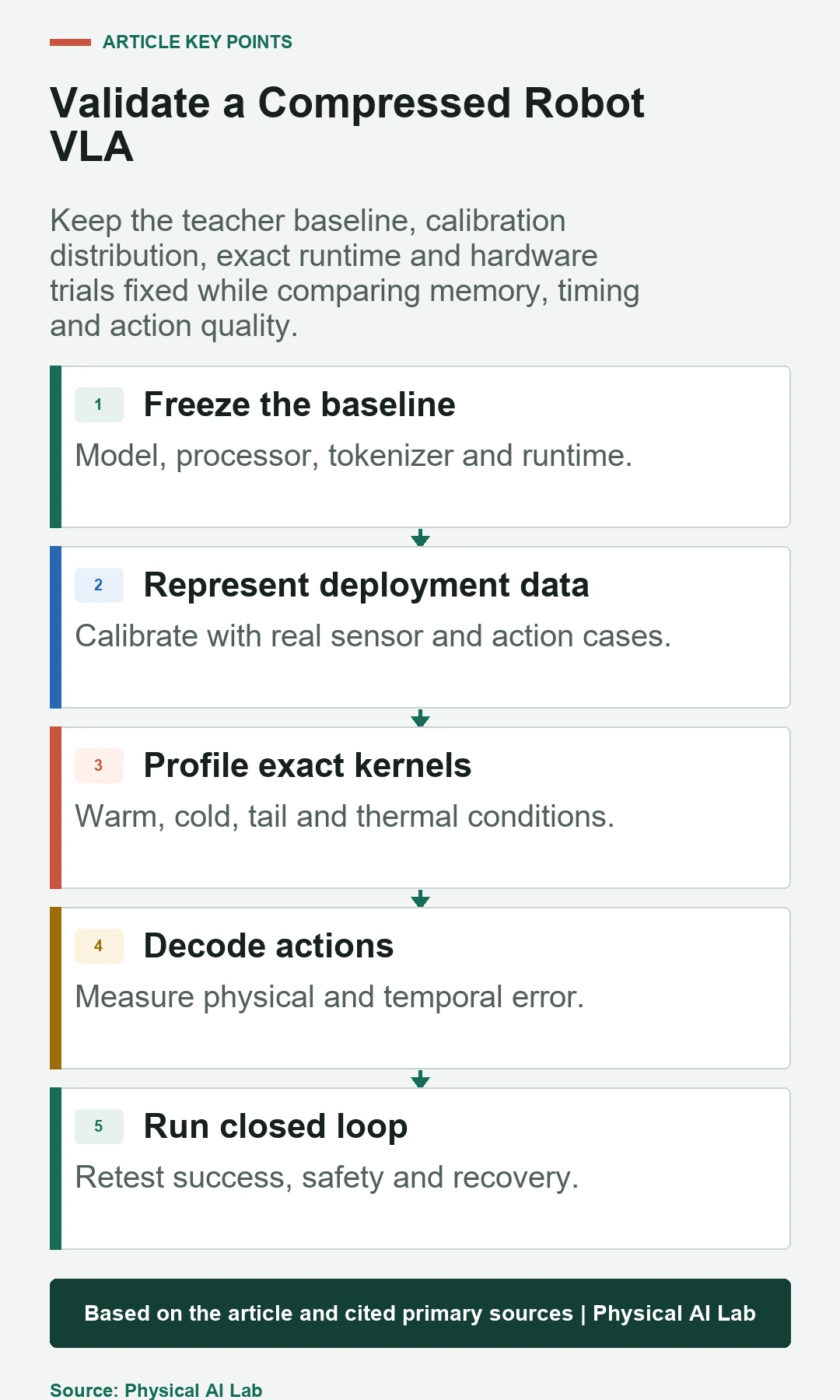
Pin model and processor checksums, tokenizer, action decoder, normalization, runtime, kernels, compiler, device, power mode, control rate and evaluation trials. Record cold and warm behavior so compression does not receive a different cache or batch condition.
Measure weights, peak memory, input-to-first-action latency, steady-state and tail latency, energy, temperature, throttling, decoded actions, task success and safety events.
.jpg)
Separate weights, activations and cache precision
Weight-only quantization reduces parameter storage but may leave activation and key-value cache memory unchanged. Activation quantization can save bandwidth but is more sensitive to outliers. Cache precision matters for long visual-language contexts.
Document precision by module and tensor class. A model advertised as four bit can still contain higher-precision embeddings, norms, heads or fallback operators.
| Method | Primary change | Potential gain | Primary risk |
|---|---|---|---|
| Weight-only PTQ | Stored weights | Memory and bandwidth | Kernel fallback |
| Weight-activation PTQ | Weights and activations | More compute savings | Outlier error |
| QAT | Training includes quantization | Low-bit recovery | Training cost |
| Distillation | Smaller student | End-to-end reduction | Teacher bias |
| Architecture change | Attention or token path | Complexity reduction | Recipe-specific regression |
Start with post-training quantization
PTQ converts a trained model using calibration statistics and is the fastest baseline. Test per-channel or group-wise choices, outlier handling and modules kept in higher precision. Do not assume the lowest bit width is the best deployable point.
Current Transformers bitsandbytes documentation describes supported 8-bit and 4-bit paths and hardware constraints. Pin the documentation and library version because support changes.
Use representative calibration data
Calibration examples should cover target cameras, lighting, instruction lengths, objects, actions, rare tokens and failure states. Generic images can miss activation ranges created by robot-specific visual streams and action decoding.
Select calibration data from training or a designated calibration split, never the final test. Report domain coverage and sensitivity to set size and sampling.
Move to QAT only with a measured need
Quantization-aware training exposes the model to simulated rounding and clipping so it can adapt, often at higher engineering and compute cost. Compare it with PTQ under the same bit layout and evaluation rather than treating QAT as automatically superior.
Protect base capabilities and use low learning rates or staged unfreezing where appropriate. Version fake-quantization observers, ranges and export path with the checkpoint.
Distill distributions and action structure
Knowledge distillation can match teacher logits, intermediate representations, attention, action distributions or trajectory-level behavior. The classic distillation paper motivates transferring softened predictive information, but robot policies need action- and time-aware objectives.
Keep ground-truth supervision and safety penalties so teacher errors are not copied without challenge. Compare student gains against a same-size model trained without the teacher.
Measure action error in physical units
Compare teacher and compressed model after the exact tokenizer, inverse normalization and controller interface. Report joint, Cartesian, gripper and mobile-base errors, clipping, sign changes and action-chunk divergence over time.
Small per-step differences can compound under closed-loop feedback. Include contact, recovery and near-boundary cases instead of evaluating only easy demonstrations.
Profile actual kernels and memory movement
Bit width does not directly determine speed. Unsupported operations may dequantize, transfer to CPU or use slower kernels; small batches can underuse accelerators; memory copies and image preprocessing can dominate.
Capture an operator-level trace on the target device. Report peak allocated and reserved memory, transfers, kernel time, synchronization and fallback count.
Test cold, warm, tail and thermal conditions
Measure model load and first inference, warmed steady-state, long-run high-percentile latency and performance after thermal saturation. Include realistic camera rates, context length and concurrent perception or safety processes.
A model that meets mean latency but misses rare deadlines can produce stale or skipped commands. Define timeout behavior and verify it under resource contention.
Scope research results to model and hardware
SARA-RT reports converting studied robotics transformers to linear-attention variants through up-training in its paper. The QuantVLA project reports VLA quantization work in its stated configurations.
Neither establishes a universal speedup for another model, runtime or robot. Reproduce exact precision, architecture, device and task conditions before using reported ratios.
Run closed-loop regression on the robot
Evaluate the uncompressed and compressed packages on identical held-out trials with matched reset policy, seeds where possible and sufficient repetitions. Measure success, time, intervention, collision margin, recovery and failure mechanism.
The OpenVLA repository provides implementation context for supported checkpoints; inspect version-specific deployment code rather than assuming all VLA architectures share the same compression path.
| Benchmark | Measure | Warning | Decision |
|---|---|---|---|
| Storage | Artifact and memory | Only file shrank | Profile runtime |
| Latency | Median and tail | Deadline miss | Reject or fallback |
| Thermal | Sustained clock and power | Throttling | Change design |
| Action | Decoded physical error | Tail clipping | Raise precision |
| Closed loop | Success and safety | Offline-only parity | Do not release |
Choose from a measured Pareto frontier
Plot memory, sustained latency, energy and task outcomes for several precision and student configurations. Remove dominated options and apply hard safety and deadline gates before optimizing cost.
Close release review with the following checks.
- Freeze the exact uncompressed deployment baseline.
- Calibrate on representative robot data only.
- Profile kernels, transfers and thermal tail latency.
- Measure decoded action error in physical units.
- Require closed-loop task and safety regression before release.
Frequently asked questions
Is a 4-bit VLA always twice as fast as an 8-bit model?
No. Kernel support, memory movement, batch size and unquantized modules determine speed.
Does LoRA make inference smaller?
Not necessarily. LoRA reduces trainable parameters; the base model and runtime may remain the same size.
Should PTQ or QAT be tried first?
Start with a measured PTQ baseline, then use QAT when the target low-bit configuration fails and training cost is justified.
Can low offline action error replace robot trials?
No. Closed-loop accumulation, latency and controller interaction require hardware evaluation.
Can distillation and quantization be combined?
Yes, but test the order and interaction against a fixed teacher baseline and closed-loop gates.
Compression-to-Closed-Loop Boundary
Robot VLA compression is a deployment optimization, not a file-size contest. Select it from exact-device timing, memory, power, decoded action and closed-loop evidence.