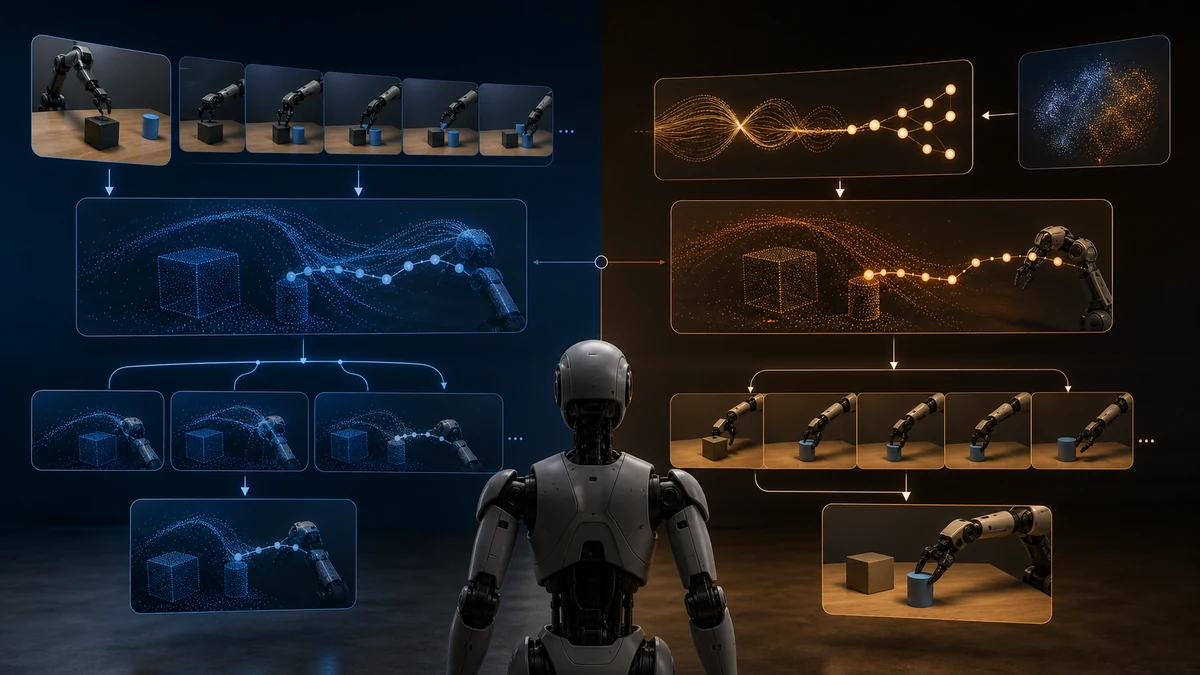
Choose UnifoLM-WMA-0 when the experiment needs future-interaction prediction, synthetic rollouts or a world-model-enhanced action policy. Choose UnifoLM-VLA-0 when the main job is to post-train and evaluate a direct vision-language-action policy for manipulation.
Both are research repositories with code and checkpoints, not plug-and-play commercial autonomy. Their documented datasets, action dimensions and clients differ, so start from the supported example closest to your hardware rather than assuming every G1 or Z1 configuration works unchanged.
WMA and VLA solve different parts of the learning problem
UnifoLM-WMA-0 uses a world model for two declared roles: an interactive simulation engine that generates future interaction video and a policy-enhancement path that connects prediction to an action head. It can be configured for simulation and decision-making modes.
UnifoLM-VLA-0 continues pretraining a visual-language backbone on robot manipulation data and predicts actions for embodied tasks. The difference is therefore the central training and inference route, not simply which repository has newer code.
| Decision point | UnifoLM-WMA-0 | UnifoLM-VLA-0 |
|---|---|---|
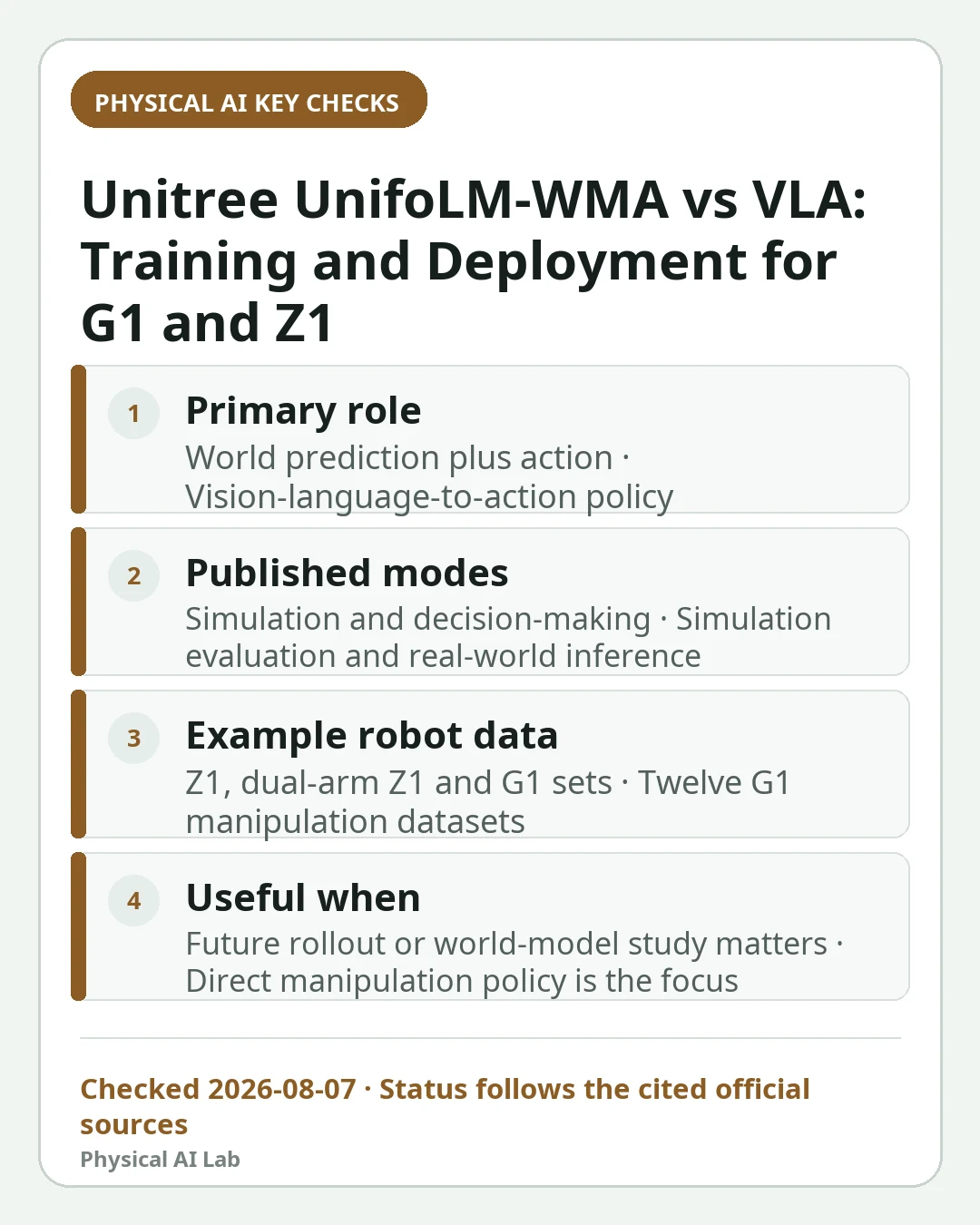
| Primary role | World prediction plus action | Vision-language-to-action policy |
| Published modes | Simulation and decision-making | Simulation evaluation and real-world inference |
| Example robot data | Z1, dual-arm Z1 and G1 sets | Twelve G1 manipulation datasets |
| Useful when | Future rollout or world-model study matters | Direct manipulation policy is the focus |
The published datasets are not interchangeable
The WMA repository lists five main open datasets across Z1, dual-arm Z1 and G1, plus additional G1 dexterous-arm data. The official UnifoLM-WMA-0 Dual model page describes its checkpoint as fine-tuned on five Unitree datasets in both decision-making and simulation modes.
The VLA repository lists twelve G1 task datasets, including stacking, packing, wiping and towel folding. A dataset name tells you the recorded embodiment and task, but not that it matches your gripper, camera calibration or action representation.
Training paths diverge before deployment
WMA training first adapts a video generation model as a world model and then post-trains decision-making and simulation modes on downstream data. The repository allows a team to skip a mode that is not needed, but configuration still must match state, action and camera inputs.
VLA converts LeRobot data through HDF5 into RLDS, registers datasets and mixtures, and configures action chunks, state dimensions and normalization. This is a framework for engineering work, not a one-command route from raw recordings to a safe robot.
| Preflight check | Why it matters | Failure if ignored |
|---|---|---|
| CUDA and dependency version | Repositories specify distinct environments | Build or kernel mismatch |
| Camera view and calibration | WMA training notes a main-view constraint | Wrong spatial prediction |
| Action and state dimensions | Must match the embodiment | Invalid or unsafe commands |
| Normalization and checkpoint | Connects training data to inference | Motion scale or policy mismatch |

Both real-robot examples use a server-client boundary
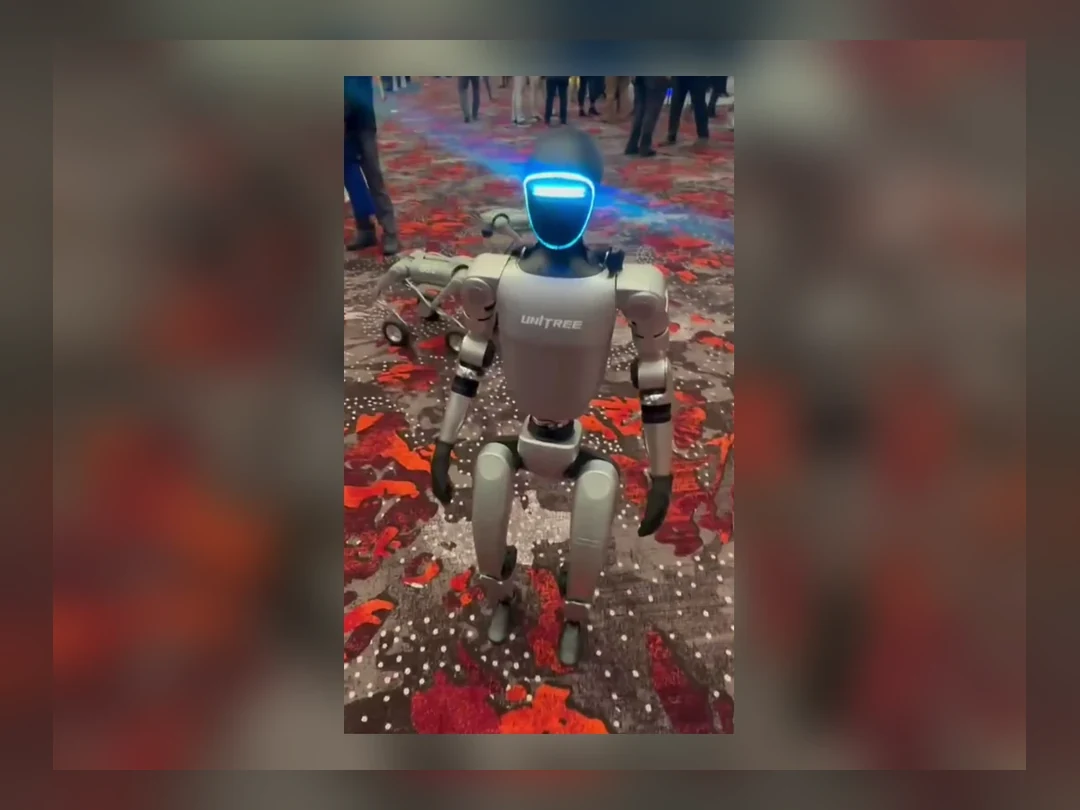
The WMA decision-making example runs inference on a server while a Unitree client gathers observations and requests actions. Its sample G1 Dex1 command specifies action and observation horizons, control frequency and a language instruction.
The VLA repository likewise documents server-side inference and a robot client. Network transport, model inference and low-level control remain separate responsibilities; the physical AI see-think-act guide helps keep those boundaries explicit.
Select by the hypothesis you need to test
Use WMA if the research question concerns whether imagined future interaction improves policy choice or provides useful synthetic rollouts. Use VLA if the central question concerns instruction grounding and manipulation actions from visual-language observations.
A team can compare them only after harmonizing the embodiment, task, data budget and success metric. The robot VLA evaluation guide is useful for direct policies, while our world-model primer explains what a video prediction alone does not prove.
Open code still requires hardware-specific validation
Before moving from an example to G1 or Z1 hardware, verify the repository commit, checkpoint card, robot client, controller mode, emergency stop and joint limits. Run offline playback and simulation before enabling live commands.
Neither repository promises unchanged compatibility with every Unitree option or a certified safety layer. Record the exact hardware, firmware and commit in every result so a successful lab demo is not mistaken for a supported commercial product configuration.
Frequently asked questions
Is UnifoLM-WMA simply a simulator?
No. The repository describes both an interactive simulation role and a decision-making mode that connects the world model to an action head for real-robot experiments.
Does UnifoLM-VLA support every Unitree G1 configuration?
The repository publishes G1 datasets and a real-robot workflow, but users must match cameras, grippers, action dimensions, normalization, controller and checkpoint to their actual configuration.
Which one should I start with?
Start with WMA for future-video or world-model-action experiments and VLA for direct visual-language manipulation policy work. Choose the documented dataset and embodiment closest to your test.
Official sources checked
- Unitree UnifoLM-WMA-0 official repository
- Unitree UnifoLM-VLA-0 official repository
- Unitree UnifoLM-WMA-0 Dual official model
- Unitree UnifoLM-VLA Base official model
Last checked: August 7, 2026