A world model is an internal representation that helps an AI system predict how a state may change. In robotics, it can connect the current scene and robot condition to the likely result of an action. The prediction may be expressed as future images, object states, latent features, contacts, rewards or a sequence of robot observations.
The practical value is counterfactual reasoning. Before pushing a box, the robot can compare candidate directions and estimate whether the box reaches the goal, collides with an obstacle or leaves the reachable workspace. After acting, the system compares the observation with the prediction and updates its belief or training data.
World models sit inside the broader Physical AI control loop. They are not automatically planners, controllers or safety systems. A useful deployment separates what the model predicts from how a decision is selected and how the real result is verified.
A world model represents task-relevant state
The model does not need to reproduce every atom in the environment. It needs variables or features that preserve consequences relevant to the task: object pose, geometry, support, contact, robot configuration, motion, people and constraints. An image-only representation may omit forces or hidden object properties that change an action outcome.
State can be explicit, such as a map and object poses, or latent, where a neural network compresses observations into learned features. Explicit state is easier to inspect, while latent state may capture complex patterns. Hybrid systems combine geometry, robot state and learned visual representations.
Prediction must be conditioned on an action
A generic future video model predicts what may happen next. A control-oriented world model asks what may happen if the robot takes a particular action. Conditioning on action turns passive forecasting into a tool for comparing choices. The action may be a discrete skill, trajectory, end-effector command or chunk of joint targets.
The prediction horizon matters. Short horizons can support contact and local motion, while long horizons help sequence tasks but accumulate uncertainty. Hierarchical planning can use coarse long-range predictions to choose a strategy and detailed models for the next safe motion.
World models can predict different outputs
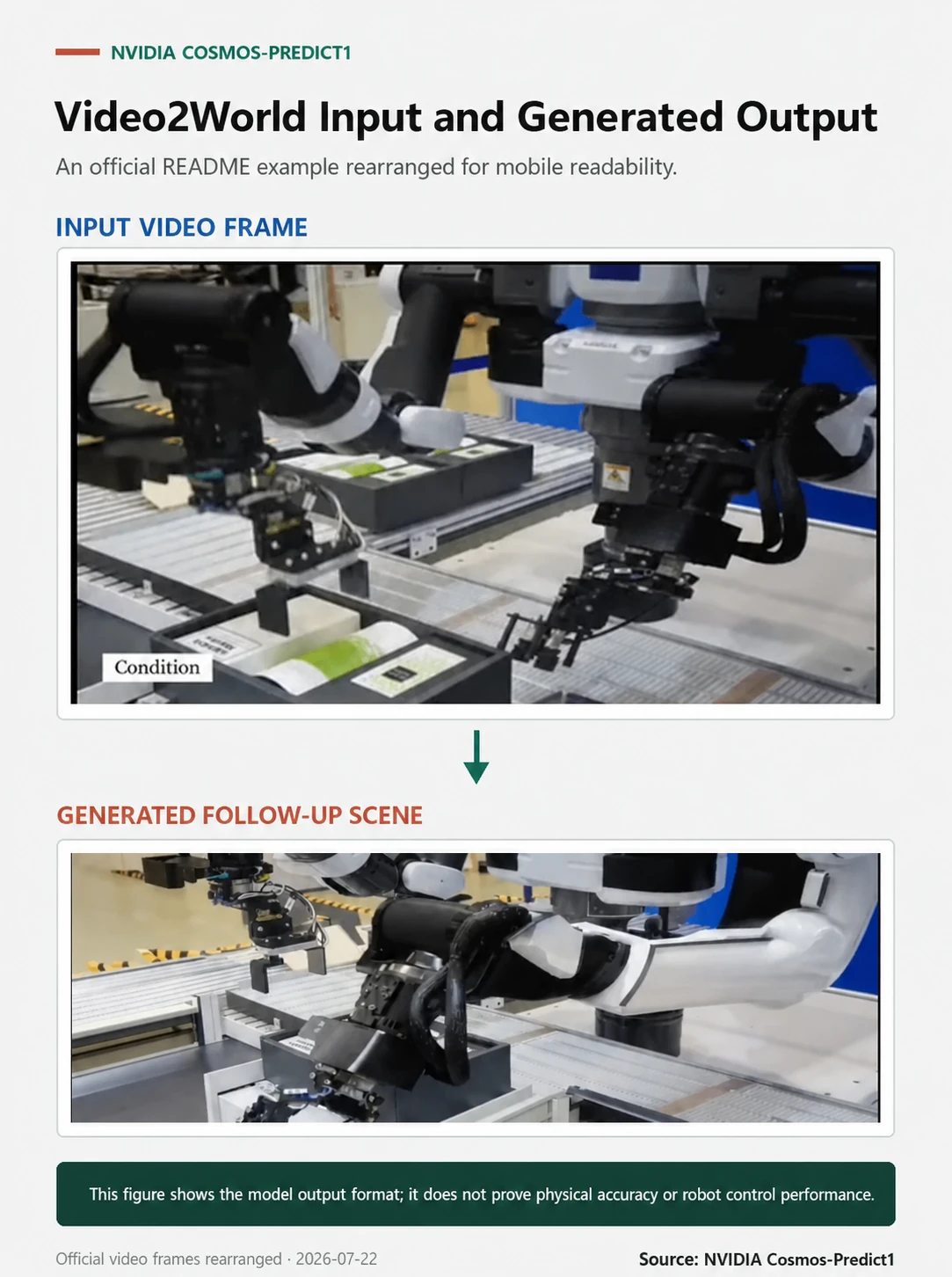
Video prediction produces future pixels that are intuitive to inspect, but visually plausible frames may hide wrong depth, contact or dynamics. State-transition models predict structured variables. Reward or value models estimate task progress, while occupancy and collision predictions focus on geometric safety.
NVIDIA describes Cosmos world foundation models for generating and understanding physical-world scenarios. Google DeepMind groups systems such as Genie and Gemini Robotics under world models and embodied AI. Product labels do not replace task-specific validation.
| Prediction type | Useful for | Hidden risk | Validation |
|---|---|---|---|
| Future video | Visual scenario generation | Plausible but wrong physics | Geometry and event checks |
| Object state | Manipulation planning | Missed contacts or properties | Pose and outcome error |
| Latent state | Efficient policy learning | Difficult interpretation | Downstream task success |
| Occupancy or collision | Navigation and motion safety | Unmodeled dynamic agents | Recall under real motion |
Planning uses rollouts to compare candidate futures
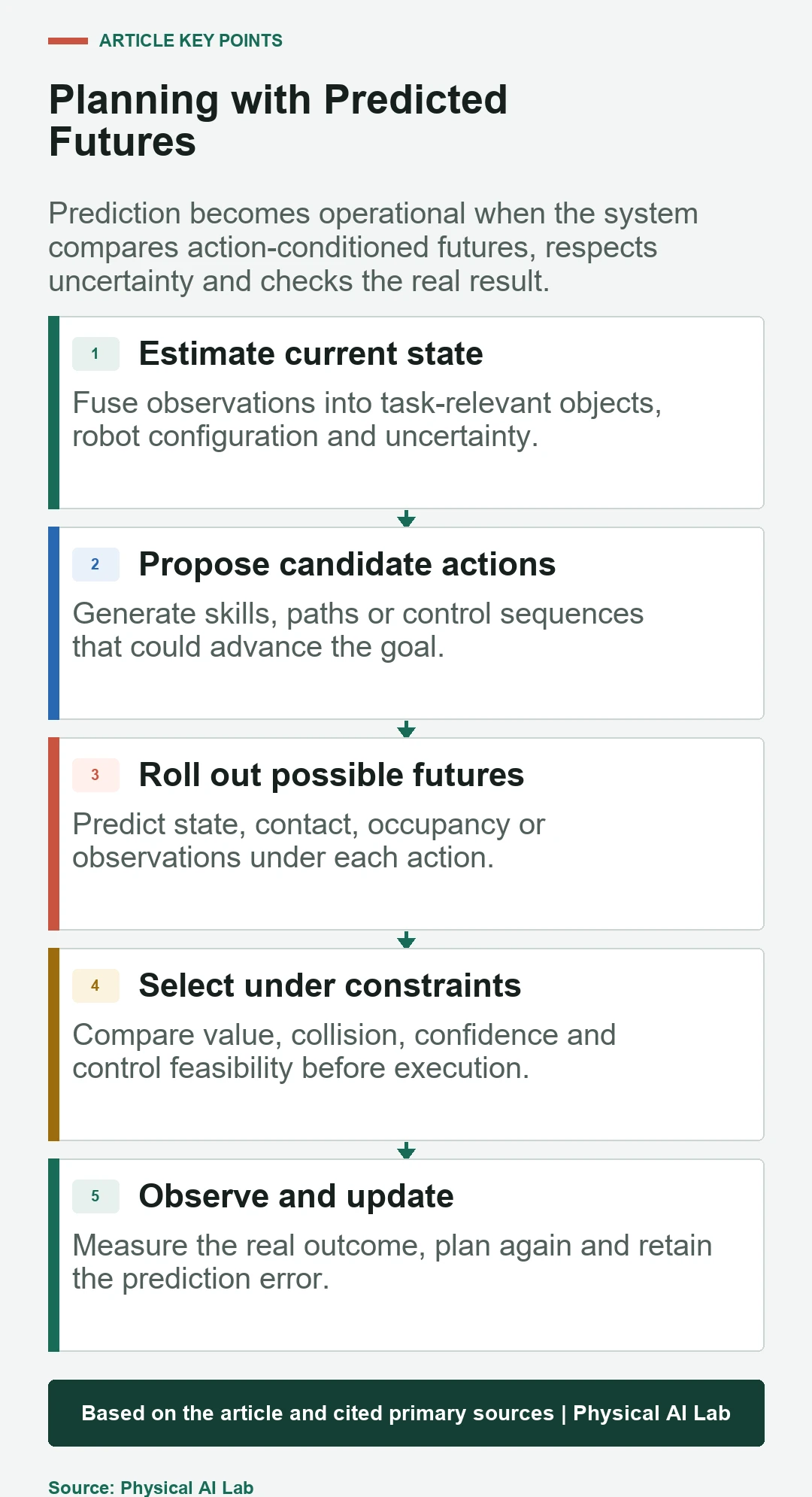
Model-predictive control evaluates candidate action sequences, selects an early action, observes the result and plans again. Receding-horizon updates limit the damage from a long prediction error. Search, sampling or learned policies can propose candidates, and the world model scores likely outcomes.
A rollout should preserve constraints and uncertainty. The highest predicted reward is not necessarily the safest choice. Planners can reject futures that approach joint limits, collide with people, exceed force limits or depend on low-confidence state. A conservative fallback is part of the decision system.
Uncertainty grows with horizon and ambiguity
Many physical futures are possible. A hidden object can move, friction can vary and a person can change direction. A model that outputs one sharp future may look confident while ignoring alternatives. Ensembles, probabilistic outputs or multiple sampled rollouts can expose some of that ambiguity.
Calibration asks whether stated confidence matches observed error. Test uncertainty across object types, lighting, payload, contact and action duration. If low confidence does not cause a slower action, new observation or safe stop, the uncertainty estimate does not improve operations.
Prediction quality must be measured for the task
Pixel similarity can penalize harmless visual differences and miss a physically critical contact error. Evaluation should include geometry, object identity, collision, contact, task events and the downstream decision. The metric should reflect what the planner needs to choose safely and successfully.
Compare against simple baselines such as constant velocity, rigid motion or a calibrated simulator. A large learned model is valuable only when it improves the decision under realistic latency and compute limits. Report results on held-out scenes and action sequences rather than training reconstructions.
| Evaluation question | Suggested evidence | Why it matters |
|---|---|---|
| Where will objects be? | Pose and occupancy error | Supports reach and collision checks |
| Will contact succeed? | Contact and grasp outcome | Connects prediction to manipulation |
| Does action ranking improve? | Regret or selected-task success | Tests planning value |
| Is confidence calibrated? | Error by confidence bucket | Enables conservative behavior |
| Does it run in time? | End-to-end latency and jitter | Determines usable control horizon |
Simulation and world models are related but different
A simulator uses explicit or learned rules to evolve a modeled environment. A world model may be a simulator, a learned predictor or a mixture. High-fidelity simulation can provide structured contact and sensor outputs; learned models can cover visual variation or patterns that are difficult to engineer manually.
Both face the sim-to-real gap. A predicted scenario can be convincing without matching the robot’s sensor timing, actuator response or contact mechanics. The correct question is whether the model improves real decisions inside a defined operating envelope.
Data coverage determines which futures are credible
A world model cannot reliably predict interactions absent from its data or physics assumptions. Training should cover normal operation, failed grasps, collisions, slip, recovery, varied payloads and environmental changes. Rare unsafe events require careful simulation, controlled tests or synthetic augmentation.
Synthetic data can widen scenario coverage, as explained in the robot synthetic data guide. Real robot trajectories remain essential for calibration and exception discovery. Dataset documentation should identify robots, sensors, tasks, action rates and exclusions.
A deployment architecture separates roles
The world model may run onboard for short-horizon decisions or remotely for planning and analysis. A separate state estimator prepares inputs, a planner proposes actions, a controller executes within limits and monitors verify results. Logs retain predictions and observations so errors can be diagnosed after a trial.
Compute placement depends on latency, power, model size and connectivity. The edge AI guide explains the edge-cloud split. Safety-critical stopping should not depend on an uncertain network round trip or an unvalidated generated future.
Read world-model claims with a validation checklist
Ask what is predicted, which actions condition the prediction and which robot data trained the system. Check horizon, sensor inputs, frame rate, uncertainty, held-out environments and whether evaluation occurs on hardware. A showcase video can establish output format but not decision quality.
The strongest evidence compares planning with and without the world model under the same task distribution. It reports failures and compute cost, and shows how prediction error affects robot safety or success. Claims should distinguish generated imagery, simulation capability and closed-loop control.
- Identify the predicted state and horizon.
- Confirm that predictions are action-conditioned.
- Check uncertainty and alternative futures.
- Measure downstream planning improvement.
- Validate closed-loop behavior on real hardware.
Frequently asked questions
Is a world model the same as a digital twin?
No. A digital twin usually represents a specific asset or process with operational data. A world model is a broader prediction mechanism and may be learned across many environments.
Does a world model need to generate video?
No. It can predict object state, occupancy, contact, reward, latent features or other task-relevant variables. Video is one possible output.
Can a world model replace a physics simulator?
Sometimes it can approximate selected dynamics or visual outcomes, but explicit simulation may remain better for constraints, interpretability or precise contacts. Hybrid approaches are common.
How does a robot use a world model?
The robot can roll out candidate actions, score likely outcomes, choose an action, observe the real result and plan again. This is often combined with state estimation and model-predictive control.
What proves a world model is useful?
Show that it improves real task decisions, success, safety or sample efficiency against baselines while meeting latency and compute constraints. Visual realism alone is insufficient.
Model and Validation Note
World-model products and research systems evolve rapidly. Verify current model cards, licenses and evaluation conditions, then reproduce decision-level results on representative robot hardware before deployment.