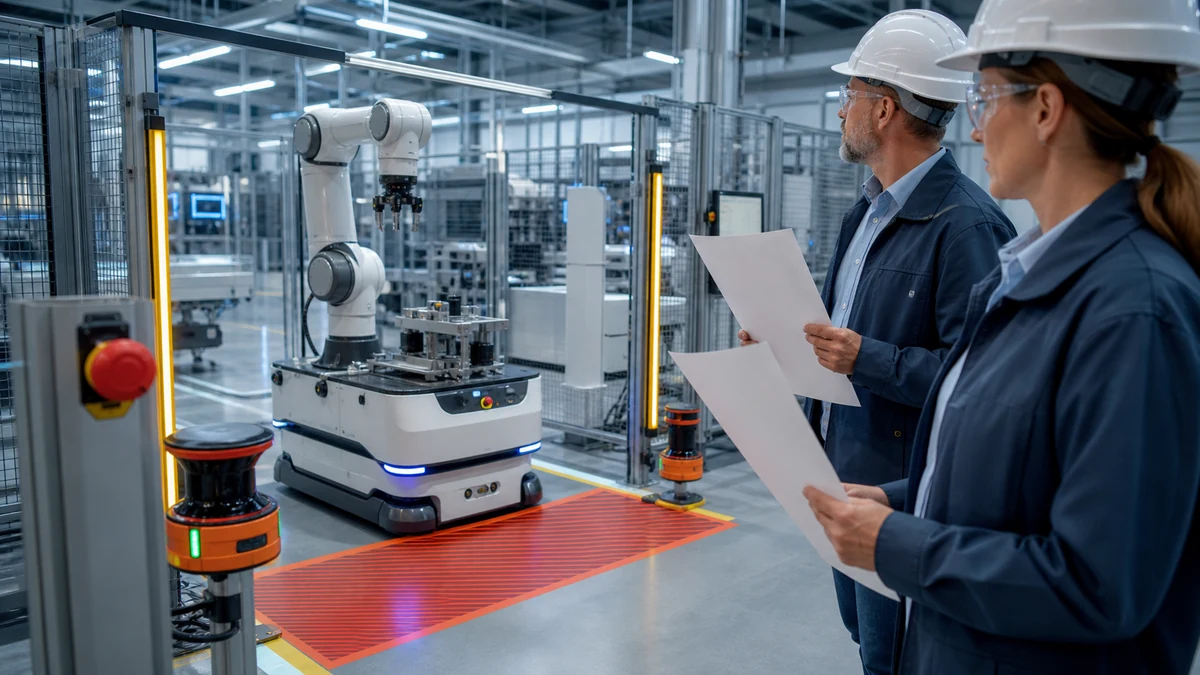
A robot does not become a high-risk AI system merely because it uses machine learning. The classification depends on the intended purpose, the role of the AI in the product, the consequences of failure, the applicable product legislation and, in some cases, whether a third-party conformity assessment is required.
The finished robot may also fall under the EU Machinery Regulation as a product. A credible market-access plan therefore runs two tracks in parallel: classify the AI system under the AI Act, and demonstrate the safety and conformity of the machinery. Shared evidence can be reused, but the two legal tests should never be treated as interchangeable.
Start with intended purpose, system boundaries and operator roles
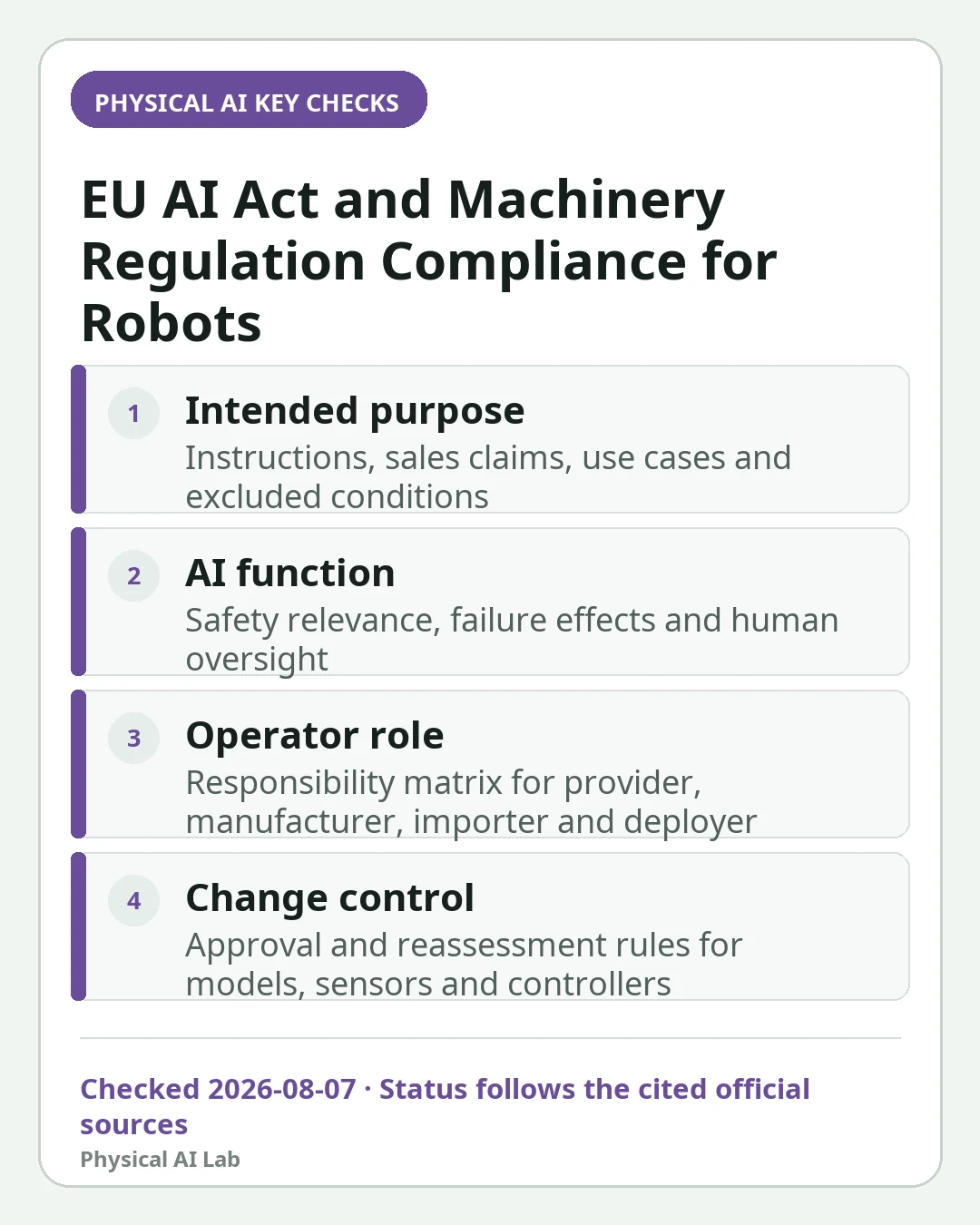
Freeze the intended purpose before assigning a risk class. Describe the users, operating environment, tasks, foreseeable misuse, prohibited conditions, input data, decisions made by the AI, human intervention and the physical consequences of an incorrect output. Marketing claims, instructions and engineering specifications should tell the same story because each can shape how the product is understood.
Map every economic operator and technical contributor. The robot manufacturer, foundation-model or component supplier, system integrator, EU importer, distributor and deployer may not carry the same duties. Record who places a name on the product, who sets or changes the intended purpose, who controls updates and who can authorize a safety-related modification after installation.
| Decision input | Evidence to retain |
|---|---|
| Intended purpose | Instructions, sales claims, use cases and excluded conditions |
| AI function | Safety relevance, failure effects and human oversight |
| Operator role | Responsibility matrix for provider, manufacturer, importer and deployer |
| Change control | Approval and reassessment rules for models, sensors and controllers |
Apply the AI Act high-risk gates in the correct order
Article 6 of the official EU AI Act provides a central product-safety route. In broad terms, the analysis asks whether the AI is a safety component of a product, or is itself a product, covered by specified Union harmonisation legislation and whether that product must undergo a third-party conformity assessment before it is placed on the market or put into service. Each element needs evidence; the presence of motors, cameras or autonomy alone is not the test.
A separate review should cover the use cases listed in Annex III, including specified applications involving biometrics, critical infrastructure, education, employment, essential services, law enforcement and other listed fields. The team must compare the actual intended purpose with the legal category and its qualifications. A feature inventory is not enough: document what decision the system supports or makes, who is affected, the material consequence and whether an exception applies.
| Gate | Practical question |
|---|---|
| Product or safety component | Can AI failure undermine a safety function or protected outcome? |
| Applicable product law | Which harmonisation act and product category cover the robot? |
| Conformity route | Does the relevant product require third-party assessment? |
| Annex III use | Does the actual purpose match a listed high-risk use case? |
Run Machinery Regulation conformity as a product-safety workstream
The official Machinery Regulation (EU) 2023/1230 governs machinery and related products placed on the EU market or put into service within its scope. The manufacturer must determine the applicable route and prepare the risk assessment, risk-reduction measures, technical documentation, instructions, conformity assessment, EU declaration of conformity and CE marking as required for the product.
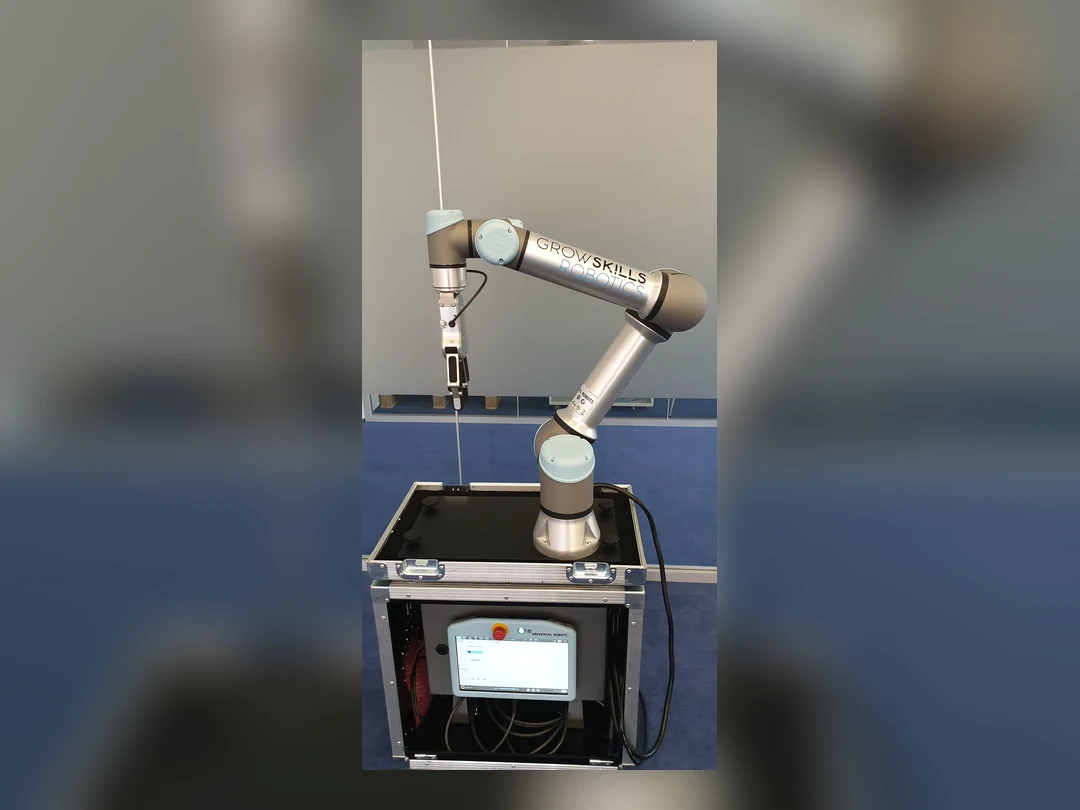
For an adaptive robot, model accuracy is only one small part of safety assurance. Verification should cover protective stops, speed and force limits, safety-related control functions, loss of communications, obscured sensors, unexpected restart, power restoration, cybersecurity-related unsafe states and human recovery actions. The team must show that learning or software updates cannot silently invalidate the declared safety envelope.

Use the revised 2026 timetable and the corrected machinery date
Regulation EU 2026/1744 entered into force on 27 July 2026 and amended parts of the AI Act timetable. The European Commission's official AI Omnibus implementation notice explains that the general high-risk AI rules apply from 2 December 2027, while high-risk AI embedded in regulated products such as machinery applies from 2 August 2028. Teams should check the consolidated legal text when making a release decision, not rely on an older slide deck.
The corrected date of application for the Machinery Regulation is 20 January 2027. Some copies of the initially published text can still lead readers to an earlier January date, so compliance files should reference the official corrigendum and the current consolidated material. A later legal deadline is not a safe reason to postpone architecture decisions, laboratory bookings, supplier evidence or notified-body discussions.
| Date | Planning significance |
|---|---|
| 27 July 2026 | Regulation 2026/1744 entered into force |
| 20 January 2027 | Corrected Machinery Regulation application date |
| 2 December 2027 | Revised application point for general high-risk AI rules |
| 2 August 2028 | Revised application point for high-risk AI in regulated products |
Build linked evidence without collapsing the two regimes
For the AI Act track, maintain evidence on intended purpose, risk management, data governance, technical documentation, logging, transparency, human oversight, accuracy, robustness and cybersecurity to the extent required by the system's role and classification. For the machinery track, maintain the machinery risk assessment, essential health and safety requirements mapping, drawings, circuits, safety-function verification, test reports, instructions and conformity records. Give every requirement an owner and a version.
Reuse is valuable when it is explicit. A hazard record can link the affected person, hazardous situation, AI contribution, safety function, preventive measure, validation test, residual risk, responsible owner and change history. That traceability lets the review board see whether a model, sensor, gripper or controller update changes the product-safety case, the AI classification, both, or neither.
Make the launch gate multidisciplinary and auditable
A legal-only review at the end of development is too late for a physical system. Product, AI, functional safety, cybersecurity, quality, field operations and legal specialists should review the same product version and intended-purpose statement. The classification memo should cite the legal basis, state assumptions, identify unresolved facts and define the technical or commercial changes that trigger reassessment.
For the surrounding engineering controls, use the guides to ISO 10218:2025 and robot-integrator responsibility, FMEA, HAZOP and STPA for robot risk assessment and power-and-force-limiting contact testing. This article is an informational map checked on 7 August 2026, not legal advice for a particular robot or transaction.
Frequently asked questions
Is every AI-enabled robot a high-risk AI system under the EU AI Act?
No. The intended purpose, safety-component role, applicable product legislation, conformity route and any Annex III use case must be assessed. A robot's appearance or level of autonomy does not decide the classification by itself.
Does an AI Act assessment replace Machinery Regulation conformity?
No. The regimes can interact, but they have distinct tests and evidence. Maintain an AI governance file and a machinery product-safety file, then link shared hazards, controls, tests and changes through traceability records.
When should a robot company begin EU compliance work?
Begin during architecture and intended-purpose definition. Work backward from the corrected machinery date and revised AI Act dates, allowing time for classification, risk reduction, testing, supplier records, conformity assessment and controlled updates.
Official sources checked
- EUR-Lex, Regulation (EU) 2024/1689 (Artificial Intelligence Act)
- EUR-Lex, Regulation (EU) 2026/1744
- European Commission, AI Omnibus enters into force
- EUR-Lex, Regulation (EU) 2023/1230 on machinery
- EUR-Lex, Corrigendum to Regulation (EU) 2023/1230
2026-08-07