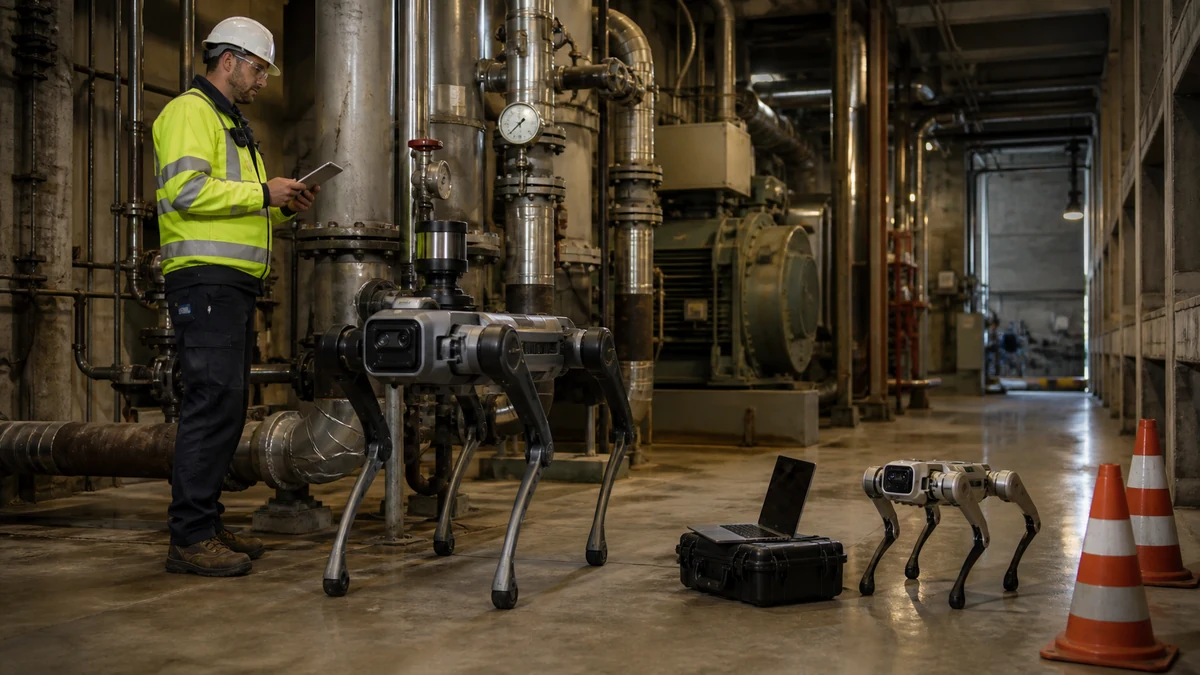
Choose Boston Dynamics Spot first when the job is repeatable industrial inspection with mission software, payload integration, fleet operations and enterprise support. Choose Unitree Go2 first when the goal is a lower-cost platform for locomotion, perception, classroom work or application development. They are both quadrupeds, but they transfer different amounts of deployment responsibility to the buyer.
The official Spot product page presents inspection, research and hazardous-response configurations, a documented API and a 14-kilogram payload rating. The official Go2 store showed a selected Pro configuration at USD 2,800 when checked on August 7, 2026, plus USD 399 to USD 1,000 shipping and buyer responsibility for duties, taxes and customs. That displayed price is not comparable with a confidential Spot deployment quote until hardware, software, support and site work are aligned.
The practical choice is industrial mission ownership versus development access
Spot is packaged around creating, repeating and supervising missions at customer sites. Its value proposition includes more than a walking machine: the buyer can combine perception payloads, inspection workflows, fleet software, training and support. Go2 offers a compact entry point into quadruped behavior, mapping and application work, while EDU pricing and development access require a separate sales conversation.
A robot that can traverse the same corridor is not automatically a substitute. An algorithm experiment inside a controlled laboratory and a route inside an operating plant have different requirements for environmental protection, failure recovery, cybersecurity, spare parts, change control and accountable support. Start with the operational consequence of failure, not a video or a chassis category.
| Decision factor | Spot | Go2 |
|---|---|---|
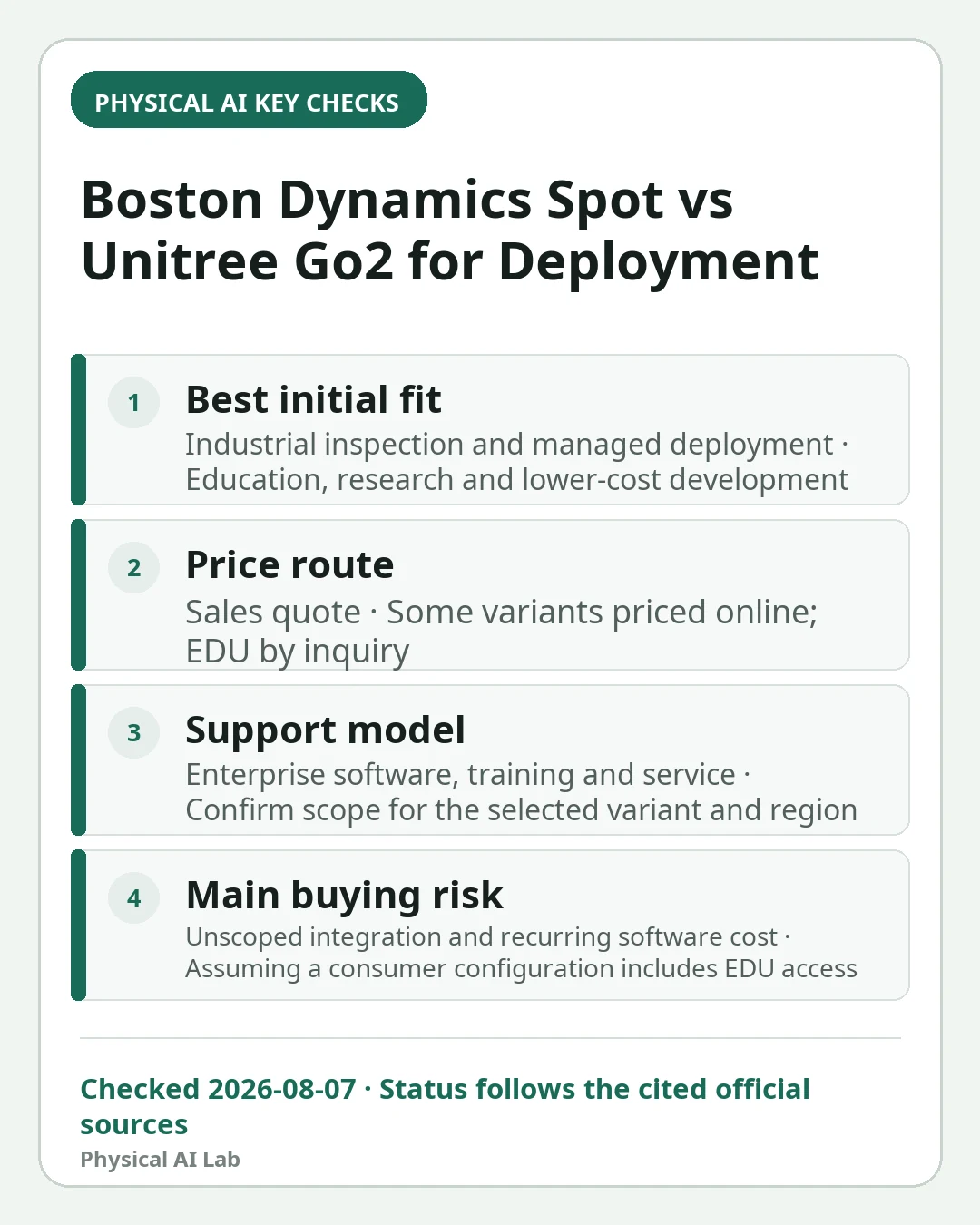
| Best initial fit | Industrial inspection and managed deployment | Education, research and lower-cost development |
| Price route | Sales quote | Some variants priced online; EDU by inquiry |
| Support model | Enterprise software, training and service | Confirm scope for the selected variant and region |
| Main buying risk | Unscoped integration and recurring software cost | Assuming a consumer configuration includes EDU access |
Spot publishes payload and environmental specifications for mission equipment
The official Spot specification sheet lists an approximate 33.8-kilogram robot mass, 1.6-meter-per-second maximum speed, 14-kilogram payload, about 90 minutes of average runtime, IP54 protection and an operating range from minus 20 to 55 degrees Celsius. It also states a 300-millimeter step capability and plus-or-minus 30-degree slope rating. These are product specifications under defined conditions, not a promise of identical runtime with every payload and mission.
Go2's official page highlights a 4D LiDAR L2, a standard 8,000-mAh battery, an optional 15,000-mAh battery and app-assisted point-cloud mapping and path assignment. Those are useful development capabilities. They do not establish an explosion-protection rating, a safety-rated perception function or approval for a particular industrial payload, and the exact purchased variant still governs what is accessible.
| Comparison axis | Spot official position | Go2 official position and boundary |
|---|---|---|
| Robot scale | Approximately 33.8 kg | Compact quadruped platform; verify selected variant |
| Payload | Up to 14 kg | Validate mount, power, balance and dynamic load |
| Environment | IP54 and temperature range published | Do not infer an industrial rating from consumer features |
| Energy | About 90 minutes average runtime | 8,000 mAh standard and 15,000 mAh optional are advertised |
Sensor count matters less than a complete inspection data path
Spot's 360-degree perception supports mobility, while an inspection deployment may add thermal, acoustic, gas or other mission payloads. An available API does not itself create a trustworthy result. The team still has to manage time synchronization, coordinate frames, calibration, alarm thresholds, evidence retention and delivery into maintenance or asset-management systems.
Go2's wide-field LiDAR and mapping functions can accelerate prototyping, but consumer app features and EDU development interfaces should be kept separate. Before purchase, obtain a written matrix for raw camera and LiDAR access, low-level control, firmware, sample-code license, offline behavior, account dependency, update policy and any capability that changes by Air, Pro, X or EDU configuration.

Support and recovery create a larger deployment gap than locomotion demos show
Boston Dynamics describes preconfigured packages, documentation, training and enterprise software around Spot. A deployment quote should still name the exact robot generation, batteries, chargers or Dock, payloads, Orbit or other software, operator seats, data retention, service response and supported software period. A product family name is not a complete statement of work.
A team adapting Go2 for a plant may own more of the network-loss behavior, safe-stop logic, mapping, weather and floor validation, charger workflow, recovery and regional repair process. The lower acquisition price remains a real advantage for capable engineering teams, but integration labor and downtime can reverse the apparent saving when the mission must operate on schedule.
Compare total cost for the same mission instead of aligning sticker prices
Spot does not currently have a public official list price on the cited product page. The Go2 store amount varies by selected version and market, and it is not a universal landed cost that includes EDU features, import charges and local support. Converting an old reseller figure or a different country's price into a current official comparison would create false precision.
Build parallel quote columns for robot hardware, batteries, charging or docking, payloads, compute, SDK access, fleet management, analytics, integration, safety validation, training, warranty, spares and one year of operating labor. Then estimate useful inspections completed, intervention minutes, missed readings and downtime. Cost per accepted mission is more informative than the cheapest chassis.
| Total-cost layer | What must be aligned |
|---|---|
| Hardware | Robot, batteries, charging, dock, payload and compute |
| Software | SDK, fleet tools, analytics and update term |
| Site work | Mapping, integration, safety validation and training |
| Operations | Interventions, consumables, repairs and downtime |
Run both candidates through the same corridor and acceptance denominator
A useful trial fixes the route, lighting, thresholds, slopes, network disruptions and sensor targets. Count every attempt and record route completion, missed inspection points, near contacts, human intervention, battery exchange, recovery and data-delivery success. The robot sensor-fusion guide helps define measurement quality, while the Spot price and TCO guide and Go2 variant buying guide keep product-specific cost details out of this comparison.
The outcome should not be a universal winner. Go2 can be the rational choice when the team wants inexpensive access and can engineer and support the stack. Spot can justify a much higher deployment cost when an operating organization needs inspection packages, fleet tooling and a clearer enterprise support path. The correct choice is the configuration whose failure, integration and support responsibilities the buyer can actually own.
Frequently asked questions
Is Unitree Go2 cheaper than Boston Dynamics Spot?
Go2 has a far lower visible hardware entry price, while Spot uses sales quotes. The products include different deployment software, support and integration expectations, so compare total cost for one defined mission rather than the chassis price.
Can Go2 replace Spot for factory inspection?
Not on the basis of locomotion alone. A factory deployment must validate environmental limits, payload integration, safe behavior around people and vehicles, network failure, recovery, support and repeatable delivery of inspection data.
Do the Spot API and Go2 SDK offer equivalent access?
No. Sensor access, low-level control, firmware, licensing, fleet operations and support differ. Put every required interface and software version into the quote and acceptance test.
Official sources checked
- Boston Dynamics Spot official product page
- Unitree Go2 official store
- Boston Dynamics Spot official specifications
2026-08-07