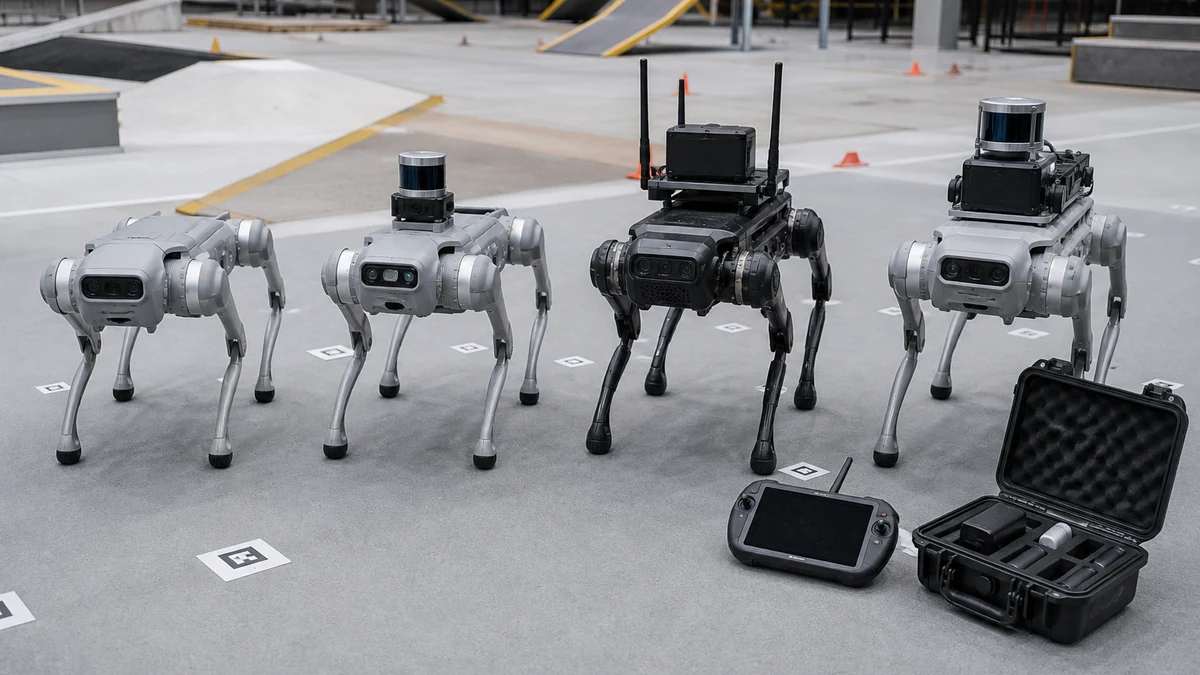
The simplest Go2 choice is task-based. Unitree's official comparison page lists Air as the lowest-cost standard model at $1,600, Pro with communications and tracking features at $2,800, X with an included controller and partial secondary-development access at $4,500, and EDU as the quote-only research model with full secondary-development support, a larger battery, a depth camera and foot-end force sensors. Unitree says the displayed prices exclude freight and tax.
A buyer should not turn the $1,600 headline into a delivered-cost promise. The official Go2 store page currently shows shipping in a roughly $399 to $1,000 range and assigns customs, tax and import charges to the buyer. It also lists the remote controller as optional for Air and Pro but included with X and EDU. For a broader comparison with Unitree's humanoids, use the Unitree R1, G1, H1 and H2 guide.
Air, Pro, X and EDU occupy four different buying tiers
All four variants share the Go2 form factor, but their public offer types differ. Air, Pro and X have displayed base prices, while EDU requires a sales quote. The official comparison page lists a standing size of about 70 by 31 by 40 centimeters and a weight of about 15 kilograms across the family, so model selection is driven mainly by electronics, software access, battery and included equipment rather than chassis size.
The table below preserves Unitree's variant-specific qualifiers. The 5 m/s figure is an approximate maximum attached to X and EDU; it is not a universal Go2 speed. Likewise, the two-to-four-hour runtime is tied to EDU's 15,000 mAh battery, not to every model.
| Variant | Public base price | Listed speed | Battery and runtime | Warranty |
|---|---|---|---|---|
| Air | $1,600 | 2.5 m/s | 8,000 mAh; about 1–2 hours | 6 months |
| Pro | $2,800 | 3.5 m/s | 8,000 mAh; about 1–2 hours | 12 months |
| X | $4,500 | 3.7 m/s; approximately 5 m/s maximum | 8,000 mAh; about 1–2 hours | 12 months |
| EDU | Contact sales | 3.7 m/s; approximately 5 m/s maximum | 15,000 mAh; about 2–4 hours | 12 months |
Controller inclusion and development access can change the real price
Unitree's selector offers Air and Pro with or without a handheld controller. The separate controller listing is $300 at the checked date, but it also shows a backorder notice, so the displayed price does not establish immediate availability. X and EDU include a controller. A fair comparison should use the configuration actually needed in the field, not assume every base price contains identical control hardware.
Software access creates a larger boundary. Air and Pro are marked as not supporting secondary development. X is marked for partial secondary development, while EDU supports it. A research team that needs low-level interfaces, custom perception or experimental control should obtain an exact EDU or X entitlement in writing; a consumer feature list does not confer research access. The ROS 2 QoS guide becomes relevant only after the purchased variant, SDK and network path actually expose the required interfaces.
| Capability | Air | Pro | X | EDU |
|---|---|---|---|---|
| Handheld controller | Optional | Optional | Included | Included |
| Secondary development | No | No | Partial | Yes |
| 4G, voice, tracking and ISS features | Not listed | Listed | Listed | Listed |
| Charging-dock compatibility | No | No | Yes | Yes |
| Depth camera and foot-end force sensors | No | No | No | Yes |
Payload and sensing numbers need variant labels
Unitree lists a recommended or normal payload of about 7 kilograms for Air and about 8 kilograms for Pro, X and EDU. The approximate maximum is 10 kilograms for Air and Pro and 12 kilograms for X and EDU. Those values are payload ratings, not a promise that the robot will maintain maximum speed, runtime or stability while carrying that mass over any terrain.
EDU is the only variant in the official matrix with both a depth camera and foot-end force sensors. Those sensors can support research on terrain perception and contact, but hardware presence does not establish the quality of an algorithm or dataset. Teams comparing locomotion claims should use repeatable terrain, payload and recovery tests such as those described in the legged robot performance guide.

The delivered price depends on freight, customs and destination
Unitree's product page says prices exclude tax and freight. Its store currently presents shipping charges in a roughly $399 to $1,000 range, and the shipping policy says customs duties, taxes and import responsibilities belong to the buyer. Currency conversion, brokerage, local compliance work, replacement batteries and a controller can all move the final total above the headline price.
The policy says orders normally ship within 30 business days and estimates 20 to 45 business days for delivery from China, but it does not guarantee those dates. A procurement budget should therefore contain separate lines for the selected SKU, controller, battery or charger options, freight, tax, customs, broker fees, insurance and local support. Compare that landed structure with the humanoid robot price and deployment-cost framework rather than ranking only base prices.
Runtime and top speed are test conditions, not universal outcomes
The official one-to-two-hour and two-to-four-hour ranges are approximate. Temperature, gait, speed, payload, terrain, sensor use, wireless activity and battery condition can change useful runtime. A four-hour EDU upper bound should not be copied onto Air, Pro or X, and it should not be treated as four hours of continuous maximum-speed operation.
The same applies to speed. Air is listed at 2.5 m/s, Pro at 3.5 m/s, and X and EDU at 3.7 m/s with an approximate 5 m/s maximum. Select a robot on the sustained pace and control margin required for the task, not the single largest number on the page. High-speed operation also changes stopping distance, fall energy and the safe test area.
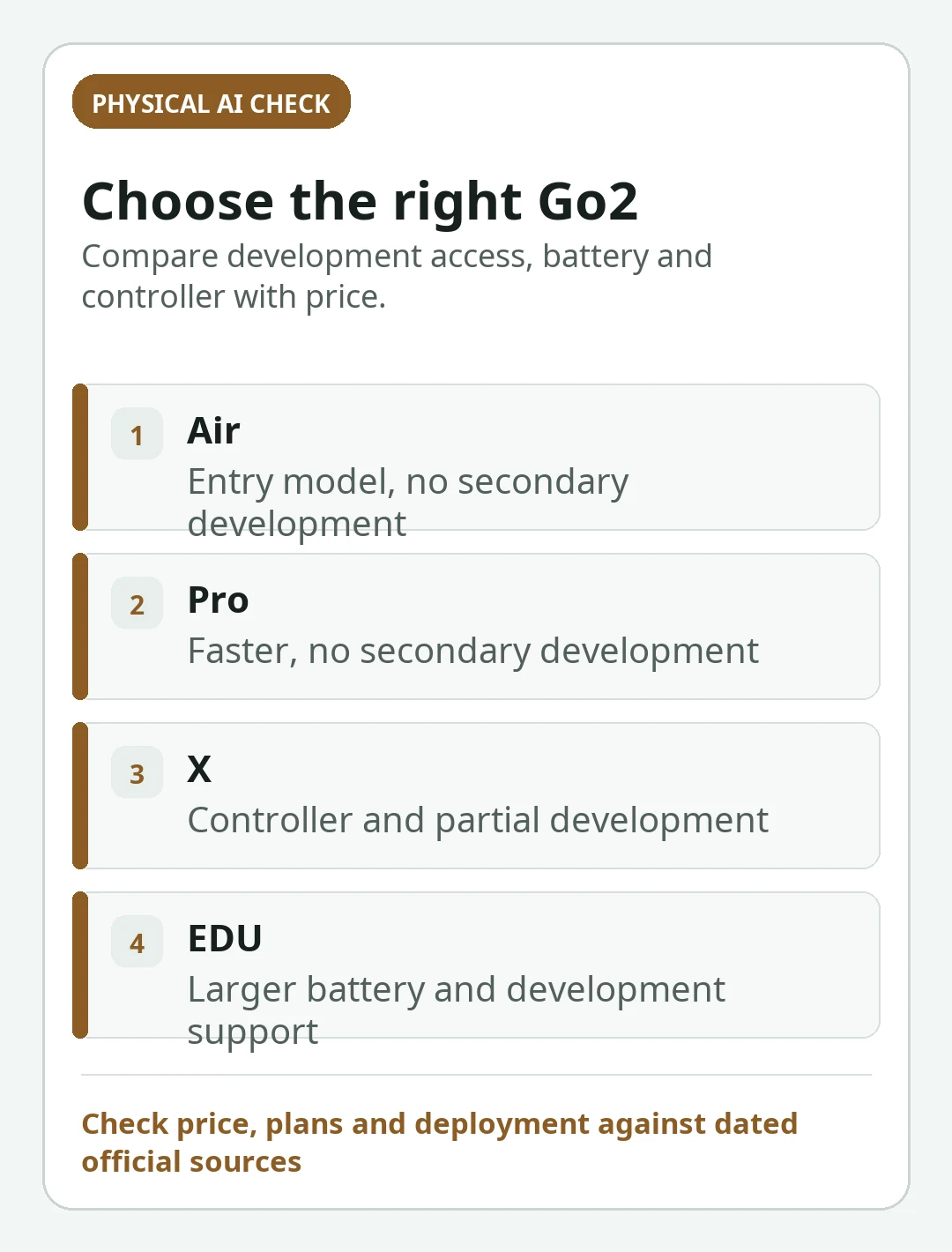
Choose the model that exposes the controls your project needs
Air fits buyers who want the lowest entry price for standard operation and do not need the listed Pro communications features or secondary development. Pro fits users who want the added 4G, voice, tracking and ISS feature set but still do not need a research interface. Confirm regional service availability before treating any wireless feature as usable.
X is the intermediate choice when an included controller, charging-dock compatibility and partial development are sufficient. EDU is the appropriate starting point when the project depends on documented secondary development, the larger battery, depth sensing or foot force data. Even then, request the exact SDK, API, firmware, support scope and safety restrictions in the quote.
Confirm region, interface and acceptance tests before payment
Unitree's footnote says the non-mainland-China 4G function supports 43 European countries except Ukraine and some Asian regions. It is not a universal cellular promise. Ask which SIM, radio bands, cloud services and account region apply at the destination, and whether the feature continues to work without a subscription or remote service.
For Air and Pro, confirm whether the order includes the controller. For X and EDU, obtain the development entitlement and supported interface list. Then run a small physical AI proof of concept covering runtime with the real payload, recovery, network loss, safe stopping, charging and parts availability. The best SKU is the least expensive one that passes those acceptance tests without relying on an undisclosed interface.
Frequently asked questions
How much does a Unitree Go2 cost before shipping and tax?
Unitree lists Go2 Air at $1,600, Pro at $2,800 and X at $4,500. EDU is quote-only. These are base figures; Unitree says freight and tax are excluded, and the buyer is responsible for customs and import charges.
Does every Go2 include a handheld controller?
No. Unitree lists the controller as optional for Air and Pro and included for X and EDU. The separate controller listing is $300 at the checked date, so compare like-for-like configurations.
Which Go2 model is intended for secondary development?
The official comparison marks EDU as supporting secondary development and X as supporting it partially. Air and Pro are marked no. Buyers should still confirm the exact SDK, interfaces and support entitlement in the order.
Official sources checked
- Unitree: Go2 official product and specification page
- Unitree Store: Go2 product selector
- Unitree Store: Go2 controller
- Unitree Store: Shipping policy
- Unitree: Go2 battery information
Last checked: August 6, 2026