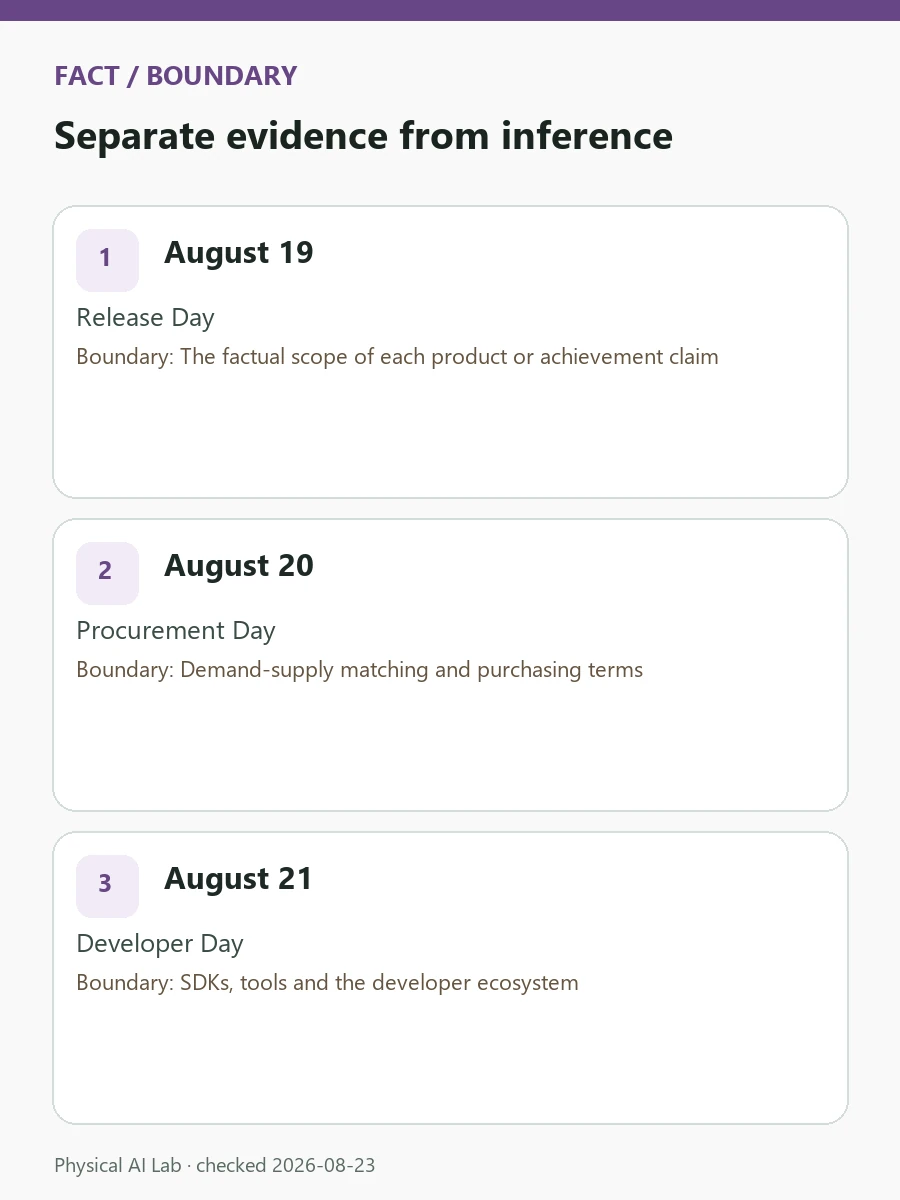
The published WRC 2026 agenda assigned Release Day to August 19, Procurement Day to the 20th and Developer Day to the 21st. Those labels explain three commercialization jobs; they do not prove that a negotiation, integration or delivery was completed.
What each published program day was designed to do
The published agenda described Release Day as the venue for new products and reported achievements, Procurement Day as the venue for demand-led discussions and supply-chain matching, and Developer Day as the venue for technical exchange and ecosystem building. The published agenda assigned the 22nd and 23rd to hands-on public access and broader engagement.
This analysis separates what organizers have stated from what still needs evidence. We use event and company figures only within their published date and scope; undisclosed pricing, lead times and success rates remain unknown.
| Date | Program | What to examine |
|---|---|---|
| August 19 | Release Day | The factual scope of each product or achievement claim |
| August 20 | Procurement Day | Demand-supply matching and purchasing terms |
| August 21 | Developer Day | SDKs, tools and the developer ecosystem |
A credible robot must satisfy buyers and developers
A product should explain more than its launch-day capabilities. Procurement teams need total cost and safety terms; developers need APIs, logs and simulator support. Deployment risk rises when the launch, procurement and developer documents make different promises.
Repeatable physical AI requires sensor time synchronization, state estimation, planning, low-level control, safety limits and recovery to function as one chain. Perception performance by itself is not enough.
Compare the documents before committing to a deployment
Start with failure conditions, not a single successful run. Record repeat counts, the points at which a person intervened and recovery time after a stop. This evidence exposes the gap between a demonstration and an operating system.
| Document | Questions it should answer |
|---|---|
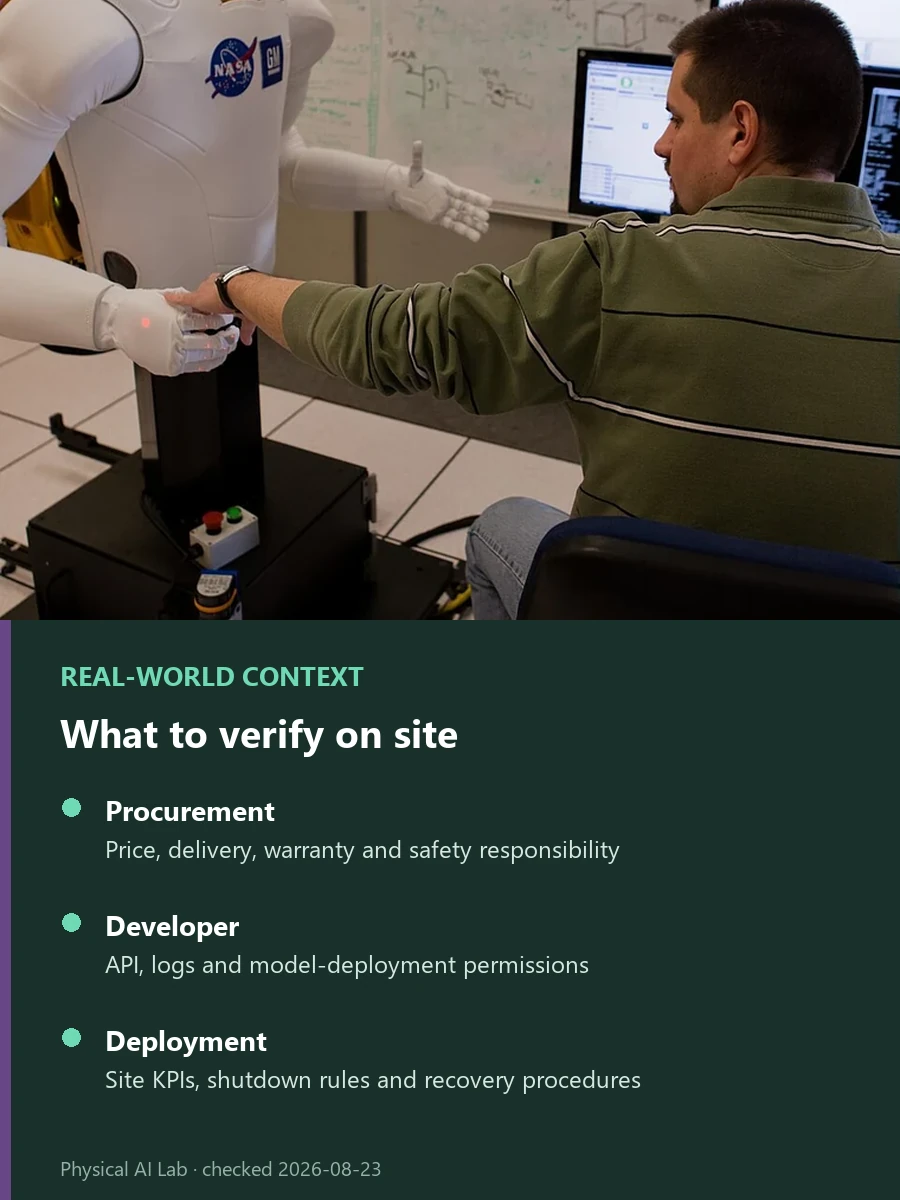
| Procurement | Price, delivery, warranty and safety responsibility |
| Developer | API, logs and model-deployment permissions |
| Deployment | Site KPIs, shutdown rules and recovery procedures |

An MOU is not the same as booked revenue
A memorandum of understanding or partnership announcement at the event should not automatically be counted as a sale. Check whether it is a paid contract, a test installation, a target volume or a confirmed delivery.
Organizer and company material remains promotional primary-source evidence. Revisit the judgment when customer-site results, independent tests or regulatory documents are published.
Background for reading the commercialization stack
The physical AI company ecosystem clarifies who supplies each layer, while the robot simulator comparison and edge AI for robots guides show what developers need after a launch. Together they provide the technical background for this August 2026 commercialization analysis.
Why the three-day sequence matters
The published agenda separated releases on August 19, procurement on the 20th and developer activity on the 21st within the WRC 2026 program, making the gaps between announcement, purchase and ecosystem support visible as questions for post-event evidence. Repeatable results and disclosed deployment terms matter more than the scale of the launch.
Frequently asked questions
When should a Procurement Day announcement be counted as an actual sale?
Only when the parties identify a paid contract, quantity or scope, product configuration and delivery obligation. A meeting, memorandum or target volume is evidence of intent, not booked deployment.
What operating metrics should appear in the deployment document?
Look beyond task success to the human-intervention rate, mean recovery time, continuous operating time and failure conditions. Those four metrics reveal whether the system can leave the demo environment.
What should match across release, procurement and developer materials?
The supported task, hardware configuration, safety limits, software access, price scope and service promise should describe the same product. Conflicts among those documents are a deployment risk.
Official sources checked
- Beijing municipal government's official WRC 2026 event guide
- Invest Beijing's WRC 2026 industry overview
- World Robot Conference official service platform
Last checked: August 23, 2026