The confirmed change is portfolio-level: ABB has added a counterbalanced autonomous forklift to the Visual SLAM and AMR Studio environment already used by Flexley Mover and Tug. The F712 product page publishes strong maxima, but it does not say that every maximum can be achieved together on every rack and floor.
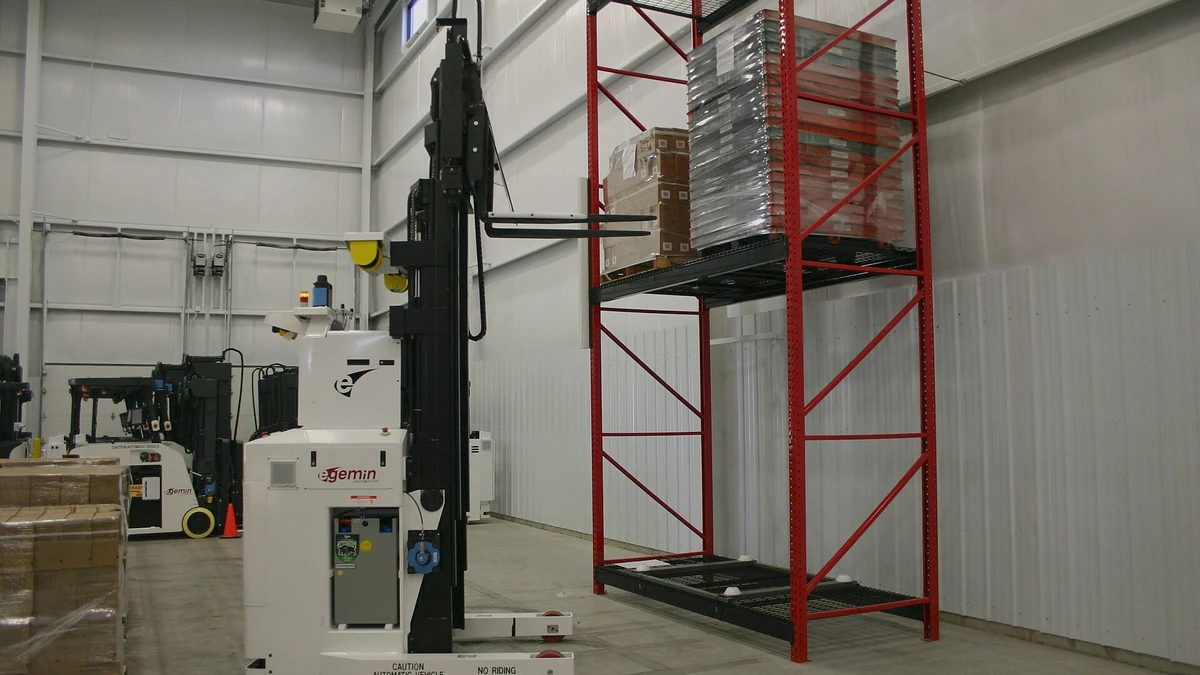

What changed in ABB’s mobile-robot portfolio
F712 is presented as a counterbalanced autonomous forklift for pallet transport and high-bay storage and retrieval. ABB emphasizes a common navigation, fleet-management, and software environment across its own mobile-robot portfolio. That interoperability statement should not be enlarged into immediate compatibility with every third-party AMR, WMS, safety state, or fork command. The new product category is confirmed; field performance remains site-specific.
Put the headline specifications beside their conditions
ABB lists up to 2,000 kg payload, up to 8.5 m lift, fleet-level positioning of ±10 mm and ±1 degree, and loads as large as 4.0 by 2.5 by 1.8 m. It also claims AMR Studio can reduce installation time by up to 20%. Load center, mast, travel speed, floor, rack, lighting, comparison baseline, and included engineering work are required before those figures can be combined. Manufacturer maxima are useful inputs only when their simultaneous conditions are disclosed.
| Published item | ABB statement | Condition still needed |
|---|---|---|
| Payload | Up to 2,000 kg | Load center, size, mast, and speed |
| Lift | Up to 8.5 m | Rack tolerance and height-specific derating |
| Position | Fleet level ±10 mm and ±1° | Lighting, floor, map, and percentile |
| Installation | Up to 20% faster | Baseline project and included work |
| Infrastructure | No added navigation infrastructure | Network, safety zones, rack references, charging |
Visual SLAM solves only part of fork alignment
Visual SLAM tracks camera features to estimate vehicle pose and update a map. Pallet approach, mast alignment, fork height, and insertion add separate sensing and control stages. Reflective wrap, repetitive rack uprights, dark aisles, moving vehicles, floor joints, and changing landmarks can weaken localization. The SLAM failure guide shows why map confidence and final fork accuracy must be logged separately. Navigation pose, pallet detection, and fork insertion form a chain rather than one accuracy number.
A product page cannot design the warehouse
ABB names warehouse receiving, production supply, finished-goods transport, and drive-in or drive-through racks. Public pages do not fully specify regional price, delivery, batteries, chargers, speed curves, safety certificates, service coverage, or height-by-load charts. High lift increases consequence. Buyers need the allowable load and travel-speed envelope at each height, not a collage of independent maxima. Infrastructure-free navigation does not mean infrastructure-free operations.
Fill the specification gaps with site acceptance tests
Run real pallets with centered and eccentric loads, worn pockets, rack tolerance, floor slope, different lighting, and blocked aisles. Record fork contact, near miss, retry, map relocalization, braking, manual recovery, and damage—not just successful placements. Protective lidar, bumpers, and other safety devices have roles different from Visual SLAM; one does not silently repair the other’s failure. Average alignment can hide repeated contact at one rack family.
| Known | Still unknown | Acceptance test |
|---|---|---|
| Visual SLAM common platform | Sensor redundancy and low-confidence fallback | Relocalize after lighting and aisle change |
| 2,000 kg maximum | Load-center derating | Brake with real and eccentric pallets |
| 8.5 m maximum | Height-specific capacity and sway | Repeat on actual racks |
| ±10 mm and ±1° | Test distribution and recalibration | Compare shifts and floor wear |
| 20% installation claim | Comparison scope | Measure engineering hours on a prior project |
Wait for operating distributions, not another maximum
Customer evidence should report representative load-height cycles, intervention rate, protective stops, map rebuilds, charging contention, mixed-fleet deadlocks, pallet damage, and software rollback. A rush order, aisle closure, and two low-battery vehicles requesting the same charger make a better orchestration test than a single forklift on an empty demo route.
The next evidence milestone is a complete customer denominator.
- mixed-fleet priority
- charging queue
- network loss
- map rollback
- service coverage
Questions readers ask next
Under which load-center, mast, rack, floor and lighting conditions can the stated 2,000-kilogram, 8.5-meter and positioning figures be evaluated together?
It is most relevant to sites moving heavy pallets between floor positions and high racks, especially where ABB Mover or Tug vehicles share a fleet layer. Fit still depends on load center, aisle width, rack tolerance, people mixing, floor, and regional support.
How should Visual SLAM localization interact with independent protective sensors, low-confidence fallback and mixed-fleet traffic rules?
No. ABB says separate navigation infrastructure is not required, but wireless coverage, chargers, safety zones, rack references, floor maintenance, and low-confidence localization behavior still need engineering.
Official source trail: