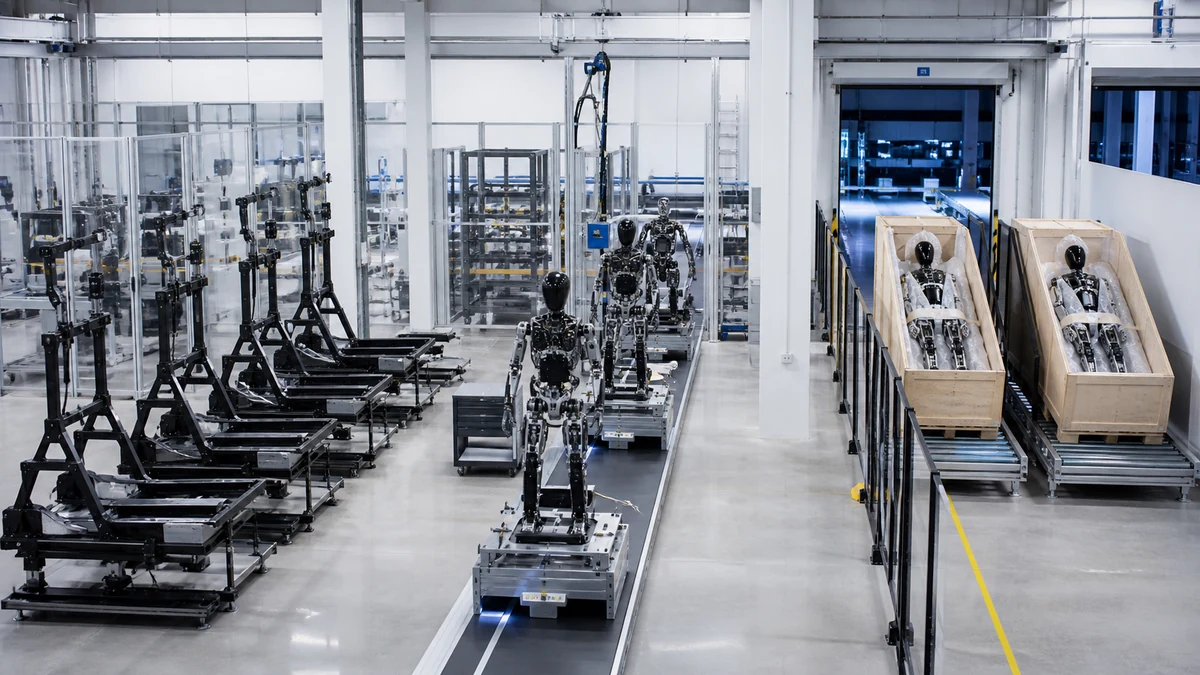
1X says in its 2026 NEO Factory article that the 58,000-square-foot Hayward facility is online and that, with San Carlos coming online, it has capacity for up to 10,000 NEOs per year. It also targets more than 100,000 units of annual capacity by the end of 2027 through added automation. Both are capacity statements, not cumulative completed-unit reports.
The same official article says current NEOs coming off the line are being prioritized for internal development and in-home testing while 1X follows its NEO launch and delivery plan toward doorstep deliveries starting in 2026. The cited pages do not publish a cumulative external-customer delivery count as of August 7, 2026. Price, preorder and country terms remain on the separate NEO buying guide.
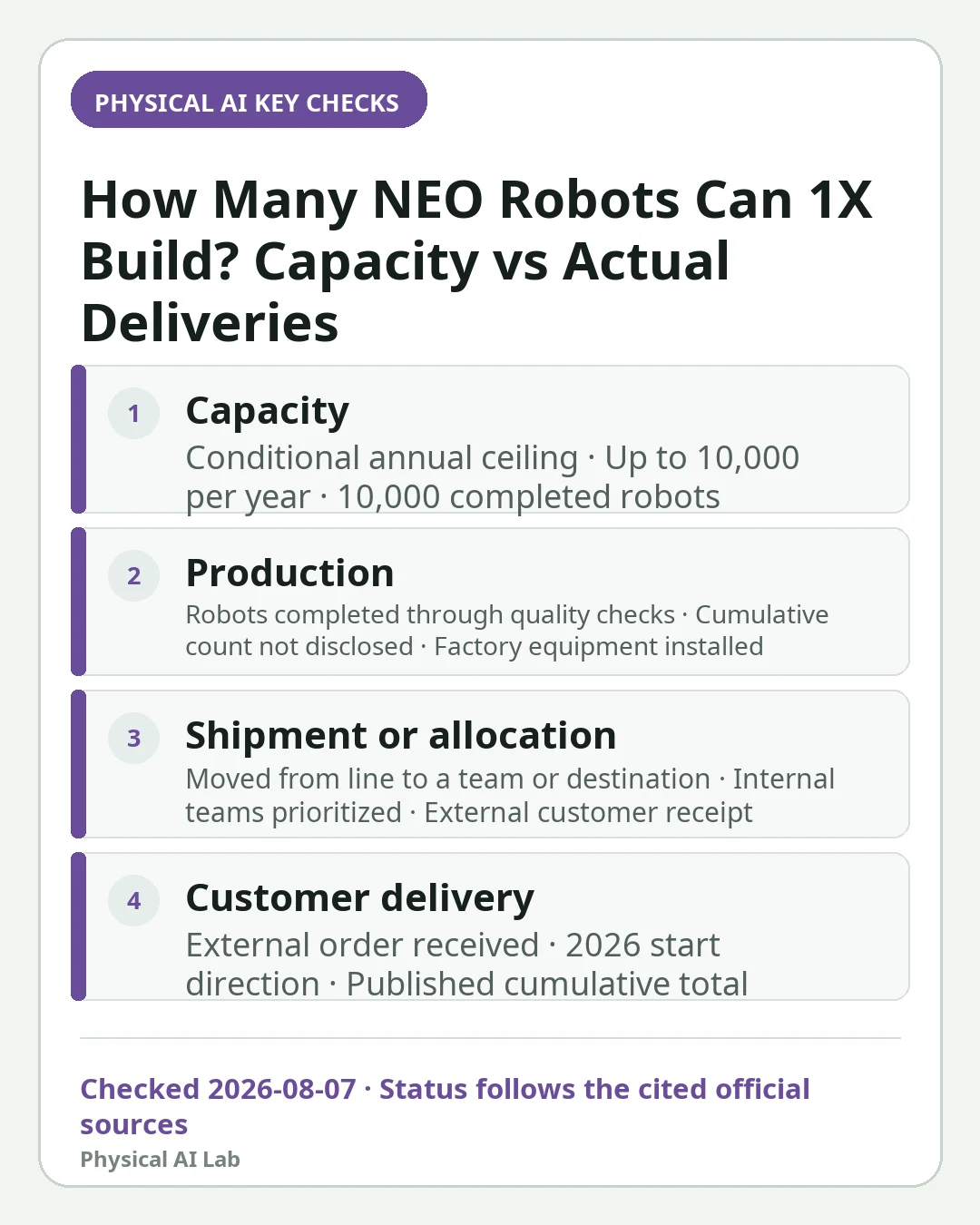
Capacity, output, shipment and customer delivery are four stages
Ten thousand per year is the ceiling a factory could reach under assumed shifts, staffing, component supply, yield and uptime. Production counts completed robots, shipment counts units leaving a factory or moving to an operating team, and customer delivery counts units received by an external buyer. An internal test robot can be built and shipped without being an external delivery.
A statement that first-year capacity was booked is a demand or reservation metric. It still precedes an Order Invitation, accepted contract, production allocation, shipment and installation. Recording a date and quantity at every stage prevents waitlist demand from becoming a fictional delivered fleet.
| Stage | Meaning | Current official evidence | Do not equate it with |
|---|---|---|---|
| Capacity | Conditional annual ceiling | Up to 10,000 per year | 10,000 completed robots |
| Production | Robots completed through quality checks | Cumulative count not disclosed | Factory equipment installed |
| Shipment or allocation | Moved from line to a team or destination | Internal teams prioritized | External customer receipt |
| Customer delivery | External order received | 2026 start direction | Published cumulative total |
Hayward is operating, but its capacity utilization is undisclosed
1X describes Hayward as a vertically integrated U.S. high-volume humanoid factory. It covers 58,000 square feet, employs more than 200 people and, according to the company, became fully operational after final permits in January 2026 and a three-month buildout. Motors, batteries, structures, transmissions, soft goods and sensors are among the critical systems produced in house.
Fully operational means the facility and processes are functioning; it does not mean the line is using its annual ceiling. Without monthly completions, shift count, utilization, first-pass yield and rework, sustained ramp speed cannot be calculated. Photos of equipment are not a shipment ledger.
Ten thousand per year remains a conditional line capability
The 1X manufacturing page says the Hayward NEO Factory has capacity to produce 10,000 NEOs per year. The longer factory article describes Hayward online and San Carlos due later in the year while giving the same up-to-10,000 figure. Neither wording reports that 10,000 units were completed in 2026.
Turning capacity into output requires component supply, trained staff, stable automation, inspection, rework, new-product introduction and reliability testing. 1X cites more than 20 million reliability cycles and testing at stations, but it does not publish monthly finished-robot yield or customer-site failure rates on these pages.

The 2027 robot target and 10,000-battery capacity are different plans
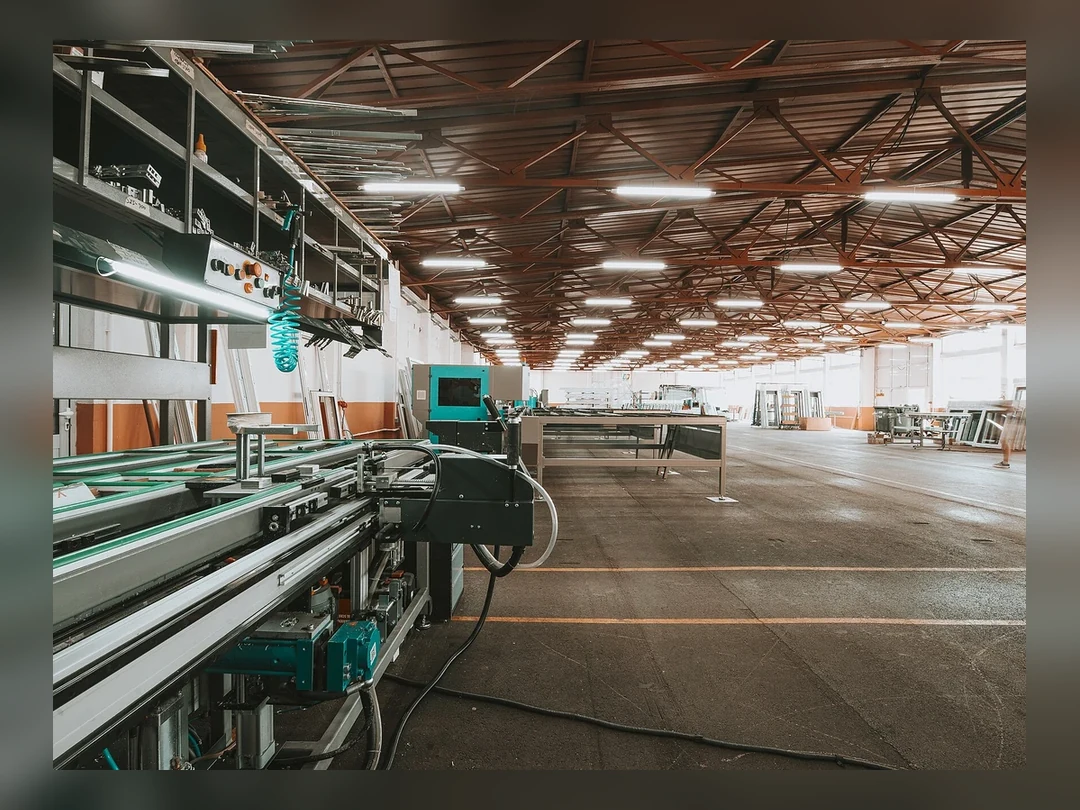
1X plans to scale toward more than 100,000 units of annual capacity by the end of 2027 through automation and the San Carlos facility. This is a future capacity target, not a promised customer-delivery total. Equipment commissioning, permits, supply, yield and demand all affect the path.
The factory article also describes a 500-millisecond weld cycle and capacity for 10,000 batteries per year. A battery-line number is not a robot count without the pack requirement per robot, test and spare units, scrap and replacement demand. The on-board Jetson Thor choice belongs in the separate robot edge-compute stack and creates its own supply boundary.
| Published number | Category | Time basis | Defensible reading |
|---|---|---|---|
| Up to 10,000 NEOs/year | Current capacity | 2026 factory statement | Actual output remains separate |
| 100,000-plus/year | Future capacity target | End-of-2027 target | Not guaranteed shipments |
| 10,000 batteries/year | Component-line capacity | Current process description | Does not automatically equal 10,000 NEOs |
| 200-plus employees | Factory staffing | At publication | Not a robot completion count |
Internal test allocation must stay separate from household deliveries
1X says NEOs currently coming off the line are prioritized for internal teams to accelerate development and testing in homes. That supports the conclusion that physical units are being produced; it does not establish that those units reached paying households. The internal allocation count is also not disclosed, so an external-share estimate is unavailable.
The company says it is working to deliver NEO to customers' doorsteps starting in 2026. A start year allows for first deliveries but does not promise that every preorder ships within the year. Autonomy shown during internal or home tests should be reviewed separately with the humanoid video evidence checklist.
The next useful update follows serial numbers through the pipeline
The useful sequence is monthly completions, quality releases, internal allocation, external shipment, customer receipt by market and units actually operating. Connecting the same serial-number cohort and dates across those stages reveals the gap between capacity and delivered results better than another factory-ceiling headline.
The defensible conclusion today is that Hayward is operating and 1X has stated current capacity of up to 10,000 NEOs per year plus a 2027 goal above 100,000. The official record reviewed here does not prove 10,000 completed robots, 10,000 external deliveries or any specific cumulative household-delivery count.
Frequently asked questions
Is 1X currently producing 10,000 NEOs a year?
1X publishes capacity for up to 10,000 per year, not an actual annual or monthly completion total. Current factory utilization is not disclosed on the cited pages.
Are 100,000 NEOs in 2027 confirmed customer deliveries?
No. The figure is a target for annual production capacity by the end of 2027, conditional on automation and facility scale-up.
How many NEOs have reached customers in 2026?
The cited 1X factory and manufacturing pages describe a 2026 delivery start direction but do not disclose a cumulative external-customer delivery count.
Official sources checked
- 1X: NEO Factory in Hayward
- 1X: Manufacturing
- 1X: NEO home robot launch and delivery plan
- 1X: Order NEO
Last checked: August 7, 2026