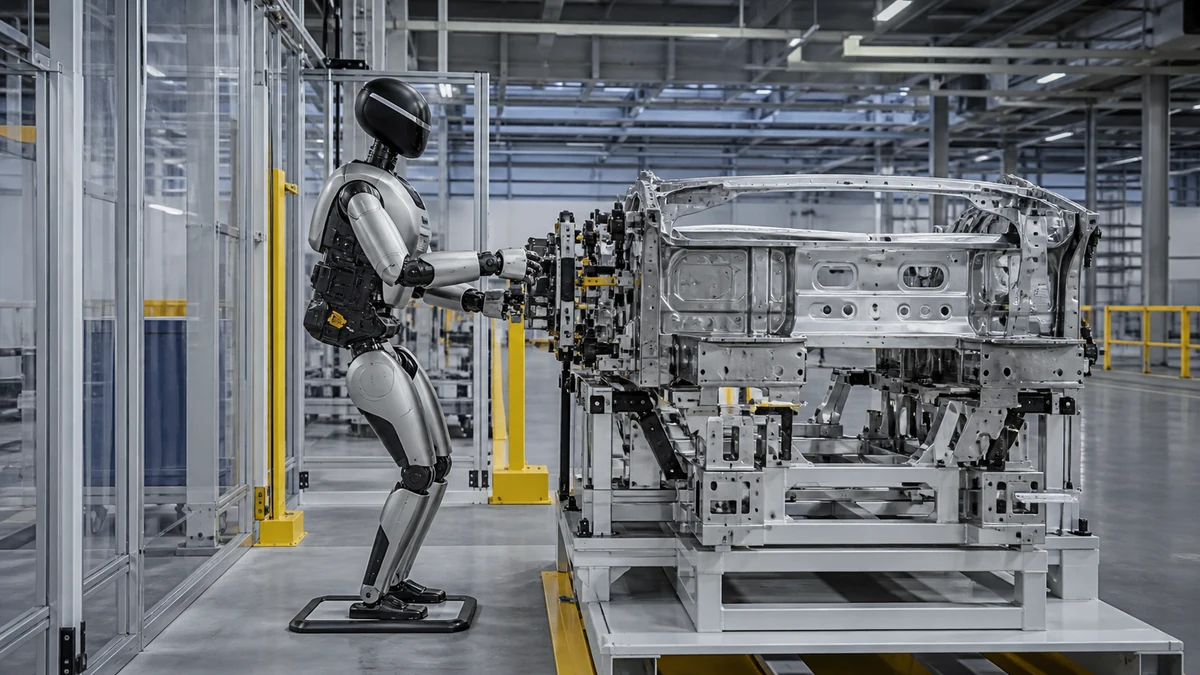
Hyundai Motor Group's published roadmap says Atlas is planned to enter selected processes at Hyundai Motor Group Metaplant America, or HMGMA, beginning in 2028. The first named example is parts sequencing; component assembly is placed in a later phase beginning in 2030. As of August 7, 2026, those dates describe a plan, not a completed fleet rollout.
This article tracks the HMGMA task and evidence boundary only. For the robot's current product status and public specifications, use the Atlas price and specifications guide; for reading demonstration footage, use the humanoid video evidence checklist.
The roadmap starts with validated factory processes in 2028
Hyundai says Atlas will be integrated gradually across its manufacturing network through process-by-process validation. HMGMA in Savannah, Georgia, is the specifically named starting site, with introduction beginning in 2028 where safety and quality benefits have been demonstrated.
The announcement gives parts sequencing as the first example. That means arranging and supplying components in the required order, not automatically performing every assembly operation on a vehicle. The wording matters because a factory-wide autonomy claim would exceed the official plan.
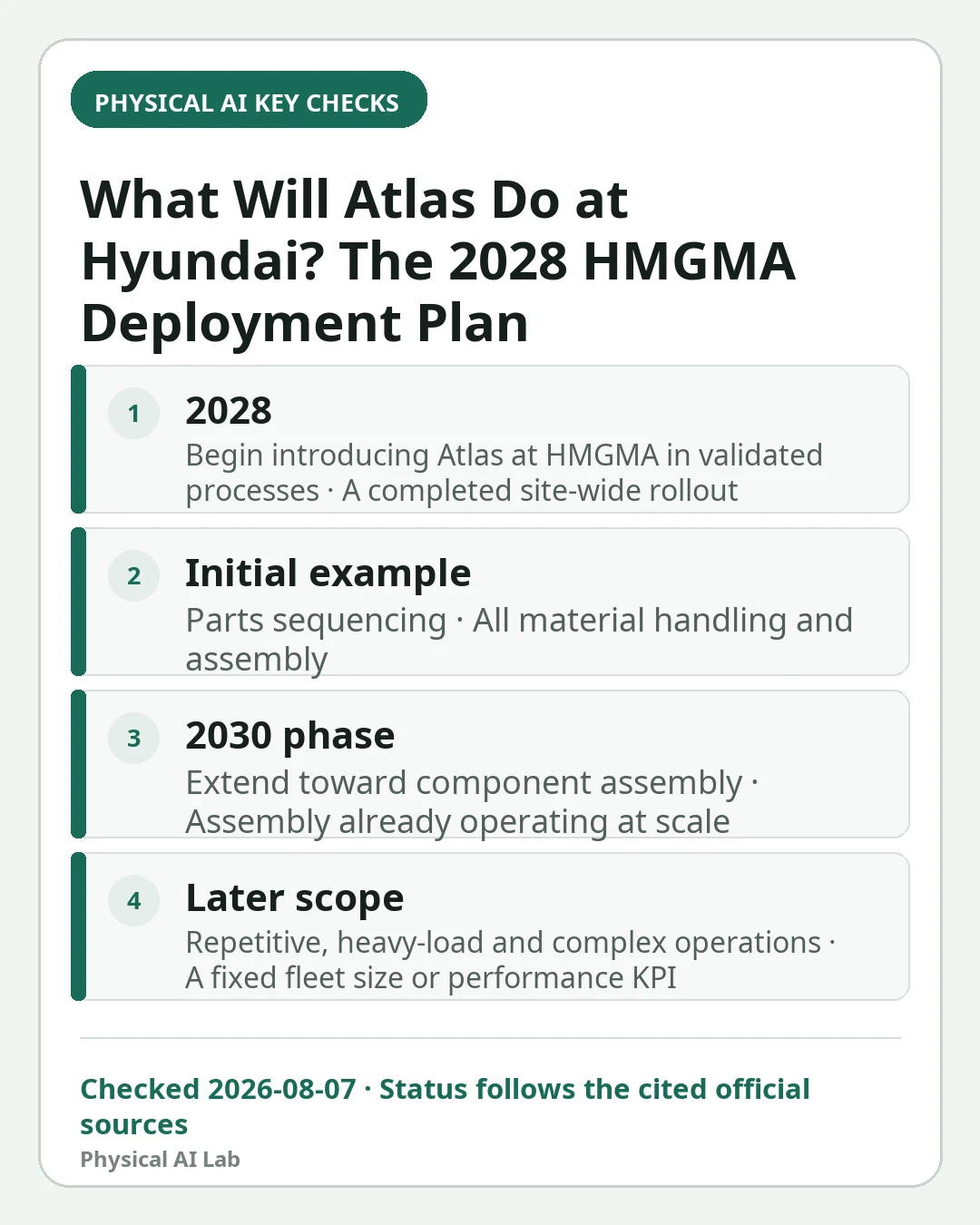
| Roadmap point | Published meaning | What is not established |
|---|---|---|
| 2028 | Begin introducing Atlas at HMGMA in validated processes | A completed site-wide rollout |
| Initial example | Parts sequencing | All material handling and assembly |
| 2030 phase | Extend toward component assembly | Assembly already operating at scale |
| Later scope | Repetitive, heavy-load and complex operations | A fixed fleet size or performance KPI |
Parts sequencing is a narrower job than vehicle assembly
Sequencing work can involve identifying parts, picking or moving containers, and presenting components in the order required by a downstream station. A useful pilot therefore needs part identity, placement accuracy, cycle time, safe-stop behavior and human-recovery procedures, not just a video of Atlas carrying an object.
This differs from the broad manipulation problem covered by the warehouse picking robot guide. At HMGMA, the relevant acceptance test must be tied to Hyundai's own parts, racks, takt time and safety controls.
Component assembly is a separate 2030 phase
Hyundai's detailed strategy story places component assembly after the initial 2028 introduction. Assembly can add tighter fit, contact, tool use and quality-verification requirements, so it should not be folded into the earlier sequencing milestone when reporting progress.
A team following the roadmap should record the date, site, process and evidence type for every update. A laboratory demonstration, a line-side pilot, an accepted production station and a multi-shift scaled fleet are four different states.
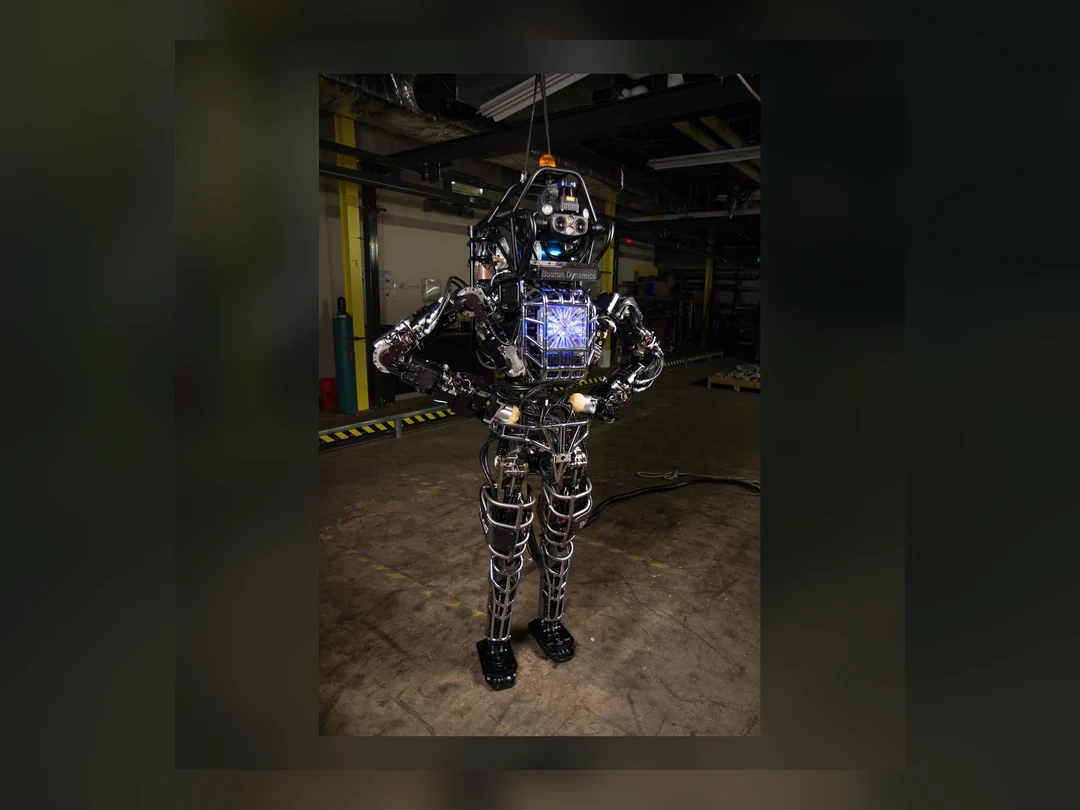

Use an evidence ladder to read future announcements
The strongest evidence will identify an operating process and measurement window, then report intervention, quality, uptime and safety outcomes. A commitment or installed pilot is meaningful, but it does not by itself establish sustained production performance.
Boston Dynamics has also said 2026 deployments are committed to Hyundai and Google DeepMind. That indicates the commercialization path is active, yet it should not be rewritten as proof that the 2028 HMGMA phase has already been completed.
| Evidence level | Example | Safe conclusion |
|---|---|---|
| Roadmap | Hyundai names a year and intended process | The organization has stated a plan |
| Pilot | Robots are tested at a named station | Site-specific validation is under way |
| Accepted operation | A production process passes defined criteria | That process is operating under stated conditions |
| Scaled operation | Fleet, shifts and measured results are disclosed | Scale can be discussed within the disclosed scope |
People remain supervisors and decision owners
Hyundai's strategy says workers will train and supervise robots while people retain control. That framing is important for task design: escalation, safe access, restart authority and responsibility for abnormal conditions need explicit owners.
A learning policy cannot replace independent protective measures or site risk assessment. The physical AI safety-layer guide explains why policy behavior, motion control, protective functions and operating procedures require different evidence.
What to verify when 2028 arrives
Check the exact HMGMA process, number and version of robots, operating shifts, human intervention definition, quality criteria and duration of the reported trial. Ask whether results cover normal production variation and recovery from faults, not only nominal cycles.
Also separate Hyundai's corporate roadmap from Boston Dynamics product updates. The relationship is close, but a product capability announcement and a factory acceptance result answer different questions.
Frequently asked questions
Is Atlas already working at HMGMA at production scale?
The cited Hyundai roadmap says introduction is planned to begin in 2028. As of August 7, 2026, it is not evidence of a completed, scaled HMGMA operation.
What is the first Atlas task named by Hyundai?
Hyundai gives parts sequencing as an example of an initial process where safety and quality benefits would first be validated.
Will Atlas assemble cars in 2028?
The published roadmap separates the phases: selected processes such as sequencing begin from 2028, while expansion into component assembly is targeted by 2030.
Official sources checked
- Hyundai Motor Group CES 2026 AI robotics strategy
- Hyundai Motor Group story on the HMGMA Atlas roadmap
- Boston Dynamics Atlas product page
- Boston Dynamics new Atlas commercialization announcement
Last checked: August 7, 2026