An autonomous cargo aircraft is not simply an oversized delivery drone. A converted general-aviation freighter moves cargo between airports through the national airspace, maintenance and certification system. A small delivery drone usually carries a light package at low altitude close to the destination. Both may use automation and remote supervision, but their missions, surveillance equipment, approval paths and cost structures are different.
Airport-to-airport freight and doorstep delivery solve different logistics gaps
A regional cargo aircraft fits the lane between a small-city airport and a hub, carrying medical supplies or industrial parts. It can use runways, air traffic control, fuel and maintenance infrastructure and the payload and range of an existing aircraft. Trucks still move cargo into the origin airport and out of the destination airport.
A delivery drone covers a shorter segment from a store or local depot to a landing or lowering point near the customer. Avoiding an airport brings it closer to pedestrians, buildings, power lines and tight landing areas. Small packages, frequent launches, battery turnover and low-altitude traffic information dominate operations.
| Dimension | Autonomous regional freighter | Small delivery drone |
|---|---|---|
| Typical mission | Medium- or long-range regional freight between airports | Short delivery from a local node to the customer area |
| Aircraft and infrastructure | Potential conversion of general-aviation aircraft; runway and maintenance use | Purpose-built UAS; pads, vertiports or field landing |
| Surrounding traffic | Integration with crewed aircraft in controlled airspace | Low-altitude UAS density and risk to people on the ground |
| Unfinished segment | Pickup before and final delivery after the airport | Building access, precise handoff and recovery |
Fix the door-to-door job before comparing technology. Moving a 200kg shipment to a mountain airport and delivering a 2kg medicine package to a front door do not support the same aircraft benchmark.
Reliable Robotics illustrates the conversion path for an existing aircraft
The official U.S. Department of Transportation Reliable Robotics demonstration announcement says Reliable Robotics and the City of Albuquerque were selected for the FAA's eIPP. At the time, regional cargo test operations using autonomous safety technology and a proprietary radar on existing general-aviation aircraft were planned to begin in August 2026. That is a test-program plan, not approval for commercial operations on every route.
Conversion may reuse an existing airframe, airport and maintenance ecosystem. Adding automation still changes configuration, weight, power demand and failure modes, however, so the modified system needs its own safety evidence. Certification of the base aircraft does not approve the new autonomous functions.
Do not treat autonomous and pilotless as synonyms. DOT material also describes remotely-piloted regional air cargo operations. Even without a pilot onboard, remote operators, controllers, maintainers and ground-cargo staff may remain.
A conversion changes more than the controls. Computers, radar, antennas and power equipment can affect weight and center of gravity and must be shown fail-safe alongside cargo loading. The operator also needs a defined use of the conventional cockpit for testing or ferrying after remote equipment faults, and an accountable process for restoring airworthiness after software updates. Reuse of an existing aircraft is valuable only when modification certification and maintenance responsibility are clear.
Radar and Remote ID address different surveillance questions
A regional freighter must detect and remain separated from other aircraft in the existing traffic system. Airborne or ground radar may combine with transponders, air traffic information, flight plans and communications. Reliable's focus on proprietary radar relates to detect-and-avoid and airspace integration; detecting a target, planning a safe avoidance path and coordinating with control are separate capabilities.
Remote ID lets an operating UAS broadcast identifying information to help authorities and relevant parties identify it. It is not a radar that directly detects and avoids every collision. At low altitude, UTM concepts also share position, intended flight and airspace or ground constraints among services.
Evaluate surveillance under loss, not only normal communications. Ask what remains when GPS degrades or the data link drops, whether the aircraft holds, diverts or lands, and when a remote operator takes authority.
Detect-and-avoid performance cannot be reduced to one range. Test small general-aviation aircraft, helicopters, non-transponder targets, ground clutter and bad weather. Measure whether another information source covers a missed target, whether false alarms overload routes and controllers, and the full delay from detection to achieving safe separation.

Remote operators remain accountable outside the cockpit
Automatic takeoff, en-route flight and landing do not remove the human role. A remote operator must handle abnormal weather, aircraft alerts, controller instructions and destination closure. Supervising several aircraft requires a priority and takeover procedure when more than one raises an alert at once.
Delay and link loss are core failure cases. Freezing all control when video slows can be unsafe, while continuing the old route while waiting for reconnection can enter a hazard. The concept of operations must divide authority among onboard safety automation, the ground station and air traffic control.
Regional cargo combines airport maintenance and flight operations; small drones may rely on a field organization that turns many batteries and aircraft rapidly. Do not judge autonomy only by an aircraft-per-operator ratio. Measure alert response and the quality of intervention.
The remote center also needs human-factors tests for shift length, alert rate and fatigue at night. Long periods of normal automation can make a sudden handoff harder. Operators must be able to reconstruct aircraft state and the rationale for recent decisions quickly.
National airspace and UTM distribute traffic information differently
Regional freighters operate inside air traffic control, established flight rules and airport procedures. Voice control does not scale naturally to large numbers of small low-altitude drones, so UTM research has explored digital sharing of flight intent, constraints and hazards.
The official FAA UTM Pilot Program page describes early functions including exchange of flight intent between operators, notices of airborne and ground activity and shared airspace-reservation data. Trials in 2019 and 2020 also examined Remote ID and denser operations. This establishes a research path, not proof that an identical commercial UTM service is available everywhere today.
Airspace integration is not solved by model accuracy alone. An operator still needs one plan for airspace authorization, weather minimums, diversion, emergency landing sites, telecom outages, noise and local privacy.
Selection for a test program is not commercial certification
The official FAA eIPP selection announcement says that on March 9, 2026 the agency selected 8 projects across 26 states. Reliable Robotics is named as a partner in the Albuquerque project, and the FAA said data from the demonstrations would inform rules for next-generation aircraft.
Participation is an important way to build data with the regulator, but it does not mean type certification, aircraft airworthiness, operator approval and route or airspace authorization are all complete. Separate the date of an announced plan from first flight, repeated operations and paid commercial service.
Small drones likewise need more than aircraft registration or one remote-pilot credential. BVLOS, operations over people, airspace, package delivery and local rules may require additional approval. A business case should use the documents for the operating country and aircraft category.
Track announcement, test authorization, first actual flight, repeated testing and paid service as distinct states. Preserve changed dates and the evidence behind them. Do not extrapolate a restricted site, weather window, payload or operator count to a national network. Verify supplier statements about certification against regulator records or written conditions and leave unresolved approvals as contractual prerequisites.
Door-to-door cost matters more than airborne time
Regional cargo economics include pickup, airport handling, fuel, maintenance, remote operations, delay or diversion and the truck after arrival. Labor does not fall to 0 because the pilot leaves the aircraft; remote control, dispatch, compliance and maintenance remain.
A delivery drone can fly a short leg quickly but is sensitive to depot density, battery rotation, landing failure, recovery and customer handoff. Urgent light cargo may justify a high unit price, while heavy nonurgent cargo may remain better suited to ground transport.
Weather cancellation needs a priced fallback. Include transfer to a truck or crewed flight when icing or visibility grounds a regional aircraft, and customer reassignment when wind stops a drone. Accumulate route availability, diversion and replacement transport across at least one season rather than pricing from fair-weather flight time.
The modes can connect: a regional aircraft covers the airport leg and a drone or ground robot handles the last segment. Transfer time, custody, temperature control and tracking-number continuity then become new costs. A slow handoff can erase the advantage of fast flight.
Make the adoption decision in mission, safety and approval order
First fix cargo weight and volume, origin, destination, distance and required arrival time. Map airport access, the need for field landing and the fallback mode. Only then compare aircraft and autonomy.
| Decision area | Autonomous regional freighter | Delivery drone |
|---|---|---|
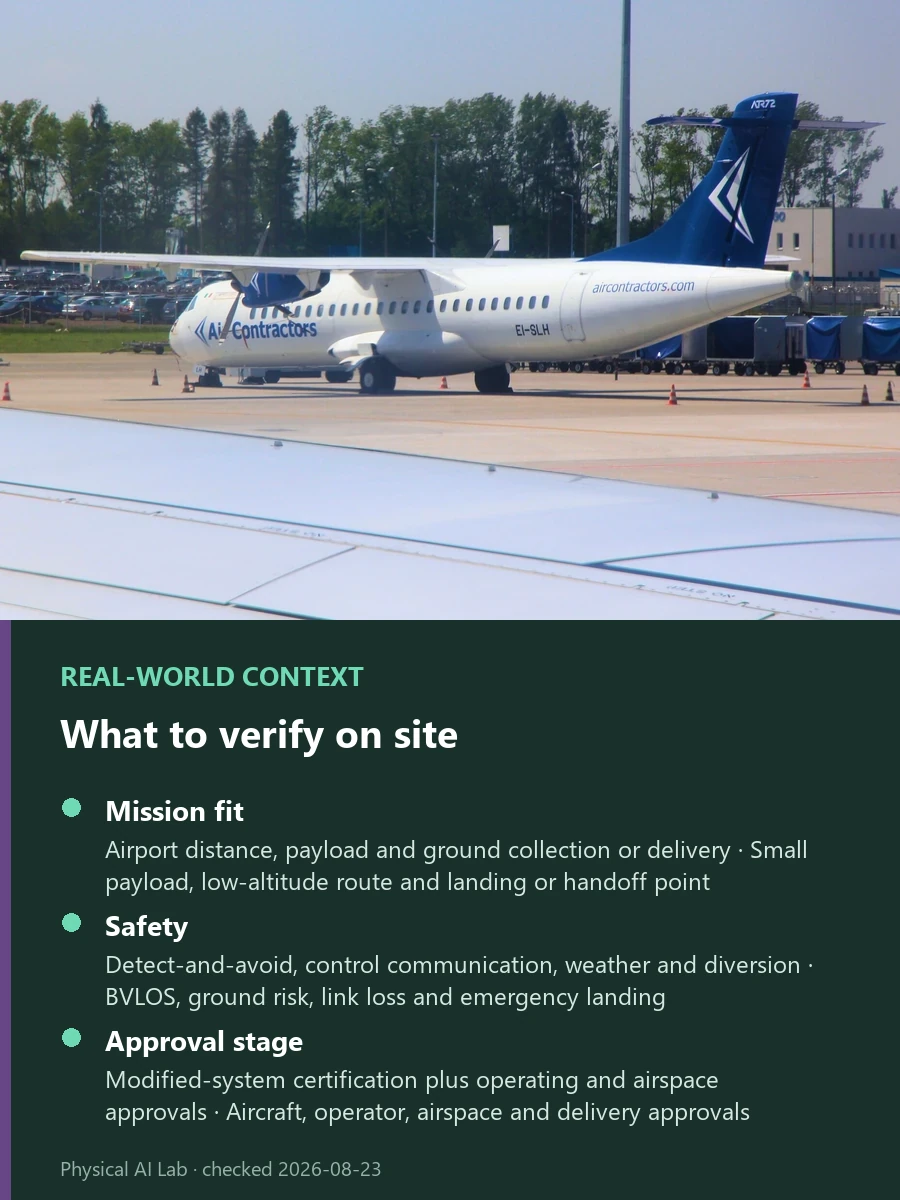
| Mission fit | Airport distance, payload and ground collection or delivery | Small payload, low-altitude route and landing or handoff point |
| Safety | Detect-and-avoid, control communication, weather and diversion | BVLOS, ground risk, link loss and emergency landing |
| Approval stage | Modified-system certification plus operating and airspace approvals | Aircraft, operator, airspace and delivery approvals |
| Total cost | Airport, maintenance, remote center and final delivery | Depot, battery, remote intervention and recovery |
Physical AI drone architecture, outdoor physical AI testing and edge AI for robots provide deeper context on onboard architecture, weather testing and local operation during link loss.
A pilot passes through repeated evidence, not one demonstration. Measure scheduled-flight completion, weather cancellations, human intervention, link failures, emergency procedures, maintenance time and door-to-door cost over the same period. Regulatory-program selection is an opportunity to test, not a commercial verdict.
Frequently asked questions
Is an autonomous cargo aircraft legally a drone?
The unmanned-aircraft categories can overlap broadly, but logistics and certification analysis should separate a converted regional freighter from a small delivery drone by aircraft, airspace and mission.
Does removing the onboard pilot make cargo flight fully unmanned?
No. Remote operators, controllers, dispatchers, maintainers and ground-cargo staff may remain. The operating concept must define their authority and responsibility during link loss.
Which is cheaper: a regional cargo aircraft or a delivery drone?
It depends on payload, route, airport access, weather, maintenance and final handoff. Compare total door-to-door cost and successful service completion, not the price of the flight segment alone.
Official sources checked
- Official U.S. DOT Reliable Robotics demonstration announcement
- Official FAA eIPP selection announcement
- Official FAA UTM Pilot Program page
Last checked: August 23, 2026