A receiving bin can fit the object and admit the closed fingers, yet leave too little room to open the gripper. In this Blender study, a bin with a 120 mm inner width accepted the sampled descent of a gripper around a 60 mm cube. Finger-to-wall contact candidates appeared at a 64 mm aperture, followed by the first detected penetration sample at 64.5 mm—before the intended 74 mm opening.
Codex ran this virtual geometry comparison in Blender 5.2.2 LTS on October 5, 2026. Four bin widths were tested against a prescribed descent, opening, and withdrawal sequence. The cube followed an assumed rigid held pose during descent and remained at an assigned position on the bin floor afterward. No physical release, falling, slipping, or grasp retention was simulated.
The earlier workcell layout study examined camera sightlines and an approach envelope. This comparison follows the gripper into the receiving bin.
The opening fingers need more room than the cube
The cube was 60 mm wide, but the fingers’ outer span was 116 mm at the closed aperture and 130 mm at the intended open aperture. Those are different dimensions from the aperture itself, which measures the distance between the inner pad planes. A bin selected only around the cube’s width leaves out the space occupied by the fingers and their outward movement.
The experiment setup kept placement centered with zero cube yaw. The bin’s inner Y dimension remained 130 mm, its floor top was 8 mm above the worktable, and its wall top was at Z = 54 mm. Only the inner X width changed, with the floor, end walls, and side-wall positions adjusted consistently for each width.
Each condition prescribed the same sequence: descend from 100 mm above the placement position with a 60 mm aperture, open to 74 mm at that position, then withdraw vertically by 100 mm while open. A detected penetration stopped further phases for that condition. The downloadable bin-width study files (ZIP) include the starting scene export, unchanged script, and the four conditions’ measurements. The records show where each sequence reached its limit:
| Bin inner X width | What happened in the sampled sequence |
|---|---|
| 100 mm | Both fingers penetrated the side walls at the first failed descent sample, 28 mm above placement. Opening and withdrawal were not reached. |
| 120 mm | Descent completed without detected penetration. Finger-wall contact candidates appeared at a 64 mm aperture; penetration was detected at 64.5 mm. Withdrawal was not reached. |
| 130 mm | No penetration was detected, but unintended contact candidates remained at full opening and during early withdrawal. |
| 150 mm | No penetration or unintended contact candidates were detected in the sampled descent, opening, or withdrawal. |
The 130 mm result is a boundary condition, not a positive allowance. At the full 74 mm aperture, the fingers’ 130 mm outer span nominally matches the bin’s inner width. Its raw record contains 15 sample records with unintended contact candidates, representing 14 unique configurations. The full-opening record and the withdrawal record at 0 mm describe the same pose; further contact candidates persist at withdrawal heights of 2, 4, and subsequent 2 mm steps through 26 mm.
Here, “unintended” distinguishes finger-wall encounters from the permitted cube-floor contact at placement. A contact candidate is a numerical geometric classification; it does not establish a physical contact force.
The renders show where opening stopped
The 120 mm image shows the first detected opening-penetration sample at a 64.5 mm aperture. The gripper has reached the placement height, but it has not reached the intended 74 mm opening. The small finger-wall overlap is partly obscured by the bin walls, so the raw pair results establish the penetration; the render shows the configuration in which it occurred.
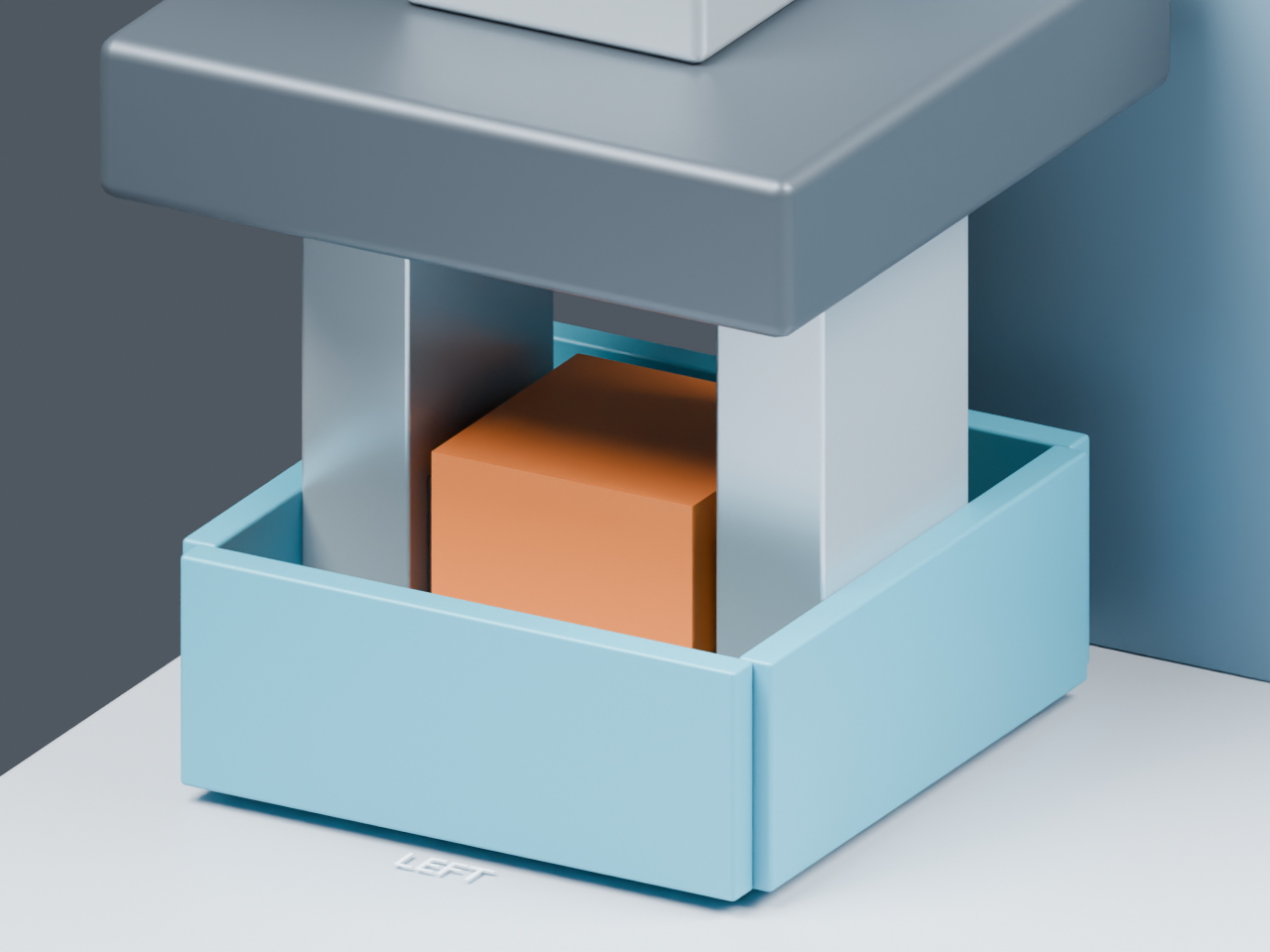
The 150 mm image shows the gripper at the same placement height with its aperture fully opened to 74 mm. This is the pose used to illustrate release clearance, not the end of the withdrawal. The 150 mm record separately includes the sampled withdrawal up to 100 mm.
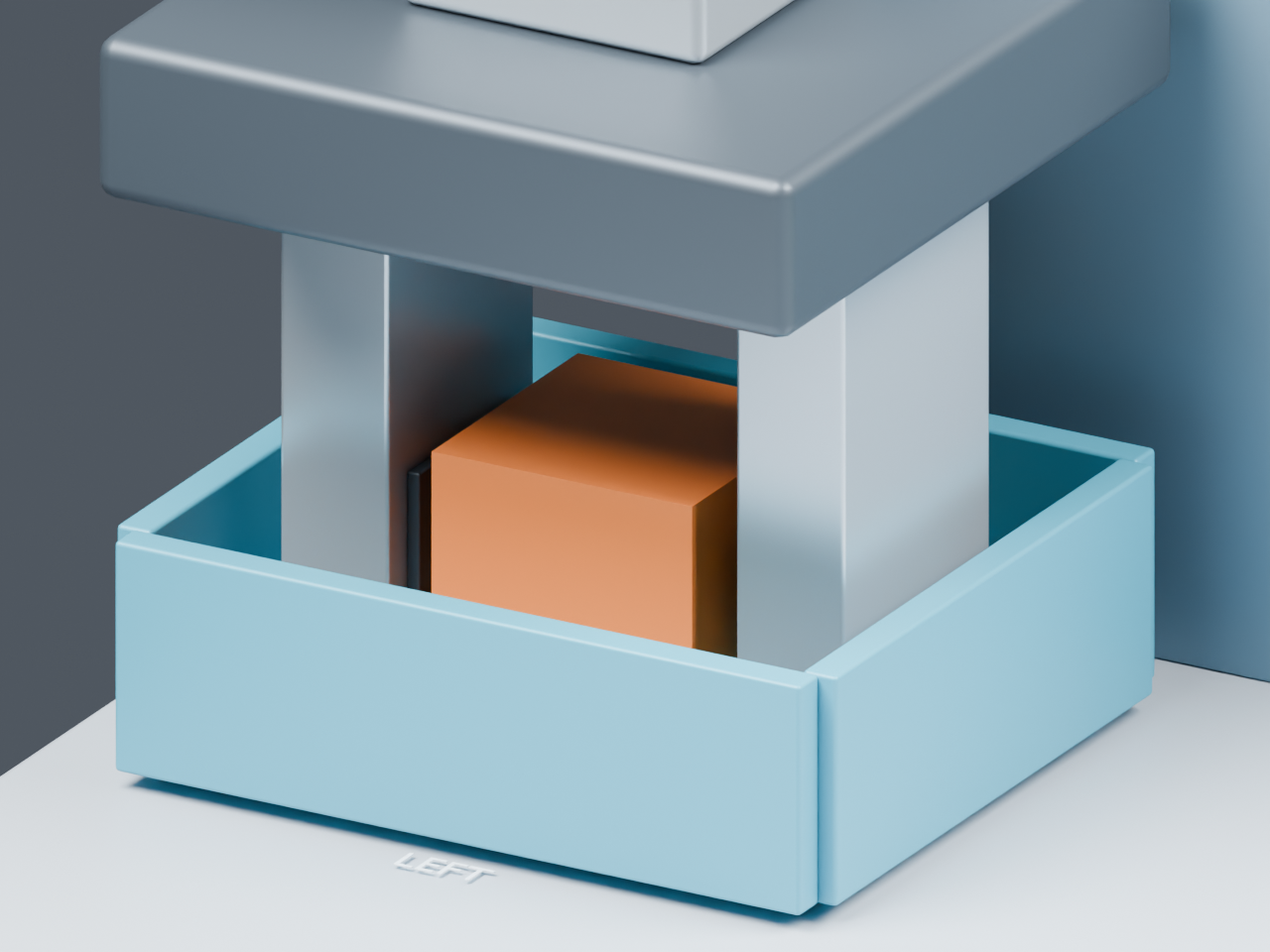
The camera and pose verification records the same diagnostic camera for these images. They compare different reached opening states—64.5 mm and 74 mm—not the same aperture in two bins. Neither image demonstrates a physical release or shows the complete robot.
The 160 mm palm stayed above the 54 mm rim
The palm was wider than even the 150 mm bin, but it did not need to pass between the side walls. At the placement pose, its lower face was at Z = 130.5 mm, above the wall top at Z = 54 mm. The fingers extended into the bin. Using the maximum width of the entire gripper as a single pass/fail dimension would discard that height difference.
For the fingers at full opening, the nominal side gap in the widest tested bin is simply (150 − 130) / 2 = 10 mm. That number describes centered finger-to-side-wall spacing at the specified aperture. It is not the minimum clearance to every object in the scene, a manufacturing tolerance, or a recommended safety distance. The 150 mm condition supplies a candidate geometry for further checks; it does not establish the narrowest usable bin.
In a new layout, compare the finger span throughout opening with the wall spacing at the heights those fingers occupy. Then follow the open fingers until they clear the rim. This includes the movement that object-fit and closed-entry checks miss. A different placement depth, finger shape, rim height, or withdrawal direction would need its own comparison.
The geometry-checking code evaluated individual beveled component meshes at 2 mm descent and withdrawal intervals and 0.5 mm opening intervals. It screened projection separation and used Blender’s Boolean intersection operation to confirm positive-volume overlap. Consequently, 64.5 mm is the first failed opening sample, not an exact collision onset, and untested intervals are not proven clear.
The numerical classifier used a 0.001 mm contact tolerance; penetration required a projection margin below −0.001 mm and computed intersection volume above 0.000001 mm³. These thresholds describe the calculation, not practical part tolerances. The test also assumed the cube’s position relative to the gripper during descent rather than validating the internal grasp. Arm reach, contact mechanics, and reliable release remain separate questions.
The useful bin-selection result is the missing phase in the 120 mm case: entry succeeded in the samples, but opening did not. Size the modeled receiving space around the opening and exit movement as well as the object, then verify the changed geometry before treating the bin as a workable release location.