An object can still exist at the expected coordinates and sit directly in front of a Blender camera, yet lie entirely before its near clipping plane. Moving the mesh is then the wrong first diagnosis: check whether its finite geometry falls within the camera’s Clip Start and Clip End interval.
An AI-operated Blender 5.2.2 LTS study on October 5, 2026 kept the same finite mesh across eight clipping intervals. Evaluated vertices and camera transforms were independently audited, and all eight actual camera renders were inspected. The example is synthetic render geometry, not a physical camera or perception test.
The Blender camera manual defines this interval in terms of direct visibility. It also makes a useful distinction: objects outside it can still influence an image indirectly through later light bounces. Camera clipping therefore does not mean that Blender deletes the mesh or removes every possible lighting consequence of it. The camera API exposes the distances as clip_start and clip_end.
The object is fixed; the near plane moves past it
Consider one box measuring 80 × 80 × 240 mm. Its center is 560 mm forward of the camera and 150 mm to the camera’s right. Turn the box 30° about the view’s vertical axis. In this constructed layout, all eight corners remain inside the left, right, top and bottom view boundaries. The test changes only the near and far clipping distances.
The closest part of this tilted box is 436.1 mm forward of the camera; the farthest is 683.9 mm forward. These are signed distances along the camera’s viewing axis, not distances to the object’s origin and not world Z coordinates. Translating or rotating the camera in the world does not make world Z a substitute for camera depth.
With Clip Start at 100 mm and Clip End at 1,000 mm, the whole box is inside the depth interval. Set Clip Start to 500 mm and the near plane crosses the box. Its origin still lies inside the interval at 560 mm, so an origin-only check would miss the partial clipping. Move Clip Start to 750 mm and the entire box lies before it. The same mesh has no positive-volume overlap with that camera-depth interval.
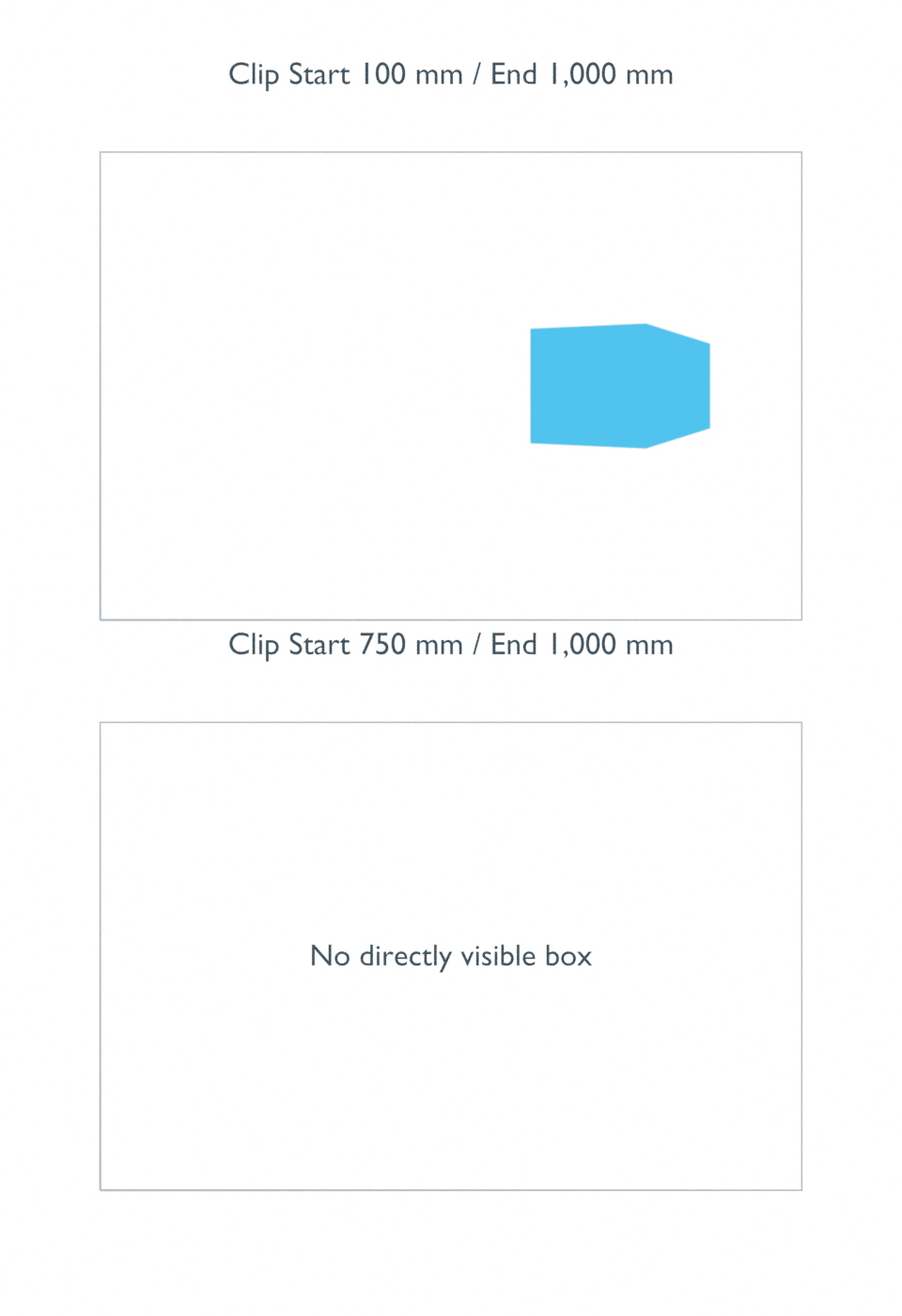
That last state is the useful diagnostic for a nearby object that disappears: compare the near plane with the object’s farthest camera-depth point. Do not merely check that the object is in front of the camera. This conclusion is about the isolated box’s depth geometry; a real missing render can also involve framing, occlusion or render visibility settings.
No corners inside does not mean no box inside
A narrower interval reveals another trap. Set Clip Start to 500 mm and Clip End to 600 mm. None of the eight original vertices is within those bounds, but the middle of the convex box crosses the interval. A routine that retains an object only when an original vertex passes both depth tests would reject geometry that should be examined further.

For this single convex box, its continuous depth range makes that overlap test valid. The same min/max test is not a general occupancy proof for disconnected objects or arbitrary concave geometry. In the detailed study, each original box face is separately clipped against both planes. Those calculations retain portions of original faces; they do not create a cap over the cut or measure image coverage.
You can reproduce the depth distinction with Python’s standard library:
from math import sin, cos, radians

# Synthetic box: 80 x 80 x 240 mm, center depth 560 mm, view-Y turn 30 degrees.
angle = radians(30)
depths = [560 - sin(angle)*x + cos(angle)*z
          for x in (-40, 40) for z in (-120, 120)]
lo, hi = min(depths), max(depths)
print(f"Box camera-depth interval: {lo:.3f}..{hi:.3f} mm")
for near, far in ((100, 1000), (500, 1000), (750, 1000), (500, 600)):
    inside_vertices = 2 * sum(near <= z <= far for z in depths)  # two Y values
    positive_overlap = min(hi, far) > max(lo, near)
    full_inside = near <= lo and hi <= far
    state = "inside" if full_inside else "partial" if positive_overlap else "outside/touch"
    print(f"clip {near}..{far} mm: {state}, {inside_vertices}/8 vertices inside")
assert not any(500 <= z <= 600 for z in depths)
assert min(hi, 600) > max(lo, 500)  # convex box still intersects the slab
The four classifications are inside, partial, outside/touch and partial, with 8, 4, 0 and 0 vertices inside respectively. This short calculation uses the specified box and view-axis rotation. It is not a general Blender mesh visibility detector. If a clip plane only touches the box at its extreme depth, that equality is recorded separately in the fuller calculation: it provides no positive-volume overlap, and should not be described as a useful margin.
Separate a clip result from other causes
The actual native comparison used the same finite mesh and camera pose with a 35 mm lens, a 36 mm horizontal sensor and a 960 × 640 source frame. Coordinates were authored in meters and are reported here in millimeters. The camera was also translated and rotated in the world so that an incorrect world-Z calculation could not accidentally reproduce the intended result. The reader code retains extra numerical digits for reproduction; the prose rounds the depth bounds to 0.1 mm. Neither precision is a hardware accuracy claim.
The controlled scene used an emissive box against transparent film, with no other receiver or reflector, and Cycles at 16 samples without denoising. The independent audit reconstructed camera-axis distances from world coordinates and clipped each original face against the two planes. The full-before-near and full-beyond-far output frames had zero positive-alpha pixels; the 500–600 mm case retained directly visible surfaces. Original frame files and scene geometry were preserved. Image appearance was checked separately from convex-box overlap and original surface area.
Partial clipping need not produce an obvious silhouette change. A far plane can remove back geometry that was already hidden behind the front faces. A retained-surface-area percentage is consequently not a visible-pixel percentage. Compare the fully enclosing and wholly excluded intervals first, with settings stated beside the frames. Then inspect a partial interval. A clip plane touching only an extreme point is a boundary case, not a positive-volume margin; raster appearance alone cannot establish that distinction.
This is a render-camera clipping diagnosis, separate from placing two cameras so both see a target around a fixture. It makes no claim about hardware perception, physical depth accuracy or real sensor visibility.