Domain randomization trains or tests a robot across many simulated variations so the real environment is less likely to be a surprising special case. Instead of building one visually perfect simulation, the method samples uncertain appearance, sensor, dynamics and control parameters from defined distributions. The policy must succeed across the resulting family of environments.
Randomization is not a license to vary everything arbitrarily. Ranges that are too narrow omit real conditions; ranges that are too wide can make optimization unnecessarily difficult and create physically impossible combinations. Useful distributions come from calibration, component tolerances, environment measurements and the failure modes observed on hardware.
The method addresses parts of the sim-to-real failure problem, but it does not guarantee transfer. Held-out simulation and real-robot tests remain necessary. A policy can exploit simulator artifacts or fail on a real variable that was not modeled at all.
Randomization turns uncertainty into a training distribution
A nominal simulator uses one value for mass, friction, lighting or sensor noise. The early domain randomization study framed transfer around varied simulated appearances; modern robot systems also randomize physics, sensors and control. The design question becomes which distribution approximates relevant real uncertainty.
Keep the nominal calibrated model. It provides a reference for debugging and helps determine whether randomization improves transfer or merely lowers all performance. Version randomization settings with seeds, software and asset identifiers so experiments can be reproduced.
Visual randomization targets perception gaps
Textures, colors, lighting direction, intensity, camera pose, background, distractors and object placement can change image statistics. Blur, exposure, compression and occlusion can approximate parts of the camera pipeline. These variables help when the policy or perception model depends on pixels.
Visual diversity should preserve task semantics. Random colors may be inappropriate if color identifies the target. Unrealistic lighting may hide the object completely. Use real image measurements and a held-out visual set to verify that the model learns geometry and task cues rather than a new simulation shortcut.
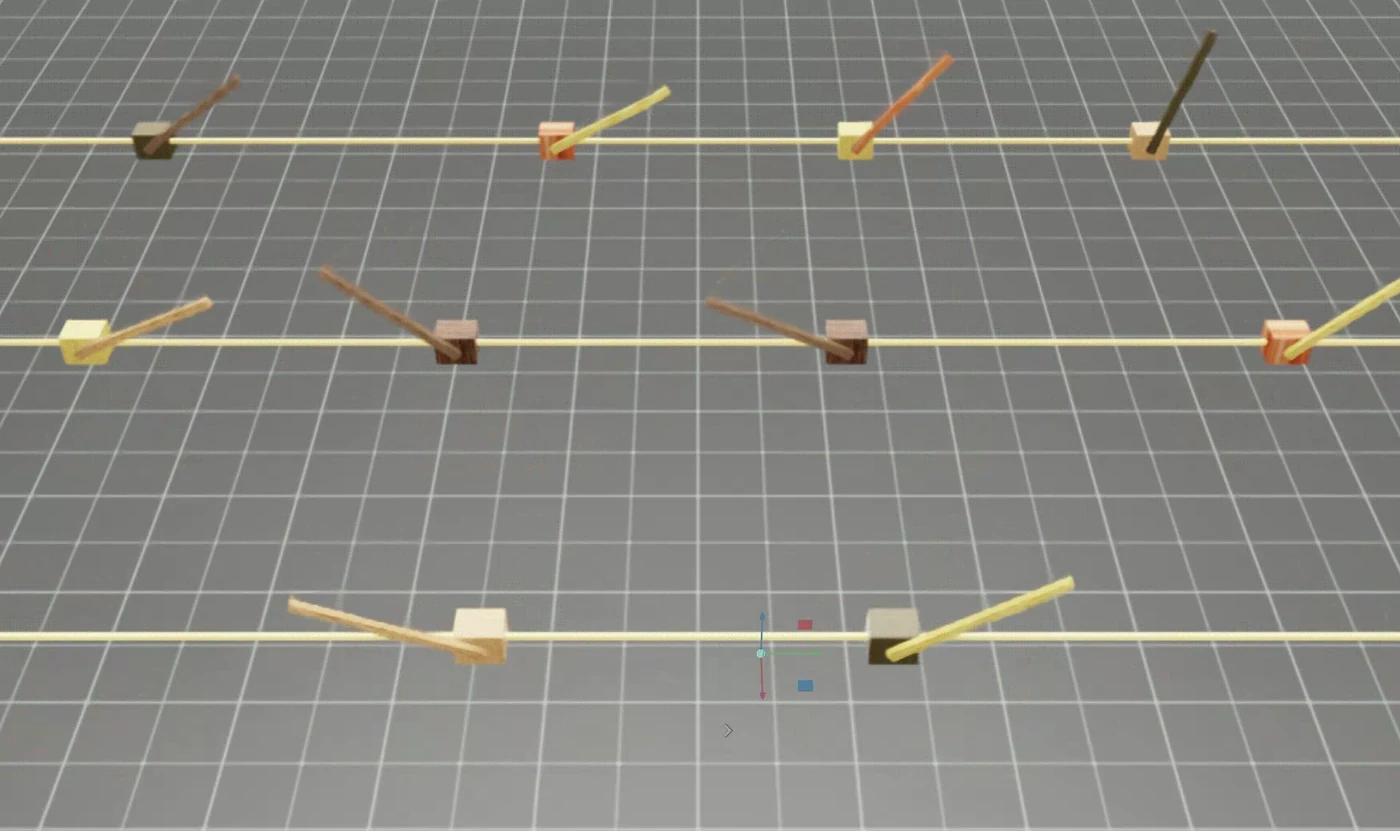
Physics randomization targets dynamics and contact
Mass, center of mass, inertia, friction, restitution, compliance, actuator strength and damping affect motion and contact. Small errors can change a grasp, impact or legged gait. Randomization can make policies less dependent on one estimated parameter, especially when exact identification is difficult.
The ranges need physical constraints. Inertia must remain consistent with mass and geometry; friction can vary by material pair; payload changes several linked properties. Sampling every variable independently can generate impossible robots and contacts that slow learning without representing deployment.
Sensor and control randomization cover the timing loop
Sensor noise, bias, dropout, quantization, frame delay and calibration error alter observations. Control rate, action delay, motor response, saturation and safety filtering alter execution. These gaps can matter even when rendered images and rigid-body dynamics look realistic.
Model the location of the uncertainty. Camera delay and controller delay have different effects. A constant calibration bias differs from sample-to-sample noise. Apply the variable at the same stage and timescale where it occurs on the real robot, then log the sampled values with each episode.
| Domain | Example variables | Measurement source | Failure addressed |
|---|---|---|---|
| Visual | Light, texture, camera and clutter | Real image statistics | Perception shift |
| Physics | Mass, friction, damping and compliance | Identification and tolerances | Dynamics mismatch |
| Sensor | Noise, bias, dropout and timestamp | Hardware logs | Observation error |
| Control | Delay, rate, limits and actuator response | Controller traces | Execution mismatch |
Hardware failures should select the next variables
Start with a transfer test and classify failures. If a grasp misses because the camera transform drifts, add calibration uncertainty. If a policy overshoots under payload, identify mass and actuator response. Randomizing unrelated textures would not fix either cause.
Use sensitivity analysis to rank variables. Vary one factor around the calibrated model, then test interactions for the influential set. This reduces a large search space and creates an evidence trail linking each randomization choice to a measured risk.
Wider ranges are not always more robust
Extremely wide variation can force a conservative policy, prevent learning or produce behavior optimized for unlikely cases. It can also reduce nominal task quality. Robustness should mean acceptable performance across the deployment distribution and defined disturbances, not survival in every arbitrary simulator state.
Compare performance as ranges expand and track the cost on nominal and held-out conditions. Curriculum methods can begin near the calibrated model and gradually broaden. Adaptive approaches can emphasize parameters where the policy remains weak, but the final distribution still needs engineering justification.
Correlations prevent impossible simulated worlds
Real variables often move together. A heavier payload changes inertia and may change friction or actuator demand. Outdoor light changes exposure and image noise. Battery state can affect available power and temperature. Independent sampling ignores these relationships.
Represent conditional or joint distributions when correlation matters. Use product families, measured scenarios or latent environment profiles instead of a flat Cartesian product. Then hold out plausible correlated cases to test whether the policy generalizes beyond the training samples.
Sampling frequency changes the problem
Some parameters should remain fixed for an episode: robot mass, camera mounting bias and object material. Others change per reset, such as placement and lighting. Fast noise and latency jitter may change at every step. Sampling at the wrong frequency teaches a world unlike the target.
Document whether each variable is sampled per environment, episode, object or control step. This detail can change policy behavior even when the numeric range is identical. Reproducible seeds should restore both values and event timing.
The workflow closes with held-out and hardware tests
Measure the gap, define plausible ranges, randomize with structure, hold out simulation cases and validate on hardware. Current Isaac Lab reproducibility guidance is a useful reminder to preserve configuration and seeds. Keep a final evaluation set and report how often real feedback changed the distributions.
The card separates randomization from validation. Compare it with the broader sim-to-real transfer guide: system identification, representation learning, fine-tuning and real data may complement or replace randomization depending on the measured gap.
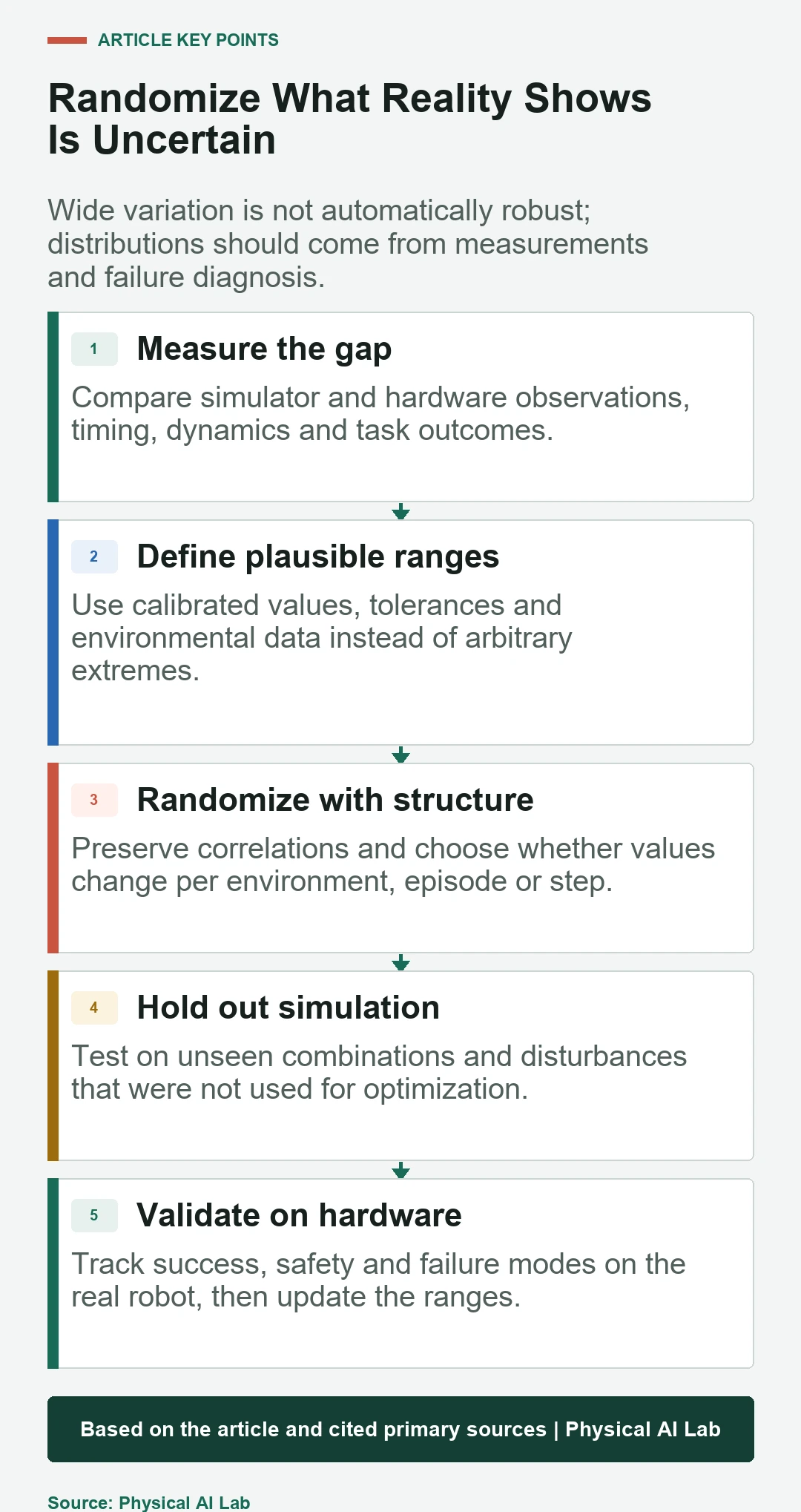
A configuration review should expose five decisions
For every randomized variable, record the physical meaning, unit, distribution, bounds, correlation, sampling frequency and evidence source. Identify which variables affect observations, dynamics or actions. Store the exact configuration and random seed with the model checkpoint.
Report nominal, randomized hold-out and real-robot performance with the same task definition. Include failures and safety filters. The result should show which uncertainty coverage improved transfer, not merely that colorful simulation scenes were generated.
| Configuration field | Question | Warning sign |
|---|---|---|
| Range | What measurement supports the bounds? | Arbitrary extreme values |
| Distribution | Are common conditions sampled often? | Uniform by default |
| Correlation | Which variables share a cause? | Impossible combinations |
| Frequency | When does reality change this value? | Every-step resampling of fixed traits |
| Validation | Which held-out and real tests are used? | Training success only |
- Keep a calibrated nominal model.
- Randomize measured uncertainty.
- Preserve physical correlations.
- Hold out simulation cases.
- Use real failures to update ranges.
Frequently asked questions
Is domain randomization required for every sim-to-real project?
No. It is useful when uncertain variables cause transfer failure, but system identification, adaptation, real-data fine-tuning or a better simulator may be more appropriate.
Does domain randomization remove the need for real data?
No. Real measurements define useful ranges and real-robot tests verify transfer. Some projects also use real data directly for training or adaptation.
Is domain randomization only for reinforcement learning?
No. It can generate varied data for supervised perception, imitation learning, policy training and robustness testing.
Does success in randomized simulation guarantee hardware success?
No. The simulator may omit an important variable or contain exploitable artifacts. Hardware validation and safety controls remain necessary.
How wide should a randomization range be?
Use measured variation, tolerances and diagnosed failures, then test sensitivity. Wider is not automatically better.
Simulation Method Note
Simulator APIs and randomization defaults change. Verify the current documentation, record exact distributions and seeds, and validate every safety-relevant policy on hardware within a controlled test plan.