A warehouse picking robot is part of a system that turns an order into a verified item at the next process. The robot may retrieve a tote, move a cart, identify an item, grasp it, place it into an order container or perform only one of those stages. Calling every stage picking hides the interface where delays and errors occur.
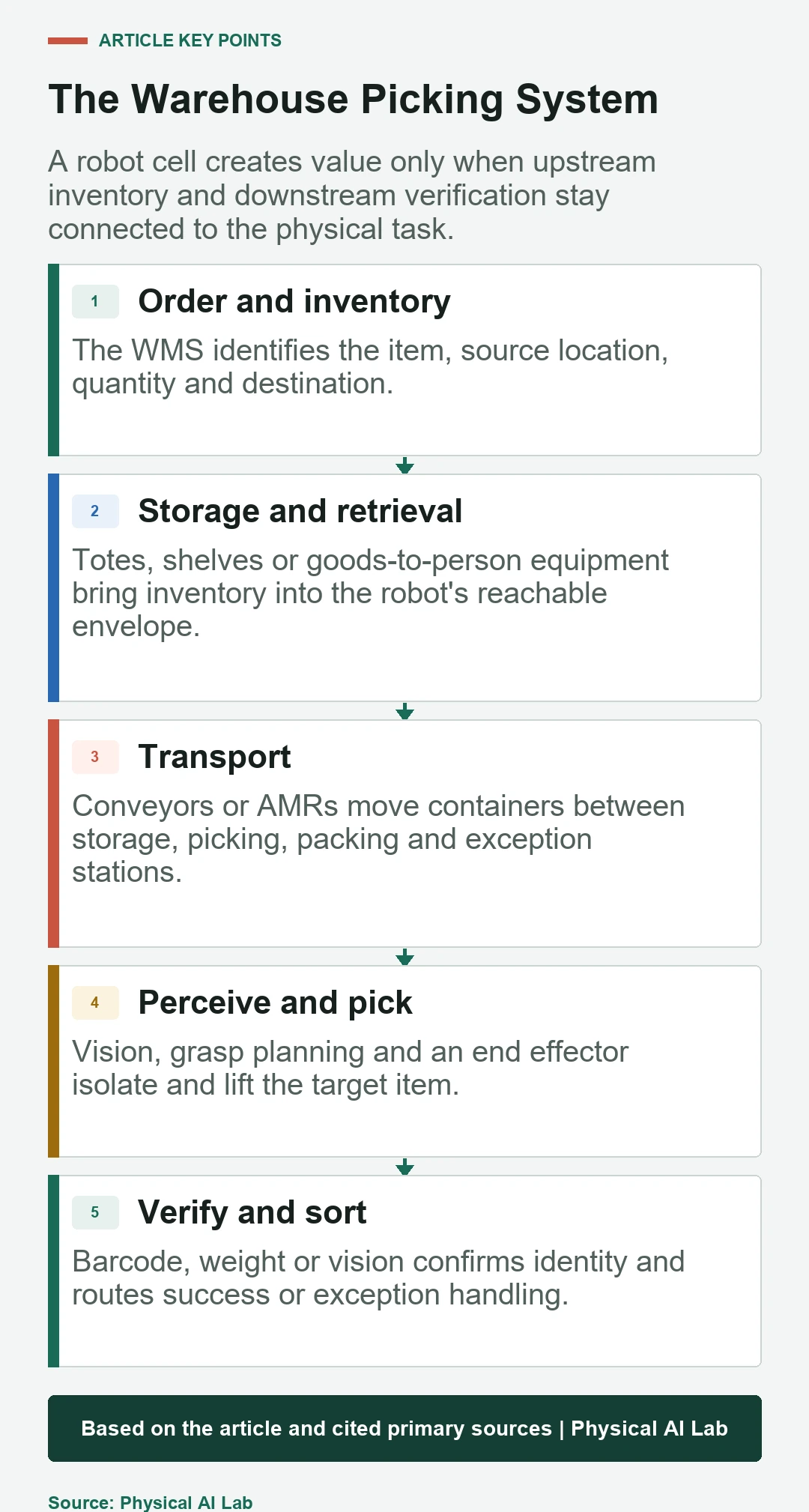
A useful design begins with the material flow. The warehouse management system identifies demand and inventory. Storage or retrieval equipment exposes the goods. Conveyors or autonomous mobile robots move containers. A manipulator selects an item, and a downstream check confirms identity and quantity. Exception handling returns uncertain cases to a safe path.
The right robot therefore depends on item distribution, order profile, site layout and upstream data quality. A fast arm cannot compensate for missing inventory, inaccessible totes or slow replenishment. Evaluate throughput, accuracy, intervention and uptime across the complete workflow rather than presenting one pick rate as the system result.
Picking includes more than grasping
Piece picking means selecting individual items, while case picking handles cartons and pallet picking handles larger loads. Goods-to-person systems bring inventory to a station; person-to-goods or mobile manipulation sends a worker or robot through aisles. The physical and software architectures differ even when the final action is called a pick.
Define the start and finish state. Does the test begin with a known item in front of the robot, or with an order in the WMS? Does it finish after the grasp, after barcode verification or after placement into a destination container? A clear boundary prevents subsystem performance from being mistaken for warehouse performance.
Warehouses are structured but not uniform
Warehouses offer mapped aisles, labeled locations and recurring container types, which makes automation more tractable than a home. Variation remains large: packaging changes, polybags deform, reflective products confuse sensors, bins become overfilled and seasonal demand shifts the mix. Dust, lighting and damaged cartons create additional long-tail cases.
The deployment envelope should name item dimensions, mass, surface, deformability, barcode placement and packing density. It should also cover tote geometry, presentation method and replenishment rules. A pilot that excludes the hardest items can still be valuable, but its coverage must be measured against the actual order volume.
The WMS and inventory state drive every action
The robot needs a task containing source, destination, item identity, quantity and priority. Interfaces must handle stale stock, short picks, substitutions and order cancellation. When the physical bin disagrees with the database, the system needs a reconciliation path rather than forcing the manipulator to guess.
Log task identifiers from order release through verification so a failure can be traced across software and equipment. Message latency, duplicate commands and lost acknowledgements can reduce throughput even when the robot motion is reliable. Integration testing is therefore part of the picking acceptance test.
Transport and manipulation can use different robots
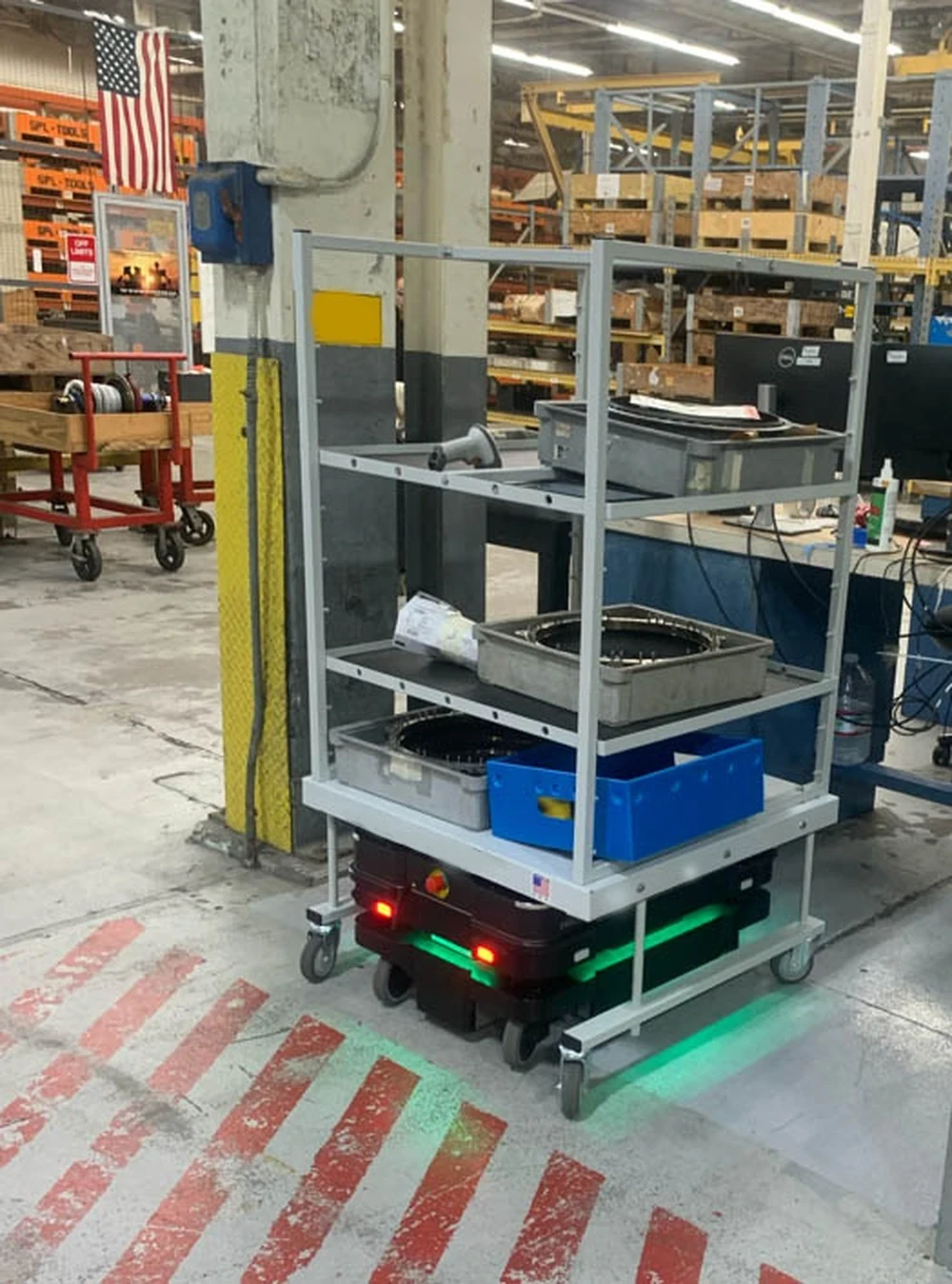
An AMR can move shelves, carts or totes while a fixed arm performs manipulation at a prepared station. This separates navigation from dexterous picking and can simplify safety and maintenance. Other designs place an arm on a mobile base to reach many locations, accepting greater planning and stability complexity.
A warehouse system does not need to be humanoid. The comparison with humanoid robot types should start from stairs, reach, tools and workflow flexibility. Specialized transport and picking machines may deliver higher reliability when aisles, containers and stations can be designed around them.
AI changes perception and exception coverage
Conventional automation can handle known geometry with rules and fixtures. Machine learning can expand object recognition, pose estimation and grasp scoring across a wider item set. It can also classify damage or choose among suction, pinch and alternative approach directions. These models still operate inside calibrated cameras, robot kinematics and safety limits.
Unstructured tote picking becomes a bin-picking AI problem when items overlap and move after each grasp. Model performance should be measured by object coverage and recovery, not only offline detection accuracy. The relevant output is a verified pick under the site’s time and damage constraints.
End effectors determine the practical item envelope
Vacuum cups are efficient for many boxes and bags but struggle with porous, perforated or heavily wrinkled surfaces. Parallel fingers can grasp edges and rigid parts but require collision clearance. Tool changers expand coverage while adding cycle time, cost and another failure interface.
Build an item-to-gripper matrix using representative inventory. Record contact success, seal quality, drops, double picks and packaging damage. A claimed payload does not describe small-item handling, and a high suction rate does not guarantee that the selected item can be separated from neighbors.
| Item condition | Likely method | Primary risk | Evidence |
|---|---|---|---|
| Rigid box | Vacuum or parallel grip | Label or surface variation | Pick and damage rate |
| Polybag | Adaptive vacuum | Wrinkle and double pick | Coverage by fill level |
| Small loose item | Finger or specialty tool | Occlusion and collision | Dense-bin success |
| Fragile package | Compliant controlled grip | Crush or drop | Damage severity per pick |
Verification closes the order loop
A successful grasp is not necessarily the correct item or quantity. Barcode, vision, weight and destination sensors can verify identity and detect double picks. When signals disagree, the system should route the item to an exception station and preserve the order state.
Measure false acceptance and false rejection separately. Accepting the wrong item creates customer and inventory errors; rejecting a correct item increases manual work. The best threshold depends on the cost of each error and the available recovery workflow.
The system map exposes bottlenecks
Map order release, storage access, transport, manipulation, verification and sortation as one queueing process. Throughput is limited by the slowest sustained stage, and variability can create starving or blocking even when average capacities appear balanced. Buffers can help but consume floor space and inventory visibility.
The card provides a shared vocabulary for vendors, integrators and operators. Assign an owner and measurement to each transition. If the arm waits for totes, the picking algorithm is not the first optimization target; if exceptions accumulate, coverage or verification may matter more than nominal speed.
Deployment metrics need denominators and exclusions
Report picks per hour with the item mix, success definition and operating time. Separate first-attempt success, eventual success after retry, manual intervention and damage. Uptime should state whether planned maintenance, blocked upstream equipment and operator delays are included.
Evaluate at peak and ordinary demand, not only a vendor demonstration set. Seasonal assortment, replenishment behavior and packaging changes can move the robot outside its training distribution. A coverage dashboard should show what fraction of actual order lines stays autonomous.
| Metric | Definition | Common distortion |
|---|---|---|
| Sustained throughput | Verified items per operating hour | Quoting burst motion speed |
| Autonomous coverage | Order lines completed without help | Excluding difficult inventory |
| Intervention rate | Human actions per items or hour | Counting only full takeovers |
| Order accuracy | Correct item and quantity at destination | Measuring grasp success alone |
| Damage rate | Damaged items per handled items | Omitting minor packaging damage |
A staged acceptance test reduces deployment risk
Start with an inventory audit and select representative item families. Validate perception and end effectors offline, then integrate one station with the WMS and verification path. Expand hours and variation only after the exception process is stable. Preserve a manual fallback during ramp-up.
Cost evaluation should include integration, floor changes, support, spare tools and labor saved or reassigned. A Robotics as a Service contract may shift ownership and maintenance, but it does not remove the need to define performance, exclusions and site responsibilities.
- Define the workflow boundary.
- Audit the real item distribution.
- Test the gripper matrix.
- Integrate verification and exceptions.
- Measure sustained end-to-end performance.
Frequently asked questions
Is every warehouse picking robot a humanoid?
No. Most systems use specialized arms, conveyors, AMRs or storage equipment. A humanoid is one possible architecture when human workspaces and tools create sufficient value.
Are picking and sortation the same?
No. Picking selects an item from storage or a container. Sortation routes a verified item or parcel to a destination, though one system may perform both.
Where is AI used in warehouse picking?
AI can support item segmentation, pose estimation, grasp scoring, damage detection, exception classification and task prioritization within a larger deterministic control system.
What metric matters most?
Use sustained verified order-line throughput with accuracy, intervention, damage, coverage and uptime. No single motion metric describes the entire system.
What should a pilot include?
Use representative inventory and demand, integrate the real WMS and verification path, record exceptions and run long enough to expose replenishment, maintenance and shift effects.
Deployment Evidence Note
Warehouse product capabilities and integrations change. Verify current documentation and reproduce performance using the site's item mix, order profile, operating hours and exception rules before procurement.