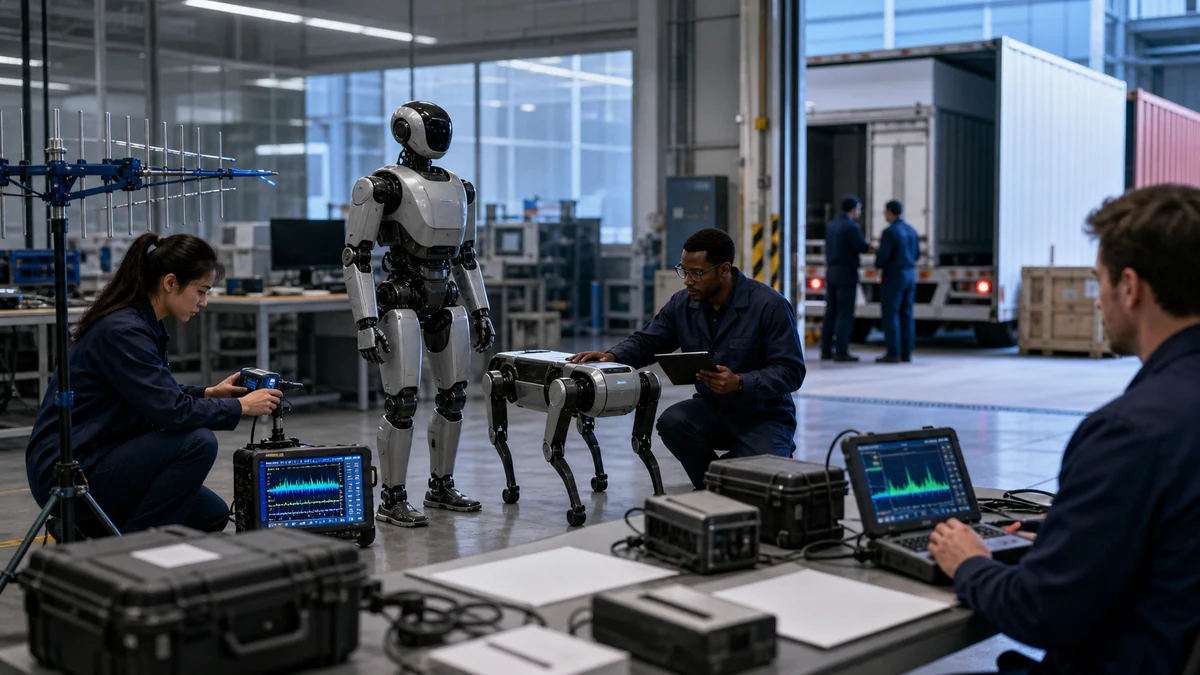
The short answer is no: the FCC did not publish a company-specific ban on every foreign robot. Its July 28, 2026 public notice added a defined category of foreign-produced advanced robotic devices to the Covered List. Covered equipment is barred from receiving FCC equipment authorization unless a Department of War Conditional Approval applies.
That action matters to new and previously unauthorized models, but it does not by itself order owners to surrender or disable every robot already in service. A sound product check separates manufacturing origin, the Appendix C device definition, an exact model's authorization history and any later FCC limitation. For adjacent technical controls, see the site's guides to ROS 2 and DDS robot cybersecurity, robot risk assessment and OTA update rollback.
The new entry changes equipment-authorization eligibility first
The current FCC Covered List includes foreign-produced advanced robotic devices as of July 28, 2026. The notice explains that equipment on the list cannot receive an authorization under section 2.903(a), and an applicant must certify that its device is not prohibited as covered equipment.
That is the cleanest statement of the legal change. Headlines that convert it into an immediate ban on all imports, sales and existing use skip the device definition, prior authorizations, exceptions and the FCC's separate procedures for limiting an authorization already granted.
| Question | What the official record says | What it does not establish |
|---|---|---|
| What was listed? | Foreign-produced advanced robotic devices | A named China- or Unitree-only list |
| What is directly barred? | FCC equipment authorization for covered equipment | Automatic seizure of every existing robot |
| Is there an exception path? | Department of War Conditional Approval | An automatic waiver based on a vendor claim |
Appendix C defines a connected mobile ground robot, not every machine
Appendix C centers on a mechanical mobile device capable of ground locomotion, navigation, obstacle avoidance or movement that operates away from a human operator in response to commands, sensor data or both. The combined device and applicable ground station or dock must exceed 4.4 pounds, and the system must include environmental sensing, qualifying wired or wireless connectivity, and software that controls autonomous movement, perception, data collection or remote command and control.
The definition can capture AMRs, humanoids and quadrupeds, but it excludes defined connected vehicles, rail-only vehicles, uncrewed aircraft systems, uncrewed underwater vehicles, specified medical devices and fixed stationary industrial robots. A product must be mapped to the full definition; a marketing label such as robot dog is not the legal test.
Authorization, import, marketing and continued use are different questions
Equipment authorization is the gateway that normally supports lawful marketing of an RF device, but a restriction on new authorization is not identical to a prohibition on possessing or continuing to use an already authorized device. The FCC's 2026 Small Entity Compliance Guide describes a process that may limit future importation and marketing without revoking the underlying authorization or prohibiting continued use.
A buyer therefore needs the FCC ID for the exact hardware revision, its grant date and scope, production origin and any later limitation—not merely a retailer's statement that inventory exists. This article explains the source boundaries and is not legal advice for a specific transaction.
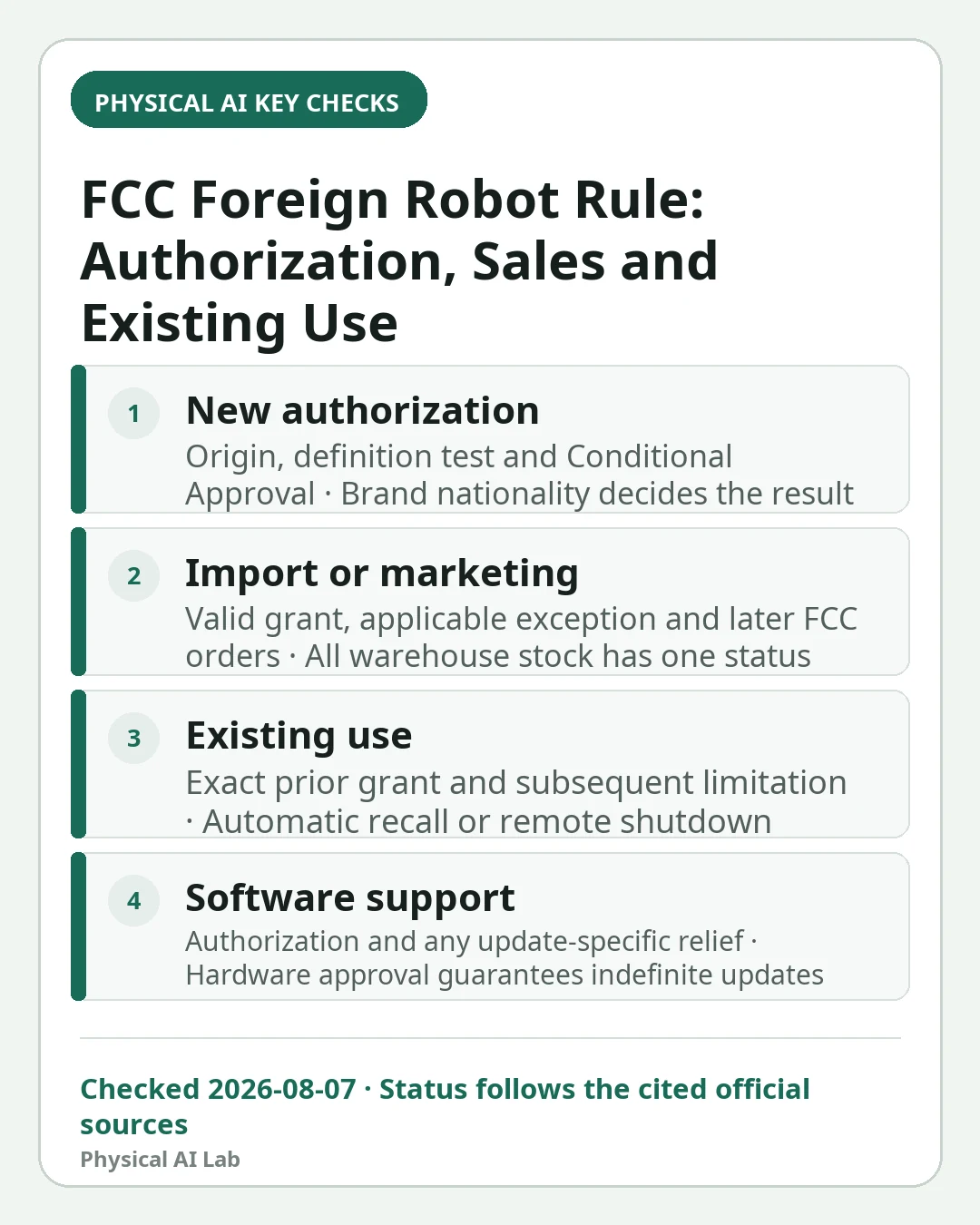
| Status | Evidence to request | Do not assume |
|---|---|---|
| New authorization | Origin, definition test and Conditional Approval | Brand nationality decides the result |
| Import or marketing | Valid grant, applicable exception and later FCC orders | All warehouse stock has one status |
| Existing use | Exact prior grant and subsequent limitation | Automatic recall or remote shutdown |
| Software support | Authorization and any update-specific relief | Hardware approval guarantees indefinite updates |

The category follows production location rather than a named company
The FCC expressly says the newly covered equipment is identified by place of production, not by entity. A U.S.-headquartered brand can therefore require analysis if the covered device is foreign-produced, while a company's nationality alone does not answer where an exact model was produced.
Unitree humanoids and quadrupeds may warrant a careful review, but the public notice does not name Unitree. Saying that all Unitree products are banned skips the model's weight, sensing, connectivity, control software, production origin, prior authorization and possible Conditional Approval.
Conditional Approval is a substantive review path, not a self-declared exemption
A producer may seek a Department of War determination that a particular foreign-produced advanced robotic device, or a class of devices, does not present the specified risk. Once transmitted to the FCC, that Conditional Approval can create an exception reflected in the Covered List.
A pending application, U.S. subsidiary, security white paper or promise to localize production is not itself an approval. Procurement teams should ask for the approving authority, covered model and revision, decision date, conditions and current list entry in writing.
A U.S. procurement check should be built around the exact model
Record the country of production and final assembly, exact model and hardware revision, FCC ID and grant date. Then map the system to Appendix C's mobility, weight, sensing, connectivity and control-software elements, and check the live Covered List plus any Conditional Approval entry.
For equipment already deployed, verify the existing grant and later FCC action before changing operations. For a new order, make authorization failure, regulatory change, security patches, replacement parts and contract cancellation explicit allocation points rather than relying on a broad compliance warranty.
Frequently asked questions
Did the FCC ban all Unitree robots in the United States?
No. The notice creates a production-location category and does not name Unitree. Each model still requires a definition, origin, prior-authorization and Conditional Approval check.
Must owners stop using a foreign-made robot they already bought?
The July notice alone does not order an automatic recall or shutdown. Check the exact model's existing FCC grant and any later order that limits it.
Can a foreign-produced robot still receive FCC authorization?
A covered device can qualify for an exception if the Department of War grants a Conditional Approval for that device or class and the FCC reflects it. A vendor's application or plan is not an approval.
Official sources checked
2026-08-07