A robot OTA release changes a physical system that can move, carry loads and interact with people. Success therefore means more than downloading and booting a package: the robot must enter a safe installation state, verify a compatible bundle, pass health and low-risk functional gates and remain recoverable.
The release unit may contain operating system, controller, drivers, AI model, parameters, calibration, maps and peripheral firmware. Atomicity and rollback become difficult when these artifacts have different storage, signing, migration and safety constraints.
Use this guide with the runtime safety-shield guide and robot observability guide. Follow manufacturer recovery procedures, applicable cybersecurity requirements and qualified safety review.
Define the release as a compatible artifact bundle
Assign immutable identities and hashes to the OS image, application, drivers, models, parameters, calibration, map and peripheral firmware. Declare allowed combinations and whether an artifact can be updated independently.
Record target hardware revision, bootloader, safety-controller interface, accelerator runtime and minimum storage. A signed package can still be incompatible with the selected robot.
Enter a verified safe installation state
Before activation, verify location, mission completion or controlled handoff, workpiece release, docking or brake state, battery and external power, network quality, storage, local hold and remote-support window. Stale status must not authorize installation.
Keep runtime safety constraints independent of the updater. A mobile robot or gravity-loaded arm must not begin rebooting in a state from which loss of control, power or communication creates a new hazard.

Use manifests to bind authorization and compatibility
IETF RFC 9019 describes a transport-independent firmware-update architecture and the role of protected manifests. RFC 9124 defines an informational manifest information model for firmware updates.
Use signed metadata to identify author, target, version, dependencies, payload digest and processing instructions. TLS protects a transport session but does not by itself establish end-to-end authorization of an artifact after caching or relay.
Separate signing roles, target checks and rollback policy
Protect offline root keys and delegate release roles with bounded permissions, expiry and revocation procedures. Require the robot to verify authorization, digest, hardware identity, allowed version and dependency state before writing an update.
Prevent unauthorized downgrade while preserving an approved recovery path. Emergency recovery keys and images need independent custody and exercises; a recovery credential left online can become the easiest fleet-compromise path.
| Gate | Robot verifies | Failure action | Audit evidence |
|---|---|---|---|
| Authorization | Role and signature chain | Reject package | Key ID and result |
| Target | Model, board and device class | Exclude robot | Measured identity |
| Version | Current, target and minimum | Block downgrade | Bundle history |
| Dependency | OS, driver, model and map | Hold installation | Compatibility decision |
| Safety state | Location, load and energy | Defer activation | Signed fresh status |
Persist update progress as an idempotent state machine
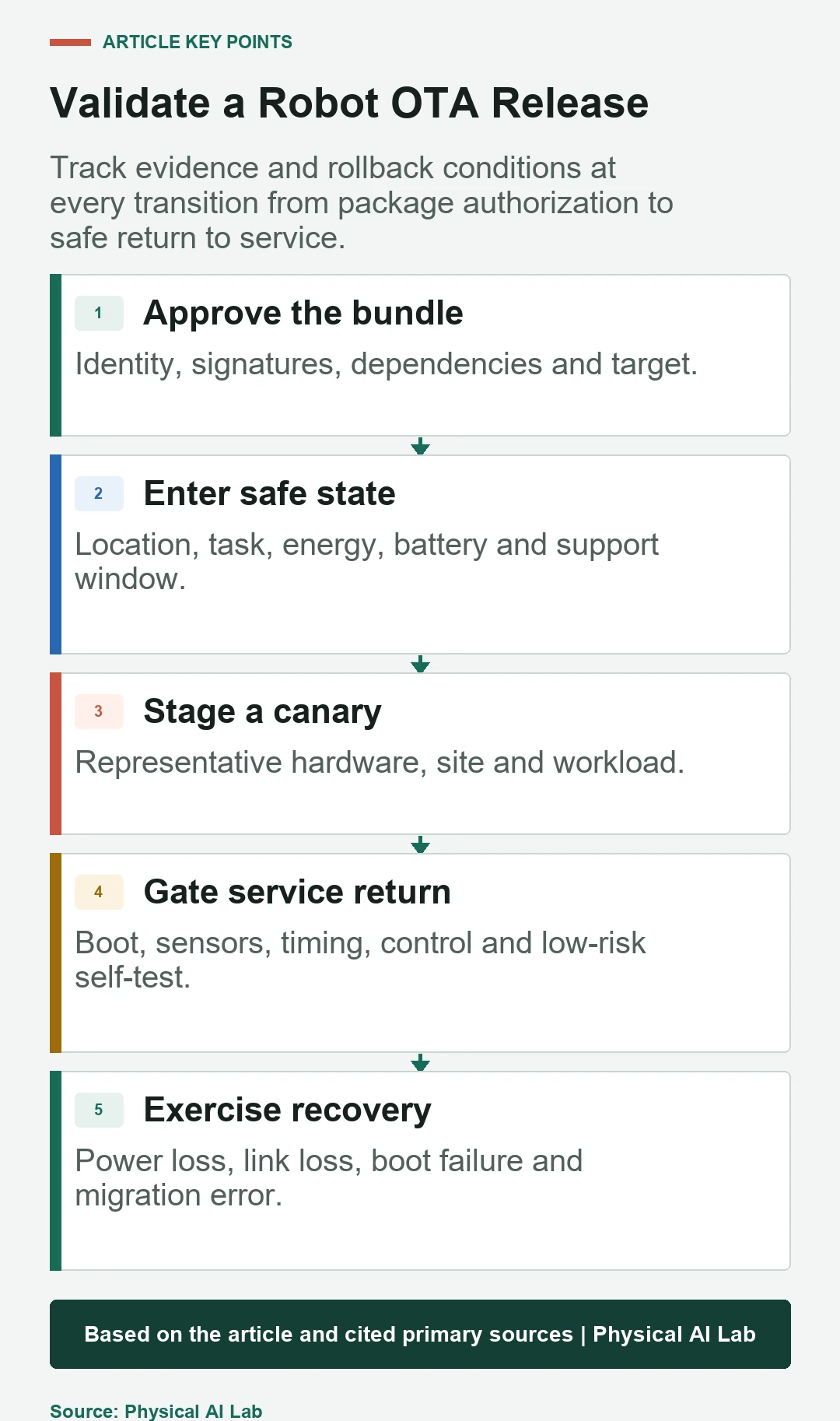
Keep downloaded, verified, staged, installed, selected, booted, healthy and released as distinct durable states. After interruption, the agent should resume or roll back from evidence rather than infer success from one server response.
Make transitions idempotent and use atomic file or partition changes where possible. Detect low power and storage before destructive steps, and limit reboot loops and repeated migration attempts.
Stage rollout across representative fleet risk
Move from development hardware to lab robots, low-consequence pilots, representative canaries and broader waves. Select canaries across hardware revisions, sensors, workloads, sites, temperature, network zones and chargers instead of choosing only the newest machines.
Define automatic pause criteria before rollout. A canary stage is useful only when enough observation time and task exposure accumulate to detect the failure modes that the next wave would amplify.
Gate return to service on physical robot health
Boot success is not service readiness. Verify required processes, safety communication, sensor discovery and freshness, time synchronization, calibration and configuration hashes, control-loop timing, resource margin and local diagnostics.
Run a bounded low-risk self-test or validation route, then require explicit release to task allocation. Treat missing health signals as unknown, not success, and preserve why the robot was held.
Treat A/B rollback and data migration separately
A/B slots can install a new executable image to an inactive partition and return to the previous slot after boot failure. They do not automatically reverse database schemas, map formats, safety parameters or peripheral firmware.
Classify changes as backward-compatible, reversible with backup or forward-only. Test mixed-version reads, backup restoration, peripheral recovery images and physical service access before the release reaches remote sites.
Inject power, network, boot and migration failures
Interrupt download, signature verification, partition writing, boot selection, first boot, health confirmation and data conversion under controlled test conditions. After each interruption, observe the active slot, data state and whether the robot can enter a defined safe service or recovery mode.
Record recovery time, automatic actions, human steps and any irreversible residue. Repeated failure on one configuration should automatically pause the remaining wave.
Use different rollback triggers for safety and operations
Unexpected motion, safety-communication failure or corrupted configuration can require immediate isolation and fleet pause. Moderate resource regression or user-interface defects may justify holding expansion while engineering investigates.
Define thresholds, observation windows, minimum exposure and authorized decision makers before deployment. Do not issue a blind fleet-wide rollback when data migration, ongoing work or heterogeneous firmware requires different recovery paths.
Version models, parameters and validation data explicitly
A model update can change input preprocessing, output meaning, accelerator behavior and safety-envelope interactions without altering application code. Include model digest, interface version, normalization and calibration references and evaluation-dataset version in the release bundle.
Connect deployment identity to the dataset lineage guide so regressions can identify training and evaluation ancestry. Decide whether model-only rollback is compatible or whether code and parameters must return together.
Release only after security and recovery evidence closes
NIST SP 800-193 organizes platform firmware resilience around protection, detection and recovery. The current Uptane Standard 2.1.0 is vehicle-focused and notes potential use in other connected domains; it is a useful security architecture reference, not a robot-safety certification.
Preserve threat model, keys and roles, compatibility matrix, safe-state requirements, canary plan, health gates, failure-injection traces, rollback and field recovery evidence. Close review with the following checks.
| Release area | Acceptance evidence | Automatic stop condition | Manual escalation |
|---|---|---|---|
| Package | Signature and compatibility pass | Unauthorized or wrong target | Key or manifest dispute |
| Installation | Durable state transitions | Power or storage unsafe | Repeated interrupted state |
| Health | Boot and physical self-test | Missing critical signal | Ambiguous calibration |
| Fleet | Canary exposure and metrics | Safety or failure threshold | Cross-site pattern |
| Recovery | Slot, data and peripheral restore | Rollback failure | Physical service image |
- Sign and target every immutable release bundle.
- Verify a fresh physical safe state before activation.
- Stage representative canaries with automatic pause rules.
- Gate service return on sensors, timing, control and self-test.
- Prove rollback, migration and field recovery under interruption.
Frequently asked questions
Is a successful download a successful robot update?
No. The robot must verify the bundle, activate from a safe state, pass health and functional gates and return to service under control.
Does an A/B partition make every change reversible?
No. Databases, maps, safety parameters and peripheral firmware need separate compatibility, backup and recovery design.
Should the whole fleet receive the same release at once?
No. Use representative staged waves with predeclared hold and rollback criteria.
Can the updater rely on the cloud to know the robot is safe to reboot?
Not alone. Require fresh robot-reported state and local enforcement; stale backend state must not authorize activation.
Does Uptane certify a robot OTA system as safe?
No. It provides a security-update framework for vehicles and potential adjacent domains; robot motion safety and application validation remain separate.
Secure Release and Recovery Boundary
A robot OTA release is complete only when authorized compatible artifacts, a verified installation state, staged evidence, physical health gates and recovery from interrupted or irreversible changes have all been demonstrated.