The published humanoid-games program used sports and scenario tasks to test different capabilities. Sports can reveal balance and whole-body control, while industrial deployment depends on repetition, uptime, safety, repairability and predictable cost; the program listing itself is not industrial proof.
Why competitions include sports and work scenarios
The official program deliberately combines competitive events with scenario events. Athletic ability and practical task ability can reinforce each other, but they are not measured by the same score.
This comparison separates organizer claims from our interpretation. Any event or company figure stays within the original source's date and scope; unpublished prices, lead times and success rates remain unknown.
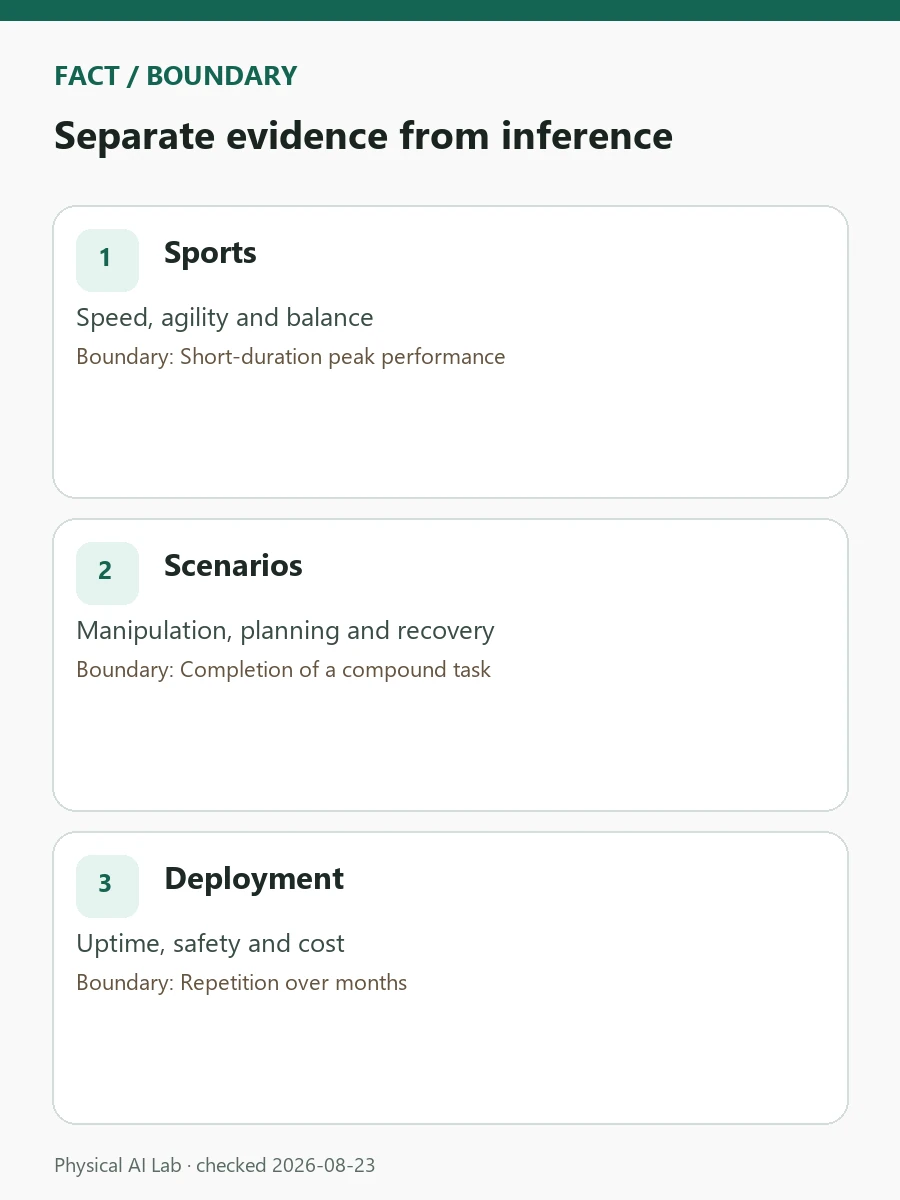
| Context | What it emphasizes | What can be missed |
|---|---|---|
| Sports | Speed, agility and balance | Short-duration peak performance |
| Scenarios | Manipulation, planning and recovery | Completion of a compound task |
| Deployment | Uptime, safety and cost | Repetition over months |
Peak output and production reliability optimize different systems
Sports reward maximum performance over a short interval; a workplace rewards stability over long hours and a manageable total cost of ownership. Those objectives lead to different choices in control, cooling, batteries and reducer life.
A deployable physical AI loop must also connect sensor timing, state estimation, planning, low-level control, safety limits and recovery without interruption.
Translate a highlight into uptime, intervention and cost
Ask for the failure conditions behind the successful run. Repetition count, human assistance and recovery time after a stop make it possible to compare an athletic demonstration with an operating system.
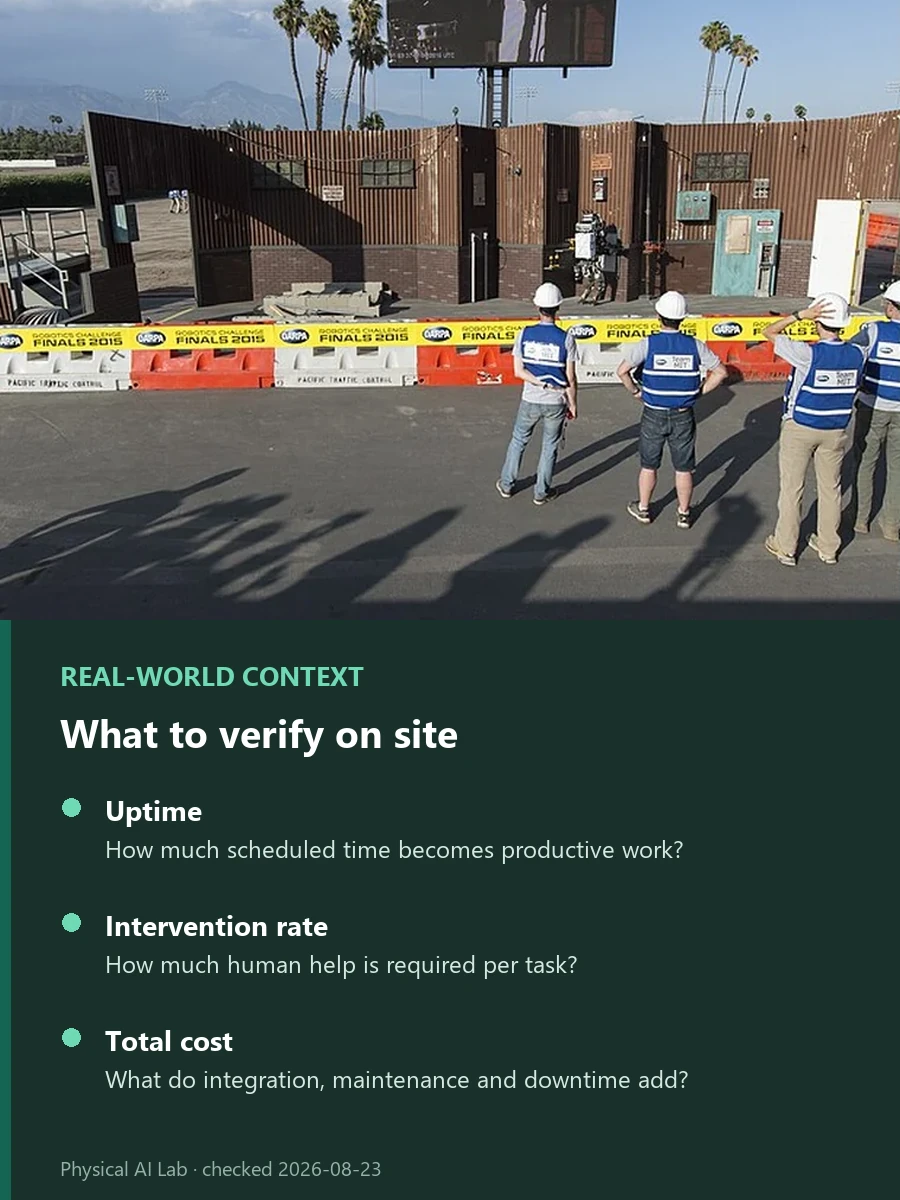
| Deployment metric | Question to ask |
|---|---|
| Uptime | How much scheduled time becomes productive work? |
| Intervention rate | How much human help is required per task? |
| Total cost | What do integration, maintenance and downtime add? |

Spectacular motion is valuable evidence—but not a business case
The point is not that athletic movement is unimportant. A deployment decision simply needs separate evidence of task success and reduced human intervention at the customer site.
Official event material remains the primary source for the program. Customer data, independent tests and regulatory documents should update the judgment when available.
Read sports results inside the wider robot stack
The physical AI company ecosystem locates the suppliers behind a humanoid, the robot simulator comparison explains pre-deployment testing and edge AI for robots covers realtime constraints. This August 2026 article uses that stack to translate sports results into workplace questions.
Use the performance that matches the job
Running, soccer and dance demonstrate balance and whole-body control. Industrial performance has to add sustained uptime, safe repetition, recovery and serviceability under the customer's actual conditions.
Frequently asked questions
What must be retested before a sports humanoid enters a factory?
Retest balance and recovery with the site’s payloads, floors, duty cycle, people and safety zones. Athletic motion is relevant, but it does not establish uptime, stopping distance, repair time or cost per completed task.
Which sports metrics transfer most directly to industrial work?
Balance recovery, controlled contact, repeatability and operation without remote assistance transfer better than peak speed alone. They still need to be retested with the worksite's payloads and surfaces.
Why can a slower humanoid be the better industrial choice?
Lower speed may reduce heat, energy use, wear and stopping distance. If it delivers higher uptime, fewer interventions and faster repair, the slower system can produce more useful work.
Official sources checked
- Beijing municipal government's official guide to the 2nd World Humanoid Robot Games
- Beijing municipal government's official WRC 2026 event guide
- Beijing municipal government's World Humanoid Robot Games operations update
Last checked: August 23, 2026