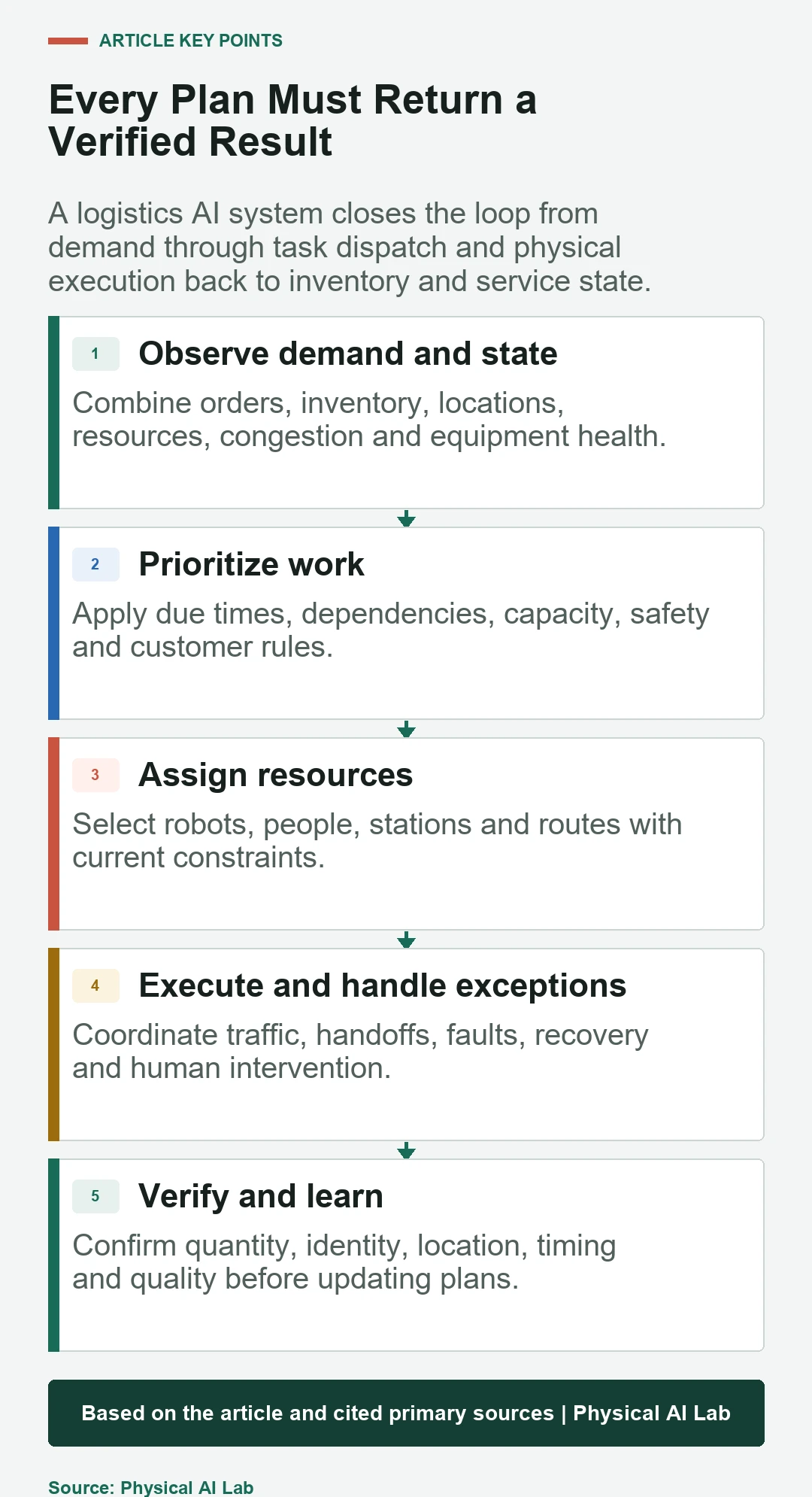
A logistics AI system turns demand and facility state into decisions about inventory, tasks, routes, robots, people and equipment. Its value comes from closing the loop: an order becomes physical work, execution returns verified results, and the updated state informs the next decision.
No single algorithm runs the warehouse. Forecasting, WMS or WES logic, fleet management, traffic control, robot autonomy, PLCs and human procedures operate at different timescales. Interfaces and exception handling determine whether local optimization improves or disrupts the whole flow.
This architecture guide connects to Physical AI ecosystem roles and robot edge computing. Actual designs depend on facility layout, safety, vendors, data quality and current interface specifications.
The decision loop begins with trustworthy state
Orders, inventory, locations, resource status, congestion, equipment availability and labor constraints create the operating state. Missing or stale data produces impossible plans even when the optimization algorithm is correct.
Define ownership, timestamps, identity and confidence for every state field. Reconcile physical counts with system records. Track late events and duplicates so retries do not silently corrupt inventory or task status.
Demand and inventory logic set the work to be done
Forecasts support staffing, replenishment and slotting, while current orders create immediate priorities. Inventory logic must distinguish available, reserved, in-motion, quarantined and uncertain stock.
Use AI forecasts as inputs to bounded operational policies. Measure forecast error by the decisions it affects, such as stockouts or excess moves. Preserve deterministic controls for contractual and safety constraints.

Task decomposition connects orders to executable actions
An order may require picking, transport, buffer, inspection, packing and shipping. The orchestration layer creates tasks with dependencies, locations, payloads, due times and completion evidence.
Task granularity matters. Oversized tasks reduce flexibility, while tiny tasks create communication and scheduling overhead. Each action needs preconditions, ownership, timeout and a recovery path.
| Layer | Primary decision | Typical horizon | Completion evidence |
|---|---|---|---|
| Planning | Capacity and demand | Days to shifts | Resource plan |
| Orchestration | Task priorities and dependencies | Minutes to hours | Verified workflow state |
| Fleet management | Vehicle assignment and traffic | Seconds to minutes | Pickup and delivery |
| Robot autonomy | Local path and control | Milliseconds to seconds | Pose and action result |
| PLC or equipment | Interlocks and machine cycles | Deterministic cycle | Sensor and handshake |
Resource allocation should optimize the workflow, not one robot
Assign robots, people, stations and equipment using capability, distance, battery, queue, maintenance, traffic and due time. The fastest robot choice can create downstream congestion or starve another critical station.
Evaluate throughput, flow time, lateness and utilization together. Excessive utilization can reduce resilience. Keep capacity for failures, charging, replenishment and demand peaks.
Fleet traffic is a shared-space coordination problem
Routes interact through aisles, intersections, elevators, doors and charging stations. Traffic control reserves resources and prevents deadlock while robot autonomy handles local motion and obstacles.
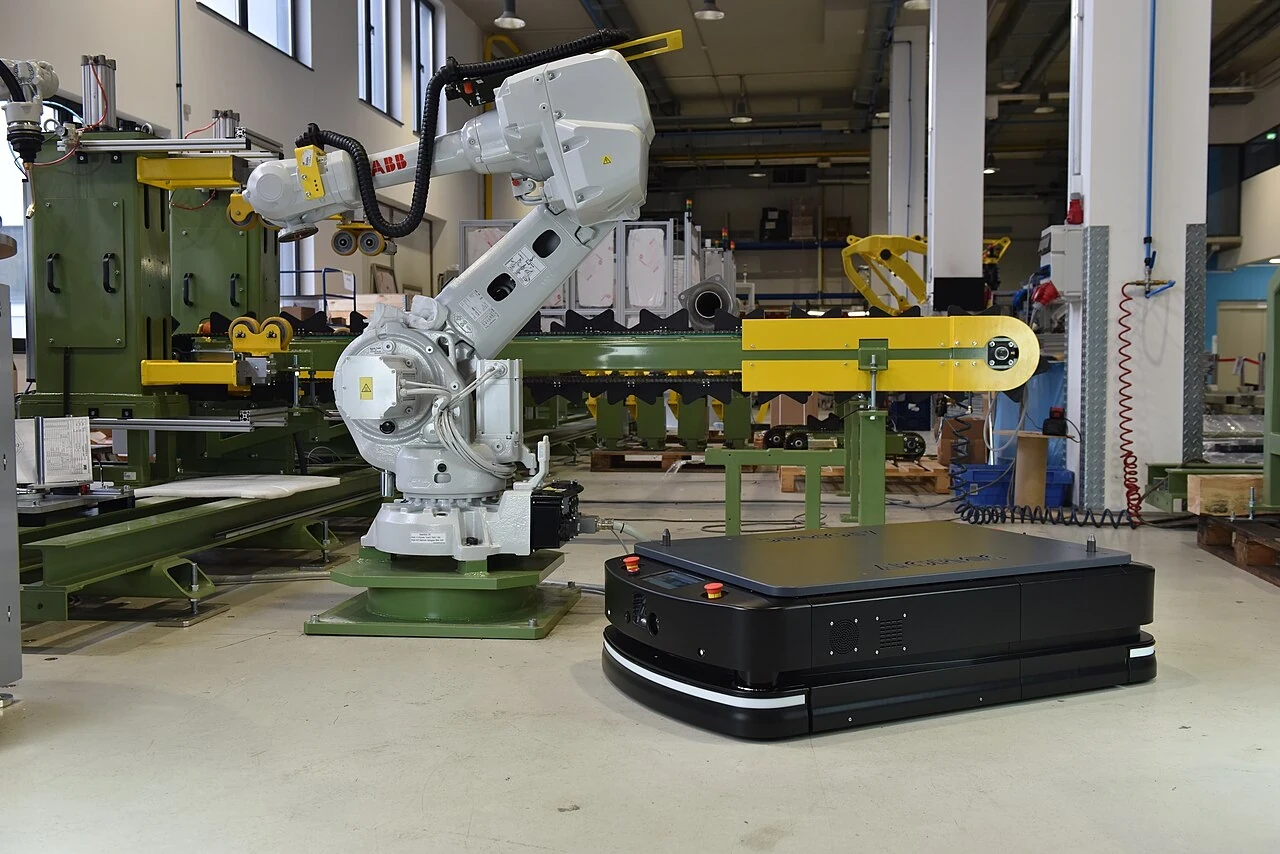
Real AGV operation shows why digital plans must connect to equipment and physical handoffs. Model narrow passages, one-way rules, human zones and blocked resources. Simulate peaks, then validate timing on site.
Interfaces need explicit state machines
The open VDA 5050 repository illustrates a standardized interface between mobile-robot fleets and higher-level control. A standard message still requires agreed versions, semantics, identity, error handling and operational testing.
Design commands and acknowledgments as state machines with idempotency. Handle delayed, duplicated, reordered and missing messages. A command accepted by software is not the same as a verified physical transfer.
Exception control determines real autonomy
Common exceptions include blocked paths, missing loads, unreadable labels, full buffers, failed handshakes, localization loss, low battery and human intervention. Define detection, containment, retry, alternate routing and escalation.
Measure interventions by type, duration and skill level. The system should preserve context so an operator understands what happened and can resume safely. Recovery quality often matters more than nominal-path speed.
| Exception | Detection | Automated response | Escalation evidence |
|---|---|---|---|
| Blocked route | Progress timeout | Replan or wait | Map and obstacle context |
| Missing load | Identity sensor | Search or quarantine | Order and location history |
| Equipment fault | Handshake or PLC state | Reroute task | Fault code and safe state |
| Low battery | Energy forecast | Charge or reassign | Task and charger capacity |
| Inventory mismatch | Verification failure | Hold and reconcile | Physical and digital trace |
Battery and maintenance state belong in planning
A robot that accepts a task but cannot complete it before charging creates delay and traffic. Energy-aware allocation considers task distance, payload, waiting, charger availability and battery limits.
Health data can schedule inspection or remove a degrading robot before failure. Predictive signals should not bypass maintenance rules. Track false alarms, missed failures and operational cost against simpler preventive schedules.
Operational metrics need system boundaries
Measure verified units per hour, flow time, on-time completion, intervention, downtime, queue, congestion, damage, safety and energy. State whether upstream starvation, planned breaks and blocked downstream equipment are included.
Robot utilization alone can reward congestion. Compare end-to-end customer or production outcomes. Segment results by shift, order profile, SKU, zone and exception condition to expose where performance changes.
A staged deployment protects continuity
Begin with data validation and shadow planning, then limit automation by zone, task and operating period. Provide rollback, manual control and reconciliation. Train operators on normal operation and exceptions.
Use simulation and historical replay for candidate policies, then verify on live bounded trials. Monitor drift in orders, layout and fleet behavior. A logistics AI system succeeds when it improves sustained flow while remaining understandable and recoverable.
- Create one timestamped source of operational state.
- Define task ownership, dependencies and completion evidence.
- Coordinate traffic, energy and equipment interfaces.
- Design exception state machines before scaling.
- Measure end-to-end flow, safety, intervention and cost.
Frequently asked questions
What is a logistics AI system?
It is the combination of data, forecasting, task orchestration, resource allocation, fleet control and feedback that coordinates physical logistics work.
Is a WMS the same as robot fleet management?
No. A WMS manages inventory and orders, while fleet management assigns and coordinates mobile robots. A WES or orchestration layer may connect them.
Why is exception handling important?
Real facilities contain blocked paths, missing loads, equipment faults and data mismatches. Scalable autonomy depends on detecting and recovering from them.
What should be measured besides throughput?
Measure flow time, on-time completion, intervention, downtime, congestion, inventory accuracy, damage, safety, energy and cost per verified outcome.
What is VDA 5050?
It is an interface specification intended to connect higher-level control with mobile-robot fleets. Integration still requires compatible versions and tested semantics.
Operations and Interface Note
Logistics interfaces, facility risks and vendor capabilities vary. Verify current specifications and safety requirements, then stage changes with rollback, reconciliation and human exception procedures.