An assistive robot that cannot find a door button has more than a recognition error. Camera placement, lighting, model confidence, route feasibility, arm reach, user input, and safe recovery all become part of the same incident. The Meta project account presents RAMMP as an early real-world research platform for shortening that chain on the device.
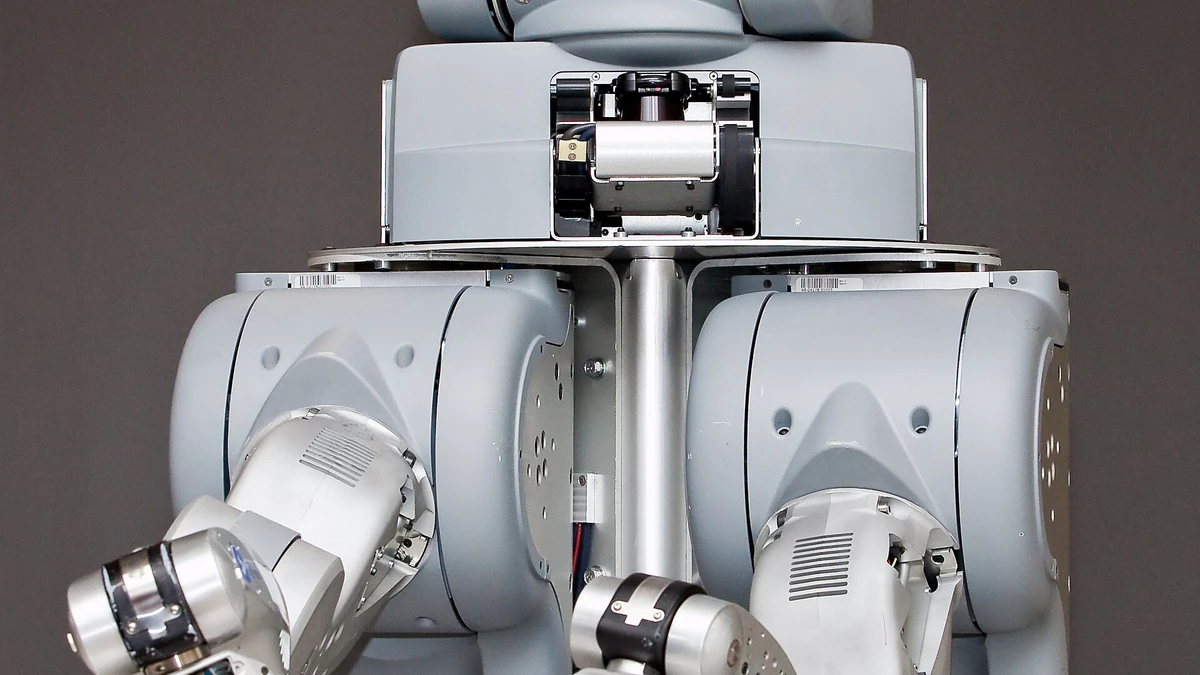

Mobility and manipulation share one physical scene
Meta describes a project led by the University of Pittsburgh’s HERL and ATDev that combines a mobility base, manipulator, assistive-technology operating system, and digital twin. Door buttons, cups, curbs, people, and furniture need to share coordinates with the user, wheels, and arm. A small pose error in perception can become an unreachable grasp or an unsafe base movement, so activity completion must be measured after detection accuracy. A perception score cannot stand in for an activity completed safely by a user.
Camera uncertainty starts before the model
The team reports using SAM to automate training-data labels and DINOv2 embeddings to fine-tune a lightweight RF-DETR detector, while also optimizing DINOv3 and SAM for edge hardware. Multi-angle and multi-height imagery can reduce viewpoint bias, but automated labels can reproduce errors quickly. Transparent cups, reflective buttons, wet curbs, low contrast, and wheelchair-height occlusion deserve a separate challenge set rather than being averaged into easy scenes. The claimed 360-degree scope is not a guarantee that every hazard is always detected.
DINO and SAM do not command the motors
DINO-family encoders provide reusable visual representations; SAM identifies image regions. In RAMMP they support the perception pipeline, not wheel speed or arm current. A detection needs confidence, location, identity persistence, and a timestamp. If a cup changes identity between frames or a button coordinate jitters, the control layer should ask for another view or user confirmation instead of converting an uncertain point into motion. A confidence threshold needs a physical response, not just a dashboard color.
Edge inference trades network dependence for device limits
Processing on the device can reduce cloud round trips and keep essential functions available during a network outage. It introduces limits in battery, heat, memory, resolution, and compute scheduling. Meta notes tradeoffs from lower precision and practical resolutions. A thermal or low-power mode can therefore change latency and boundary quality even when the model file is unchanged. The edge robotics guide helps turn those tradeoffs into an on-device test. On-device processing can improve privacy posture without automatically guaranteeing privacy.
Correct perception can still meet an impossible reach
A correctly detected object may lie outside arm reach because of chair pose, joint limits, table height, or an obstacle. A correctly detected curb may still be unsafe because of slope, tire grip, passenger mass, or battery state. Record model detection, route feasibility, user comprehension, physical execution, and damage-free completion separately. That separation prevents a strong vision result from being misreported as an independent-living outcome. Reachability and mobility constraints belong in the success denominator.
A safe stop should create a recoverable state
Stopping can mean decelerating the base, retracting the arm, preserving the user’s balance, presenting a clear visual or spoken message, and offering manual or remote assistance. Independent distance, force, and brake protections should not wait for a vision model to finish. Recovery should identify the last trusted scene, invalidate stale commands, capture a new view, ask the user when appropriate, and limit repeated attempts.
An uncertain system should fail into a state the user can understand and control.
| Test condition | Signal to observe | Safe result | Warning sign |
|---|---|---|---|
| Backlit door button | Confidence and coordinate jitter | New view or user confirmation | Immediate approach on low confidence |
| Person enters path | Latency and stopping distance | Independent slowdown and stop | Wait for AI-only decision |
| Partially hidden cup | Identity and grasp candidate | Cancel or change viewpoint | Grasp the wrong object |
| Device overheats | Inference time and frame rate | Detect degradation and limit function | Continue while hiding latency |
| Network loss | Local functions and log state | Maintain essentials or stop safely | Wait indefinitely for cloud response |
Retest the research goal without inventing clinical outcomes
The ARPA-H project page lists an award of up to $41 million; Meta’s article says up to $41.5 million. Preserve that official-source discrepancy instead of choosing a cleaner number. Funding and consortium scale do not establish long-term functional improvement, fewer injuries, user satisfaction, regulatory clearance, or commercial availability. Those outcomes require diverse users, environments, assistive needs, and longitudinal testing.
The project remains research; funding is not a clinical or commercial result.
- embedding retention
- consent withdrawal
- model update
- camera height
- backlighting
Questions readers ask next
How are SAM and DINO-family models used for labeling, visual representation and detection rather than direct motor control?
Published field statistics do not yet identify one dominant failure. Early testing should prioritize the chain from viewpoint and lighting changes to pose error, route or grasp planning, and physical execution. Report each stage rather than naming perception accuracy as the activity result.
What should RAMMP do when perception is uncertain, the edge device overheats or a user withdraws consent for retained visual data?
Reduce speed or stop, invalidate the uncertain target, acquire another viewpoint, and ask the user before retrying. The base and arm should retain independent force, distance, and stop limits; repeated failure should move to manual control or an explicit support request.
Official source trail: