Robot teams used to spend most of a deployment sprint converting a model, matching drivers, and deciding which accelerator should run it. Once inference worked, the camera clocks, action buffers, robot drivers, and safe-stop path still had to be built around it.

Intel’s May 31, 2026 announcement positions OpenVINO Physical AI as a preview that joins these pieces more directly. Physical AI Studio prepares and exports VLA models; the new framework is intended to connect optimized inference with sensors and robot actions. General availability was targeted for the second half of 2026, not declared complete in the announcement.
Define the framework at the action-loop level
Intel says Physical AI Studio covers robot data collection, fine-tuning, optimization, quantization, and VLA export. The OpenVINO Physical AI page describes common APIs for cameras, sensors, models, and robot behavior, with ACT, SmolVLA, and PI0.5 examples, LeRobot export, heterogeneous CPU/GPU/NPU execution, and asynchronous real-time action chunking. The unit of deployment therefore expands from a model file to a sensor-to-action loop. The value proposition is shared deployment plumbing, not a new proof of robot intelligence.
Keep Studio, Runtime, robot drivers, and safety distinct
OpenVINO Runtime remains an inference optimizer. Physical AI Studio addresses data and model preparation. ROS 2 and device drivers carry messages and hardware commands. OpenVINO Physical AI sits across those boundaries, but it does not replace a safety PLC, brake, risk assessment, or robot controller. Open-source components also do not guarantee hardware neutrality if camera plugins, NPU kernels, or deployment tooling create a new migration cost. A framework abstraction is useful only when operators can still see the failure source.
| Layer | Primary job | Does not replace |
|---|---|---|
| Physical AI Studio | Collect, fine-tune, optimize, and export | Robot controller or safety approval |
| OpenVINO Runtime | Optimize CPU, GPU, and NPU inference | Task semantics or grip policy |
| OpenVINO Physical AI | Connect sensors, policies, and actions | Safety PLC, brake, or risk assessment |
| ROS 2 and drivers | Move messages and device commands | VLA accuracy or generalization evidence |
Why robotics deployment became fragmented
A server model can accept a batch and return an answer. A robot receives camera frames, joint state, and force signals on different clocks, then changes the next observation through its own action. Teams repeatedly rebuild codecs, threads, buffers, timeouts, and fallback logic. A common framework can reduce that surrounding integration code only when the supported robot, camera, and timing requirements match the actual application. Robot time, embodiment, and feedback make this different from ordinary edge inference.
How asynchronous action chunking changes the timing problem
A VLA may emit a chunk of future actions. The robot can execute an existing chunk while the next inference runs, reducing stop-start behavior. The same buffer can continue an outdated action when the scene changes. Define the action expiry, overlap rule, maximum jitter, stale-scene detector, and mandatory deceleration. The on-robot VLA serving guide shows why worst-case latency matters more than an attractive mean. A full buffer can hide latency while increasing stale-action risk.
Read preview status and the 130-plus figure carefully
Intel described a GitHub preview and a general-availability goal for the second half of 2026. A live product page does not establish stable APIs, long-term support, or security maintenance. The headline’s 130-plus number refers to Series 3 edge AI and compute design engagements, not OpenVINO Physical AI customers, robot fleets, or production deployments. Sensory AI’s Ella is one Intel-architecture example, not a universal cost benchmark. A roadmap date and an ecosystem engagement count are not adoption evidence.
Run a parallel benchmark before replacing a working stack
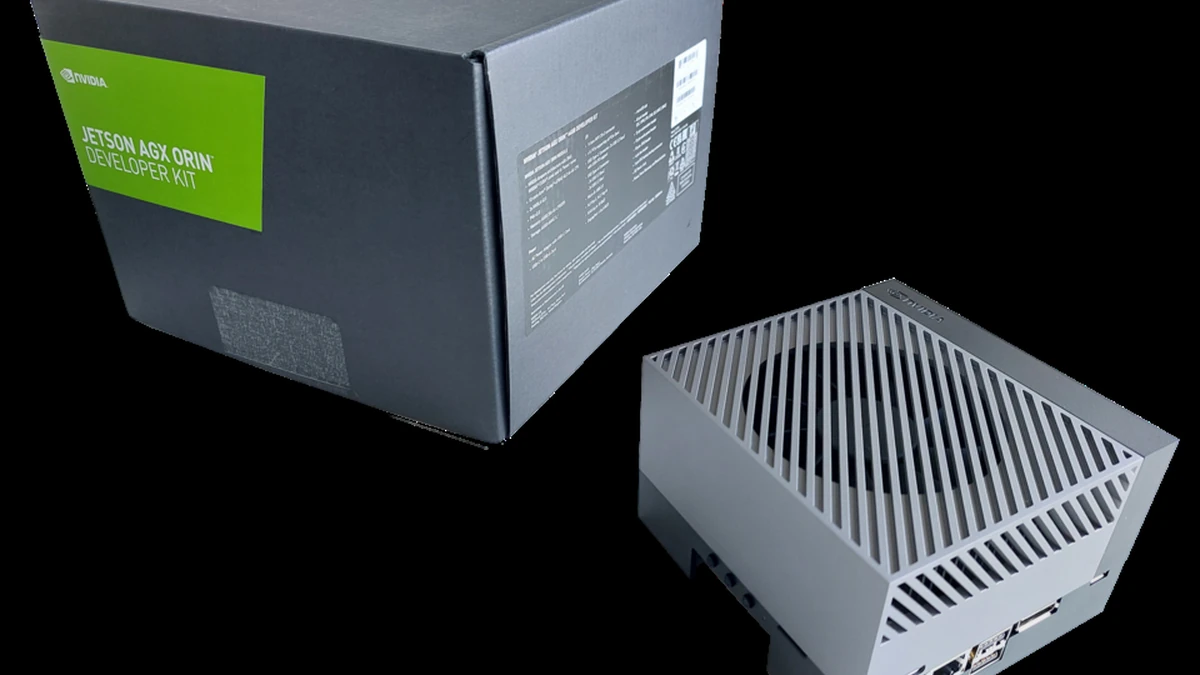
Do not remove a Jetson or other working accelerator stack on the strength of a preview. Run the same VLA, camera, robot, and task on both systems. Measure cold start, eight-hour latency distribution, memory copies, dropped frames, power, thermal throttling, timeout recovery, model-swap code changes, and safety independence. Track signed models, dependency versions, software bills of materials, and rollback after a security patch.
Production acceptance should compare complete loops under the same physical conditions.
- model signature
- dependency inventory
- security update
- driver recovery
- safety independence
Questions readers ask next
What new deployment work does OpenVINO Physical AI address beyond the inference optimization already provided by OpenVINO Runtime?
A supported Intel device is not enough. The project needs synchronized sensors, a supported robot driver, a defined action space, a VLA policy, force and speed limits, an independent stop interface, and representative acceptance tasks. Confirm versions in the current release documentation.
Which supported devices, API-stability commitments, security controls and worst-case latency tests are still needed before production use?
A common framework can become a liability when a special control cycle or proprietary sensor does not fit the API, or when abstraction hides the cause of a fault. If the team cannot inspect worst-case latency, buffer state, and fallback behavior, reduced code does not mean reduced risk.
Official source trail: