Physical AI and embodied AI are overlapping terms, not cleanly separated technologies. Both concern an agent that obtains information through a body or physical system, interacts with an environment and uses the consequences of action as part of intelligence. The same robot may be described with either term depending on the speaker and question.
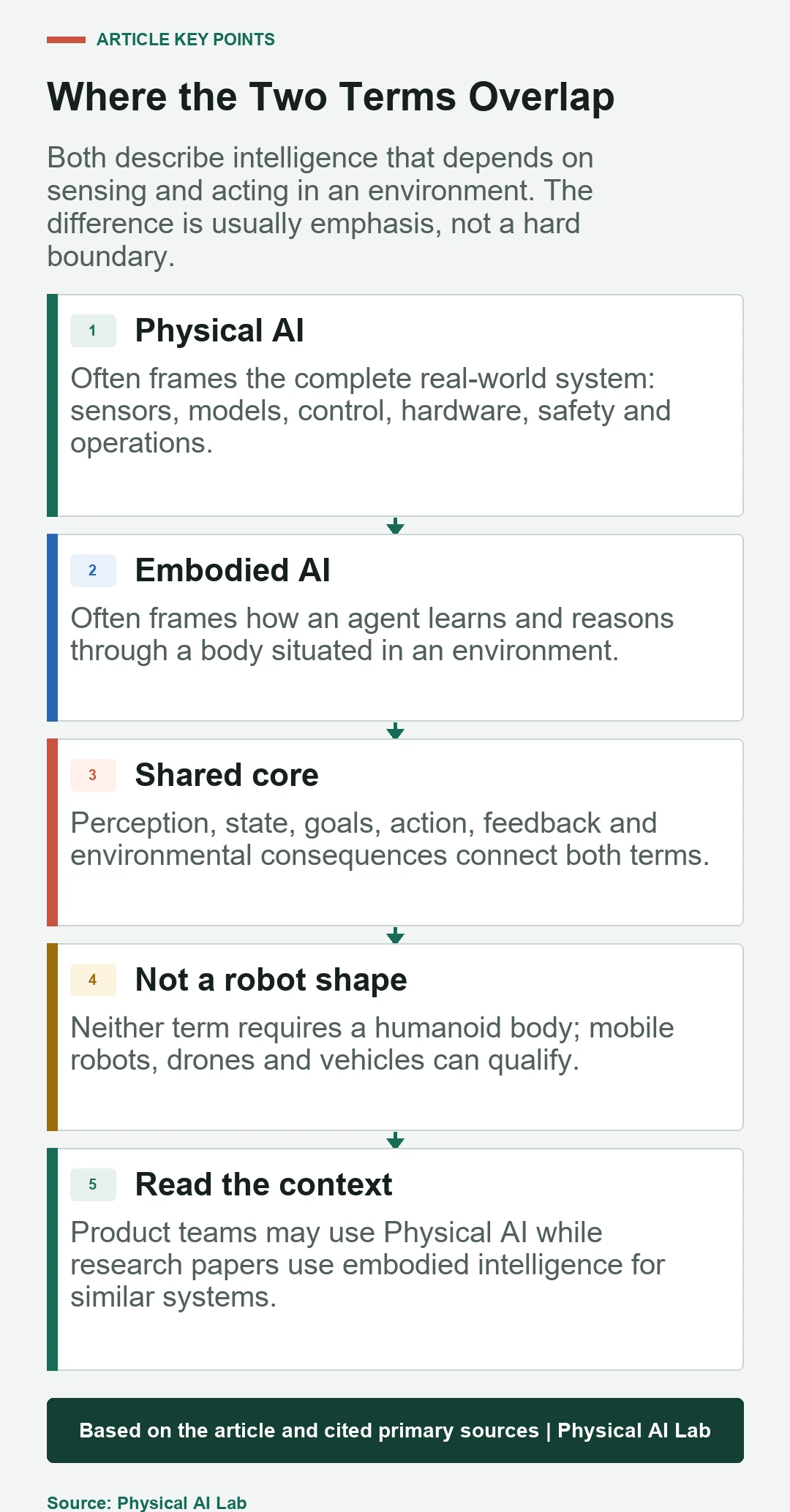
The difference is usually emphasis. Physical AI often points to the complete engineered system that connects perception, models, control, hardware, safety and real-world operation. Embodied AI often points to how intelligence is shaped by a body, sensory experience and interaction with an environment. One sounds more system- and deployment-oriented; the other often sounds more research- and cognition-oriented.
Do not turn that tendency into a rigid rule. Company pages, research papers and conferences use the terms differently, and some use them interchangeably. A useful reading asks what components, experiments and outcomes the author actually describes rather than deciding from the label alone.
The shared core is a perception-action loop
Both terms require more than a model that processes static digital input. The agent observes an environment, maintains some representation of state, chooses an action and receives a new observation after the action changes the world. That feedback makes the intelligence dependent on timing, body limits and environmental response.
The overlap includes robots, autonomous vehicles, drones and other adaptive machines. It does not require a humanoid. The practical distinction begins only after identifying which part of the shared loop the author wants to emphasize.
Physical AI usually frames the complete real-world system
In an engineering discussion, Physical AI often includes sensors, compute, learned models, planners, controllers, actuators, safety functions and operations. A policy can be intelligent in a benchmark but still fail as Physical AI if calibration, latency, mechanics or recovery prevent it from working on hardware.
The term is therefore useful when the question is deployment: can the system perform a defined task, under which conditions, with what intervention and failure cost? It encourages a stack-level view in which a model is one component of a machine that must be tested and maintained.
Embodied AI usually frames intelligence through a body
Embodied AI asks how an agent’s body, sensors, actions and environment contribute to learning and reasoning. A body determines what can be perceived, which actions are available and how experience is gathered. The same task can become a different learning problem when the camera, hand, mobility or action space changes.
The NVIDIA embodied AI glossary describes systems that interact with the physical world, while the Allen Institute for AI embodied research emphasizes agents that learn through interaction. These examples show why the term often appears near simulation, navigation, manipulation and situated reasoning.
The terms answer different first questions
Physical AI often begins with, ‘How do we make intelligence work reliably in the physical world?’ Embodied AI often begins with, ‘How does a body and its interaction with an environment shape intelligence?’ The systems studied may be identical, but the first question directs attention toward integration and deployment while the second directs attention toward representation and learning.
A paper can discuss embodied learning and still contain important Physical AI engineering. A product can use the Physical AI label and still depend on embodied training. The terminology describes a viewpoint more reliably than it defines an exclusive category.
| Dimension | Physical AI emphasis | Embodied AI emphasis |
|---|---|---|
| First question | Can the full system act reliably in reality? | How does body-world interaction shape intelligence? |
| Typical scope | Model, sensors, control, hardware, safety and operations | Agent, embodiment, perception, action and environment |
| Common evidence | Task trials, recovery, latency, safety and uptime | Generalization, interaction, navigation and manipulation |
| Common context | Products, deployment stacks and industrial systems | Research, simulation and agent learning |
Spatial grounding makes the overlap concrete
Consider the instruction to clear space for a laptop. The agent must identify relevant objects, understand their spatial relationships, choose what to move and select a safe destination. This is embodied reasoning because the answer depends on a scene, a body and possible actions. It is Physical AI when that reasoning becomes a functioning robot system.
Google’s robotics spatial-reasoning documentation shows examples that connect language to points and trajectories in a scene. Those outputs can support a robot, but perception alone is not action. Calibration, planning, control and feedback still decide whether the intended object is moved safely.

Neither term means humanoid robot
A humanoid is a body architecture, while Physical AI and embodied AI describe relationships between intelligence, bodies and environments. The humanoid robot types guide explains how different human-shaped machines target homes, industry and research. Those robots may use Physical AI, but the category also covers non-humanoid systems.
A warehouse mobile robot, autonomous drone or adaptive industrial arm can be embodied and physically intelligent without a head, torso or legs. The useful test is whether sensing, decisions and actions form a closed interaction loop, not whether the machine resembles a person.
Physical AI is also broader than a VLA model
A vision-language-action model can connect images and instructions to robot commands. That is one possible intelligence component. Physical AI also includes controllers, safety monitors, mechanics, sensors and operational procedures that may be conventional rather than learned.
Embodied AI is also not limited to VLA architectures. An agent can learn navigation through reinforcement learning, use a modular perception and planning stack, or study active perception without a language model. Treat model names as implementations inside the larger conceptual space.
Read the source before choosing the label
A product announcement may use Physical AI to signal real-world deployment. A research paper may use embodied AI to describe a benchmark or learning problem. Some organizations deliberately connect both. The correct interpretation comes from the methods, inputs, outputs and tests described in the source.
Use the table to translate common source language into a reading question. This prevents a terminology debate from replacing technical evaluation and keeps attention on what the system actually does.
| Source language | Likely emphasis | Question to ask |
|---|---|---|
| Physical AI platform | Integrated real-world stack | Which hardware tasks and operating limits are validated? |
| Embodied agent | Learning through body-world interaction | Which body, sensors, actions and environments are tested? |
| Generalist robot model | Transfer across tasks or bodies | What is shared, adapted and evaluated? |
| Spatial reasoning | Grounding language in geometry | Does the output control a robot or only describe a scene? |
Choose the term that matches the decision
Use Physical AI when discussing system architecture, deployment, safety, operations or the relationship between models and machines. Use embodied AI when discussing how bodies, environments and interaction affect learning or cognition. Use both when the distinction is not central and define what the article means on first use.
For search and research, try both terms. Robotics sources may organize the same subject under embodied intelligence, robot learning, interactive agents, Physical AI or autonomous systems. The vocabulary is still evolving, so a narrow keyword can hide relevant work.
- Define the term in the context where it appears.
- Identify the body, sensors, actions and environment.
- Separate the learned model from the complete machine.
- Ask what was tested in simulation and on hardware.
The distinction should improve evaluation
A useful definition changes the questions a reader asks. Physical AI should lead to integration, failure and deployment evidence. Embodied AI should lead to questions about morphology, observation, interaction and generalization. If the label does not change the evidence requested, the debate may be semantic rather than technical.
Keep the shared closed loop in view. Both fields depend on what the agent senses, how it represents state, what actions the body can execute and how the next observation reflects the consequences. That loop is more stable than any current naming convention.
Frequently asked questions
Are Physical AI and embodied AI the same thing?
They overlap strongly, but the terms often emphasize different questions. Physical AI commonly frames the integrated real-world system; embodied AI commonly frames learning and reasoning through a body in an environment.
Is embodied AI always a robot?
No. Embodied agents can be studied in simulation, and physical systems include vehicles, drones and machines as well as robots. The defining idea is interaction through an embodiment.
Is Physical AI a newer name for robotics?
No. Robotics is a broader engineering field that includes systems without adaptive AI. Physical AI highlights AI connected to sensing and physical action.
Does a VLA model count as embodied AI?
It can be part of an embodied system when its vision, language and actions are grounded in a robot and environment. A model evaluated only on digital outputs does not by itself establish embodiment.
Which term should I use in an article?
Use the term favored by the primary sources and define it. Physical AI is often clearer for full-stack deployment; embodied AI is often clearer for body-environment learning questions.
The Boundary Depends on Context
There is no single standards body that fixes a universal boundary between these terms. Interpret them from the source's definitions, system components and evaluation methods.