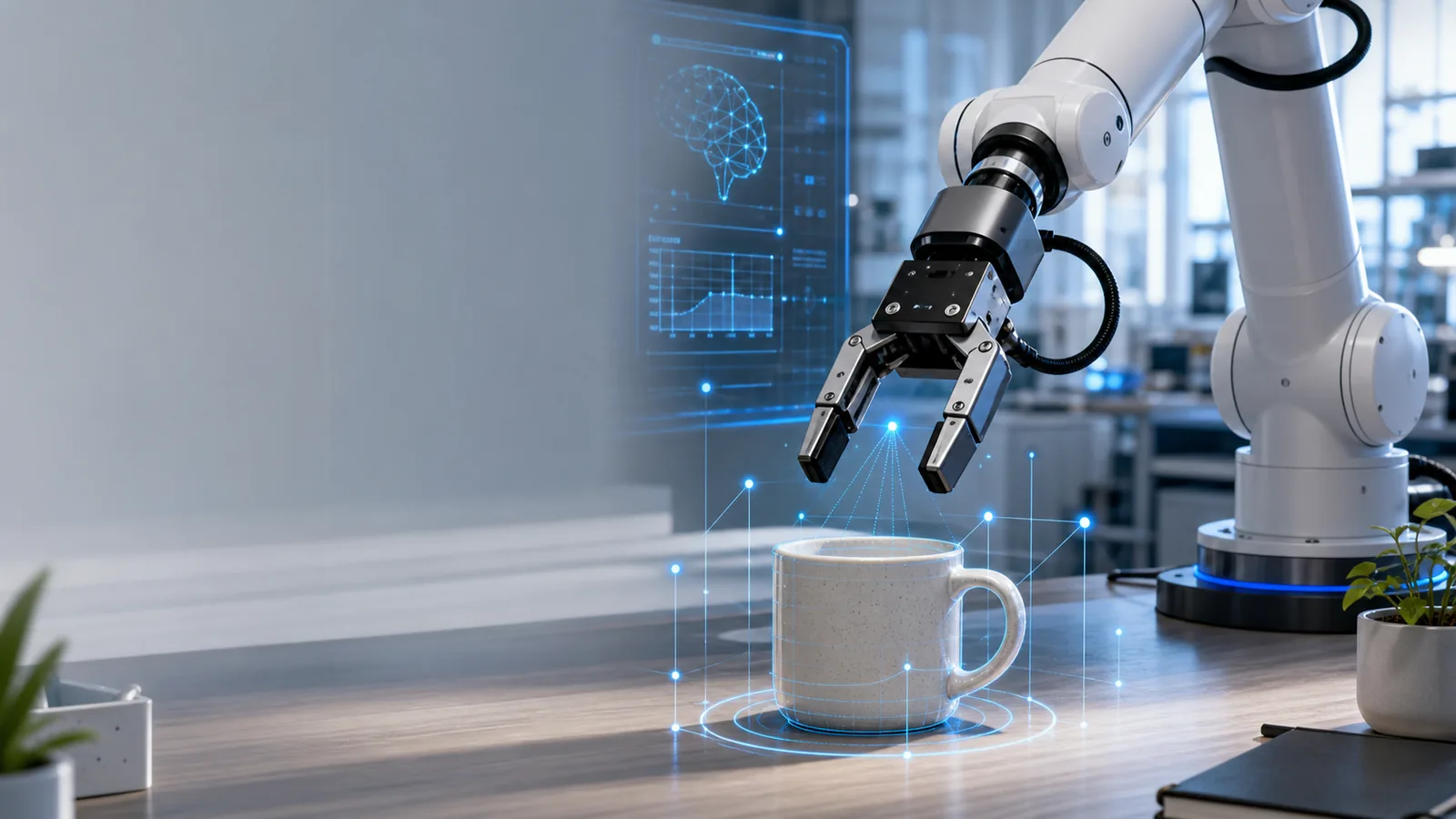
Physical AI is artificial intelligence that perceives a physical environment, reasons about what is happening and causes a machine to act. The result is not just text, an image or a prediction on a screen. It is a change in the world: a mobile robot takes a different route, a gripper adjusts its grasp, or a machine stops before contact becomes dangerous.
That physical consequence changes the engineering problem. A language model can return an imperfect answer and try again. A robot may drop an object, collide with a person or damage itself. Physical AI therefore includes the model, sensors, control stack, mechanics, safety functions and operating procedures that turn a decision into a repeatable action.
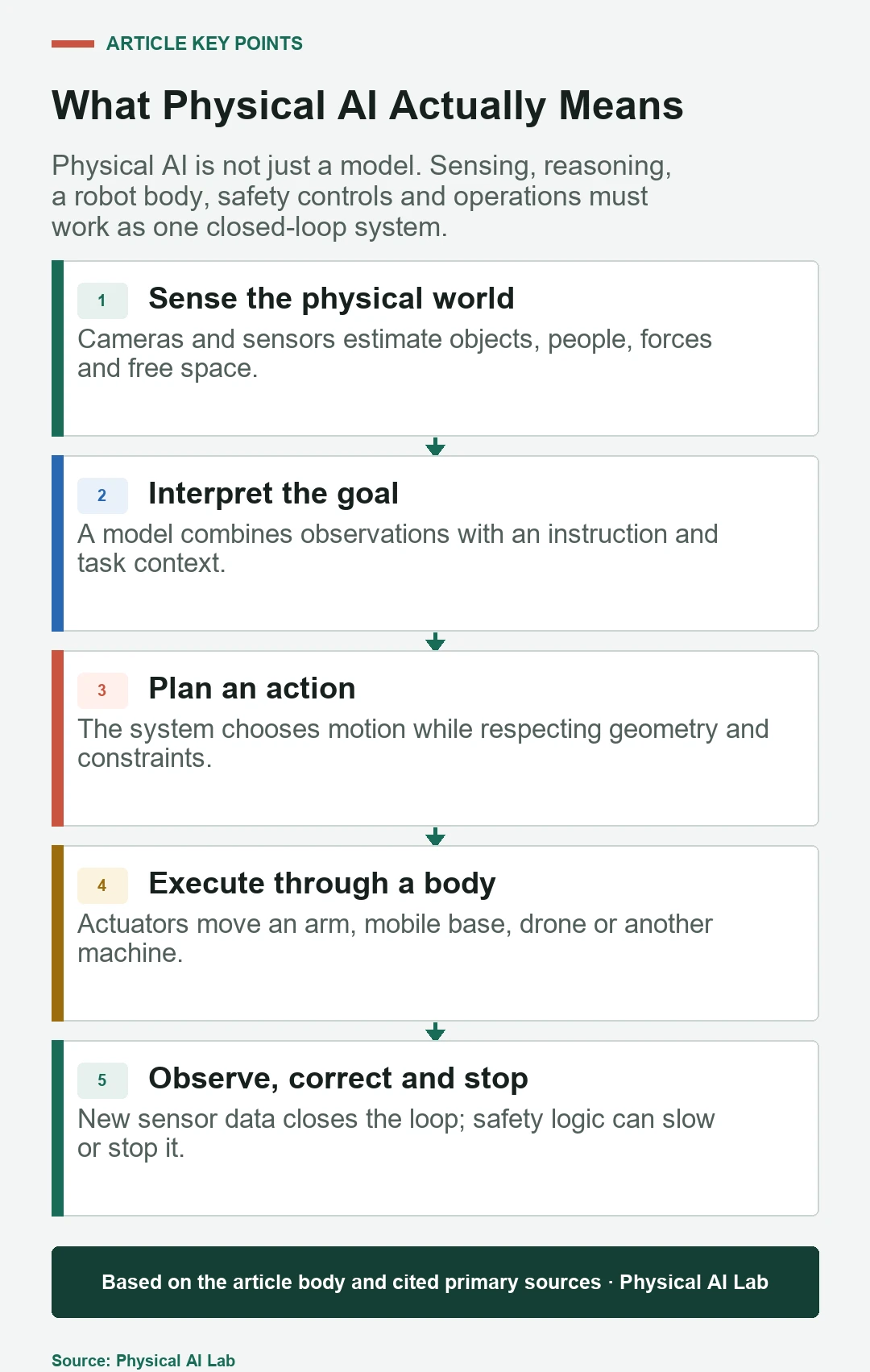
The shortest useful definition is this: physical AI closes the loop between sensing, intelligence and action in the real world. This guide explains that loop, how it differs from conventional automation and generative AI, and what evidence to request before treating a demonstration as a deployable system.
Physical AI definition
A physical AI system observes objects, people and conditions through cameras or other sensors; estimates the current state; selects an action; drives hardware; and measures what happened next. The feedback step matters because the same command can produce a different outcome when lighting, friction, payload or object position changes.
The term applies to more than humanoid robots. Autonomous vehicles, warehouse robots, inspection systems, drones and adaptive industrial machines can all use physical AI. The defining property is not body shape. It is the ability to connect perception and decision-making to action under real physical constraints.
How physical AI differs from generative AI and automation
Generative AI usually produces information: text, images, audio or code. Traditional automation usually repeats a pre-engineered sequence in a controlled environment. Physical AI sits between and beyond those categories because it must interpret a changing scene and adapt an action while remaining within safety and hardware limits.
The boundary is practical, not absolute. A robot can use a language model for task instructions and conventional motion control for a joint trajectory. The complete product becomes physical AI only when those components are integrated into a closed, testable loop that works on the machine.
| System | Typical input | Typical output | Primary failure cost |
|---|---|---|---|
| Generative AI | Prompt and digital context | Text, image, audio or code | Incorrect or unusable information |
| Traditional automation | Predefined sensor conditions | Fixed sequence | Stop, jam or quality loss |
| Physical AI | Changing sensor observations and goals | Adaptive physical action | Collision, damage, downtime or unsafe behavior |
The closed loop: perceive, estimate, plan, act and recover
Perception converts raw camera, depth, force and position signals into useful observations. State estimation combines those observations over time. Planning chooses a path or action. Control converts the plan into motor commands. Feedback reveals whether the intended result actually occurred.
A robust system also needs recovery. When a grasp slips or a route becomes blocked, it must detect the mismatch, stop or replan, and ask for human help when confidence is too low. Recovery policy is often the difference between a polished demonstration and an operational machine.
Embodiment makes intelligence measurable
A robot body imposes reach, payload, torque, speed, battery and thermal limits. Intelligence cannot command a pose the joints cannot reach or a force the actuator cannot deliver. Good policies treat those limits as part of the task rather than as an implementation detail.
Embodiment also makes claims measurable. Teams can record success rate, completion time, intervention rate, collision margin, energy use and recovery behavior. These metrics reveal whether improvements came from the model or from a carefully staged environment.
Why language grounding is harder for robots
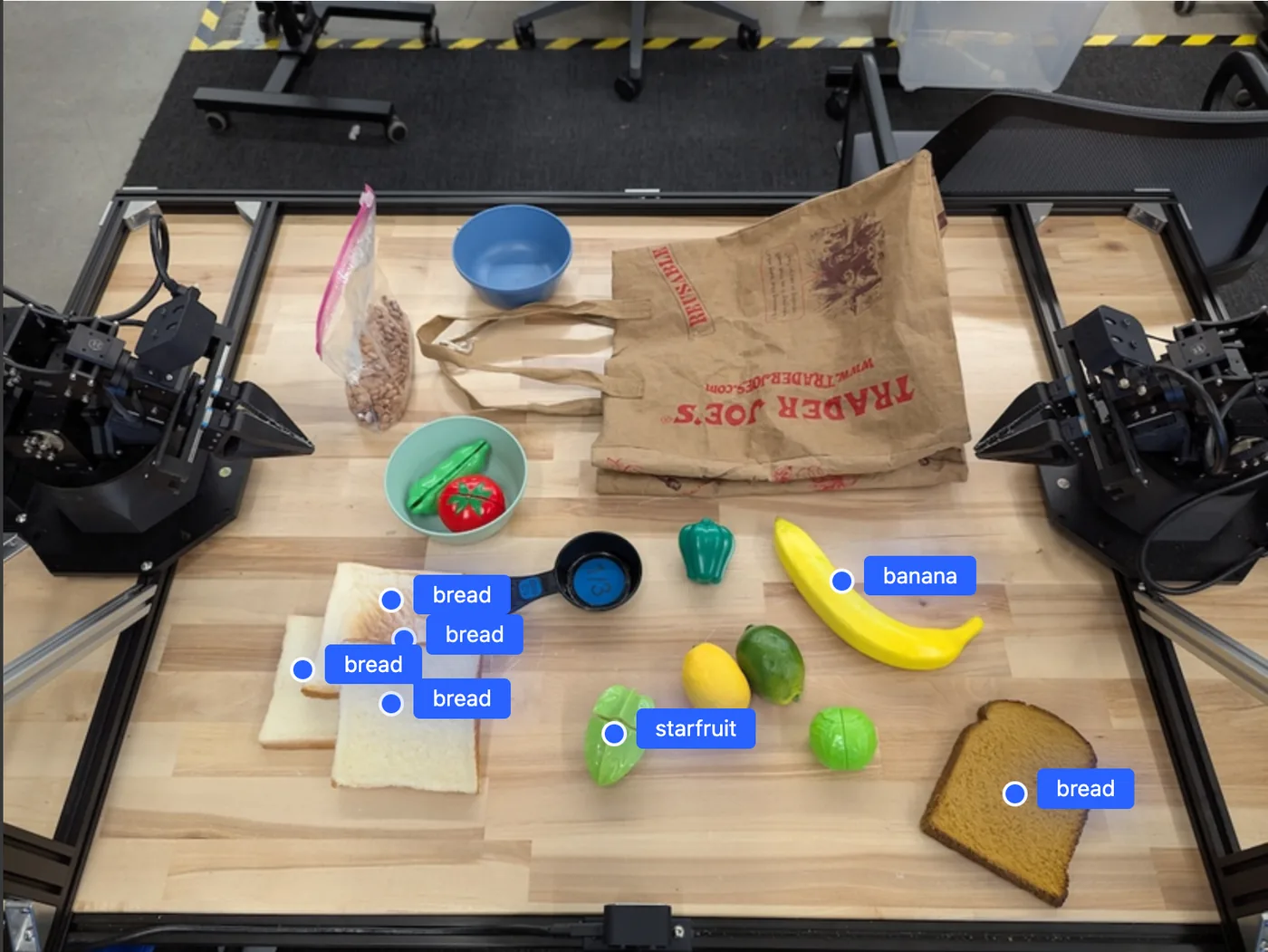
A command such as “pick up the red cup” must be grounded in a particular object, pose and safe approach. A vision-language-action model may connect visual observations and language to actions, but calibration, latency and control still determine whether the hand reaches the correct place.
Ambiguity must also be resolved physically. If two cups are red, the robot should gather more evidence or ask a question. Confidently selecting the wrong object is more costly than admitting uncertainty, so useful systems expose confidence and escalation rules.
Training data and simulation
Physical AI can learn from teleoperation, human video, robot logs, synthetic trajectories and reinforcement learning. Each source has different strengths. Demonstrations provide realistic intent, robot logs contain executable actions, and simulation can generate rare or risky conditions at scale.
Simulation is valuable only when the learned behavior survives the reality gap. The sim-to-real transfer guide explains why randomized appearance, dynamics calibration and real-world validation must be designed together rather than treated as a final export step.
Where physical AI is likely to work first
Early deployments favor tasks with economic value, repeatable workflows and bounded risk: material movement, inspection, machine tending, warehouse picking and structured service operations. These environments still vary, but the operating envelope can be described and monitored.
Homes are attractive but difficult because object placement, lighting, people and expectations change continuously. A household robot must handle a much longer tail of situations than a system deployed around a known set of bins, tools and routes.
- Start with one observable task and a clear completion condition.
- Define the allowed workspace, objects, payloads and human proximity.
- Measure interventions and recovery, not only successful trials.
- Expand the operating envelope after evidence, not before it.
Safety is a system property
No single AI model makes a robot safe. Risk reduction can include mechanical limits, guarded spaces, safety-rated sensing, speed and force limits, emergency stops, independent monitors and operating procedures. The correct combination depends on the machine, task and environment.
The AI policy should not be the only barrier between an error and harm. Safety functions need defined authority when the model is uncertain, communications fail or measured motion leaves the approved envelope. Validation must cover foreseeable misuse and faults as well as nominal task completion.
How to evaluate a physical AI claim
Ask what changed between training and evaluation: objects, backgrounds, operators, lighting, initial poses and disturbances. Request the number of trials, not just a highlight reel, and separate autonomous success from trials that required hidden resets or remote assistance.
Then inspect the full stack. A broad robot foundation model may improve task transfer, but deployment evidence still requires compatible sensors, action rates, calibration and recovery. Generality is a measured range, not a label.
| Evidence question | Useful answer | Warning sign |
|---|---|---|
| How many trials? | Total attempts and confidence interval | Only selected video |
| What was unseen? | Objects, scenes and conditions listed | “Novel” without a test split |
| How were failures handled? | Recovery and intervention counts | Failed trials removed |
| What is the operating envelope? | Payload, speed, lighting and workspace limits | Universal capability claim |
A practical deployment checklist
Write the task specification before selecting a model. Record the start state, completion state, time limit, acceptable contact, prohibited zones and human handoff. Build a representative test set that includes routine variation and known edge cases.
During pilots, log sensor inputs, model decisions, controller state, interventions and safety events on a shared clock. Review failures by cause rather than averaging them into one success rate. The result should support a go, restrict or stop decision for a defined operating envelope.
What to learn next
Three concepts provide a useful path forward: VLA models for connecting vision and language to action, sim-to-real transfer for moving policies out of simulation, and robot foundation models for reuse across tasks and embodiments.
Keep the systems view while learning each component. Better perception is not useful if latency destabilizes control; a capable policy is not deployable if it cannot recover; and an impressive body is not productive without task economics and maintainability.
Frequently asked questions
Is physical AI the same as robotics?
No. Robotics includes mechanics, electronics and control even when no adaptive AI is used. Physical AI refers to intelligence that closes the sensing-and-action loop through a physical system.
Does physical AI have to be humanoid?
No. Mobile robots, drones, vehicles and industrial systems can all use physical AI. Humanoid form is only one embodiment.
Is ChatGPT inside a robot physical AI?
Not by itself. A language model may interpret instructions, but the complete system also needs perception, grounding, planning, control, feedback and independent safety mechanisms.
What is the most important physical AI metric?
There is no single metric. Task success should be reported with intervention rate, recovery, safety events, completion time and the operating conditions under which the result holds.
Why is physical AI growing now?
Multimodal models, larger robot datasets, improved simulation and more capable hardware are advancing together. Deployment still depends on integration and real-world evidence.
Where This Definition Stops
This article explains engineering concepts and evaluation methods. It does not replace a task-specific risk assessment, safety validation or compliance review.