
RaaS usually reduces initial exposure when demand or in-house maintenance capacity is uncertain; a purchase can reach a lower cost per productive hour when workload is stable and the asset will be used for years. Make the decision on total cost per verified productive hour, not on the smallest monthly invoice.
Start with the RaaS operating model, connect measured uptime, MTBF, MTTR and OEE, and require FAT and SAT acceptance evidence. The formulas below are a decision framework, not tax, accounting or investment advice and not a return guarantee.
Fix the same task, horizon and cost boundary first
The comparison must answer one operational question: what will it cost to deliver the same accepted work, at the same service level, over the same number of months? A quote comparison is invalid when shifts, throughput, peripherals, staffing, safety controls or support hours differ between alternatives.
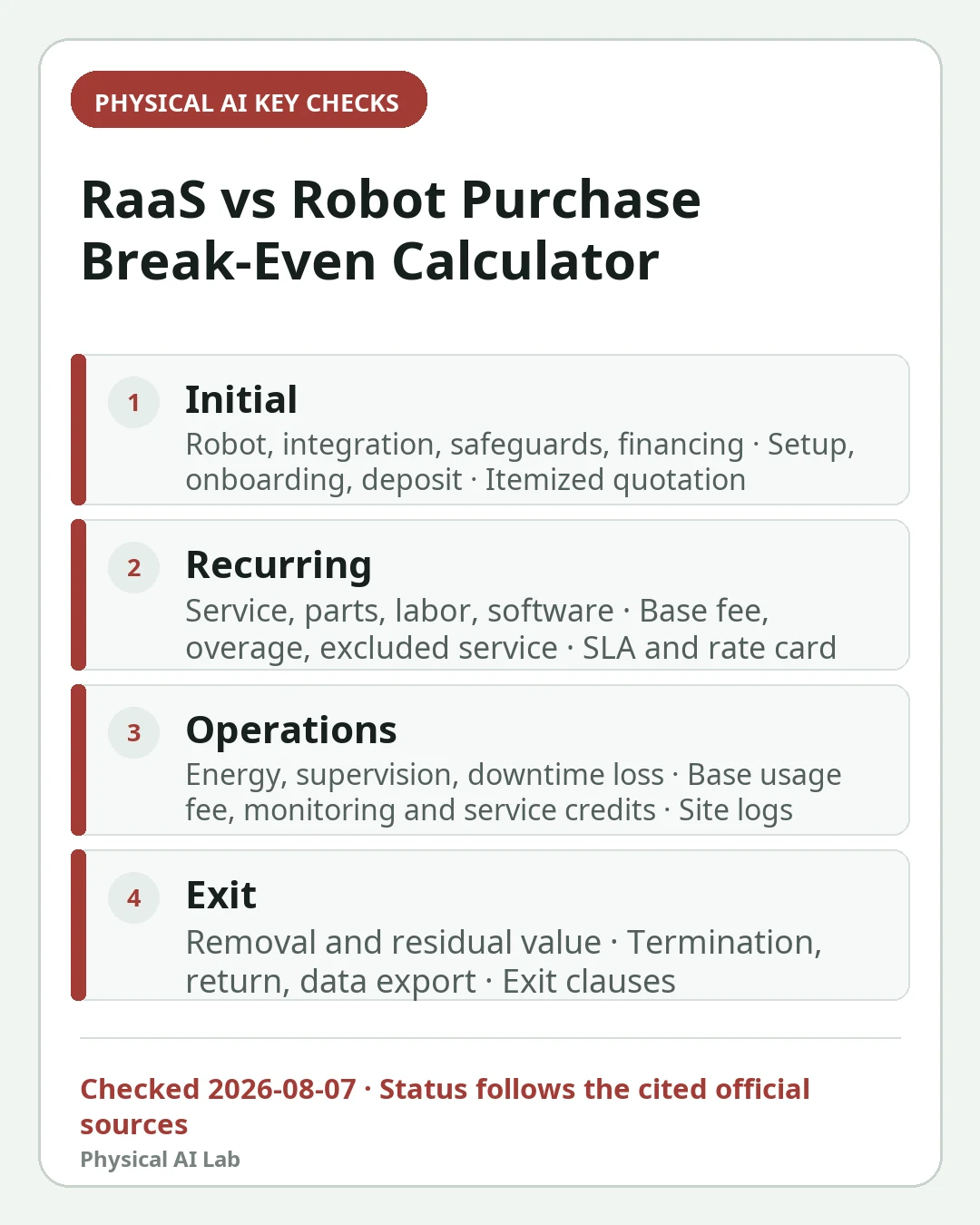
Put setup, the base subscription, included hours, overage charges, exclusions and exit costs on the RaaS side. Put acquisition, integration, financing, maintenance, spares, internal engineering, upgrades and residual value on the purchase side. Energy, supervision and lost production during downtime belong on both sides.
| Cost boundary | Direct purchase | RaaS | Evidence to retain |
|---|---|---|---|
| Initial | Robot, integration, safeguards, financing | Setup, onboarding, deposit | Itemized quotation |
| Recurring | Service, parts, labor, software | Base fee, overage, excluded service | SLA and rate card |
| Operations | Energy, supervision, downtime loss | Base usage fee, monitoring and service credits | Site logs |
| Exit | Removal and residual value | Termination, return, data export | Exit clauses |
Convert demand into verified productive hours
Scheduled hours are not productive hours. Subtract planned stops, faults, material starvation, human interventions and quality rework, then count only time that produced accepted units or completed tasks. If no pilot log exists, calculate low, base and high cases instead of presenting an unsupported point estimate.
For throughput work, divide monthly demand by a conservative effective throughput rate. Model seasonal or project demand month by month because an annual average hides minimum commitments, overage bands and the cost of an idle purchased asset. Record the unit definition so a vendor cannot count motion time while the buyer counts accepted output.
Calculate the monthly equivalent cost of ownership
A practical purchase equation is: acquisition plus integration, financing and planned upgrades, minus expected residual value, divided by evaluation months; then add monthly service, internal labor, energy and downtime loss. Residual value is uncertain, so test a range that includes zero rather than treating resale as guaranteed cash.
A simple payback period divides initial cash outflow by monthly net benefit, but a decision model should also represent ramp-up, financing, replacement parts and the timing of cash flows. When monthly net benefit is zero or negative in a scenario, label the result ‘no payback’ rather than forcing a positive number.

Calculate RaaS cost from commitments and exceptions
RaaS monthly cost equals allocated setup cost, base subscription, usage beyond included hours, internal operating labor, energy, excluded field service and downtime loss. ‘Maintenance included’ does not automatically include every part, consumable, travel charge, night callout or customer-caused incident; each boundary needs a contract citation.
The IFR 2025 service-robot release reports that almost 200,000 professional service robots were sold in 2024 and that the RaaS fleet grew by 31%. The accompanying IFR Sources and Methods describes a sample of 294 suppliers, so those market figures should not be converted into a return claim for one deployment.
The official IFR service-robot portal is a useful starting point for market categories and supporting publications, not a substitute for local evidence. Treat market adoption as context for supplier discovery; approval still needs site demand, signed commercial terms and measured operating performance.
Find where utilization and overage reverse the decision
Divide each option's monthly total by verified productive hours. The break-even point is the productive-hour level or evaluation month at which the two costs are equal. A purchase has a large fixed component that is spread over more output, while a RaaS curve can change slope at included-hour and overage thresholds.
Run one-way and combined sensitivity tests for uptime, MTTR, overage price, contract length and residual value. The directions below are common, not universal; use signed vendor quotes and site measurements to calculate the actual crossover.
| Variable change | Purchase effect | RaaS effect | How to verify |
|---|---|---|---|
| More productive hours | Fixed cost per hour falls | May enter an overage band | Monthly usage log |
| Lower uptime | Idle-asset cost rises | Depends on SLA relief | Incident and credit records |
| Longer horizon | Capital is spread further | Subscriptions accumulate | 12/24/36-month cases |
| Longer MTTR | Loss and labor rise | Recovery SLA and exclusions matter | Event-level recovery time |
Review contract responsibility beside the spreadsheet
For RaaS, define availability, planned exclusions, severity levels, response and restoration times, service credits, data export and return conditions. For a purchase, verify warranty limits, spare-parts horizon, software end of support, approval of safety-related changes and the maintenance work transferred to the buyer.
When modeled cost is close, recovery control, vendor lock-in, data ownership, cybersecurity updates and continuity if the supplier exits can decide the case. A service credit may be capped far below production loss, so do not subtract the full outage cost unless the contract truly reimburses it.
Ask both bidders to price the same failure scenario: one full production shift lost, a critical part replacement, an after-hours callout and export of operating data at contract end. A comparable scenario makes exclusions visible and prevents an apparently low base fee from hiding risk in different line items.
Use a pilot and retain a reversible decision record
Run representative tasks and measure throughput, first-pass yield, interventions, uptime, MTTR and energy. Preserve quote versions, exchange-rate dates, included and excluded services, formulas and raw log references so the model can be repeated when pricing or scope changes.
The approval memo should state not only the base-case winner but the utilization, price or SLA threshold at which the choice reverses. Reopen the decision when a threshold is crossed, and replace estimates with actual operating data each quarter after deployment.
Frequently asked questions
Is RaaS always cheaper than buying a robot?
No. It can reduce upfront exposure and maintenance burden, but accumulated subscription and overage charges can exceed ownership cost during a long, high-utilization deployment. Compare the same productive output and horizon.
What input matters most in the break-even model?
Verified monthly productive hours and uptime. Without them, the model understates both the cost of an idle purchased asset and the likelihood of RaaS overage charges.
Can a spreadsheet alone justify the contract?
No. Review availability definitions, recovery responsibility, data rights, exit charges, parts and update support, and safety ownership, then validate the inputs in a site pilot.
Official sources checked
- IFR Service Robots See Global Growth Boom
- IFR World Robotics 2025 Service Robots Sources and Methods
- IFR Service Robots portal
Last checked: August 7, 2026