Robot dataset mixture weighting determines how often each dataset or domain supplies an optimization sample. A collection holding 40 percent of stored frames does not necessarily receive 40 percent of gradient updates because samplers, episode length, filtering and action windows change exposure.
A useful mixture makes robot, task, site, operator, tool and outcome imbalance visible, then chooses weights for a declared deployment objective. Average performance must not hide collapse on a small but safety- or business-critical domain.
Use this guide with the robot data factory and robot data-quality audit. Version mixture rules, realized exposure and evaluation results together.
Distinguish storage share from training exposure
The sampler selects datasets, episodes and temporal windows at each step. Filtering, sequence length, distributed workers and dropped batches further alter realized exposure. Compute counts from the actual training iterator, not only the catalog.
Log requested and realized probabilities by domain and epoch. Alert when missing files, worker imbalance or exhausted shards silently changes the mixture.


Define domains from the deployment question
A domain may be an embodiment, task, site, operator, object family, camera setup, controller version or outcome. Hardware alone is often too coarse because two collections on the same arm can differ more by tool, workcell and instruction process.
Create hierarchical labels so analysis can aggregate or drill down. Preserve unknown values instead of assigning them to a convenient majority class.
| Mixture rule | Sampling probability | Advantage | Primary risk |
|---|---|---|---|
| Size proportional | Follows stored count | Represents collection volume | Large-domain dominance |
| Domain uniform | Equal across defined groups | Improves small-domain exposure | Repeats weak data |
| Temperature | Softens size imbalance | Tunable compromise | Sensitive exponent |
| Performance optimized | Targets validation objective | Can protect weak domains | Overfits proxy set |
| Scheduled | Changes over training | Supports curriculum | Harder attribution |
Compare proportional, uniform and temperature sampling
Size-proportional sampling preserves collection prevalence but can drown small tasks. Uniform-domain sampling protects coverage but can replay a tiny noisy dataset many times. Temperature sampling interpolates between these extremes through an explicit parameter.
Run matched-compute ablations and report both unique data and repeated exposure. A better mixture under extra updates or a different augmentation budget is not a clean comparison.
Optimize weights against a declared objective
The Re-Mix paper uses distributionally robust optimization to improve worst-case downstream-domain performance and reports results on Open X-Embodiment-derived mixtures. It also describes action normalization, discretization and early stopping in its method.
Treat those findings as research evidence, not universal weights. A private deployment may define domains differently and can overfit a small proxy validation set used to choose the mixture.
Separate success rate from failure diversity
A failure-heavy dataset can contain thousands of nearly identical terminal frames while missing distinct precursor mechanisms. Label failure type, onset, recoverability and operator response rather than weighting only a binary outcome.
Keep successful hard negatives that resemble failures. They prevent the policy or monitor from learning that any rare visual state requires stopping.
Cap repetition when oversampling small domains
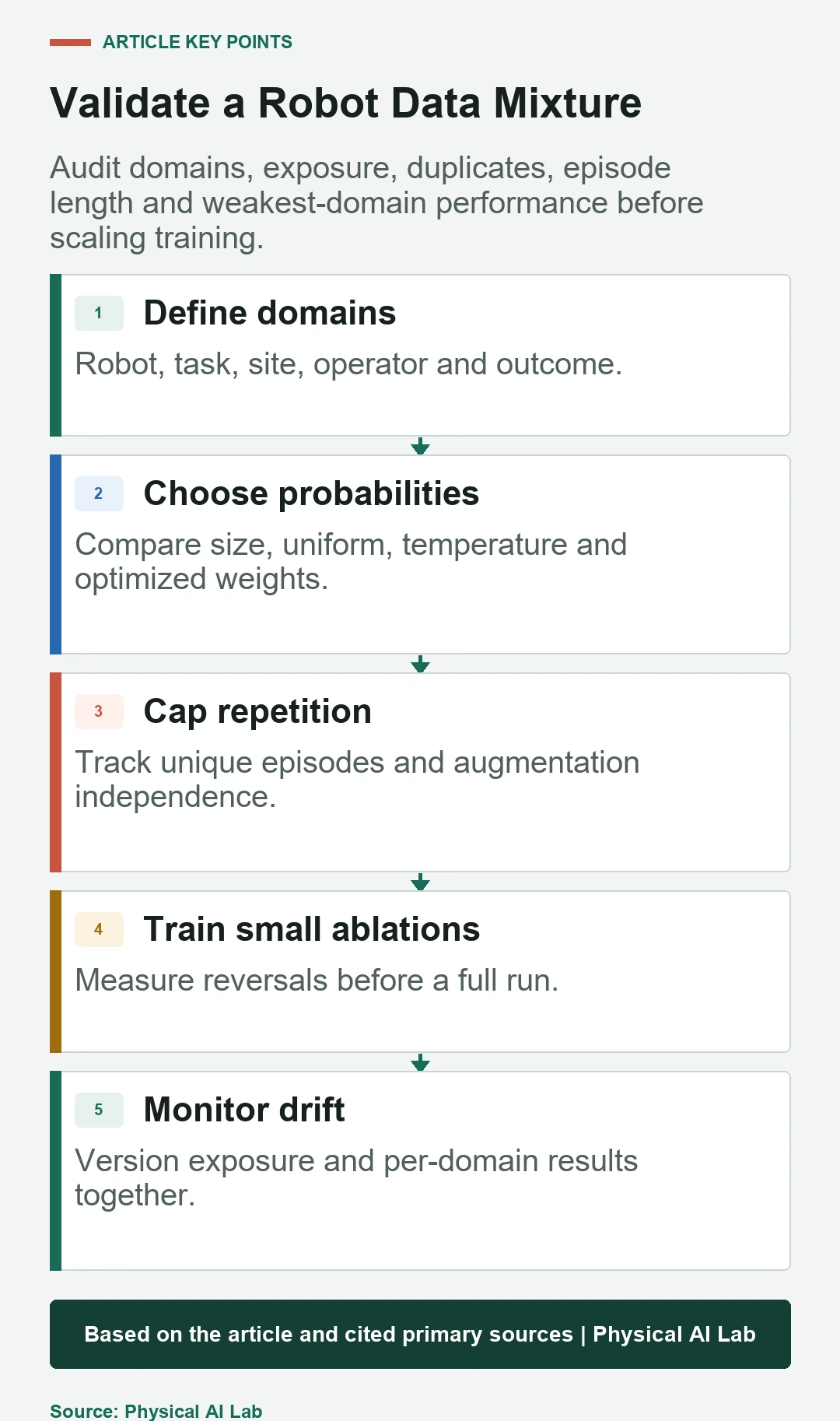
Oversampling increases exposure but not information. Track unique episodes per epoch, maximum reuse, near-duplicate clusters and label disagreement. Augmentation does not create independence when every view comes from the same trajectory.
Set a repetition cap or back off the weight when validation improvement stalls while memorization grows. Collect new diverse examples instead of indefinitely replaying a narrow source.
Normalize episode-length contribution
Sampling frames uniformly gives long episodes more updates, while sampling episodes uniformly gives each trajectory equal initial probability. Action chunks and temporal windows add another length-dependent multiplier.
Choose the unit that matches learning intent and log effective windows per episode. Use the action-chunking guide to preserve horizon and control-rate meaning.
Protect rare critical domains
Some domains are small because events are rare, expensive or hazardous, not because they are unimportant. Minimum sampling floors can preserve coverage, but weak labels or unrealistic simulations can still mislead the policy.
Define critical-domain acceptance separately and require held-out hardware evidence. Do not trade a severe regression for a small improvement in the global mean.
Measure average and worst-domain performance
Report task success, precision or control metrics per domain with sample count and uncertainty. Include macro average, exposure-weighted average and worst-domain or lower-tail performance so readers can see the tradeoff.
The Open X-Embodiment project demonstrates large multi-robot mixture training, while any new mixture still needs its own held-out robots, tasks and environments.
Monitor mixture drift during long training
Shard availability, filtering, newly added data and adaptive sampling can change realized mixture over time. The model also changes which domains are weak, so a useful curriculum may differ between pretraining and adaptation.
Version every schedule transition and evaluation checkpoint. Avoid changing weights, learning rate and data cleaning together when the goal is causal diagnosis.
Use small ablations before full-scale runs
Train shorter matched-compute runs across candidate weights and look for performance reversals, instability and saturation. Small runs cannot predict every scaling effect, but they can reject mixtures that immediately erase a critical domain.
Connect results to the robot VLA evaluation guide and finish with hardware trials. Preserve seeds, sample traces and checkpoint selection rules.
| Audit | Measure | Warning | Response |
|---|---|---|---|
| Exposure | Draws and unique episodes | Requested differs from realized | Fix sampler |
| Duplication | Reuse and similarity | Tiny domain memorized | Cap or recollect |
| Length | Windows per episode | Long trials dominate | Change unit |
| Performance | Per-domain and worst case | Average hides collapse | Add floor or weight |
| Drift | Exposure by training phase | Untracked schedule change | Version transition |
Release with a mixture specification
Document domain taxonomy, dataset versions, sampling hierarchy, probabilities, schedules, repetition limits, episode unit, split, evaluation objective and stop conditions. Store realized sample traces with the training run.
Close validation with the following checklist.
- Define domains from the deployment claim.
- Measure realized training exposure.
- Cap repetition and audit duplicates.
- Report average and weakest-domain outcomes.
- Version mixture schedules, data and model checkpoints together.
Frequently asked questions
Is size-proportional mixing the most natural default?
It is transparent, but large collections can dominate and erase small deployment-critical domains.
How many times should a small dataset be oversampled?
There is no universal multiple; set a cap from uniqueness, noise, memorization and held-out improvement.
Will adding more failure data improve recovery?
Only if failure mechanisms, precursor context and recovery labels are useful and normal hard negatives remain represented.
Can mixture weights change during training?
Yes, but schedule changes and realized exposure must be versioned so effects remain interpretable.
Which mixture metric matters most?
Use per-domain performance and a declared lower-tail or critical-domain criterion alongside the global average.
Training-Exposure and Weakest-Domain Boundary
A data mixture is an optimization policy, not a folder ratio. Preserve realized exposure, uniqueness and weakest-domain outcomes with every model checkpoint.