Solix can automate the trip into a refill station and back to fieldwork. That answers a narrow, useful question: must someone visit the robot for every refill? It does not tell a farm how much preparation, supervision or recovery work remains. Assess the automated transfer and the surrounding jobs separately before changing a staffing plan.
In its August 25, 2026 announcement, Solinftec reports more than 1,700 autonomous refills and more than 45,000 gallons transferred through July. It describes docking, refilling and returning to work without a farmer making that refill trip. These are company-reported results; the release does not supply a farm-by-farm account of interventions or operator hours.
A completed refill is one part of a completed job
Picture a robot ready to replenish its tank while the farm team is working elsewhere. A successful transfer could avoid an interruption to that other work. Now change one condition: the station lacks the required supply, or the transfer cannot finish. The useful question becomes who notices, who responds and how long the field task waits. These are evaluation scenarios, not documented Solix faults or descriptions of its control logic.
Keep three records separate: a refill completed, a field task completed and an operator called to intervene. Compare those records with the support time needed to complete the field task.
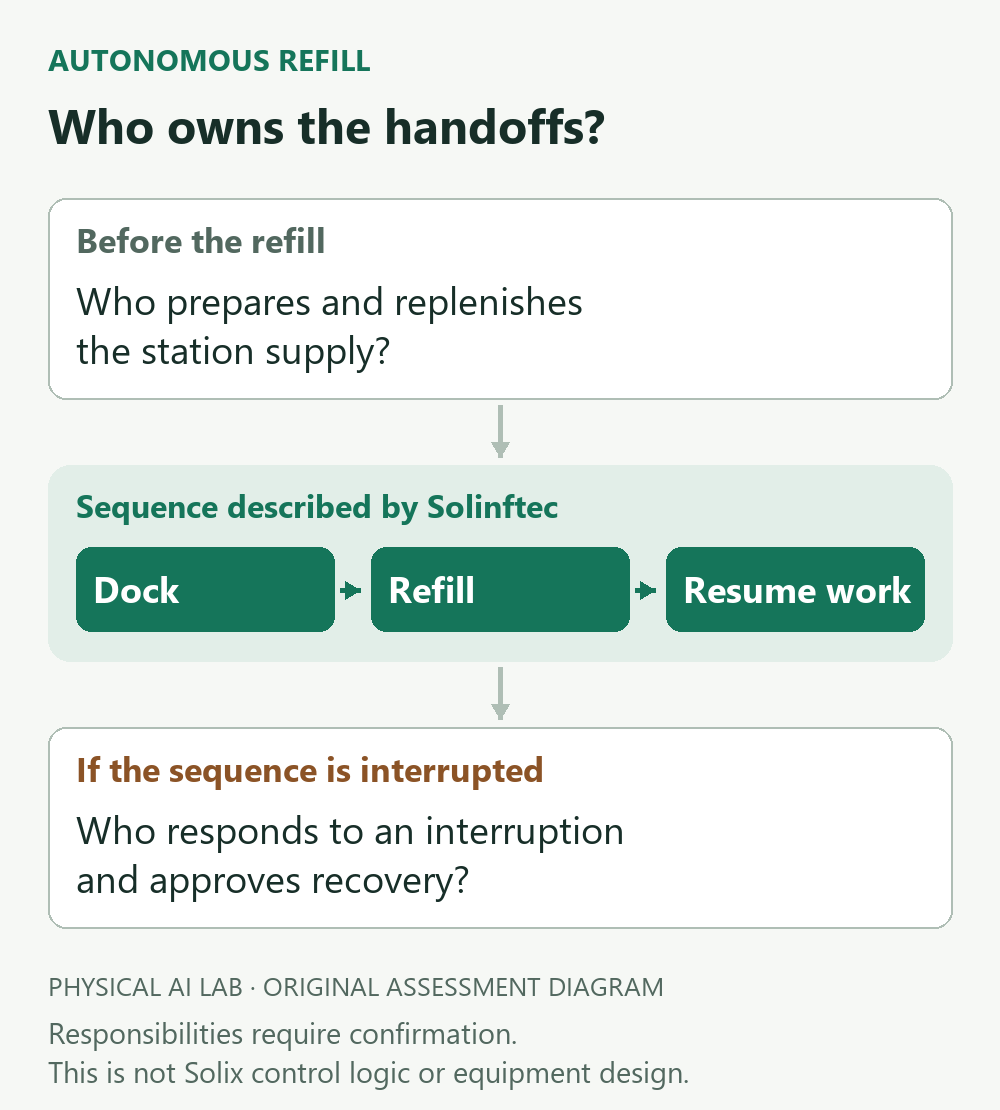
Agree who owns the handoffs
Solinftec also describes remote management, vendor support and farmer-performed routine repairs in the same release. It does not provide the full division of work between farm, retailer and supplier. Use that gap to frame the demonstration or service discussion.
| Ask the supplier and farm team | Record before the trial |
|---|---|
| Who prepares and replenishes the station’s supply? | Named role, required visit and time spent |
| Who selects the field task and approves a restart? | Decision owner and escalation contact |
| What happens when docking or transfer cannot finish? | Alert, responsible responder and recovery procedure supplied by the vendor |
| What happens if the monitoring connection is lost? | Documented system behavior and contact route |
| Which servicing and repairs require a site visit? | Work scope, parts responsibility and response commitment |
This table is a list of questions to resolve, not an operating procedure. The announcement does not establish product preparation, communications-failure behavior or intervention frequency. Obtain the instructions for the exact robot, station and software configuration being evaluated.
For the wider distinction between remote oversight and physical recovery, see our LaserWeeder fleet-operations analysis in Korean. It concerns a different machine; its procedures should not be transferred to Solix.
Measure the work around the refill
For a farm trial, compare like field tasks and keep a simple event log. Record the task and area, supply visits, successful and failed refill attempts, alerts, operator minutes, travel and time waiting for recovery. Identify which entries are measured and which are estimates. An unattended interval is useful evidence only when its start, end and exceptions are recorded.
Include setup and end-of-day service in the comparison. Moving a visit from the middle of a field task to the start of the day may improve scheduling even if total labor changes little. Conversely, a successful transfer can save a trip while a later recovery consumes that saving. A log makes both outcomes visible.
The result to seek is a change in completed fieldwork and human workload under comparable conditions. A count of refills alone supplies neither a staffing number nor a payback period.
Request a demonstrated recovery, not just a normal cycle
Ask the supplier to walk through a normal refill and explain one interrupted cycle using a procedure the supplier approves for the trial. Confirm how an interruption is reported, who responds and what evidence marks the field task as ready to continue. Do not induce faults in a working machine to test these questions.
Leave the discussion with the exact configuration, a written allocation of responsibilities and a trial log both parties can review. That is enough to test whether automatic refill removes a costly interruption for this farm. It also makes visible any work that has merely moved to another person or another part of the day.
Source checked September 8, 2026 (Korea Standard Time). This article evaluates the operating boundary described in the August announcement; it does not verify later product launches or commercial availability.