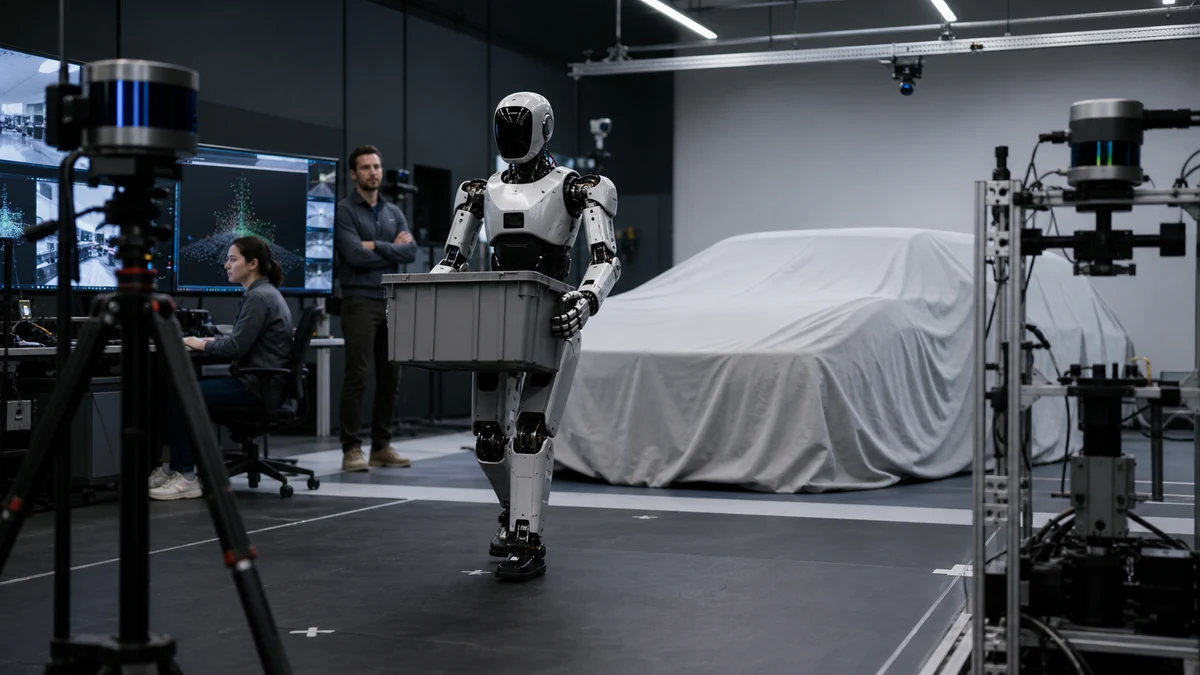
MenteeBot V3 is the humanoid platform of Mentee Robotics, which Mobileye says it acquired in early February 2026. The official MenteeBot product page lists a height of 175 cm, mass of 70 kg, speed of 1.5 m/s, payload up to 25 kg and 40 degrees of freedom, but it does not publish a retail price or a general order flow.
Mobileye's acquisition agreement announcement set expectations for initial customer-site proofs of concept in 2026 and a target of series production and commercialization in 2028. Neither statement establishes a completed customer deployment or guaranteed launch. Place the deal in the broader physical AI company landscape, but judge this product by dated evidence.
What is confirmed now: specifications and a completed acquisition
After announcing an agreement in January, Mobileye's first-quarter 2026 results said the acquisition closed in early February. It is therefore outdated to describe the transaction as merely pending, yet equally wrong to infer scaled robotics revenue or customer deployment from the corporate closing.
The V3 specifications are a useful first filter, not an acceptance result. A maximum payload and walking speed do not describe every posture, floor, duty cycle or safety setting, and a 40-DoF count does not reveal task success, grasp reliability or autonomous recovery. Those outcomes require a repeated protocol on the intended embodiment and workload.
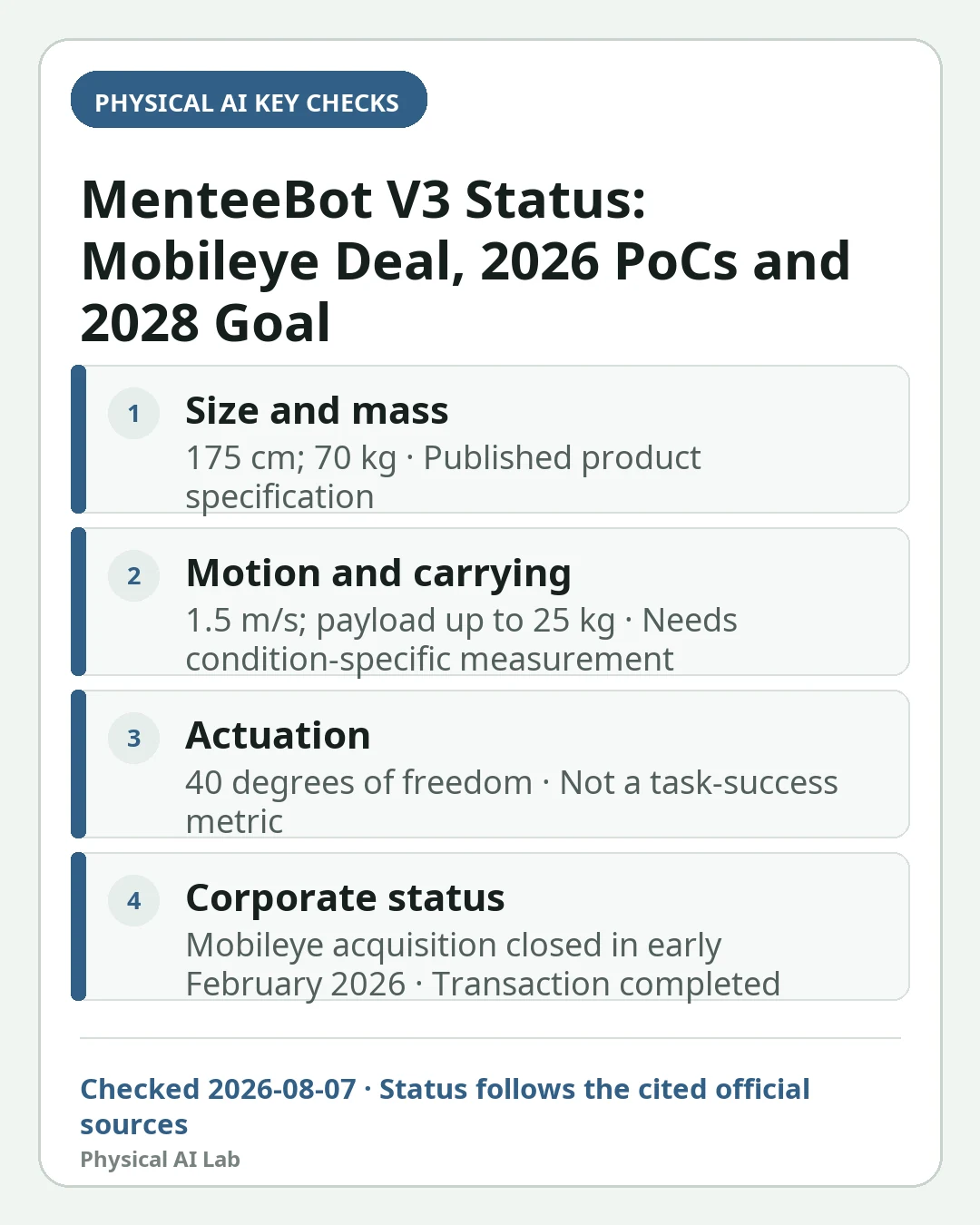
| Item | Officially disclosed | What it means today |
|---|---|---|
| Size and mass | 175 cm; 70 kg | Published product specification |
| Motion and carrying | 1.5 m/s; payload up to 25 kg | Needs condition-specific measurement |
| Actuation | 40 degrees of freedom | Not a task-success metric |
| Corporate status | Mobileye acquisition closed in early February 2026 | Transaction completed |
| Sales status | No public price or general checkout identified | Commercial terms remain inquiry-based |
Read the AI First page as an architecture claim, not an uptime report
Mentee's AI First page describes Sim2Real training, NeRF-based 3D mapping and localization, dynamic navigation, language-model interaction and a hot-swappable battery. These are the company's description of its approach; they are not an independent report of sustained customer-site reliability.
The page includes different demonstrations labeled as not teleoperated and teleoperated. A non-teleoperated clip should not be generalized to every behavior, and a swappable battery should not be converted into a verified 24-hour utilization figure. The Sim-to-Real guide explains why simulation coverage still leaves sensing, contact and operational gaps.
The warehouse video is a demonstration, not a named deployment
The official warehouse-task page shows company media of mobile manipulation. It does not disclose a customer, site, total number of trials, complete failures, intervention rate or months of production operation. It should be cited as a capability demonstration and nothing stronger.
A useful review asks who prepared the initial state, whether teleoperation or off-camera resets were used, how many consecutive runs were attempted and what happened after a missed grasp or localization error. Statements about learning unfamiliar tasks also need a defined train-test split and full logs before they support a claim of broad autonomy.

Separate the 2026 PoC plan from the 2028 production target
Mobileye said the first customer-site proofs of concept were expected in 2026. Expected does not disclose the customer, site, start date, completion or outcome. A signed evaluation, installed robot, completed acceptance test and paid production operation are separate milestones and should remain separate in any status tracker.
The 2028 statement is a target for series production and commercialization, not a promised consumer release date, volume, price, certification or delivery schedule. A business case should treat it as a conditional milestone whose prerequisites include reliable PoC evidence, a support model and a manufacturable configuration.
| Date or horizon | Official event or plan | Evidence class | Unsupported upgrade |
|---|---|---|---|
| January 6, 2026 | Acquisition agreement announced | Signed transaction announcement | The deal had already closed that day |
| Early February 2026 | Acquisition completed | Confirmed in quarterly results | Scaled robot revenue began |
| During 2026 | Initial customer-site PoCs expected | Forward-looking plan | Customer PoCs have succeeded |
| 2028 | Series production and commercialization target | Company target | Guaranteed retail launch and delivery |
Mobileye capabilities do not transfer to humanoids automatically
Mobileye framed the acquisition around complementary computer vision, mapping, simulation and AI capabilities. That strategic fit may accelerate development, but road perception and indoor whole-body manipulation have different sensors, contact dynamics, action spaces and safety cases. Automotive scale is not itself evidence of a solved humanoid task.
The integration should be evaluated through released interfaces, product revisions, customer PoC reports and repeatable metrics. Deal value, staffing and a parent's market position can explain strategic commitment, but they cannot substitute for task completion, recovery and service data from the robot.
A useful PoC contracts for data and recovery, not just a demo
Decompose the job into navigation, perception, grasp, transport and placement, with observable pass conditions at each stage. Record protective stops, dropped objects, localization loss, remote assistance and human reset time along with the final success rate. Otherwise a high-level success number cannot identify whether the bottleneck is the model, hardware or operation.
Agree before testing who owns video, state, action and failure labels; how long they are retained; and whether they may be used for model training. The robot data factory guide shows how field failures can feed a controlled improvement loop. Quality and traceability of rare failures matter more than an unqualified claim of a large dataset.
What to verify before procurement or investment
The public record reviewed here does not establish list price, standard lead time, installed customer count, long-duration uptime or planned 2028 production volume. Do not fill these gaps with market estimates or edited event footage; require a current configuration sheet, support terms and dated statements from Mentee or Mobileye.
A PoC launch announcement is less informative than a completion report. Look for run counts, confidence intervals, recovery and intervention rates, safety events, hardware failures and maintenance time under a named task. Those records determine whether the platform can move from an interesting demonstration to an operational system.
Frequently asked questions
Has Mobileye completed its acquisition of Mentee Robotics?
Yes. Mobileye's first-quarter 2026 results state that the acquisition closed in early February 2026. Closing the transaction does not demonstrate scaled MenteeBot deployments or robotics revenue.
Is MenteeBot V3 already working at customer sites in 2026?
The official announcement said initial customer-site PoCs were expected in 2026. The reviewed public sources did not establish a named customer's completed PoC or disclose its results as of August 7, 2026.
Will anyone be able to buy MenteeBot in 2028?
That cannot be concluded. The company describes 2028 as a series-production and commercialization target, not a guaranteed retail release date, price, sales territory or delivery commitment.
Official sources checked
- Official MenteeBot V3 product page
- Mentee Robotics AI First technology page
- Official MenteeBot warehouse-task demonstration
- Mobileye announcement of the Mentee Robotics acquisition agreement
- Mobileye first-quarter 2026 results and acquisition update
Last checked: August 7, 2026