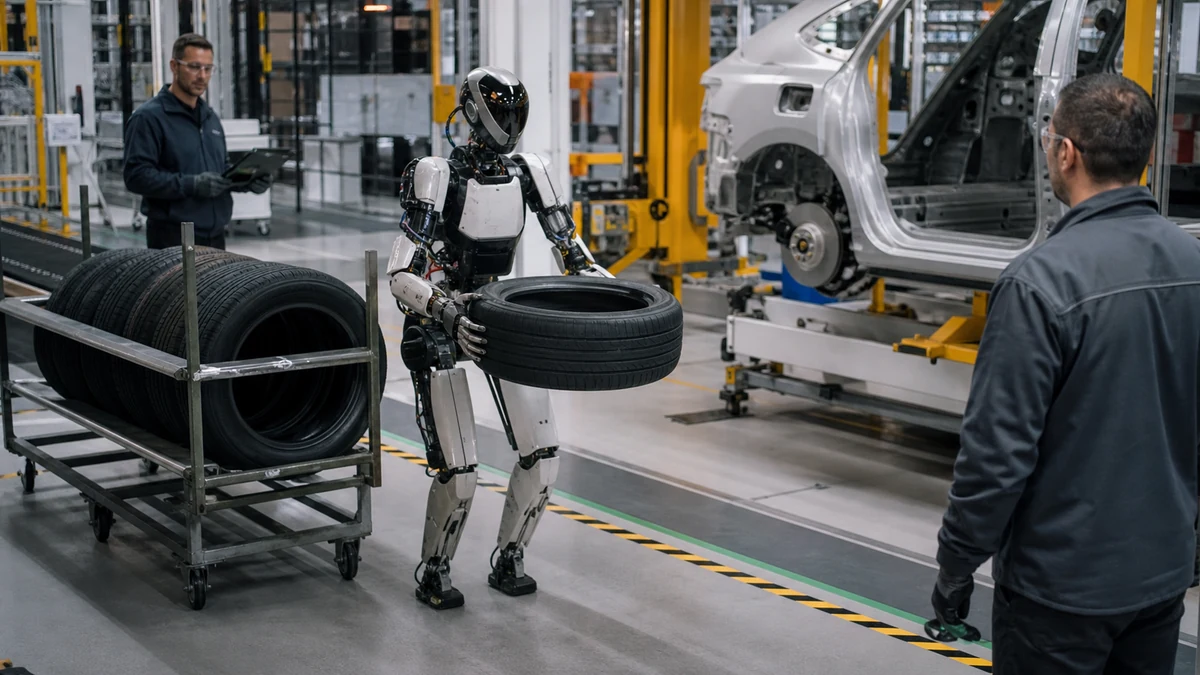
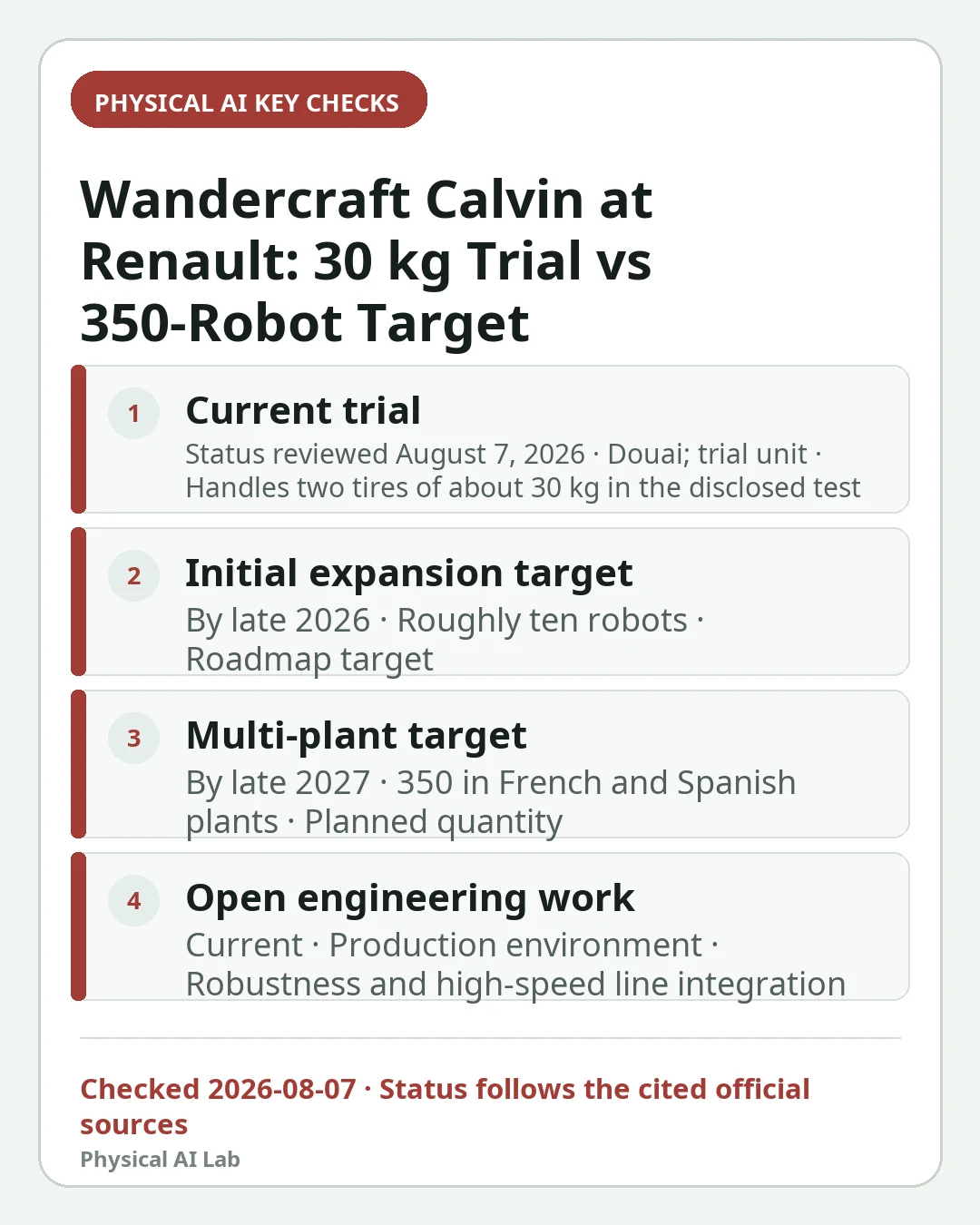
As of August 7, 2026, Wandercraft Calvin is being tested at Renault's Douai plant on a task that handles two tires weighing about 30 kg. The Renault Group account describes a target of roughly ten robots by the end of 2026 and 350 across French and Spanish plants by the end of 2027; those future numbers are not the current operating fleet.
The official Calvin-40 page describes carrying capability in the 40 to 50 kg range, a design for eight to 22 hours of continuous operation, 12 use cases and a target failure rate. These are supplier specifications or goals and must remain separate from Renault's disclosed 30 kg trial. Use the humanoid video evaluation guide when a demonstration is the main evidence.
The deployment story has three different stages
The strongest present-tense statement in the official material is that Calvin is being tested at Douai. Renault identifies a two-tire task of approximately 30 kg and explicitly says robustness and integration into a high-speed production environment remain challenges. That language is materially narrower than a fully accepted production rollout.
The approximate ten-unit and 350-unit figures are different future milestones. Combining them into an installed total, or turning one trial task into autonomous operation across a plant, would remove the time and evidence boundaries that make the announcement useful.
| Stage | Time | Place or quantity | Supported statement |
|---|---|---|---|
| Current trial | Status reviewed August 7, 2026 | Douai; trial unit | Handles two tires of about 30 kg in the disclosed test |
| Initial expansion target | By late 2026 | Roughly ten robots | Roadmap target |
| Multi-plant target | By late 2027 | 350 in French and Spanish plants | Planned quantity |
| Open engineering work | Current | Production environment | Robustness and high-speed line integration |
The 30 kg trial and the 40 to 50 kg claim answer different questions
Thirty kilograms is the approximate load of the two-tire task disclosed by Renault. The 40 to 50 kg range is a broader Calvin carrying description. It does not establish that every posture, reach, speed, travel distance and duty cycle can use the maximum figure, and it should not overwrite the actual trial description.
Part geometry, grasp point, arm moment, walking speed, floor condition and collision margin all change the feasible cycle. A plant should use its real tires, racks and route to measure repeated completion, rather than converting a nominal load into a production throughput promise.
Sensors create observability, not automatic reliability
Renault lists an inertial measurement unit at each joint, force sensors under the feet and an RGBD camera. Those components can observe posture, contact and the scene, but sensor presence alone does not establish safe mixed-worker operation, object recognition accuracy, slip recovery or long-duration stability.
A site test should introduce camera occlusion, lighting variation, displaced tires, changing foot contact and communication faults. Every protective stop, human assist, retry and wrong pickup belongs in the record; a selected success clip cannot define the autonomous operating envelope.

Keep the supplier's claims beside Renault's site language
Wandercraft says Calvin has been trained for 12 general use cases covering 70 percent of industrial and logistics demand and that three are in deployment. The product page also says the robot is designed for eight to 22 hours of continuous operation and identifies a failure-rate goal below one in one thousand.
Coverage, deployment, operating duration and failure language are supplier claims or targets. Renault's current description remains a Douai trial with open robustness and line-integration work. Attribution prevents an aspirational fleet specification from being reported as a customer-verified KPI.
| Measure | Official wording | Evidence boundary | Site validation needed |
|---|---|---|---|
| Current task | Two tires, about 30 kg | Douai trial | Consecutive cycles, failures and intervention |
| Carrying range | 40 to 50 kg | Condition-dependent product description | Posture, speed and duration matrix |
| Operating duration | Designed for eight to 22 hours | Design statement | Charging, service and measured availability |
| Use cases | 12 cases covering 70 percent; supplier claim | Not a customer-wide acceptance result | Task-specific pass conditions |
| Failure rate | Target below one per thousand | Target, not achieved fleet result | Denominator, failure definition and complete logs |
Funding and partnerships support scale but do not prove delivery
Wandercraft's Series D announcement describes 75 million dollars in funding, a minority investment by Renault and Renault's position as the first commercial partner and customer. That is meaningful commercial evidence, but it is not evidence that all 350 planned robots have been delivered and accepted.
The separate Wandercraft-SAPA partnership announcement concerns future industrial work in Italy. Its quantities and first-in-Europe language should not be imported into Renault's current fleet count. Leadership and first claims should remain attributed to the organization making them.
Use factory and site acceptance tests for each expansion gate
A factory acceptance test should cover repeated motion, limits, sensor faults, maintenance procedures and a defined task in the supplier's controlled environment. Site acceptance at Douai should then use real tires, racks, floors, workers and line cadence. The robot FAT versus SAT guide explains why passing one does not automatically pass the other.
Scaling toward 350 units also requires standardized spares, remote support, technician training, configuration control and software rollback. A robot that repeats one demonstration reliably will still fail to scale if each plant uses a different interface and no fleet-level recovery process.
The operational scorecard needs uptime and recovery
Track successful cycles, cycle time and handled load alongside protective stops, human assists, retries, charging, planned maintenance and unplanned repair. Apply the definitions in the robot uptime, MTBF, MTTR and OEE guide so that the numerator and denominator stay comparable across shifts and plants.
Evidence of progress from a trial to ten and then 350 robots should be installation, site acceptance, production use and sustained operating data, not simply another order announcement. The schedule may change as robustness, safety and line integration improve, so reporting should preserve both the target date and the date each gate was actually passed.
Frequently asked questions
Are 350 Calvin robots already operating in Renault factories?
No. The disclosed present state is a trial at the Douai plant. The 350 figure is Renault's target for French and Spanish plants by the end of 2027.
Is Calvin's payload 30 kg or 50 kg?
The roughly 30 kg figure describes Renault's current two-tire trial. The 40 to 50 kg range is a broader product carrying description that still requires validation by posture, speed, duration and task.
Does eight to 22 hours mean verified site uptime?
No. Wandercraft says Calvin is designed for that continuous-operation range. Measured availability must include charging, stops, maintenance and failures from the actual site log.
Official sources checked
- Official Wandercraft Calvin-40 product page
- Renault Group account of the Calvin trial
- Wandercraft and SAPA deployment partnership announcement
- Wandercraft Series D and Renault relationship announcement
Last checked: August 7, 2026