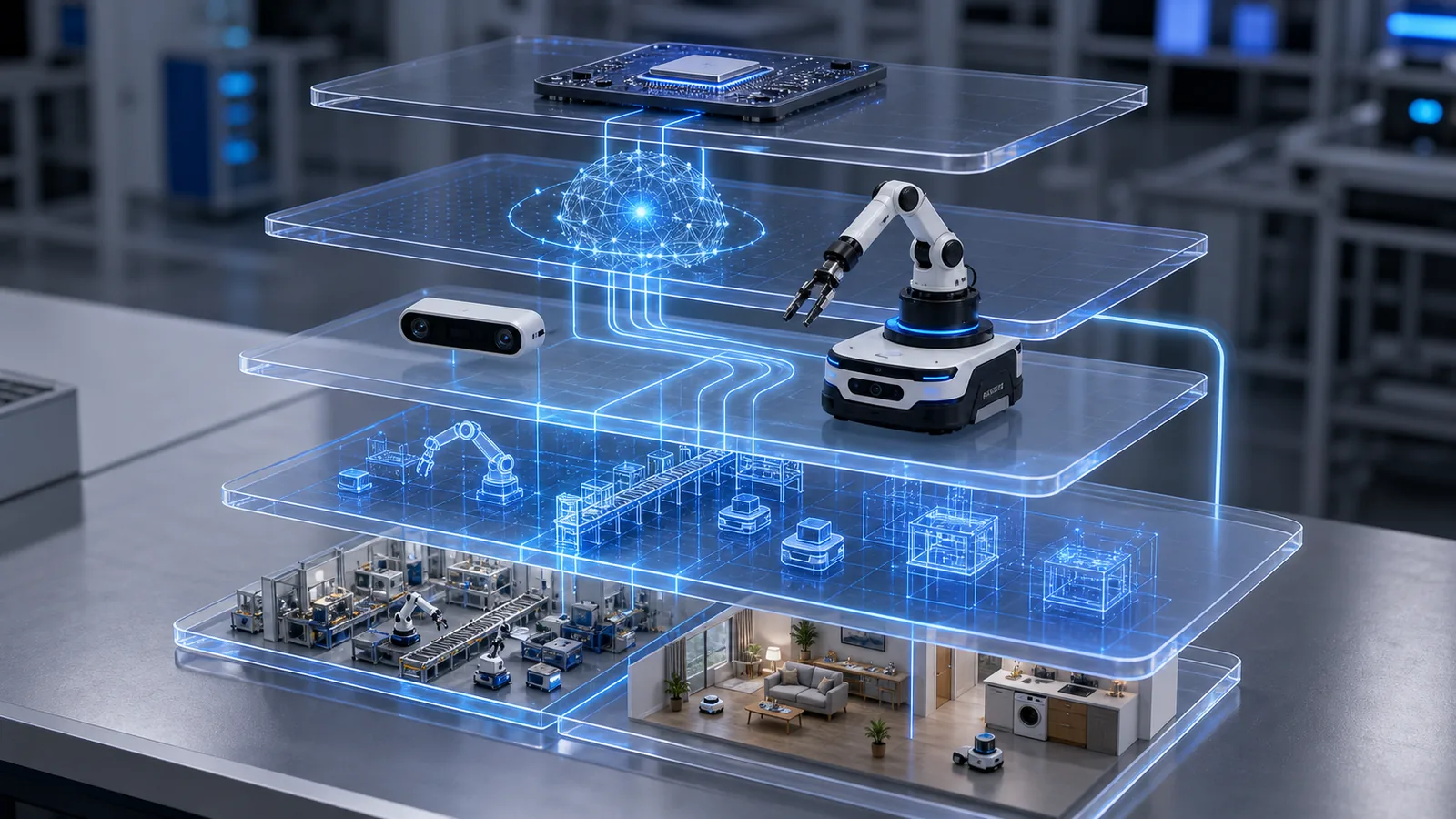
A robot foundation model is a broadly pretrained model intended to be adapted across many robot tasks, environments or embodiments. The foundation-model idea comes from language and vision: invest in diverse pretraining once, then reuse the learned representation instead of building every task policy from zero.
Robotics makes that objective harder. Data arrives from different cameras, coordinate frames, action spaces and control rates. A skill learned on one arm may not map directly to another arm, and a visually familiar task may involve different forces or reach limits.
The useful question is therefore not whether a model carries the foundation label. It is what is shared, how adaptation works and how much measured performance transfers to conditions that were truly held out.
Robot foundation model definition
A robot foundation model learns from a large and varied collection of observations, instructions and actions, then serves as a base for downstream robot behavior. The reusable part may be a visual encoder, a world representation, an action policy or a model that combines several of these functions.
It belongs to the broader physical AI stack. Pretraining may improve recognition and task transfer, but the deployed robot still needs calibrated sensors, compatible actions, stable control, safety supervision and recovery.
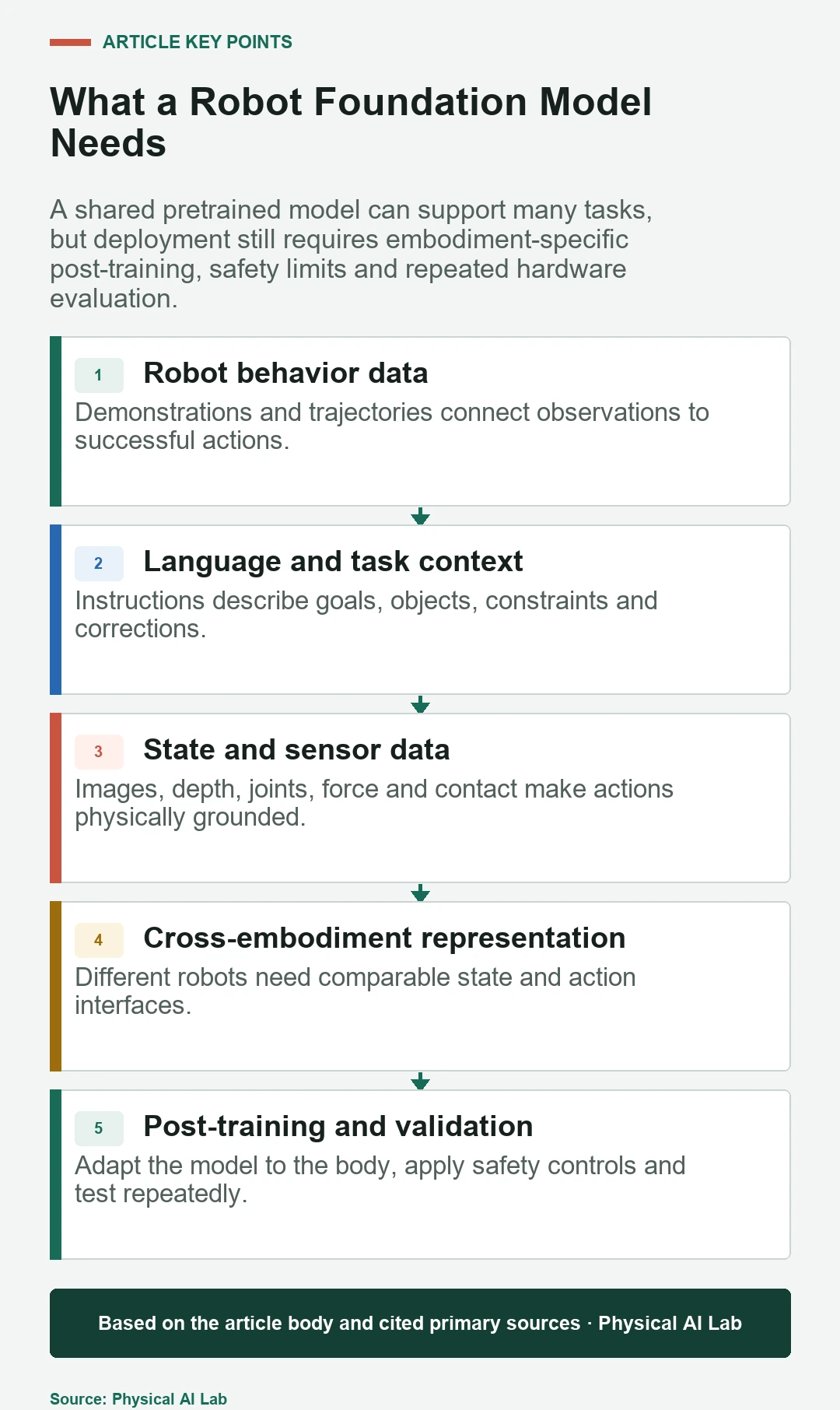
Foundation is an objective, not a guarantee
The word foundation suggests broad reuse, but there is no single threshold that makes a robot model foundational. Two models can use the label while differing greatly in task breadth, robot diversity, available weights and adaptation cost.
Evaluate the claim through disclosed evidence: training data scope, held-out evaluation, baseline comparisons and performance after a stated amount of adaptation. A model is more useful when another team can reproduce that process.
How robot foundation models differ from VLAs
A vision-language-action model is defined mainly by modality and output: vision plus language produces actions. A robot foundation model is defined mainly by the breadth and reuse ambition of its pretraining.
A model can be both. A broadly pretrained VLA that adapts across tasks and robots fits both descriptions. A robot foundation model could also provide representations for planning or prediction without directly generating low-level actions.
| Term | Defined by | Question to ask |
|---|---|---|
| VLA | Vision and language inputs with action output | What action representation and feedback rate? |
| Robot foundation model | Broad pretraining and downstream reuse | What transfers, to what, with how much adaptation? |
| World model | Prediction of future state or observations | How accurate is prediction for planning-relevant events? |
| Generalist robot policy | One policy covers several tasks | Were tasks and conditions truly held out? |
The heterogeneous robot data problem
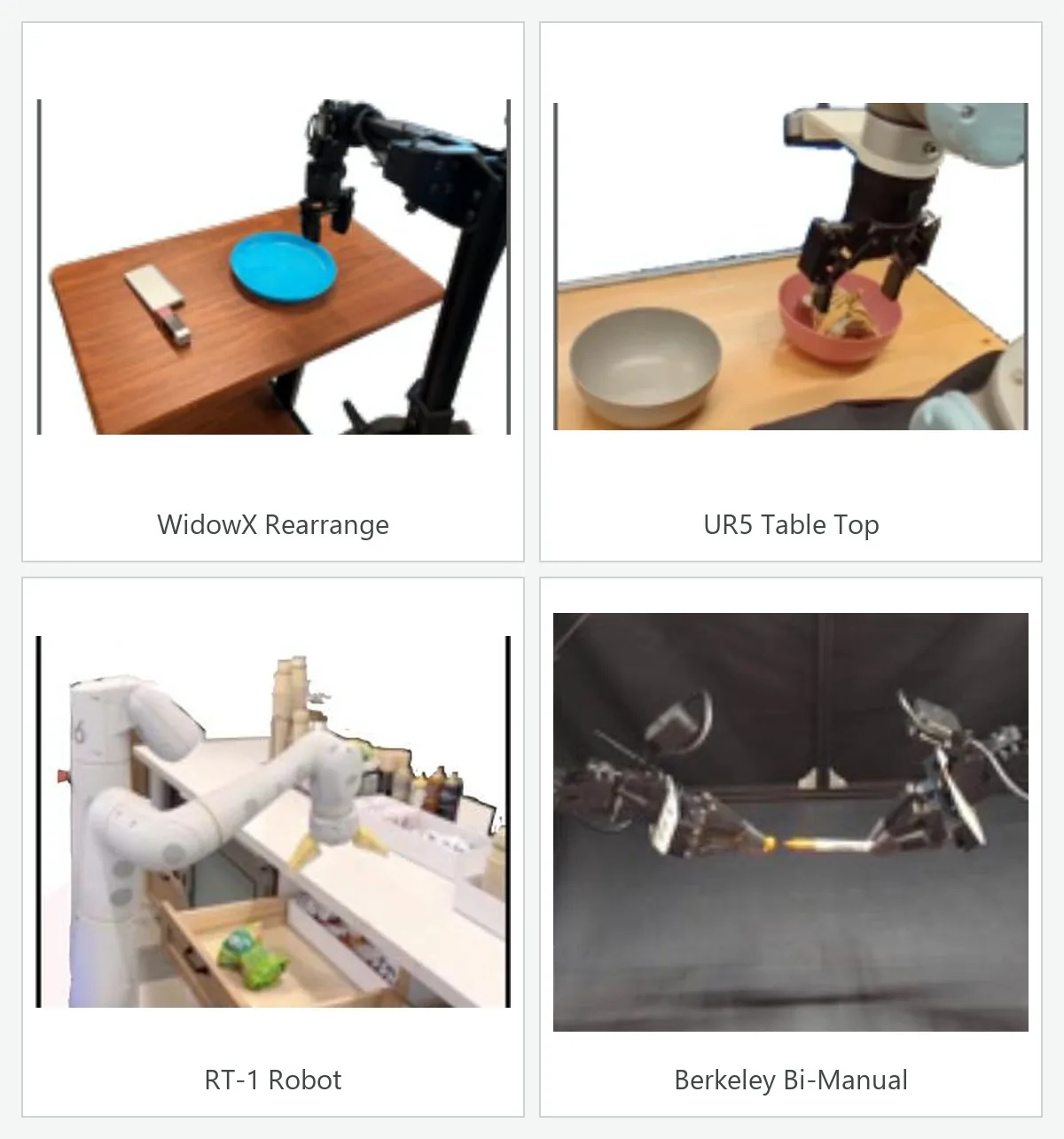
Robot datasets vary in joint count, camera placement, sampling frequency, gripper type, coordinate frames and quality. Projects such as Open X-Embodiment make that heterogeneity visible across many robot data sources. Even the same task label may hide different motions and success definitions. Combining records without preserving this context can teach inconsistent actions.
A strong data pipeline keeps embodiment metadata, timestamps, calibration, task language, outcomes and intervention labels. It also documents which data may be redistributed and which is only available through a trained model.
Shared action representations
Cross-robot learning often maps native actions into a common space such as end-effector deltas, normalized joint commands or discretized tokens. The common representation should retain task-relevant control while acknowledging embodiment limits.
Normalization can hide important differences. A unit action on a small arm and a large arm may imply different speed, force and reachable distance. Deployment needs an embodiment adapter and limit checks, not just the shared token sequence.
Pretraining objectives and model components
Training objectives can include action prediction, masked modeling, contrastive alignment, future observation prediction and language-conditioned behavior. Different objectives produce different strengths, so downstream success should guide selection.
Some stacks freeze a pretrained visual or language backbone and train a robot action head. Others update the full model or use mixture-of-experts routes. Report which parameters changed during adaptation because compute, data need and forgetting risk differ.
Adaptation methods
Common approaches include full fine-tuning, parameter-efficient adapters, behavior cloning on a small task set, prompt or goal conditioning and residual learning around an existing controller. The right method depends on data volume and how far the new robot is from pretraining.
Adaptation should include a frozen evaluation set representing intended variation. Training success alone cannot reveal overfitting, and comparison to a task-specific baseline shows whether foundation pretraining actually reduced data or improved robustness.
- Define the target robot interface and action rate.
- Measure a task-specific baseline before adaptation.
- Track trainable parameters, data hours and compute.
- Evaluate held-out objects, scenes and disturbances.
- Retain a regression suite for previously supported tasks.
Cross-embodiment transfer
Transfer across robot bodies is stronger evidence than transfer across tasks on one fixed robot, but it is also more difficult. Kinematic reach, sensing, gripper behavior and control frequency all change how an action should be interpreted.
Report zero-shot results separately from results after target-robot fine-tuning. Also report the amount of target data and any hand-authored adapter. Otherwise a successful adaptation may be mistaken for direct generalization.
Evaluation needs several holdout axes
A meaningful benchmark can hold out tasks, objects, scenes, instructions and embodiments. The split should prevent near-duplicate trajectories or frames from leaking between training and testing. Robot datasets with continuous video make this especially important.
Results should include trial counts, uncertainty, interventions and recovery. Average success across many tasks can conceal complete failure on one safety-critical subset, so task-level and condition-level results are necessary.
| Holdout | What it tests | Leakage risk |
|---|---|---|
| Object | Perceptual and grasp transfer | Same instance in another trajectory |
| Task | Skill composition and instruction grounding | Near-identical action sequence |
| Scene | Robustness to background and layout | Adjacent frames from one recording |
| Embodiment | Action and morphology transfer | Target robot present in pretraining |
Simulation and synthetic data
Simulation can expand task diversity and generate labels unavailable in reality. The sim-to-real transfer problem still applies: policies may exploit rendering, perfect state or dynamics that hardware cannot reproduce.
Synthetic data is most useful when the team names the gap it is meant to cover and tests that condition on real robots. More generated episodes do not automatically improve a model if they amplify an irrelevant or biased distribution.
Deployment limits and safety
A general pretrained policy can produce unexpected behavior outside its data distribution. Runtime limits should constrain workspace, speed, force, action change and command validity. Independent safety functions must retain authority when the model or compute stack fails.
Operational monitoring should detect changes in sensors, objects, task mix and intervention rate. Model updates need regression tests because improving new capabilities can alter old ones, even when the robot interface remains unchanged.
How to evaluate a robot foundation model claim
Ask what was reused: representation, policy weights, action tokenizer, data pipeline or only model architecture. Then ask what changed for the target task and how that adaptation compared with training a smaller task-specific policy.
Request data provenance, licenses, evaluation splits, trial counts, compute needs and failure results. Finally, check whether the stated breadth matches the tested breadth. Generality should be described as a measured operating range, not inferred from a model name.
Frequently asked questions
What makes a robot model a foundation model?
Broad pretraining intended for reuse is the core idea, but practical value depends on demonstrated transfer, adaptation cost and reproducibility.
Is every VLA a robot foundation model?
No. A VLA may be trained for one robot and task family. It becomes foundation-like when broad pretraining supports measured reuse across downstream settings.
Can a robot foundation model control any robot?
No. Sensor inputs, action spaces, timing and physical limits differ. An adapter and robot-specific validation are usually required.
Do foundation models reduce robot data needs?
They can, but the reduction must be measured against a baseline at the same target performance. Some tasks still need substantial target data.
Are open weights enough for reproducibility?
No. Data formats, preprocessing, action definitions, adaptation code, robot configuration and evaluation protocol also affect results.
What the Foundation-Model Label Does Not Prove
Model capabilities and licenses change. Verify the version, permitted use and system-level evidence before selecting a model for deployment.