WRC 2026 is most useful as a map of how robot suppliers connect with real use cases. Pre-event material listed Beijing on August 19–23, about 300 exhibitors, more than 2,000 exhibits and over 150 product debuts; those figures describe the announced scope, not verified attendance or completion.
What the official event material confirms
The official event material confirms the dates, scale, four exhibition areas and target applications across manufacturing, logistics, food service, retail, health care, caregiving, public safety and disaster response. It does not establish that any particular product has reached volume production or outperforms its alternatives.
This guide keeps reported facts separate from our analysis. Event and company figures are used only within the date and scope stated by their sources; undisclosed prices, delivery schedules and success rates remain unknown.
| Item | What is confirmed | What to verify |
|---|---|---|
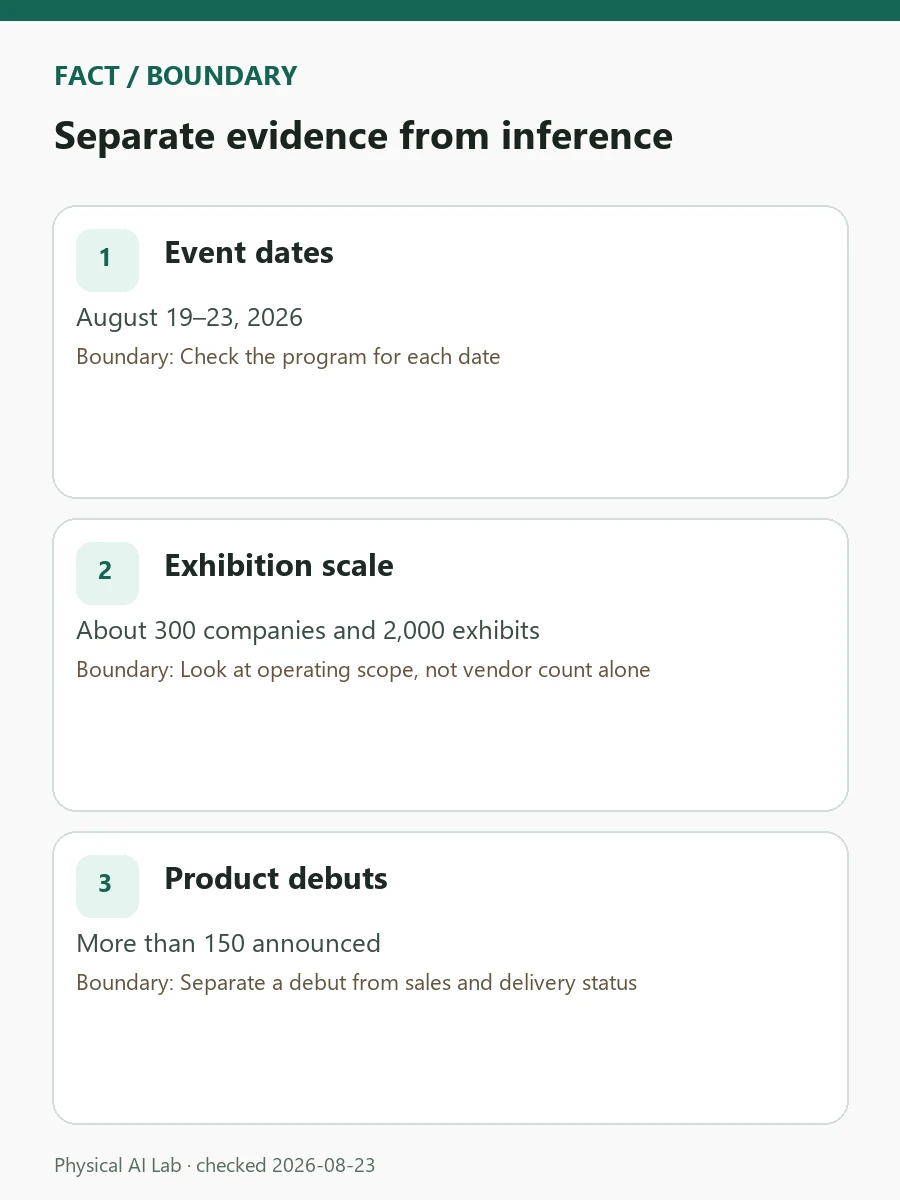
| Event dates | August 19–23, 2026 | Check the program for each date |
| Exhibition scale | About 300 companies and 2,000 exhibits | Look at operating scope, not vendor count alone |
| Product debuts | More than 150 announced | Separate a debut from sales and delivery status |
A complete robot stack matters more than a single demo
The useful question on the show floor is not whether a demo works once, but whether the entire loop—from sensor input through decision, control and recovery—can repeat. A product becomes a deployable system only when the vendor can also explain developer tools, spare parts, safety procedures and maintenance staffing.
Physical AI performance does not end with a perception model. Sensor time synchronization, state estimation, planning, low-level control, safety limits and post-failure recovery must operate as one continuous chain for the same task to be repeated reliably.
Three questions to ask before deployment
Ask for the failure conditions before asking for the highlight reel. Record how many times the same task was attempted, when a person intervened and how long recovery took after a stop. Those answers separate an impressive demo from a system that can run on site.
| Check | Question to ask |
|---|---|
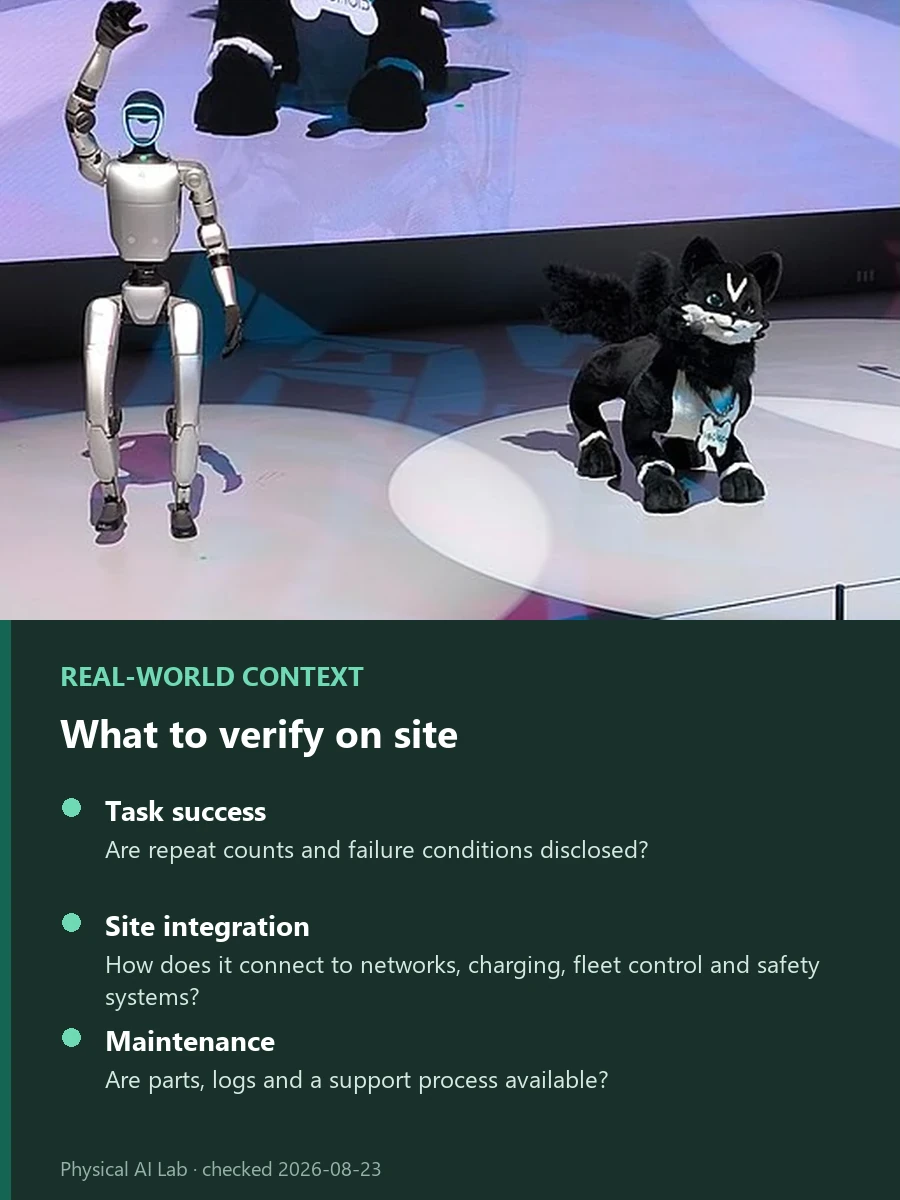
| Task success | Are repeat counts and failure conditions disclosed? |
| Site integration | How does it connect to networks, charging, fleet control and safety systems? |
| Maintenance | Are parts, logs and a support process available? |

A debut is not the same as a commercial product
More than 150 first showings do not equal 150 products ready for deployment. A debut, preorder, limited pilot, volume shipment and repeat customer rollout are different commercial stages.
Official material is still event or company communication. If customer-site data, independent testing or regulatory documentation becomes available, the assessment in this guide should be updated.
Use these background guides to read the show floor
Use the physical AI company ecosystem to identify the layers represented at WRC, the robot simulator comparison to question validation claims and edge AI for robots to examine onboard constraints. This August 2026 guide applies those lenses to the event as a whole.
What to take away
The pre-event WRC 2026 program framed the venue as a place where robot supply chains and real applications might connect, rather than merely as a stage for one or two machines. A post-event judgment still needs repeatable performance under the same conditions and clearly disclosed deployment requirements—not the size of the announcement.
Frequently asked questions
What evidence would show that a WRC exhibit is more than a show-floor demo?
Look for a published ordering route, a defined configuration, delivery and support terms, and repeated runs under named conditions. A display becomes deployment evidence only when a buyer can trace the same system from demonstration to operation.
Which performance metrics should I request first?
Do not look at task success alone. Ask for the human-intervention rate, mean recovery time, continuous operating time and documented failure conditions. Those four measures help distinguish a demo from field operation.
Which WRC exhibits deserve a closer look?
Prioritize systems that disclose repeat counts, failure conditions, intervention rate, recovery time and the infrastructure they need. A smaller deployment-ready system is more informative than a larger one-off demo.
Official sources checked
- Beijing municipal government's official WRC 2026 event guide
- Invest Beijing's WRC 2026 industry overview
- World Robot Conference official service platform
Last checked: August 23, 2026