Edge AI for robots means running AI processing on or near the machine that produces the sensor data and consumes the decision. Camera frames, lidar scans and robot state can be processed without sending every observation to a distant data center. The result can reduce network dependence, data transfer and decision latency.
Edge does not mean that every workload must run on the robot. Training large models, aggregating fleet logs, building maps and distributing updates may remain centralized. The design question is which function must continue safely and responsively when bandwidth drops, latency changes or the cloud is unavailable.
The edge is one part of the Physical AI loop. Perception and short-horizon decisions can run close to control, while non-real-time analytics use remote resources. A clear latency and failure budget is more useful than labeling the complete product edge AI.
Onboard inference reduces the age of sensor information
A camera frame becomes less useful as the scene changes. Sending it through a variable network path can make a detection stale before the robot acts. Local preprocessing and inference remove a round trip and allow the same clock and data path to be measured as part of the robot system.
Latency still includes exposure, sensor transfer, decoding, memory copies, inference, planning and command delivery. Model benchmark time alone is not the control-loop delay. Measure the timestamp of acquisition against the time the action reaches the actuator interface.
Robot compute combines CPUs, accelerators and controllers
A CPU handles operating-system services, communication and control logic. A GPU or neural accelerator can run vision and learned models efficiently. Microcontrollers and real-time processors handle deterministic motor loops and safety-related I/O. Workloads should be assigned by deadline and criticality, not marketing category.
NVIDIA’s JetPack documentation describes an edge development environment with accelerated computing, multimedia and computer-vision libraries. Other platforms use different accelerators and toolchains. Benchmark the actual model, precision and sensor pipeline on the intended production module.
| Compute layer | Typical role | Timing need | Failure concern |
|---|---|---|---|
| Microcontroller | Motor and device I/O | Deterministic and fast | Missed control deadline |
| CPU | System, planning and communication | Mixed | Resource contention |
| GPU or NPU | Vision and learned inference | Throughput and latency | Memory or thermal limit |
| Cloud or data center | Training and fleet analysis | Usually non-real-time | Network loss or delay |
A small robot shows the physical integration problem
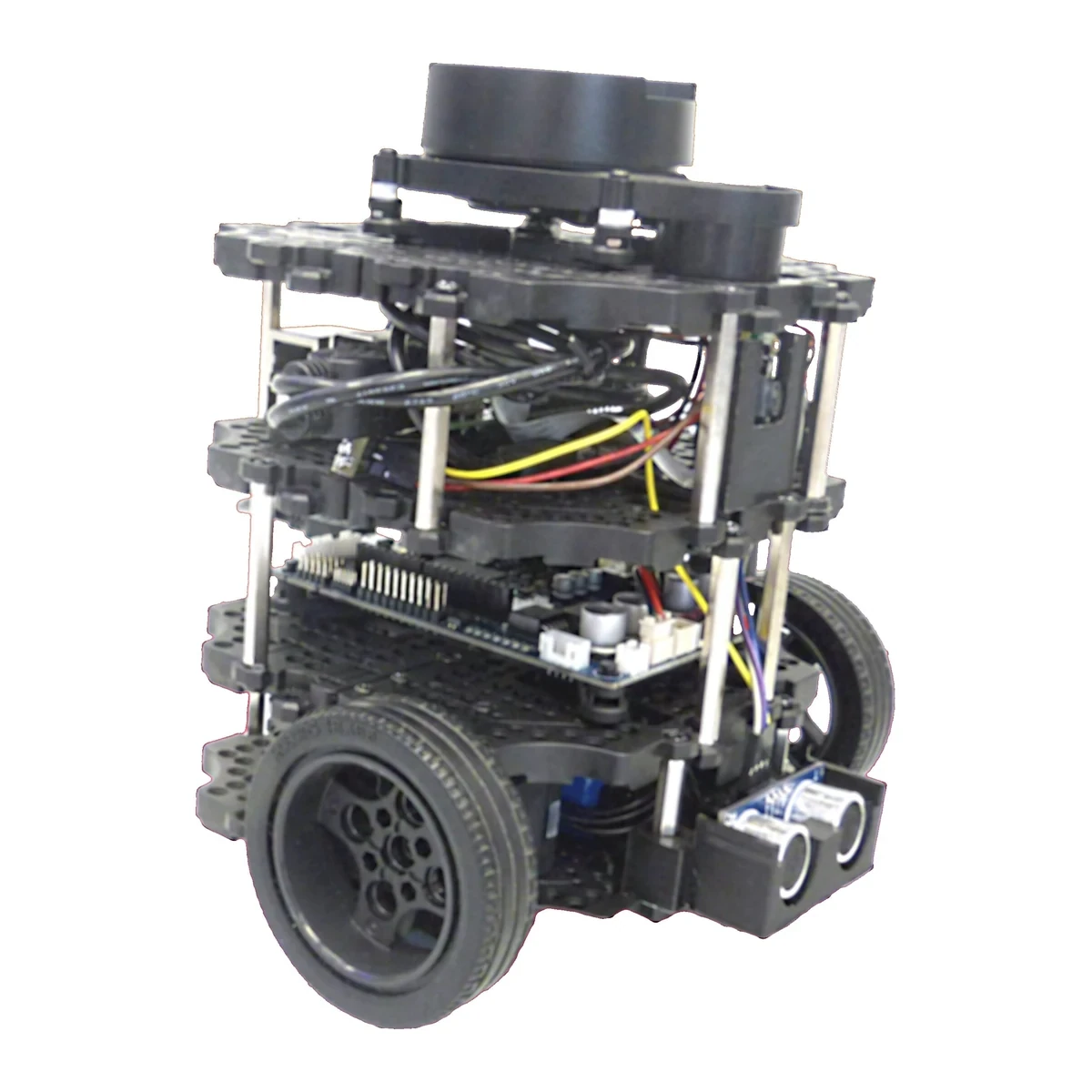
Onboard compute must share space, power, cooling, connectors and electromagnetic conditions with sensors and actuators. Vibration can loosen connections, and cable routing can obstruct motion or service. Development kits prove software feasibility but may require a production carrier, enclosure and environmental qualification.
The TurtleBot image is useful as a visible system example, not evidence of a particular AI workload. A deployment review should list the exact processor, memory, storage, sensor interfaces, operating temperature and power modes used during the measured task.

Model optimization changes accuracy and operations
Quantization, pruning, distillation, smaller input sizes and optimized runtimes can reduce compute and memory. Each change can alter accuracy, calibration and rare-case behavior. Evaluate the optimized artifact rather than assuming it matches the original research model.
Batch size one is common for interactive robots, so throughput claims based on large batches may be misleading. Dynamic shapes, unsupported operators and memory allocation can introduce unexpected delays. Pin software versions and record the model engine, precision and hardware power mode.
Power and thermal limits define sustained performance
Peak inference speed may last only until the module reaches a thermal or power limit. Fans, heat sinks, ambient temperature, enclosure airflow and battery voltage affect sustained performance. A mobile robot must also reserve energy for actuators, sensors, communications and safety devices.
Measure a complete duty cycle over representative hours. Log temperature, clocks, power and throttling alongside task latency. A slower model with stable timing may be safer than a faster average whose worst-case delay changes after the robot warms up.
| Resource | Measure | Robot impact | Mitigation |
|---|---|---|---|
| Compute | Utilization and deadlines | Delayed perception or planning | Priorities and model sizing |
| Memory | Peak and fragmentation | Process failure or swapping | Static allocation and limits |
| Power | Average and transient watts | Battery life and brownout | Power modes and margin |
| Thermal | Temperature and throttling | Variable sustained latency | Cooling and derating |
| Storage | Write rate and endurance | Lost logs or slow updates | Retention and health monitoring |
The cloud still supports training and fleet learning
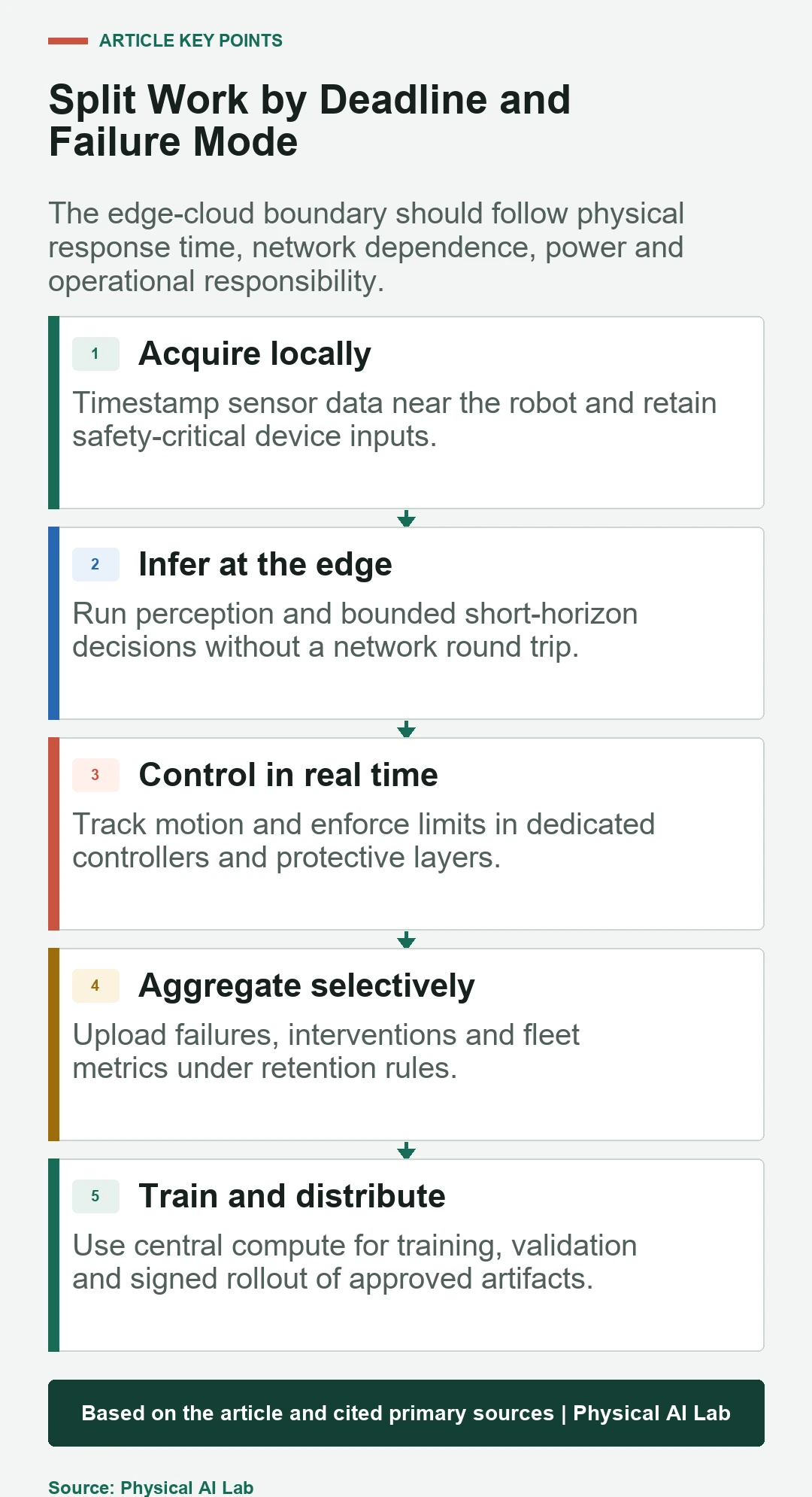
Central infrastructure can aggregate curated logs, train models, run large simulations and compare fleet behavior. It can distribute signed software and model updates after validation. These functions benefit from scale but usually do not need to sit inside the immediate collision-avoidance path.
Upload selected events rather than every raw stream when privacy, bandwidth or cost matters. Edge filtering can retain failures, interventions and novel states, but selection rules must avoid discarding evidence needed to diagnose a safety incident. Document retention and access controls.
The edge-cloud boundary follows failure requirements
Ask what happens when the network is slow, unavailable or compromised. The robot should preserve a safe state and complete only functions validated for offline operation. Remote assistance may be acceptable for exceptions if the system stops or waits safely during communication loss.
Fleet optimization, reporting and long-horizon scheduling can tolerate more delay. Person detection, obstacle response and low-level control usually cannot. Some semantic requests can be processed remotely while a local safety envelope limits every resulting motion.
Updates and cybersecurity are part of edge operations
Robots at the edge run long-lived software near physical processes. Secure boot, signed artifacts, identity, least-privilege services, vulnerability management and protected communication reduce the chance that an update or intrusion changes behavior. Offline devices still need an auditable maintenance path.
NVIDIA’s Jetson Platform Services documentation includes deployment, monitoring and alerting concepts for edge applications. Specific requirements depend on the robot and industry. Model files, configuration and calibration should be versioned with the executable software.
Observability makes intermittent failures diagnosable
Record sensor timestamps, model version, inference duration, queue depth, CPU and accelerator load, temperature, power state and action outcome. Averages conceal deadline misses, so retain percentiles and worst cases. Correlate resource spikes with robot interventions and safety stops.
Health monitoring should distinguish a failed sensor, overloaded inference process, network outage and controller fault. Each condition needs a defined degraded mode. Remote dashboards help fleets, but the robot must detect critical local faults even when disconnected.
Validate edge AI under the complete duty cycle
Test cold start, warm operation, peak sensor traffic, low battery, poor connectivity and software update recovery. Repeat the intended task while logging end-to-end latency and task success. Include worst-case scenes that produce many detections or long model paths.
Sensor choice and data rate strongly influence the result; see the robot sensor guide. If a larger model improves offline accuracy but misses real-time deadlines, evaluate a smaller local model, hierarchical inference or a bounded remote service rather than ignoring the timing failure.
- Define deadlines from the physical task.
- Benchmark the production model on production hardware.
- Test sustained thermal and battery conditions.
- Specify behavior during network loss.
- Version, monitor and safely update every edge artifact.
Frequently asked questions
Does edge AI mean no cloud connection?
No. It means time-sensitive processing occurs near the data source. Training, fleet analytics, remote support and updates can still use cloud infrastructure.
Why not send every robot camera stream to the cloud?
Bandwidth, privacy, variable latency and outages can make continuous remote processing expensive or unsafe. Local filtering and inference reduce dependence on the network.
Is model inference time the same as robot response time?
No. Response includes sensor exposure, transfer, preprocessing, inference, planning, communication and actuator timing. Measure the complete path.
What hardware is best for robot edge AI?
Choose against the actual models, sensor rates, deadlines, power, thermal environment, interfaces and product lifecycle. A benchmark on a different workload is not enough.
Can a safety function use an AI accelerator?
AI may inform safety-related behavior, but required protective functions need an architecture and validation appropriate to the applicable risk and standards. Do not assume a fast accelerator is a certified safety system.
Platform and Deployment Note
Edge hardware, runtimes and supported models change frequently. Verify current vendor documentation and benchmark the production software under sustained power, thermal, network and sensor conditions before deployment.