Synthetic data for robot learning is generated by software rather than captured only from physical sensors and human annotation. A simulator or generative pipeline can create scenes, robot trajectories and labels at scale. The data may include RGB, depth, segmentation, object pose, contact, actions, rewards and success events.
Its value comes from controllability. Developers can vary object positions, lighting, camera pose and rare failure conditions, then obtain labels directly from the scene. Synthetic data does not become correct merely because the label is automatic. Geometry, sensor effects, dynamics and task definitions can all differ from reality.
The method is therefore part of a broader sim-to-real strategy. Synthetic data can pretrain a model or fill sparse cases, while held-out real data and robot trials determine whether it improves the intended task. Dataset size alone is not the acceptance criterion.
Synthetic data can describe perception, action and events
Perception datasets pair rendered sensor outputs with labels such as bounding boxes, masks, depth, normals and object pose. Action datasets contain robot observations, states and commands. Event datasets mark contacts, collisions, grasp success, goal completion or intervention. Different learning objectives require different synchronized outputs.
NVIDIA’s current Isaac Sim synthetic data documentation separates perception, action and event, grasping, mobility and teleoperation workflows. The taxonomy is useful because a pile of images cannot teach a robot the consequence of its actions without aligned state and outcome information.
| Data type | Typical labels | Robot use | Quality question |
|---|---|---|---|
| Perception | Box, mask, depth and pose | Detection and scene state | Does appearance match sensor conditions? |
| Action | Observation, state and command | Imitation and policy learning | Are timing and frames aligned? |
| Event | Contact, collision and outcome | Recovery and evaluation | Does the label match task semantics? |
| Trajectory | Robot and object motion | Planning and prediction | Are dynamics and constraints plausible? |
Automatic labels are a major advantage
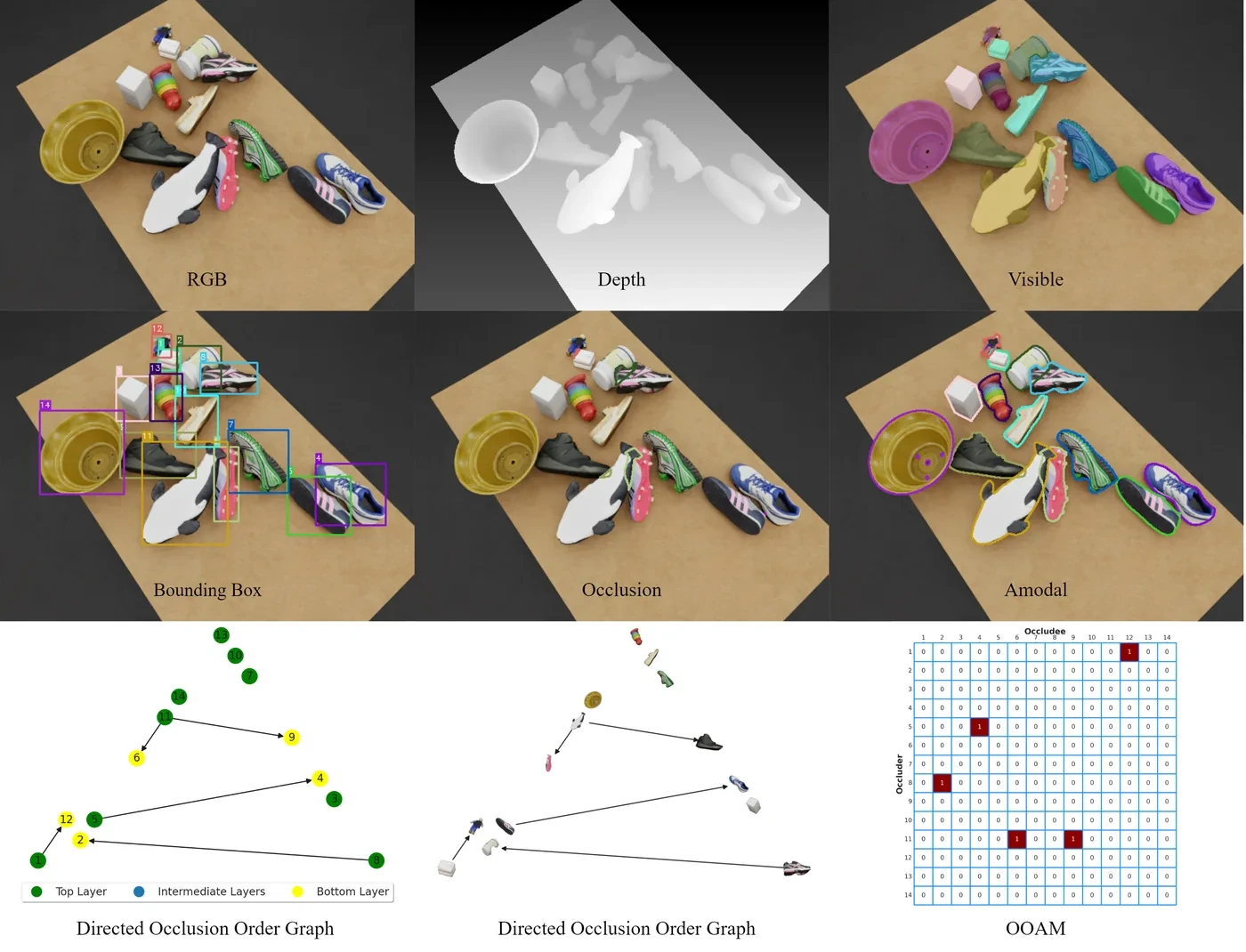
A simulator knows the identity, geometry and pose of scene objects. It can render an image and export exact labels without a person drawing every mask. It can also expose hidden surfaces, occlusion relationships and depth that may be expensive to measure in the real world.
The labels are exact relative to the simulated scene, not necessarily relative to the deployed sensor. If the renderer ignores motion blur, multipath depth errors or lens distortion, a perfect simulated label may accompany an unrealistic observation. Label correctness and observation fidelity must be evaluated separately.
Scene design begins with the deployment distribution
List the objects, environments, camera views, robot states and failure conditions expected in deployment. A warehouse detector needs packaging variation, clutter, torn labels and partial occlusion. A household manipulator needs wider geometry, materials, people, pets and changing backgrounds.
Use real measurements to define plausible ranges. Inventory statistics, camera calibration, lighting measurements and robot logs provide better priors than arbitrary variation. Preserve correlations such as object mass with geometry or camera exposure with illumination so generated scenes remain physically meaningful.
Domain randomization expands coverage
Domain randomization varies appearance, pose, sensors, dynamics and control so a model cannot rely on one nominal simulation. The goal is to cover relevant uncertainty, not to make every variable maximally random. Implausible combinations can waste capacity and reduce task signal.
The dedicated domain randomization guide explains range design, correlations and hardware feedback. Version every distribution and seed. Otherwise an improvement cannot be traced to new data, a model change or an accidental shift in the generator.
Sensor simulation determines the visual gap
Robot models consume outputs from specific lenses, depth devices, lidar patterns and inertial sensors. A generic clean render may omit noise, latency, dropout, rolling shutter, exposure, reflections and calibration error. These effects can dominate deployment even when scene assets look realistic.
Use the robot sensor guide to define which measurement properties matter. Compare distributions of intensity, depth holes, point density and timing against real captures. Reconstructed real scenes can improve appearance while still requiring correct sensor and robot dynamics.
Action data requires credible physics and control timing
A perception model can sometimes tolerate approximate dynamics because it learns from images. A policy that controls contact needs credible mass, friction, compliance, actuator limits and delays. Small errors can change grasp stability, impact or balance, causing the policy to exploit behavior unavailable on hardware.
Record the simulation step, control rate, action representation and safety limits with every dataset version. Validate motions against real trajectories and forces. Randomization can reduce sensitivity to uncertain parameters but cannot compensate for a missing mechanism or incorrect task interface.
| Gap | Synthetic check | Real check | Possible response |
|---|---|---|---|
| Appearance | Held-out assets and lighting | Real image performance | Improve materials or randomize |
| Sensor | Noise and delay injection | Raw stream statistics | Calibrate sensor model |
| Dynamics | Parameter sweep | Trajectory and contact error | Identify or randomize physics |
| Task | Scenario coverage | Failure and intervention logs | Add missing conditions |
| Label | Generator assertions | Sample human audit | Repair semantics or export |
A mixed real and synthetic curriculum is often stronger
Synthetic data can provide broad pretraining and balanced rare cases. A smaller real dataset then adapts the model to sensor appearance, dynamics and operational context. The mixture ratio should be treated as an experiment rather than a universal constant.
Keep independent real validation and test sets that never tune the generator or model. If every real failure is fed back into training before measurement, progress can be overestimated. Report synthetic-only, real-only and mixed baselines under the same evaluation protocol.
Quality means utility, fidelity and coverage
Visual fidelity asks how observations resemble reality, but task utility asks whether the data improves the downstream model. Coverage asks whether important states and failure modes are represented. Diversity without task relevance can increase volume while leaving the operational blind spot unchanged.
Audit class balance, scene combinations, duplicates, label integrity and impossible states. Train a probe model and compare performance by real-world slice, not only a single average. A generator should also expose provenance: assets, licenses, software version, parameters and random seeds.
Real-world validation closes the data loop
Deploy the candidate model in controlled robot trials and log where predictions or actions fail. Map each failure to an observation, state, parameter or task condition. Reproduce it in simulation when possible, generate targeted variants and retest on a held-out real set.
This loop makes synthetic data responsive to evidence instead of aesthetics. A photorealistic render is useful only if it reduces a measured error. Preserve failures that the simulator cannot reproduce; they identify missing physics, sensing or operational assumptions.
Governance covers licenses, privacy and reproducibility
Synthetic data can reduce collection of personal or proprietary real scenes, but generated assets and source models still have licenses and usage terms. Avoid assuming synthetic means unrestricted. Track the origin and permitted use of 3D assets, textures, pretrained models and generated outputs.
Onboard data collection may still capture people or customer environments. The edge AI guide discusses selective logging and retention. Publish a dataset card describing purpose, generation pipeline, known gaps, evaluation and prohibited interpretations.
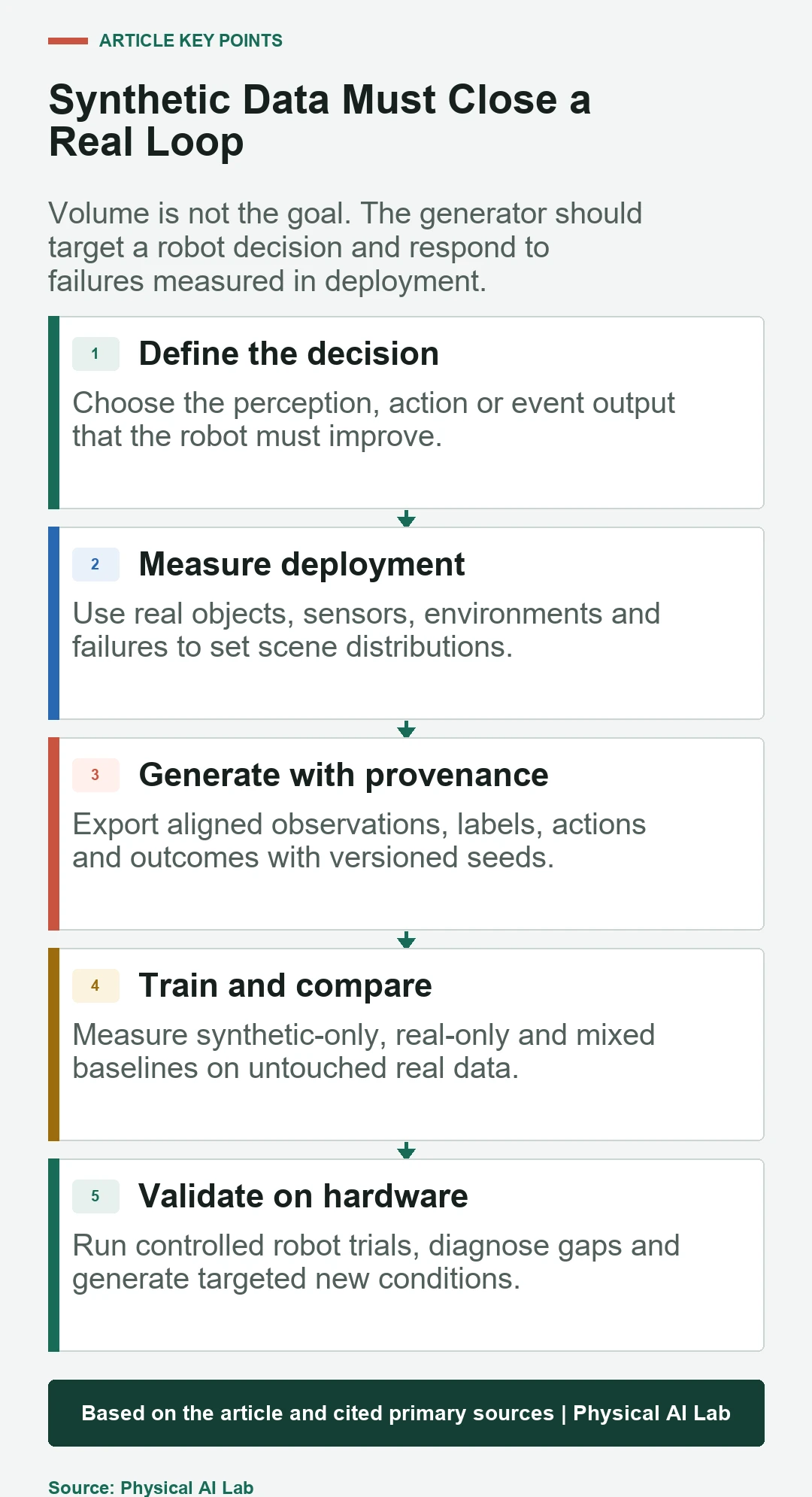
- Define the downstream robot decision.
- Generate aligned observations, actions and outcomes.
- Measure the real deployment distribution.
- Compare synthetic-only, real-only and mixed baselines.
- Close the loop with held-out real robot trials.
Frequently asked questions
Can synthetic data replace real robot data?
Usually not completely. It can reduce collection cost, pretrain models and cover rare cases, but real data is needed to measure the simulator and deployment gaps.
Is synthetic data automatically labeled?
Often yes, because the generator knows object and scene state. The exported label can still be semantically wrong or paired with an unrealistic observation, so audits remain necessary.
How much synthetic data should a robot project use?
There is no fixed ratio. Compare synthetic-only, real-only and mixed training under the same held-out real evaluation, then choose the smallest mixture that meets task requirements.
Does photorealism guarantee useful robot data?
No. Correct geometry, timing, contact, sensor effects and task coverage may matter more. Downstream real-world utility is the deciding metric.
What should a synthetic dataset card include?
Include purpose, generator and version, assets and rights, variables and distributions, sensors, labels, known gaps, quality checks and results on held-out real data or hardware.
Data and Validation Note
Synthetic-data tools, assets and licenses evolve quickly. Verify current documentation and rights, preserve generator provenance and accept a dataset only after held-out real data and robot trials show task-level benefit.