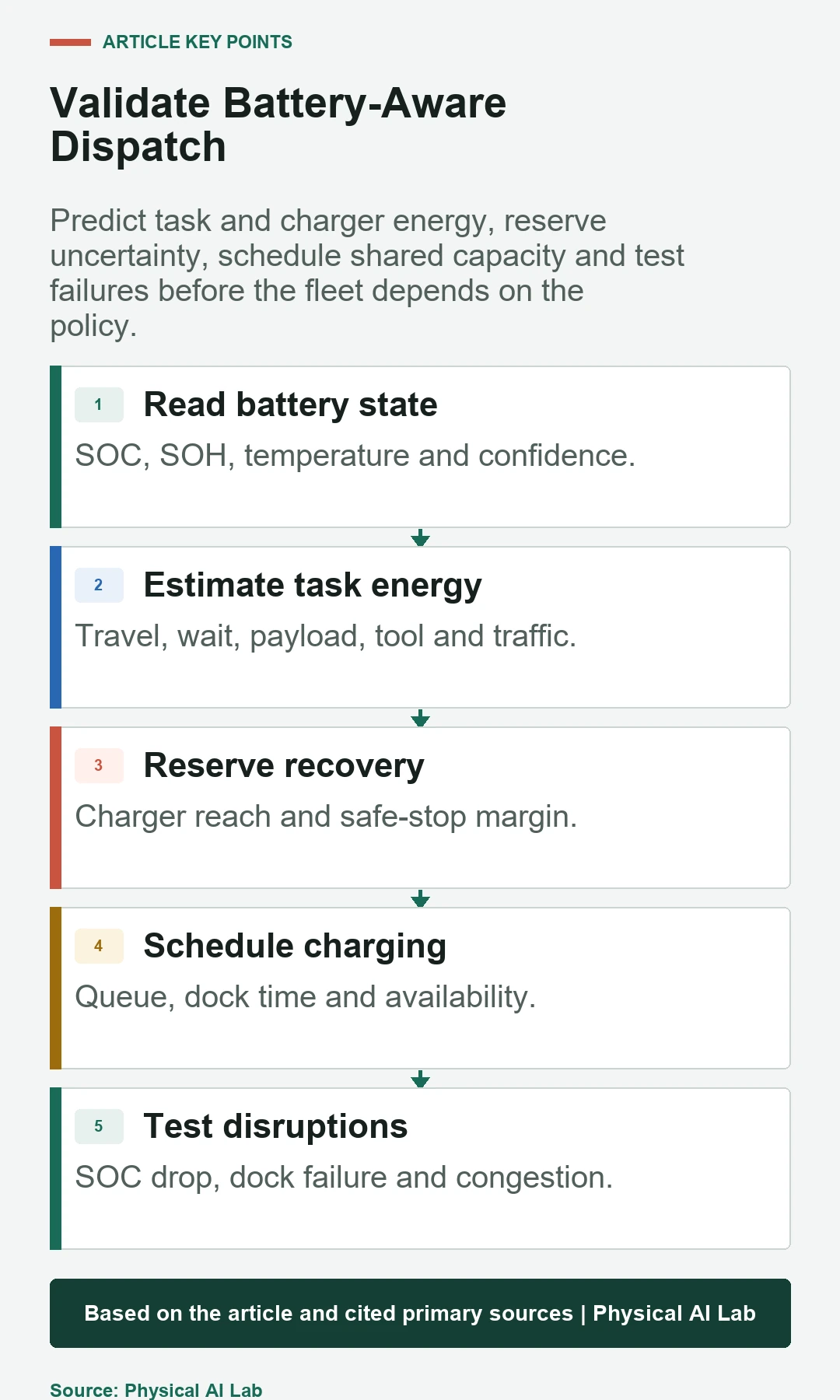
Battery-aware AMR dispatch asks whether a robot can complete the assigned work and still reach an available charger or defined safe state under credible uncertainty. Selecting the highest state of charge, or SOC, ignores task energy, battery health, traffic, charger queues and docking failures.
The planner needs an energy model, conservative reserve, shared-resource schedule and recovery policy. The BMS remains responsible for battery measurement and protection; fleet planning consumes that information without treating it as an exact fuel gauge.
Use this guide with the robot BMS SOC and SOH guide and multi-robot task-allocation guide. Validate with the exact AMR, battery, charger and facility.
Check energy feasibility through task completion and recovery
Estimate travel to pickup, task execution, delivery, expected waiting and travel from the completion point to a feasible charger. Include a defined reserve for prediction error, detours and failed first docking attempts.
Reject or defer an assignment when the conservative terminal energy is below the operational reserve, even if current SOC looks high. Preserve an independent BMS protection threshold and a local safe-stop policy.
Use SOC and SOH with uncertainty
SOC estimates available charge, while state of health, or SOH, describes changed capacity and power capability relative to an accepted reference. Both depend on temperature, current history, calibration and model assumptions.
Consume estimate age, confidence or quality flags when available. Detect sudden jumps, stale telemetry and disagreement with voltage or coulomb evidence; do not plan a long mission from one unqualified percentage.
Model motion, waiting, tools and environment separately
Energy depends on distance, speed, acceleration, turns, grade, floor, payload, traffic and control behavior. Ambient electronics drain energy while stopped, and lifts, conveyors, manipulators or refrigeration loads add task-specific power.
The current ROS 2 Kilted rmf_task Parameters API separates battery, motion, ambient and tool power-sink inputs. Pin the deployed RMF distribution and validate its models rather than assuming the current documentation matches an older fleet.
Treat charging and docking as measured tasks
A charger is not a map point. Model approach, alignment, handshake, contact or coupling, charge acceptance, taper, disconnect and return-to-service time, with success probabilities and maintenance outages.
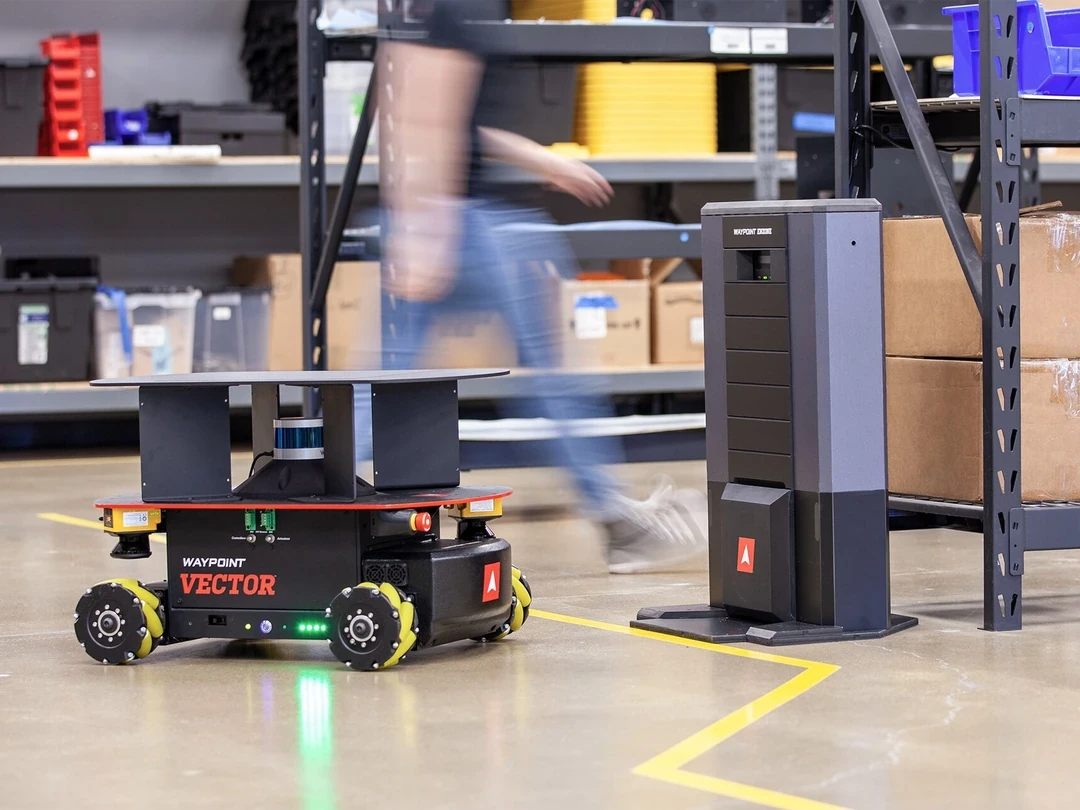
Measure queue, dock attempt, delivered energy and turnaround by charger and robot. The photograph illustrates a real charging setup but does not establish energy-transfer efficiency or scheduler performance.

Separate planning reserve from battery protection
An operational reserve absorbs forecast uncertainty and preserves options before the BMS reaches protective limits. The BMS minimum or emergency stop threshold protects the battery and system at a lower boundary and should not be used as normal scheduling slack.
Define warning, stop-assigning, go-to-charge and emergency behavior with hysteresis and temperature or health adjustments. Verify that a robot can still reach a safe location when a charger becomes unavailable.
| Energy boundary | Purpose | Owner | Failure if mixed |
|---|---|---|---|
| Forecast mean | Expected task cost | Fleet planner | No uncertainty margin |
| Planning reserve | Detour and model error | Operations engineering | Routine deep discharge |
| Charge trigger | Schedule charger travel | Fleet policy | Queue forms too late |
| BMS limit | Cell and pack protection | Battery system | Planner treats protection as usable |
| Safe-stop reserve | Controlled fallback | Robot safety design | Stranded in hazardous place |
Schedule chargers as shared constrained resources
Model charger count, compatibility, power, maintenance, reservations, queue discipline and nearby staging capacity. Avoid assigning multiple robots to arrive at the same instant without a waiting-energy and traffic plan.
Coordinate charger reservations with doors, elevators and narrow paths using the Open-RMF facility integration guide. A reservation is useful only when robot and charger state are fresh and recovery from a missed slot is defined.
Use opportunity charging only when total cost improves
Short idle windows can add useful energy, reduce deep cycling and smooth queues. They can also create extra travel, docking wear, congestion and time spent in charge handshake instead of productive work.
Compare the net energy and schedule effect over a realistic horizon. Include charge taper and thermal limits; a five-minute slot near high SOC may deliver less useful energy than the same slot at a lower SOC.
Include energy risk in task-allocation cost
Combine travel and completion time, deadline, priority, predicted energy, uncertainty, charger access, post-task position and the effect on future assignments. Hard feasibility constraints should block unsafe plans before soft cost ranking.
Avoid one global weight that hides critical reserve violations. Explain why a robot was excluded or sent to charge so operators can distinguish energy risk from traffic or capability limits.
Test SOC drops, charger faults and congestion
Inject stale or biased SOC, faster-than-expected consumption, unavailable charger, failed docking, occupied staging, blocked route and power outage in simulation and controlled field tests. Observe reassignment, recovery reserve and local behavior.
A fault must not trigger charger thrashing between robots or repeated attempts that consume the remaining reserve. Limit retries and escalate to a known safe location or human support.
Calibrate energy error by operating regime
Compare predicted and measured energy by route, payload, speed, temperature, floor, traffic, battery age and charger. Track signed error and upper-tail underprediction because average cancellation can hide dangerous low forecasts.
Retrain or retune after tire, battery, firmware, route or payload changes. Keep a conservative fallback model when confidence is low or the current regime lacks validation data.
Manage battery life separately from immediate throughput
A dispatch policy that maximizes today’s completed tasks may increase high-temperature operation, deep cycling or time at extreme SOC. Establish a life and warranty policy with BMS and manufacturer guidance, then expose its constraints to the planner.
Compare energy throughput, cycle depth, temperature and capacity trend over time. Replace or derate a pack through an approved maintenance decision, not because the scheduler compensates indefinitely for declining capacity.
Release a battery-aware planning evidence file
Preserve battery and charger models, uncertainty method, task-energy features, reserves and thresholds, queue and opportunity-charging policy, failure tests, calibration data and change triggers. Confirm applicable mobile-robot safety requirements independently.
The official catalog lists ISO 3691-4:2023 as the published driverless industrial truck safety edition while a revision is under development; it explicitly says power-source requirements are outside its scope. Close review with the following checks.
| Acceptance test | Measure | Adverse case | Reject when |
|---|---|---|---|
| Task forecast | Predicted versus measured energy | Heavy and cold route | Reserve breached |
| Queue | Wait and staging energy | Simultaneous arrivals | Robots strand |
| Docking | Success and turnaround | First attempt fails | Unlimited retry |
| Recovery | Reachable safe state | Charger outage | No alternate |
| Lifecycle | Capacity and temperature trend | Aged pack | Planner hides degradation |
- Forecast through task completion and charger arrival.
- Use SOC, SOH, age and uncertainty together.
- Separate planning reserve from BMS protection.
- Schedule charger queues, docking and outages.
- Validate upper-tail energy error and safe recovery.
Frequently asked questions
Is assigning work to the highest-SOC AMR sufficient?
No. Task energy, post-task charger access, uncertainty, health and queue conditions can make another robot safer or faster.
Should every AMR use the same charge threshold?
Not necessarily. Battery type, SOH, task risk, temperature, charger topology and validated model error can differ.
Does opportunity charging always improve throughput?
No. Travel, docking, taper, congestion and wear can outweigh the delivered energy.
What happens when a charger reservation fails?
Replan to an available compatible charger or a defined safe state while preserving reserve and limiting repeated attempts.
Does battery-aware dispatch replace the BMS?
No. The planner schedules work; the BMS estimates, monitors and protects the battery within its design.
Energy Feasibility and Recovery Boundary
Battery-aware AMR planning is acceptable when every assignment preserves conservative task, charger and recovery energy under measured uncertainty and shared-resource failure.