AMR Wi-Fi design begins with application behavior: which messages may be delayed or lost, how long an outage is tolerable, how sessions recover and what the robot does locally when communication disappears. Peak throughput at a fixed point is rarely the controlling requirement.
Roaming depends on RF coverage, client decisions, channel and power design, authentication, switching and routed backhaul. The validation must move the real robot along production routes under representative traffic and correlate network events with physical behavior.
Use this guide with the ROS 2 QoS guide and AMR versus AGV selection guide. Wireless service must not become the only layer preserving a safe robot state.
Write message-level latency, loss and outage requirements
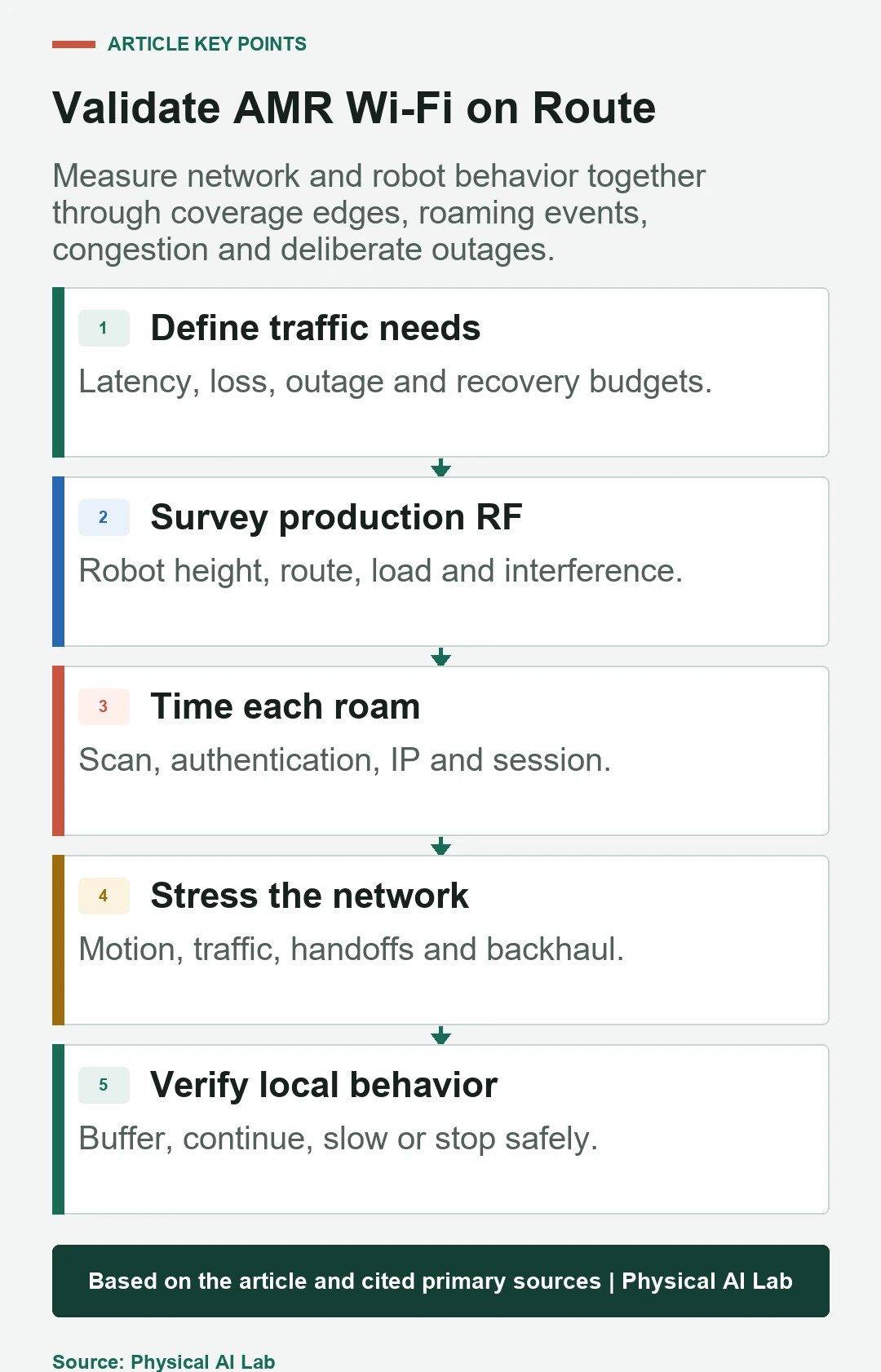
Classify fleet dispatch, route reservations, maps, telemetry, video, diagnostics, software updates and remote support by latency, jitter, loss, bandwidth, ordering, confidentiality and recovery needs. State which functions remain local.
Define maximum tolerated continuous outage and stale-data behavior, not only average packet loss. A command that arrives after its validity window can be more dangerous than one that is explicitly rejected.
Survey RF in production conditions and at robot height
Measure along real routes, docking points, elevators, doors, racks and intersections while machinery, people and inventory occupy normal positions. Include the antenna location and orientation on the robot, not just a handheld device at standing height.
NIST’s Guide to Industrial Wireless Systems Deployments organizes objectives, environment examination, selection, design, deployment and monitoring across the lifecycle. Use a repeatable route and preserve floor plan, channel, time and production state.
Balance cell overlap, interference and client roaming
More access points or maximum transmit power can increase co-channel interference and encourage a client to remain attached to a weak distant cell. Design channels, widths, power, antenna patterns and overlap from measured client behavior and capacity.
NIST’s industrial RF propagation study reports measurements across varied facilities and analyzes path loss, delay spread and K factor. Factory metal, motion and layout make generic coverage radii unreliable.
Treat the access point as one component of a route
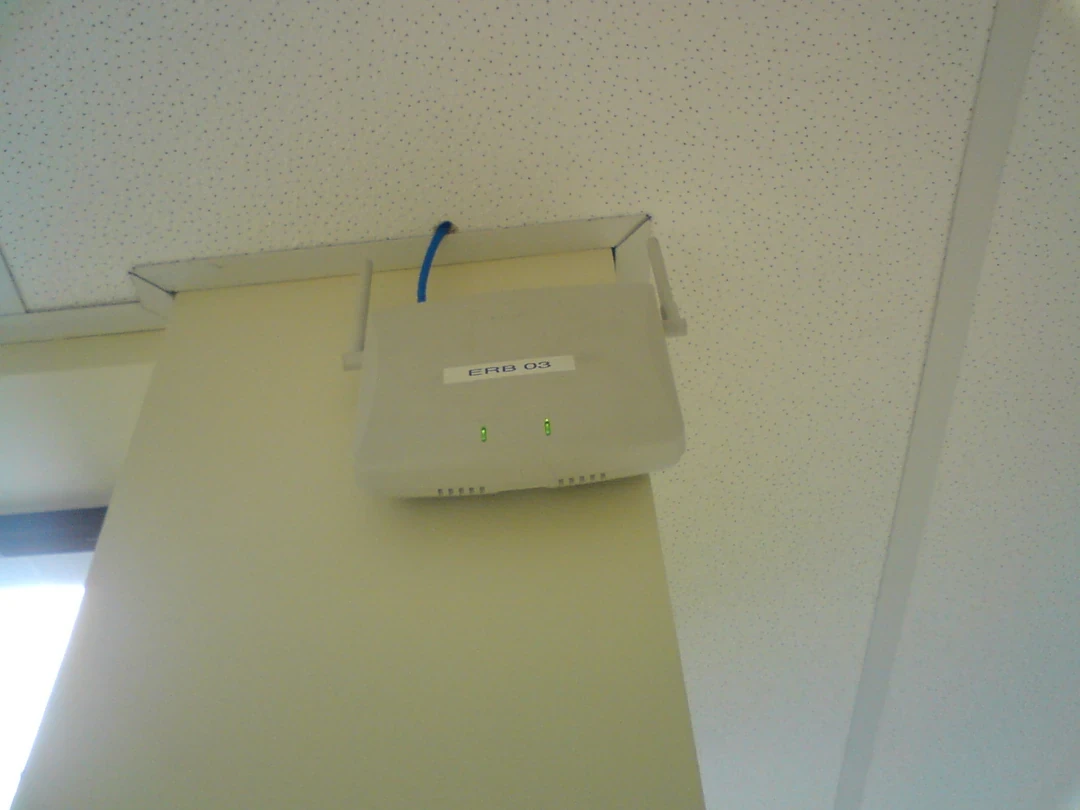
The wall-mounted device in the photograph cannot reveal antenna pattern, channel utilization, backhaul, controller policy or AMR client behavior. Record exact hardware, firmware, configuration and cable or switching path.
Verify mounting, power, environmental rating and maintenance access. A visually intact AP may be overloaded, misconfigured or connected through a failing uplink.

Decompose roaming into measurable phases
Measure detection or scanning, candidate selection, authentication and association, key exchange, IP and routing continuity, transport recovery and application-session recovery. Different captures may be needed on the client, AP, controller, switch and application.
A fast Layer 2 handoff can still produce a long task interruption when address resolution, VPN, DDS discovery or an application timeout restarts. Use one time-qualified trace across layers.
| Roam phase | Measure | Likely dependency | Failure symptom |
|---|---|---|---|
| Discovery | Candidate and scan time | Client and channel plan | Sticky weak AP |
| Authentication | Exchange duration | Security and key cache | Long association gap |
| Network | Address and route continuity | VLAN and backhaul | Packets blackholed |
| Transport | Loss and retransmission | Protocol and buffers | Burst latency |
| Application | Session and state recovery | DDS or fleet logic | Robot stays stale |
Test while the AMR moves under traffic
Drive at representative and adverse speeds through handoff zones while generating the production traffic mix. Repeat direction, load, antenna orientation and concurrent robot count; stationary speed tests do not reproduce roaming decisions.
Capture RSSI or equivalent signal metrics, channel utilization, retry and loss, AP transition times, message age and robot state. Mark exact route position so recurring failures map to physical changes.
Tune ROS 2 QoS by data semantics
Reliable delivery can be appropriate for state that must arrive, but retransmission and backpressure can increase latency on a lossy link. Best effort can be appropriate for replaceable high-rate sensor samples when the newest data matters more than every historical sample.
Pin the deployed ROS 2 distribution and test publisher-subscriber compatibility, history, depth, deadline, lifespan and liveliness under loss. Use the ROS 2 sensor and command QoS guide rather than applying one profile to every topic.
Design VLAN, QoS and backhaul without hiding congestion
Separate robot, guest, video and management traffic according to security and operational needs. Validate switching capacity, uplink redundancy, controller reachability, DHCP or address strategy and end-to-end priority mapping.
Priority cannot create bandwidth. Rate-limit bulk uploads and updates, then stress the network with realistic concurrent traffic to expose queues, drops and recovery rather than testing an empty network.
Correlate network events with robot behavior
Use a common run ID and qualified clocks for robot logs, packet capture, WLAN controller events, switch telemetry and fleet actions. Measure message age at consumption, not merely packet arrival at one interface.
The robot time-synchronization guide helps establish timing evidence, while recognizing that wireless clients may use different synchronization quality and require uncertainty reporting.
Define safe local behavior before link recovery
Specify whether the robot completes a bounded local segment, slows, stops at a safe location, preserves a reservation, releases resources after timeout or waits for authenticated recovery. The correct response depends on local perception, map, traffic and hazard analysis.
Do not depend on a remote stop command over the failed link. Validate local watchdogs, stale-command rejection, obstacle response and restart authorization with deliberate communication outages.
Monitor route-level degradation and changes
Track roaming gap distributions, message age, retries, channel utilization, AP association, application recovery and robot interventions by route and time. Fleet averages can hide one aisle or direction with severe tail latency.
Repeat surveys and regression runs after AP, firmware, security, switch, rack, inventory, machinery or AMR antenna changes. Alert on deterioration before repeated mission failures become normalized.
Release an AMR wireless validation file
Preserve message requirements, local loss-of-link behavior, survey method, RF plan, AP and client baselines, roam captures, traffic loads, QoS profiles, backhaul tests, robot traces, outage results and change triggers.
Close review with the following checks.
| Acceptance test | Evidence | Adverse case | Reject when |
|---|---|---|---|
| Coverage | Route signal and retries | Inventory and moving robot | Unmeasured dead zone |
| Roaming | Phase and session times | Bidirectional handoff | Tail exceeds budget |
| Traffic | Age, loss and queues | Video and fleet load | Priority collapses |
| Outage | Robot and reservation state | AP or uplink loss | Unsafe remote dependency |
| Regression | Before and after route run | Layout or firmware change | No comparable baseline |
- Define outage and stale-data behavior per message class.
- Survey production routes at the real antenna height.
- Measure every roam through application recovery.
- Stress concurrent traffic, switching and backhaul.
- Prove local safe behavior without a remote command.
Frequently asked questions
Does strong RSSI eliminate AMR roaming problems?
No. Interference, client decisions, authentication, backhaul and application recovery can fail despite strong signal.
Does enabling fast-roaming features always reduce handoff time?
No. Client support, security configuration, network design and application behavior must be compatible and measured.
Should every ROS 2 topic use reliable QoS on Wi-Fi?
No. Reliability can add backlog and latency; choose profiles from each data stream’s semantics and validate under loss.
Must an AMR stop immediately whenever Wi-Fi drops?
The local response depends on risk and capability, but it must be predefined, bounded and safe without relying on the failed connection.
When should the RF survey be repeated?
After material AP, client, security, switch, layout, machinery, inventory or route changes and whenever monitoring shows route-level degradation.
Wireless Performance and Local-Safety Boundary
AMR Wi-Fi is acceptable when route-based RF, roaming, backhaul and application recovery meet defined budgets and the robot remains locally safe throughout a communication outage.