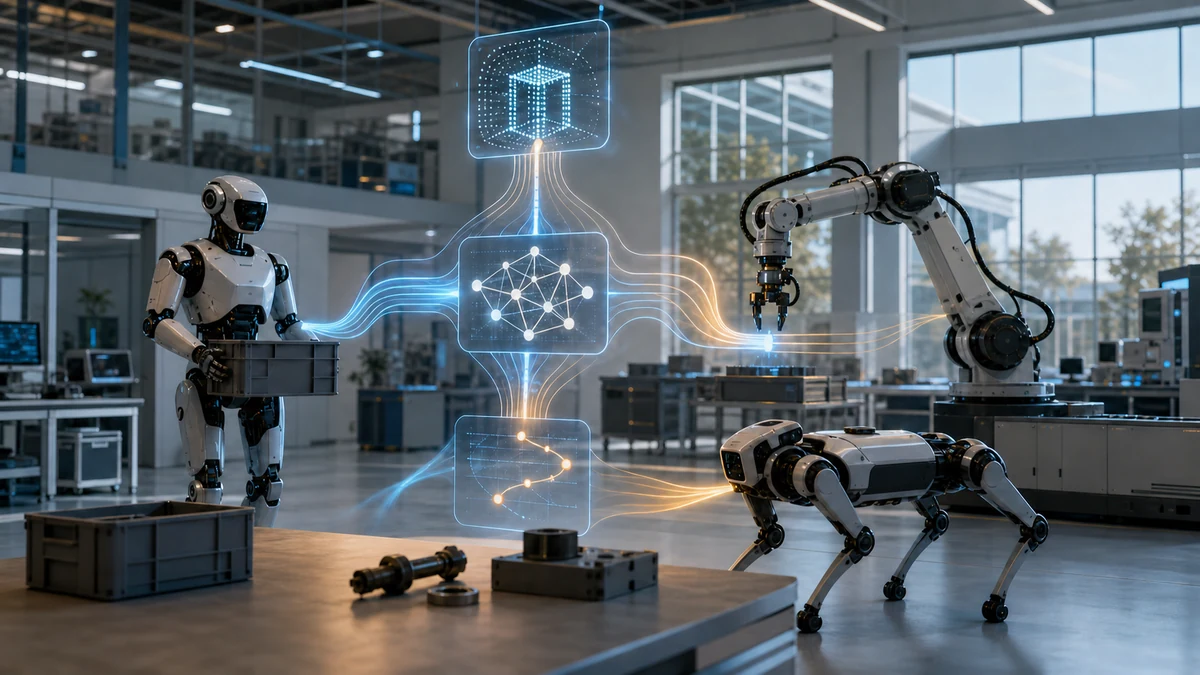
Gemini Robotics ER 2 is the high-level brain in Google's latest physical AI stack. Announced on July 30, 2026, it accepts text, images, video and audio, reasons over a robot's changing environment, calls tools or robot APIs and returns text. The practical change is continuity: instead of treating every camera frame as an isolated picture, ER 2 can follow a task through time and decide what should happen next.
That distinction matters. ER 2 does not directly produce joint angles or motor torques. A lower-level vision-language-action model, controller or robot API still executes movement. Readers who want the broader vocabulary can start with our guides to VLA versus VLM models and the see-think-act loop in physical AI.
ER 2 is an orchestration model, not a motor controller
Google describes Gemini Robotics ER 2 as a vision-language model for embodied reasoning. It is based on Gemini 3.5 Flash and is available in public preview through the Gemini API and Google AI Studio. Its job is to interpret a goal, understand visual context, plan a sequence, call available tools and monitor whether the plan is working. The model can hand instructions to robot-specific functions, but those functions remain responsible for physical execution.
This makes ER 2 closer to a mission planner than a universal robot controller. Its outputs are text, even when its inputs include video. Adding ER 2 does not automatically give a machine safe manipulation, navigation or certified autonomy; hardware interfaces, lower-level policies and safety systems remain necessary. The table compares it with Gemini Robotics ER 1.6.
| Question | Gemini Robotics ER 1.6 | Gemini Robotics ER 2 |
|---|---|---|
| Primary role | Embodied reasoning and high-level planning | Continuous embodied reasoning, orchestration and progress monitoring |
| Model availability | Deprecated August 31, 2026, according to Google’s robotics overview (checked October 13, 2026). | Public preview through Gemini API and AI Studio |
| Temporal context | Video understanding for robotics workflows | Greater emphasis on continuous video and task state over time |
| Tool use | High-level planning and tool calls | Expanded orchestration, including streaming workflows and multi-robot demonstrations |
| Motor output | Not a direct motor-action model | Still not a direct motor-action model; output is text |
Continuous video turns perception into task memory
A single image can show where an object is, but many robot tasks depend on what just happened. Did the gripper already close? Did the box fall? Has a person entered the work area? ER 2 can reason over a stream of visual observations and maintain a higher-level view of task progress. That temporal context is useful when the next instruction depends on the result of the previous action.
In Google's evaluations, ER 2 reached 57.4% on progress classification. Google also reports 91.3% moment-finding accuracy and a mean absolute distance of 0.96 seconds. These are company-reported results under defined conditions, not independent success rates for every robot or workplace. Applications still need clear actions, timely input and explicit success signals.
Standard and streaming endpoints serve different control loops
Google exposes two preview model identifiers. The standard endpoint, gemini-robotics-er-2-preview, is designed for request-and-response workflows and supports a broader set of Gemini tools. The streaming endpoint, gemini-robotics-er-2-streaming-preview, works through the Live API for lower-latency interaction. Both accept text, image, video and audio input and return text.
A standard call suits a robot that pauses at decision points. Streaming is more appropriate when an application must keep a running conversation while observations arrive. It does not remove network delay or become a deterministic real-time controller, so collision avoidance and servo control remain below this layer. See our ER 2 pricing and API guide.
| Capability | Standard preview | Streaming preview |
|---|---|---|
| Model ID | gemini-robotics-er-2-preview | gemini-robotics-er-2-streaming-preview |
| Interaction pattern | Request and response | Live API streaming |
| Input modalities | Text, image, video, audio | Text, image, video, audio |
| Output modality | Text | Text |
| Selected tool support | Function calling, structured output, code execution, Search and Maps grounding | Function calling, Search grounding and thinking |
| Best fit | Rich planning steps and asynchronous workflows | Lower-latency observation and supervision |

Tool calls connect language plans to robot capabilities
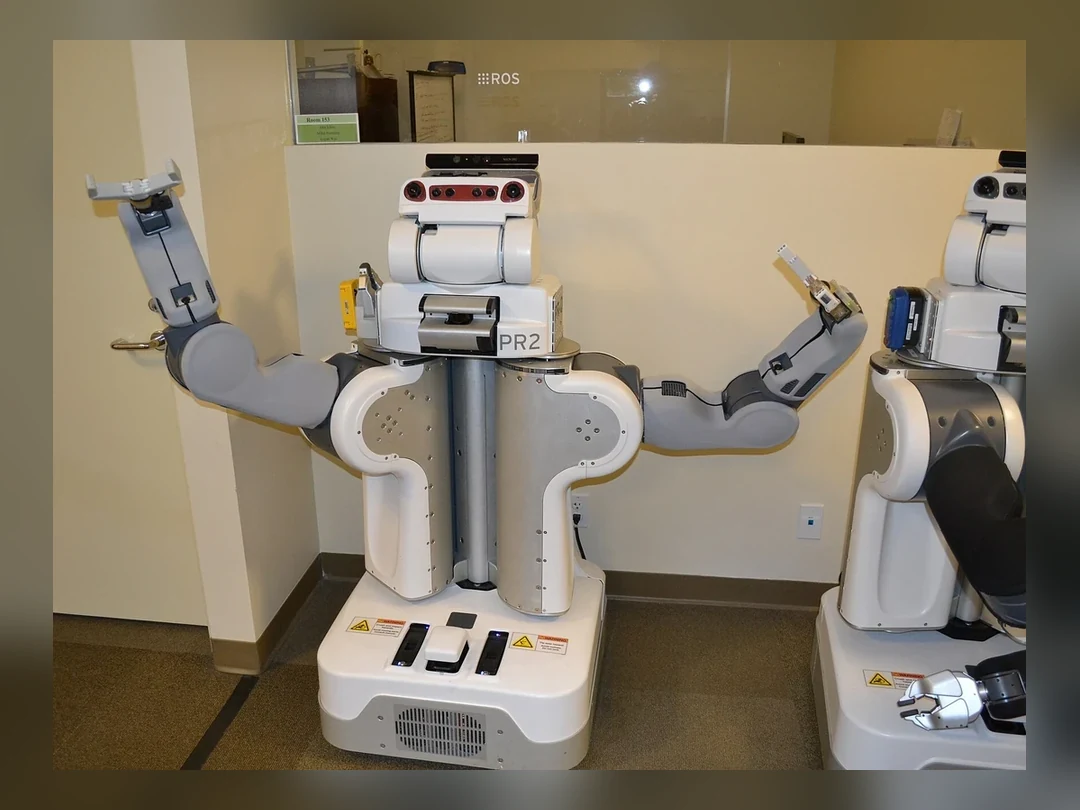
A robot application can expose named functions such as navigate_to, inspect_object or close_gripper. ER 2 can select a function and supply arguments based on the goal and visual context. The application validates the call, executes it through the robot's own SDK or controller and sends the result back. The model can then inspect the new state and choose another action.
Tool use is powerful, but it is not a safety guarantee. ER 2 can misunderstand a scene, hallucinate a tool parameter or choose an inefficient sequence. Applications should validate every call, define timeouts and safe fallbacks, and use independent hardware protections for hazards.
The Apollo and Franka demonstration shows multi-robot planning
Google demonstrated ER 2 coordinating an Apptronik Apollo 2 humanoid and a Franka F3 Duo manipulation system. In the example, the high-level model decomposed a task and allocated steps across machines with different capabilities. The point was not that the robots shared identical controls; it was that one reasoning layer could work through distinct tools and embodiments.
Real facilities rarely contain one universal robot. A supervisor could eventually route work according to reach, payload and tool availability. However, Google's example is a research demonstration, not proof of commercial deployment, universal interoperability or guaranteed performance. Our Google physical AI strategy guide maps the wider portfolio.
ER 2 and On-Device 2 occupy different layers
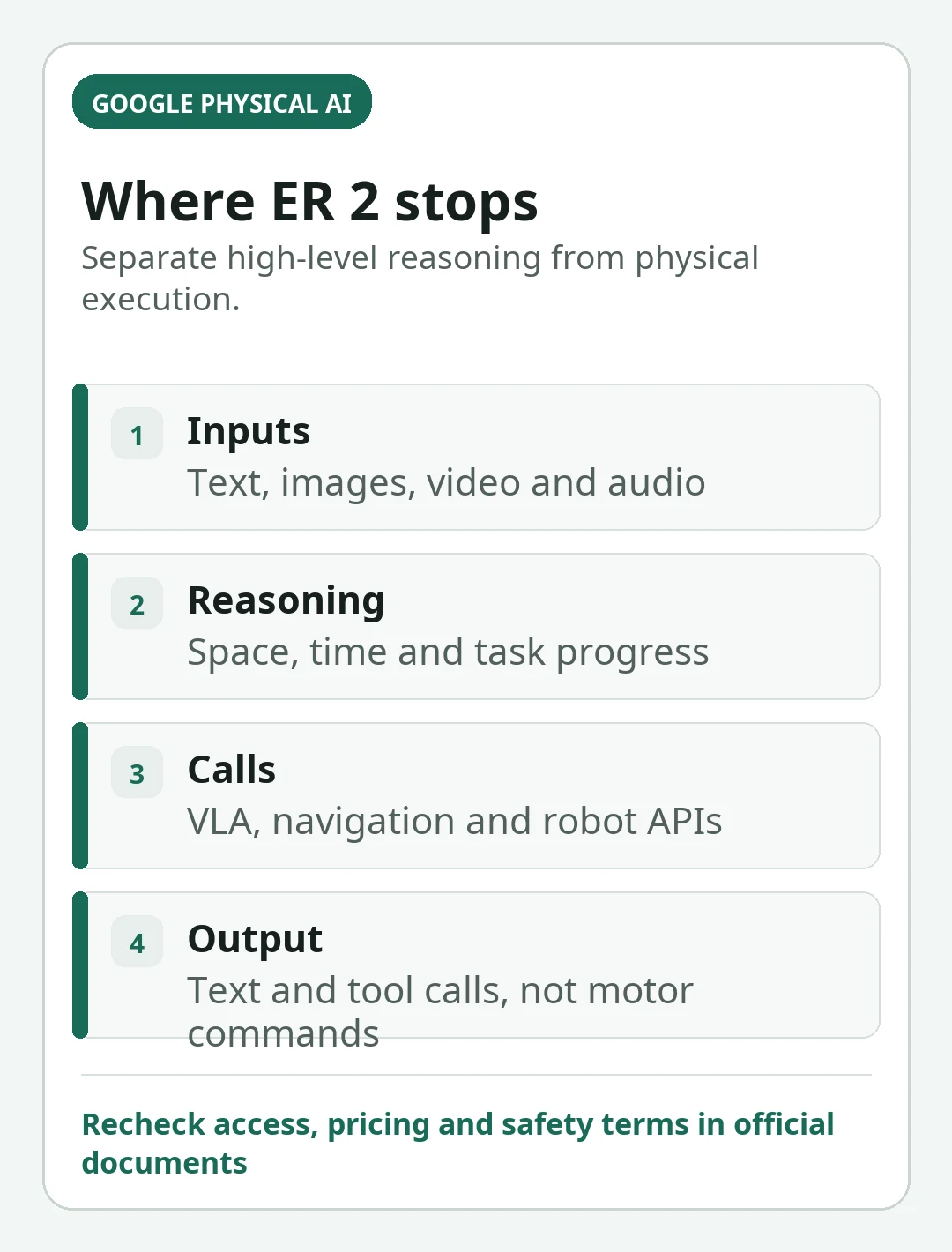
The similar names can obscure a fundamental difference. Gemini Robotics ER 2 is a cloud-accessible VLM that produces text for planning and orchestration. Gemini Robotics On-Device 2 is a VLA designed to run locally and output numerical robot actions. It takes text, images and robot proprioception as inputs and is currently offered only to trusted testers.
A future system could use ER 2 to decide that a drawer should be opened and use an on-device VLA to generate the movement. That is a conceptual stack, not a promise that the models plug together automatically. Developers still need adapters, robot-specific training, control validation and a safety architecture.
| Layer | Typical input | Typical output | Responsibility |
|---|---|---|---|
| ER 2 high-level model | Goal, video, images, audio and tool results | Text and function calls | Reason, plan, orchestrate and monitor |
| On-device VLA or another action policy | Instruction, camera data and robot state | Numerical robot actions | Translate intent into learned movement |
| Robot controller | Action targets and sensor feedback | Motor commands | Execute timing-sensitive control |
| Safety system | Independent sensors and limits | Stop, restrict or permit | Protect people, equipment and workspace |
Public preview means useful access with real constraints
ER 2 can be tested now through Google AI Studio or the Gemini API, but preview status matters. Model behavior, identifiers, pricing and feature support can change. Google lists a 131,072-token input limit and a 65,536-token output limit for both ER 2 preview variants. Large context windows help with complex instructions, yet production reliability still depends on focused prompts and controlled tools.
Google states that free-tier and unpaid AI Studio content may be used to improve products and may be reviewed by humans; sensitive, confidential or personal data should not be submitted there. Paid prompts and responses are not used to improve products, although limited safety logging can remain. Robot video may capture identifiable people, so notice, consent and minimization matter. ER 2 must not be the sole safeguard in a safety-critical system.
Frequently asked questions
Is Gemini Robotics ER 2 a VLA model?
Google classifies ER 2 as a vision-language model for embodied reasoning. It accepts multimodal observations and returns text or function calls for high-level orchestration. A VLA or controller is still needed to produce and execute numerical robot actions.
Can developers use Gemini Robotics ER 2 today?
Yes. Both the standard and streaming ER 2 variants are in public preview through the Gemini API and Google AI Studio as of August 6, 2026. Preview features, model names and prices can change, so production plans should follow the current official documentation.
Does ER 2 make any robot autonomous out of the box?
No. The model can plan, call approved tools and monitor progress, but the application must provide robot APIs, lower-level control, validation and independent safety measures. Google's demonstrations do not imply universal compatibility or certified autonomous operation.
Official sources checked
- Google: Gemini Robotics ER 2 announcement
- Google AI for Developers: Gemini Robotics API overview
- Google DeepMind: Gemini Robotics ER 2 model card
- Google AI for Developers: Gemini API release notes
- Google DeepMind: Gemini Robotics 2 safety paper
Last checked: August 6, 2026