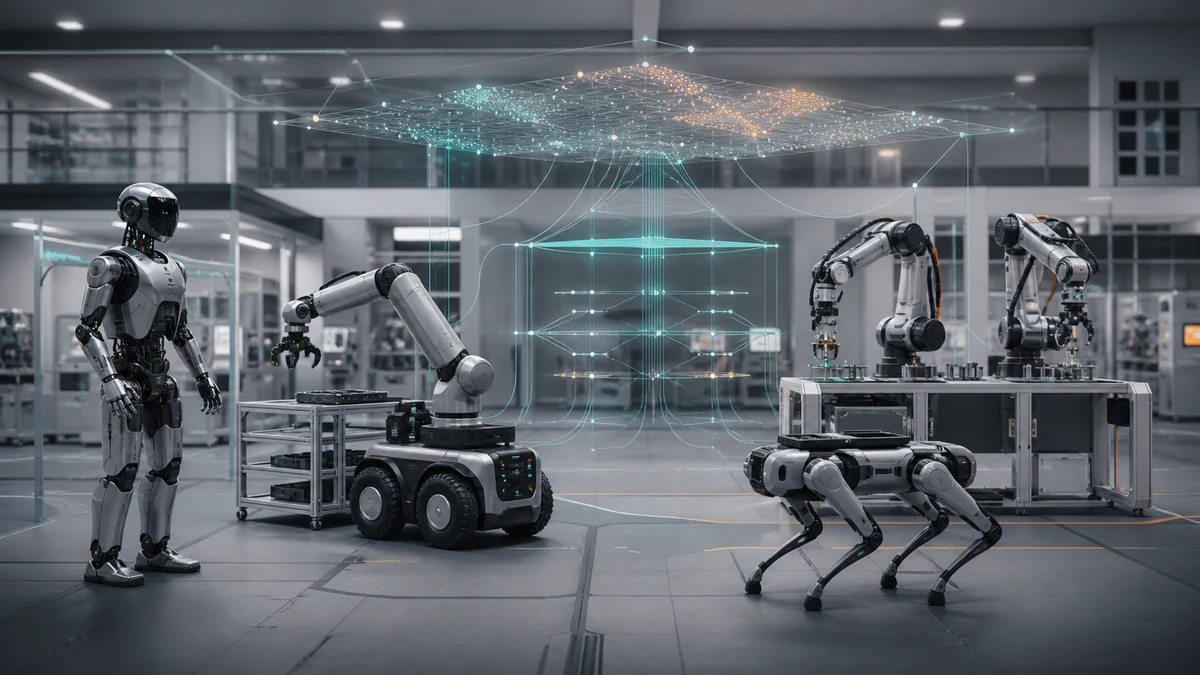
Google's latest physical AI portfolio has two distinct model layers. Gemini Robotics ER 2 is a public-preview vision-language model for high-level reasoning, tool use and progress monitoring. Gemini Robotics On-Device 2 is a locally running vision-language-action model that generates numerical robot actions and is currently limited to trusted testers. Robot demonstrations with Boston Dynamics, Apptronik and Franka show how those ideas can reach different bodies.
The useful way to read this strategy is as a stack, not as a single product announcement. Google is developing models that can understand an environment, decide which capability to call and translate instructions into movement. Our physical AI see-think-act guide explains that loop; this article maps Google's current products, previews and research evidence onto it.
Google's physical AI stack in one view
At the top of the stack, ER 2 interprets goals and scenes, builds plans, calls tools and checks whether a task is progressing. At the action layer, On-Device 2 turns instructions and sensor context into numerical actions on a specific robot. Under both sit robot controllers and independent safety systems that handle timing, limits and emergency behavior.
The three layers should not be collapsed into the word intelligence. A model can reason well and still fail because a gripper cannot reach an object. An action policy can move smoothly while misunderstanding the goal. A reliable system needs explicit interfaces between reasoning, action, control and safety.
| Component | Role | Output | Availability on August 6, 2026 |
|---|---|---|---|
| Gemini Robotics ER 2 | High-level embodied reasoning and orchestration | Text and function calls | Public preview via Gemini API and Google AI Studio |
| Gemini Robotics On-Device 2 | Local robot action policy | Numerical robot actions | Trusted testers and waitlist |
| Apptronik Apollo 2 and Franka F3 Duo | Multi-robot research demonstration | Physical execution through their own interfaces | Demonstration, not a Google robot product |
| Boston Dynamics Spot | Mobile manipulation demonstration | Navigation and arm execution through Spot APIs | Research demo, not an announced commercial integration |
ER 2 is the high-level reasoning and supervision layer
Gemini Robotics ER 2 is based on Gemini 3.5 Flash and accepts text, images, video and audio. It returns text, including structured function calls when the application provides tools. That output can tell a robot application to navigate, inspect or manipulate, but ER 2 does not directly emit joint commands. The application remains responsible for checking arguments and routing approved calls to the correct machine.
The emphasis is continuous video reasoning. A robot can report its changing view while the model tracks whether a step succeeded or a retry is needed. Google's reported progress and moment-finding results are defined evaluations, not universal field success rates. Read our Gemini Robotics ER 2 explainer for details.
On-Device 2 brings numerical actions closer to the robot
Gemini Robotics On-Device 2 addresses a different constraint: robots cannot always depend on a stable cloud connection. The model is designed to run locally, using text, camera images and robot proprioception to produce numerical actions. Local inference can reduce network dependence and keep the action loop close to the machine, although total latency and safety still depend on the hardware and controller.
Google says the model can adapt to a new robot with fewer than 200 demonstrations, or a few hours of data collection in its examples. This is a Google-reported capability, not a guarantee. The model card notes limits on out-of-distribution tasks and high-degree-of-freedom machines. Our On-Device 2 guide covers the evidence.
.jpg)
Robot partners test whether one model can cross embodiments
Google's partner demonstrations are evidence about portability, not a catalog of Google-made robots. With Apptronik Apollo 2 and Franka F3 Duo, ER 2 showed high-level task decomposition across machines with different physical strengths. With Boston Dynamics Spot, it selected and monitored navigation and manipulator functions while the robot fetched a snack in response to a natural-language request.
These examples matter because warehouses, laboratories and service environments contain heterogeneous equipment. A common reasoning layer could choose among approved capabilities without requiring users to learn every device command. Each robot still needs an adapter, a defined tool schema and its own certified controls. A successful demo does not make the underlying models interchangeable with every arm, quadruped or humanoid.
The Spot and ER 2 fetch-demo analysis reconstructs the high-level sequence and explains why it should not be described as a Boston Dynamics product launch.
| Robot or system | What the demonstration explored | What it did not establish |
|---|---|---|
| Apptronik Apollo 2 | Humanoid participation in a coordinated multi-robot task | Commercial Google-Apollo integration or general humanoid autonomy |
| Franka F3 Duo | Precise manipulation as part of an orchestrated workflow | Universal compatibility with every Franka setup |
| Boston Dynamics Spot | Natural-language planning, Spot API calls and progress monitoring | A new Spot model, a public deployment or certified autonomous fetching |
| On-Device 2 test platforms | Local action generation and adaptation to different embodiments | General access or guaranteed transfer with fewer than 200 examples |
The strategy combines general reasoning with embodiment-specific action
Physical AI faces a tension between generality and precision. Language and vision models can reason across many scenes, but safe movement depends on a robot's geometry, sensors, payload and control frequency. Google's split architecture acknowledges that tension: ER 2 aims to generalize at the semantic and planning level, while an on-device VLA or robot API handles embodiment-specific action.
This also explains why the meaning of a VLA differs from the role of ER 2. A VLA maps observation and instruction to actions. A high-level VLM decides which goal-directed action or tool should be attempted. In a mature application, conventional planning, learned policies and human approval may all sit between those endpoints.
Modularity still creates integration work: developers need consistent coordinate frames, reliable tool results, clear error codes and a shared definition of completion.
Availability is uneven across the portfolio
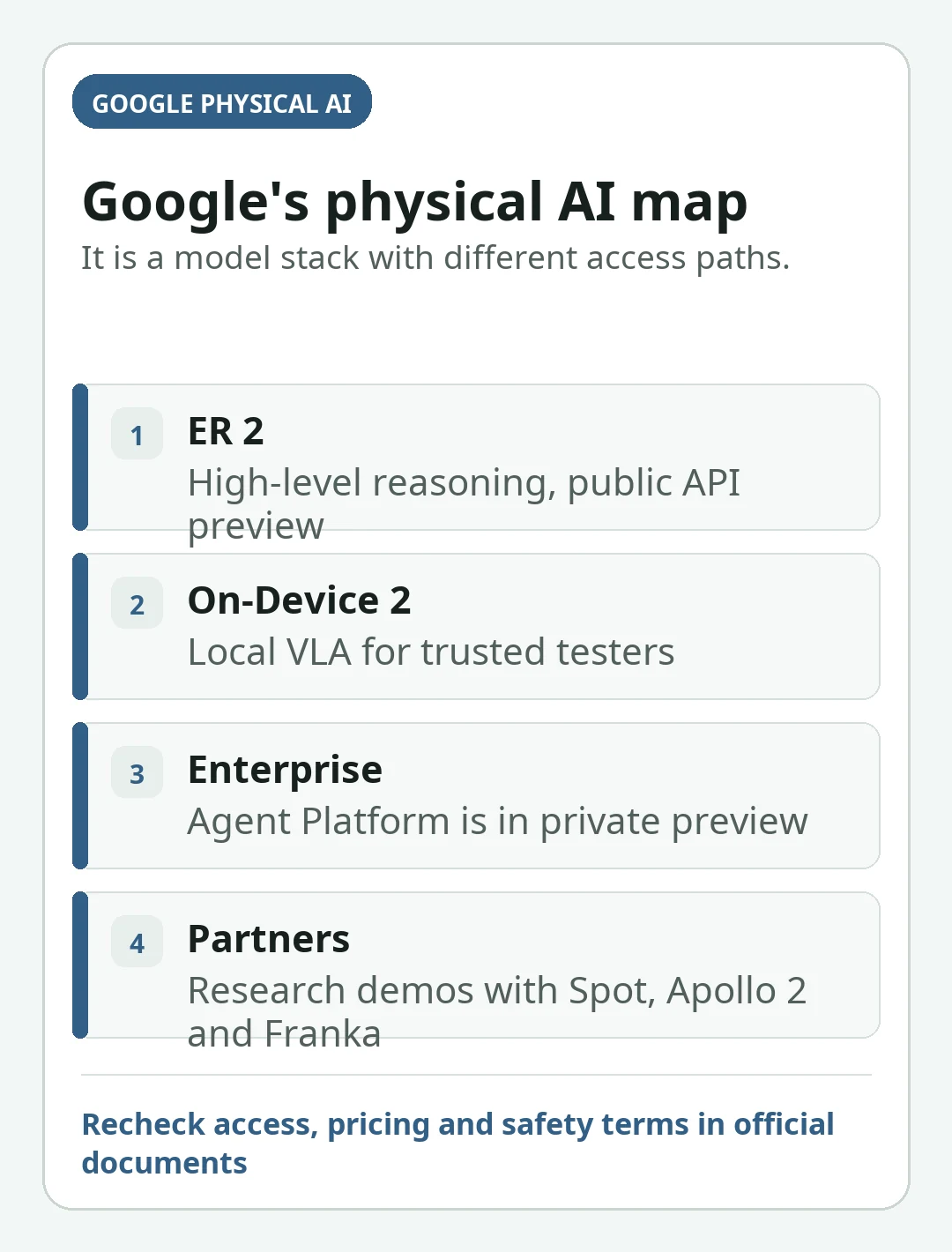
ER 2 is the part most developers can try immediately. Google offers a standard preview model and a streaming preview model through the Gemini API, with free and paid tiers. Enterprise Agent Platform access is described as a private preview. Preview status means interfaces, prices and limits can change, so experiments should isolate model calls behind an adapter.
On-Device 2 is not a public download or generally available API. Google directs interested teams to a trusted-tester waitlist. The partner robot demonstrations also do not create a bundled purchasing route. A company evaluating Spot, Apollo or Franka hardware must still work through the relevant manufacturer and its supported software stack.
The access matrix below is a practical checkpoint for planning.
| Need | Current route | Important caveat |
|---|---|---|
| Test high-level robot reasoning | ER 2 in Google AI Studio or Gemini API | Public preview; validate privacy, cost and reliability |
| Build a low-latency streaming supervisor | ER 2 streaming preview through Live API | Not a deterministic motor-control loop |
| Run Google's new action model locally | Apply to On-Device 2 trusted-tester program | No general public access |
| Reproduce a partner demonstration | Use documented APIs and contact the relevant vendor | Demo assets and integrations may not be publicly packaged |
What Google's announcements do and do not prove
The announcements support a clear direction: Google is investing in multimodal reasoning that can observe task progress, call robot tools and work across embodiments, while also developing a local action model. They show credible research progress and provide a public ER 2 experimentation path. They do not prove that general-purpose robots are ready for unsupervised deployment in open environments.
Safety remains layered. Google's material covers semantic and orchestration risks, but not functional-safety engineering, guarded workspaces or emergency stops. Robot video and audio may include identifiable people, creating notice, consent and minimization obligations. Buyers should start with one bounded workflow and compare it with a deterministic process.
Frequently asked questions
Does Google make the robots shown with Gemini Robotics?
No. Boston Dynamics Spot, Apptronik Apollo 2 and Franka systems come from their respective manufacturers. Google supplies or researches the AI models and orchestration layer used in the demonstrations.
Which Google physical AI model is publicly accessible?
Gemini Robotics ER 2 is in public preview through the Gemini API and Google AI Studio. Gemini Robotics On-Device 2 is limited to trusted testers as of August 6, 2026.
Can ER 2 and On-Device 2 be used together?
They occupy complementary conceptual layers, so a system could use high-level ER 2 planning and an on-device action model. Google has not promised a universal plug-and-play integration; robot-specific adapters, validation and safety controls remain necessary.
Official sources checked
- Google: Gemini Robotics ER 2 announcement
- Google DeepMind: Gemini Robotics ER 2 model card
- Google DeepMind: Gemini Robotics On-Device 2
- Google DeepMind: Gemini Robotics On-Device 2 model card
- Google AI for Developers: Gemini Robotics API overview
Last checked: August 6, 2026