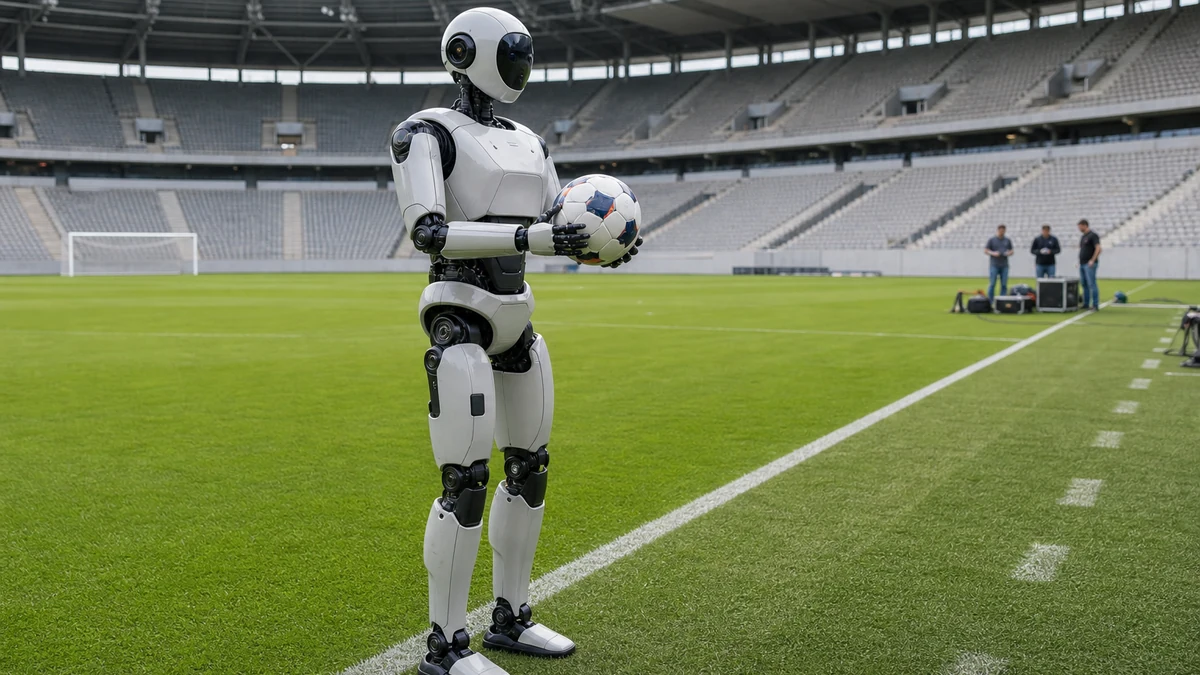
Boston Dynamics Atlas really did enter the field during halftime of Brazil's 1-2 loss to Norway on July 5, 2026 at New York New Jersey Stadium. Boston Dynamics and Hyundai say the electric Atlas performed a prepared football-themed ceremony and delivered the match ball to the referee in a live World Cup environment. FIFA's match report independently confirms the match, date, round and result.
That evidence does not answer the stronger autonomy question. Boston Dynamics and Hyundai describe human-motion retargeting, reinforcement learning and whole-body control used to train the movements, but their public accounts do not say whether the live sequence began through remote triggering, ran as a preselected routine, used teleoperation, or received human supervisory intervention. The accurate verdict is a real live robot performance with an undisclosed live control arrangement—not proof that Atlas planned and executed the entire appearance without people.
The confirmed event was a halftime ball-delivery performance
The FIFA match report records Brazil versus Norway in the round of 16 on July 5, 2026 at New York New Jersey Stadium, with Norway winning 2-1. FIFA establishes the sporting event and result. It should not be used alone to infer how Atlas was controlled.
Boston Dynamics' field-deployment account and Hyundai's official announcement identify a production Atlas entering the field at halftime, carrying out selected ceremony movements and delivering the match ball to the referee. The sources also describe extensive preparation in test and field-like environments.
This is stronger evidence than a studio clip: the robot operated at the actual venue during a live global event. It is still a selected performance, not a football match, an open-ended navigation trial or an endurance study.
| Claim | Public evidence | Verdict |
|---|---|---|
| The match occurred on July 5, 2026 | FIFA match report | Confirmed |
| Norway beat Brazil 2-1 in the round of 16 | FIFA match report | Confirmed |
| Atlas appeared on the field at halftime | Boston Dynamics and Hyundai official accounts | Confirmed |
| Atlas delivered the match ball to the referee | Boston Dynamics and Hyundai official accounts | Confirmed |
| The appearance used learned football movements | Boston Dynamics and Hyundai describe the training pipeline | Company-reported technical claim |
| No human initiated, supervised or could interrupt the routine | Not disclosed in the cited sources | Unknown |
| Atlas can autonomously play a football match | No such test is presented | Unsupported |
Autonomous is not one switch, and the missing layer is live operation
A robot can use a learned policy for balance and motion while a person chooses when that policy starts. It can follow a prepared route while operators monitor the surroundings. It can execute a sequence on board yet still depend on a remote enable, abort or fallback. Each arrangement contains some automation; none alone proves unsupervised, goal-level autonomy.
The World Cup sources describe how movements were created and how the team prepared for the venue. They do not publish the live trigger, waypoint source, communications architecture, operator roles, intervention policy or fallback state. Without those details, there is no factual basis for choosing fully autonomous over supervised autonomy, remote triggering or a pre-scripted routine with learned subskills.
Use the word autonomous only with its level and boundary attached. Our humanoid robot video evaluation guide provides the same discipline for edited demos: identify the task decision, movement controller, environment preparation, intervention and unshown failures separately.
| Control layer | Question for the World Cup appearance | Public status |
|---|---|---|
| Motion generation | Were body motions produced by learned policies and whole-body control? | Boston Dynamics and Hyundai say yes |
| Routine selection | Who chose the ceremony sequence and its order? | Prepared performance is clear; selection mechanism is not disclosed |
| Start and transition triggers | What initiated walking, movement changes and ball handoff? | Not disclosed |
| Localization and route | Was the field path sensed online or pre-mapped and cued? | Not disclosed |
| Human supervision | Could an operator pause, redirect or recover the robot? | Not disclosed |
| Safety authority | Who held the final stop decision around staff and performers? | Not disclosed |
| Goal-level planning | Did Atlas independently decide the ceremony objective? | No supporting evidence |
Human motion became robot motion through retargeting and learning
Boston Dynamics' football-training explanation describes a pipeline rather than a person driving each joint. Human athletes performed movements that were captured, then adapted to Atlas's different proportions and joint structure through retargeting. Reinforcement learning and whole-body control were used to make the robot execute dynamic behavior while maintaining physical consistency.
Retargeting is necessary because copying coordinates from a human skeleton would not respect Atlas's mass distribution, joint limits, foot contacts or balance. Reinforcement learning can search for a feasible policy around the target motion, while whole-body control coordinates contacts and body segments. The imitation-learning versus reinforcement-learning guide explains why the reference and the optimization step solve different problems.
This pipeline supports a meaningful autonomy claim at the movement layer: the robot's controller can produce the trained motion from its own state rather than relying on a human to manually command every actuator. It does not establish how the live event chose goals, started behaviors or handled exceptions.
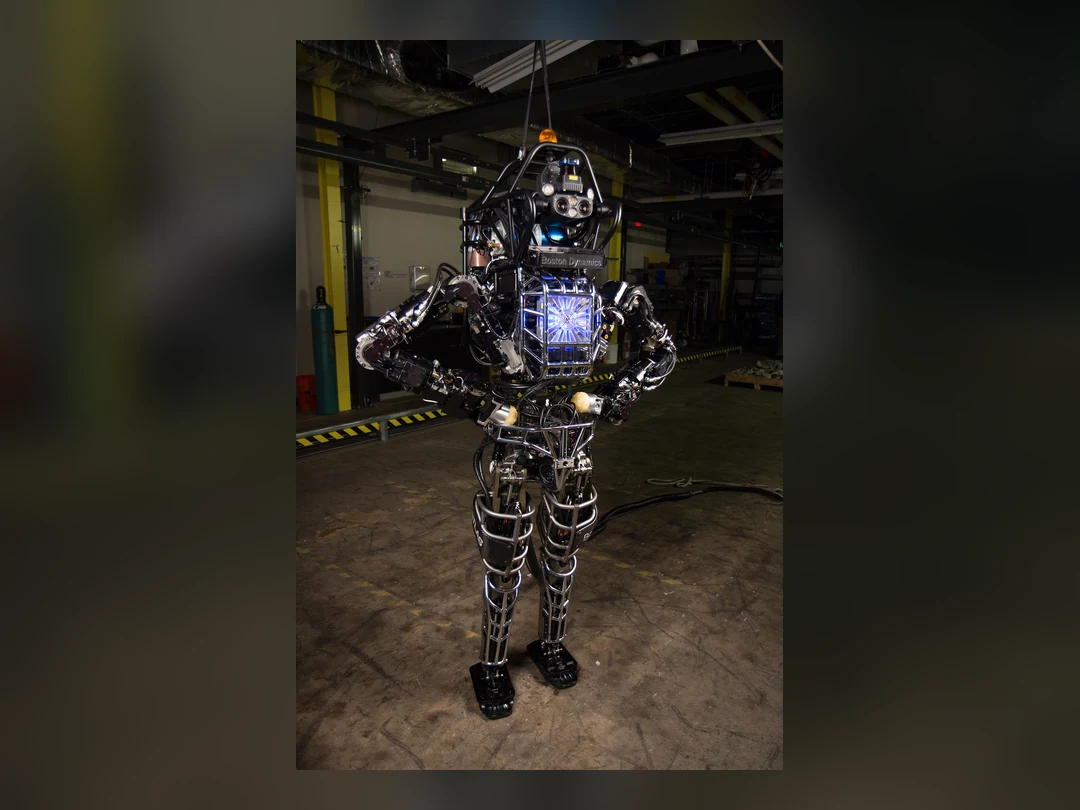

The Ghost Rabona demo and the halftime routine are not the same claim
The football campaign showed Atlas learning a Ghost Rabona, a dramatic behind-the-leg kick, from motion-capture work. That demonstration is useful evidence about dynamic policy training and retargeting. It should not be silently inserted into the match record. The official field accounts confirm the halftime ceremony and ball delivery but do not state that Atlas performed the Ghost Rabona on the World Cup pitch.
A campaign video can combine different locations, rehearsal stages and successful takes. The live event adds venue evidence but covers only what Atlas actually did there. Keeping those records separate prevents a common error: treating every published capability in a campaign as a capability demonstrated in the final performance.
The same rule applies to the phrase played football. Nothing in the official event evidence shows Atlas choosing passes, recognizing opponents, dribbling freely or adapting tactics through a match. It performed a football-themed routine; it was not entered as an autonomous player.
Rehearsal and contingency planning made the live deployment credible
Boston Dynamics says Atlas was tested in laboratory and real-world conditions, including a temporary football field during preparation. The team also planned communications and rehearsed multiple scenarios and conditions. This matters because a stadium introduces timing, surface, lighting, radio, crowd and coordination constraints that a controlled lab clip can avoid.
Preparation does not weaken the achievement. Reliable robotics depends on rehearsal, bounded operating conditions and recovery planning. It does, however, narrow what the event proves. A thoroughly rehearsed ceremony demonstrates execution in a prepared live environment, not general competence in any stadium or an ability to recover from every unexpected person, object or network event.
The public accounts do not provide total rehearsals, failed takes, intervention counts, recovery counts or a distribution of performance across surfaces. One successful public run cannot be converted into a reliability percentage. The Sim-to-Real failure guide explains why physical validation remains necessary even after extensive simulation.
| Evidence from the event | What it supports | What it does not support |
|---|---|---|
| Atlas operated at the actual match venue | Real-world deployment beyond a laboratory | Unsupervised operation in arbitrary public venues |
| The team rehearsed in field-like settings | Environment-specific preparation and risk reduction | Zero remote support or human intervention |
| Learned movement policies were used | Movement autonomy within trained behaviors | Independent goal selection or match tactics |
| A selected routine succeeded publicly | The shown sequence could be executed under event conditions | A fleet-wide success rate or long-duration reliability |
| Contingencies and communications were prepared | Operational planning for a live show | Disclosure of the actual control and fallback architecture |
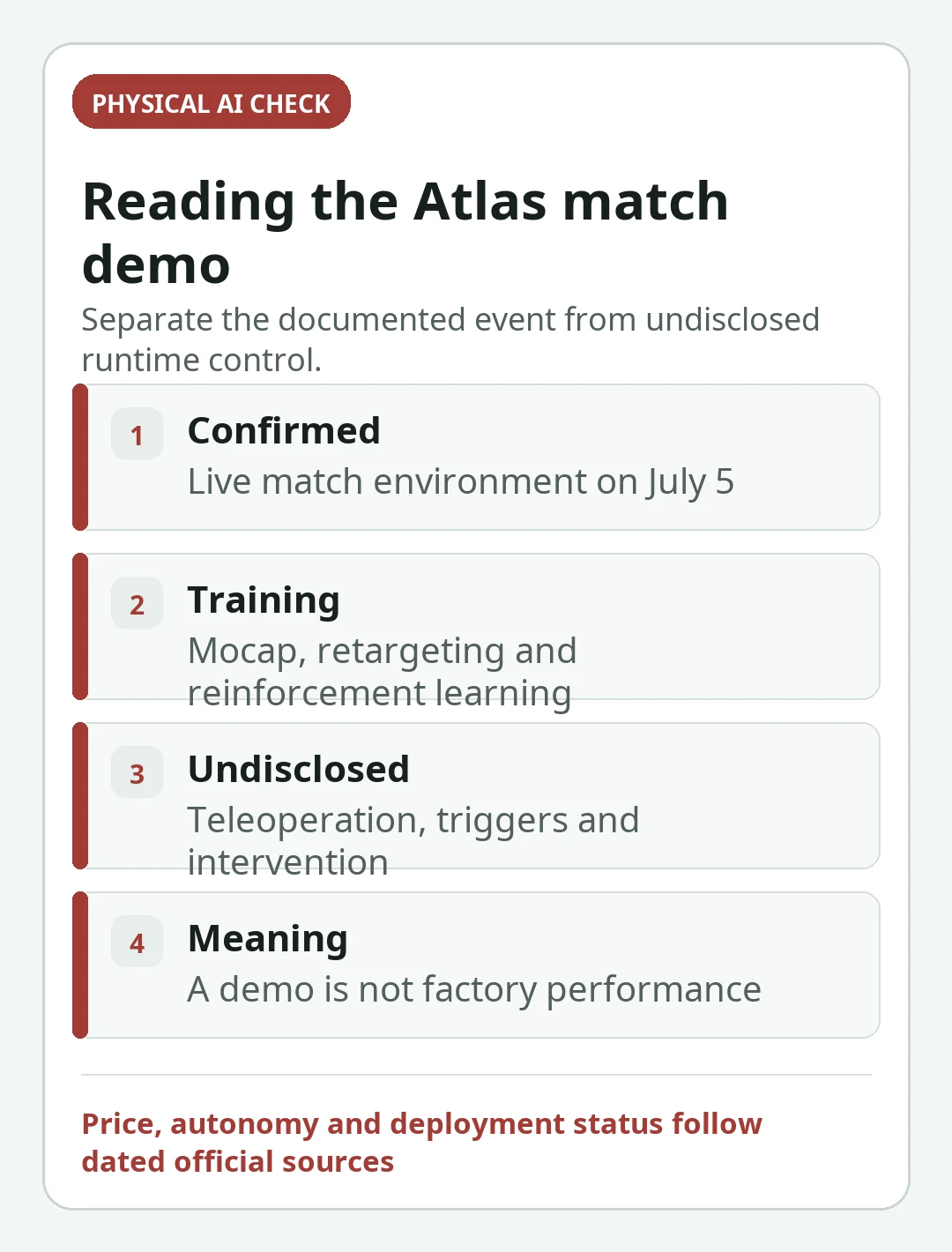
Football training suggests transferable tools, not instant factory readiness
Dynamic football motions stress balance, rapid whole-body coordination and adaptation to contact. Boston Dynamics argues that the learning tools developed around such behaviors can help industrial tasks in factories and warehouses. That is a plausible engineering direction and a company claim worth tracking.
Transfer still needs task evidence. A factory robot must perceive workpieces, coordinate with production systems, meet cycle time, detect bad states, recover without damage and satisfy site safety requirements. A successful kick or ceremony does not measure any of those outcomes. The whole-body control guide connects the shared control problem without treating one demonstration as a production acceptance test.
Atlas procurement and deployment status also belong to a separate question. The Boston Dynamics Atlas 2026 price and availability guide covers the product and customer context. The World Cup appearance should not be used as a public price, an order route or evidence that general commercial availability changed.
The defensible description keeps the achievement and the unknowns together
A precise summary is: Boston Dynamics' electric Atlas performed a prepared football-themed halftime sequence and delivered the match ball during a live World Cup match on July 5, 2026. Boston Dynamics and Hyundai say its movements were developed with motion retargeting, reinforcement learning and whole-body control after extensive simulation and rehearsal.
Then add the boundary: the companies have not publicly specified the live trigger, teleoperation status, operator intervention, route-control method or full success and failure record. Therefore, the appearance confirms learned robot movement in a live venue but does not independently establish fully autonomous end-to-end operation.
This wording avoids two opposite mistakes. Calling the appearance fake ignores corroborating first-party and FIFA records. Calling it completely autonomous fills undisclosed operating details with speculation. The most useful assessment preserves both the real field achievement and the evidence gap.
Frequently asked questions
Was Boston Dynamics Atlas fully autonomous at the 2026 World Cup?
The public sources do not establish that. They confirm a live Atlas performance and describe learned movement training, but they do not disclose remote triggering, teleoperation, supervisory intervention, route control or the safety operator's role.
Did Atlas perform the Ghost Rabona during the World Cup match?
Boston Dynamics published the Ghost Rabona as part of its football learning campaign. The cited live-event accounts confirm a halftime ceremony and match-ball delivery, but they do not say that the Ghost Rabona was performed on the match field.
Does the football demo prove Atlas is ready for autonomous factory work?
No. It demonstrates dynamic learned movement and live-event preparation. Factory readiness requires separate evidence for perception, cycle time, interventions, recovery, production-system integration, safety and sustained reliability on the target task.
Official sources checked
- Boston Dynamics: Deploying Robots Into (and Onto) the Field
- Boston Dynamics: Can football teach a robot to move?
- Hyundai: Atlas in a FIFA World Cup 2026 live match environment
- FIFA: Brazil 1-2 Norway match report
Last checked: August 6, 2026