Imitation learning trains a robot from examples of desired behavior. Reinforcement learning trains through reward feedback gathered while the policy acts or explores. The practical choice depends on whether expert demonstrations, a trustworthy reward, cheap resets and safe exploration are available.
Neither method automatically produces a deployable robot policy. Imitation can copy narrow demonstrations and fail after small errors. Reinforcement learning can exploit reward loopholes or require enormous experience. Many effective workflows pretrain from demonstrations, improve in simulation and adapt cautiously on hardware.
Use this comparison with the robot data factory and sim-to-real failure guide. Hardware learning requires task-specific supervision, limits and qualified safety review.
Imitation learning begins with an expert behavior distribution
Behavior cloning maps observations to actions using demonstrations. It can learn complex manipulation without an explicit analytical controller or reward. Its quality is bounded by what experts show and how consistently they operate.
When the learned policy makes a small error, it may reach states absent from demonstrations and compound the mistake. Collect recoveries, varied approaches and corrective data rather than only clean nominal trajectories.
Reinforcement learning begins with a reward and interaction loop
The MuJoCo Playground provides open robot-learning environments that illustrate large-scale simulation-based reinforcement learning. A policy samples actions, observes transitions and adjusts to maximize a defined return.
The reward must encode task progress without permitting shortcuts. Exploration consumes resets and can create impacts or unsafe states. Simulation, constraints and curricula reduce cost but do not eliminate reality-gap validation.

The learning signal determines the first method to try
Use imitation when experts can demonstrate the task and automatic success feedback is weak. Use reinforcement learning when outcomes can be scored repeatedly and exploration is affordable. Use a hybrid when demonstrations provide a safe starting distribution and rewards refine performance.
The choice can differ by layer. A semantic planner may learn from demonstrations, while a locomotion controller uses simulation reinforcement learning. Define observation and action interfaces before comparing algorithms.
| Condition | Imitation learning | Reinforcement learning | Likely sequence |
|---|---|---|---|
| Strong expert data | Directly useful | Can initialize policy | Imitate then refine |
| Clear automatic reward | Optional | Strong fit | RL with baseline |
| Unsafe exploration | Safer initial path | Needs simulator or constraints | Imitation first |
| Sparse success | Needs successful examples | Hard credit assignment | Demo-assisted RL |
| Novel optimum needed | Limited by examples | Can exceed demonstrations | Hybrid with careful reward |
Demonstration quality matters more than raw hours
Expert data should cover objects, approaches, contacts, failures and recoveries. Interface latency and operator viewpoint shape motion. Mixing experts can create conflicting styles or useful diversity depending on how context is labeled.
Measure episode outcomes and action consistency. Weighting or filtering should be traceable. If the robot will run autonomously, collect data from states produced by its own errors through guarded intervention or iterative data aggregation.
Reward design can create convincing but wrong behavior
A reward is a proxy for the real objective. A robot may move fast while damaging objects, hover near a target without completing it, or exploit a simulator artifact. Inspect trajectories and failure modes, not only cumulative return.
Decompose reward terms, track their scale and test adversarial scenarios. Prefer outcome measurements that correspond to verified task completion. Constrained or safety-aware training still needs independent protective controls.
Offline learning and online exploration have different risks
Offline imitation or reinforcement learning uses fixed data and avoids new hardware exploration, but it cannot recover information absent from the dataset. Distribution shift makes value estimates or action selection unreliable.
Online learning can gather targeted experience but changes the operating policy. Use shadow tests, simulation, bounded parameter updates and rollback. Production robots should not become uncontrolled experiments.
Simulation changes the cost, not the evidence boundary
Parallel environments make reinforcement learning practical for contacts, locomotion and dexterity. Domain randomization and system identification can improve transfer. Simulator reward and physics errors can also teach policies that fail on real sensors or hardware.
Evaluate with held-out simulator conditions, then progress through software-in-the-loop, hardware-in-the-loop and guarded robot trials. Real task success, intervention, heat, wear and safety remain decisive.
| Evaluation | Imitation risk | RL risk | Required evidence |
|---|---|---|---|
| Held-out episodes | Near-duplicate leakage | Reward overfit | Group-aware split |
| Perturbations | Compounding error | Brittle optimum | Recovery trials |
| Simulation transfer | Missing embodiment detail | Physics exploitation | Real calibration |
| Hardware contact | Expert coverage gap | Unsafe exploration | Guarded trials |
| Long operation | Drift and exceptions | Policy instability | Operational metrics |
Policy architecture does not settle the method choice
Transformers, diffusion policies and recurrent networks can be trained with imitation, reinforcement objectives or both. Model capacity affects data needs and latency, but the learning signal and evaluation design still determine what behavior is reinforced.
Compare algorithms with the same observation, action, task split and robot limits. Include inference timing and controller interface. A higher offline score is irrelevant if the policy misses the hardware control deadline.
Hybrid workflows should have explicit handoff criteria
A common sequence is demonstration pretraining, simulation fine-tuning, constrained hardware adaptation and periodic data refresh. Each stage should state which data, reward and policy version enters and what evidence allows progression.
Prevent evaluation data from flowing backward into training. Preserve a simple scripted or imitation baseline. If reinforcement learning improves one metric while worsening intervention, stability or energy, the release decision should reflect the complete task.
Final selection belongs to task-level trials
Measure verified success across required variation, recovery, intervention, cycle time, force, energy and hardware stress. Test unseen objects and starting states. Report denominators and confidence rather than selected videos.
Choose the simplest method that meets the evidence threshold. A hybrid is not automatically better; it adds data and debugging complexity. Preserve rollback and monitor the deployed distribution for change.
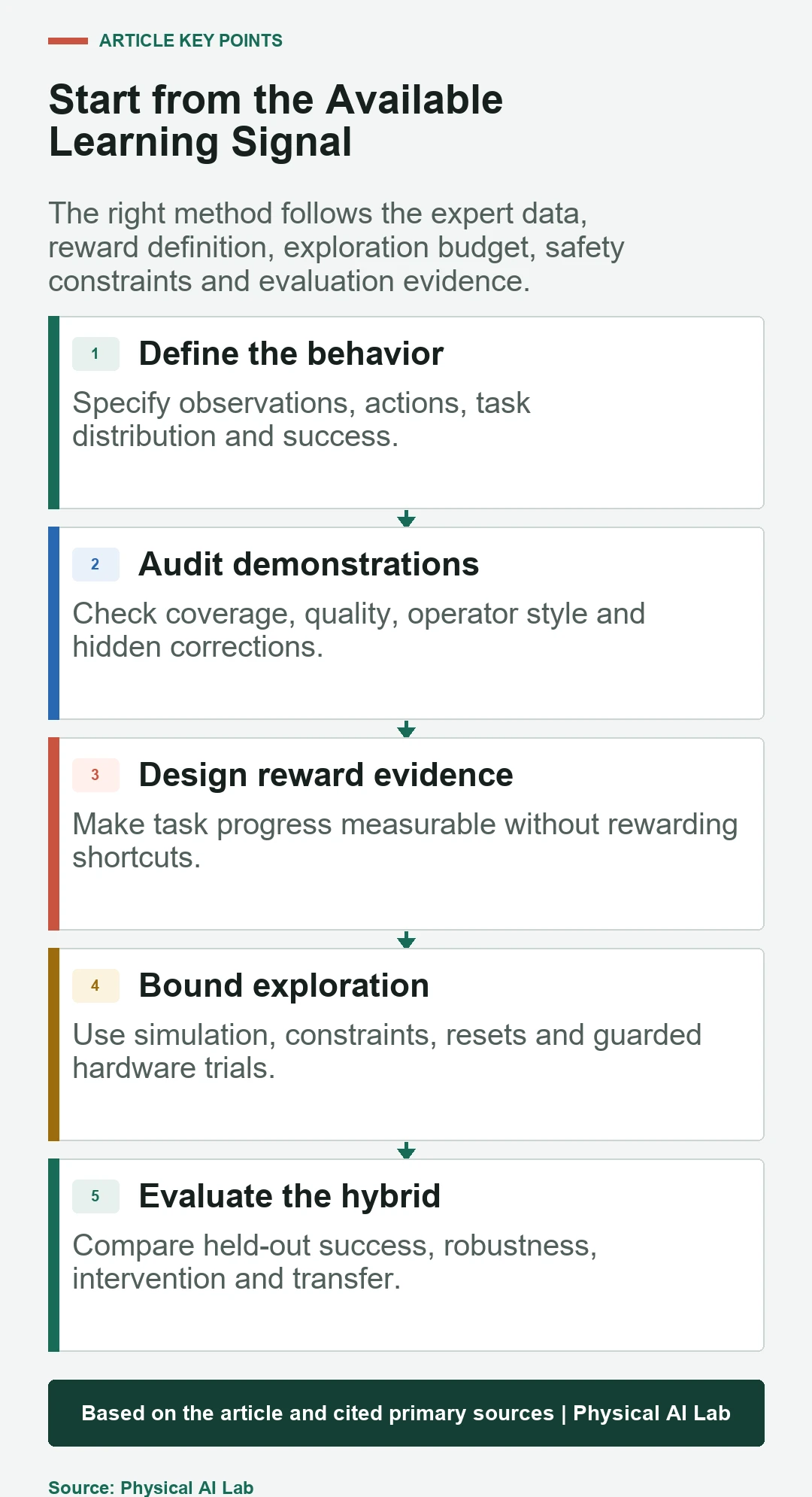
- Define task, observation, action and success.
- Audit demonstrations and reward loopholes.
- Bound exploration through simulation and safeguards.
- Use held-out and perturbation evaluation.
- Release only after representative hardware trials.
Frequently asked questions
Is imitation learning supervised learning?
Behavior cloning is commonly supervised learning from observation-action examples, although broader imitation methods can use adversarial or inverse-reward objectives.
Can reinforcement learning work without demonstrations?
Yes when rewards, exploration and resets are practical, but demonstrations often accelerate sparse or risky robot tasks.
Why does imitation learning fail after small mistakes?
The policy can enter states not represented in expert data, causing errors to compound. Recovery data and iterative collection help.
Why train reinforcement learning in simulation?
Simulation permits large-scale exploration and resets without damaging hardware, but the learned policy still needs real-world transfer validation.
When should the two methods be combined?
Combine them when demonstrations provide a useful safe starting policy and reward-guided interaction can improve performance under controlled conditions.
Learning Method Note
Robot learning can create unexpected actions outside the training distribution. Use independent limits, monitored trials, rollback and task-specific safety engineering; model training results do not certify a robot system as safe.