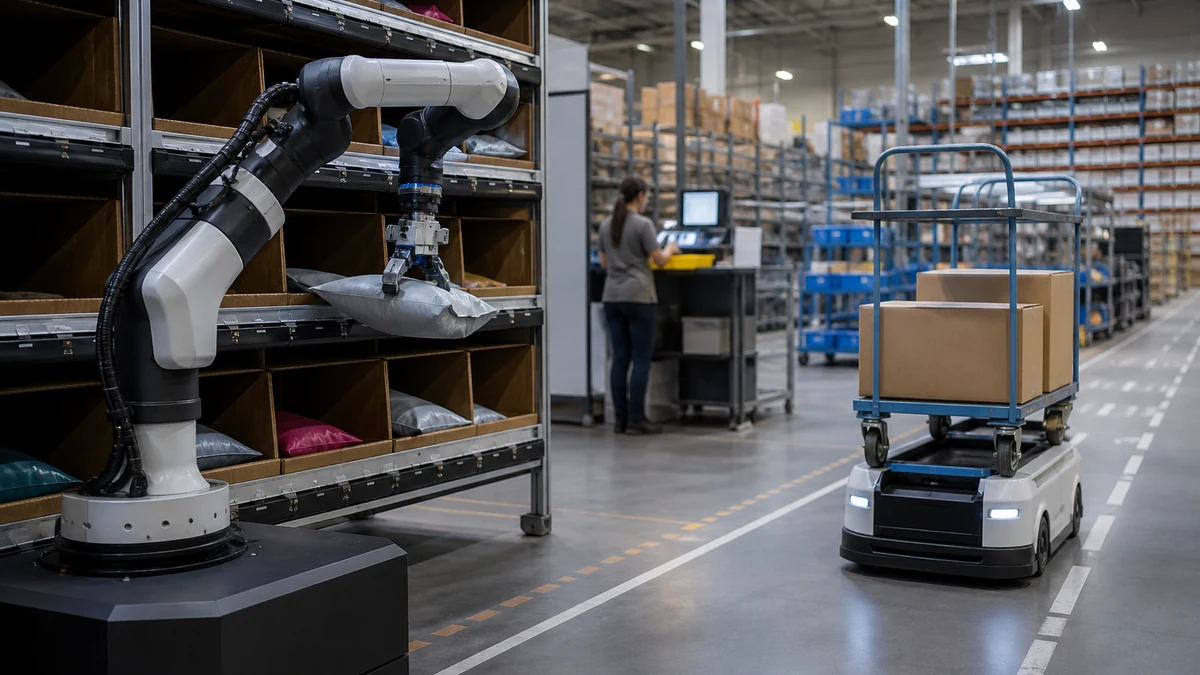
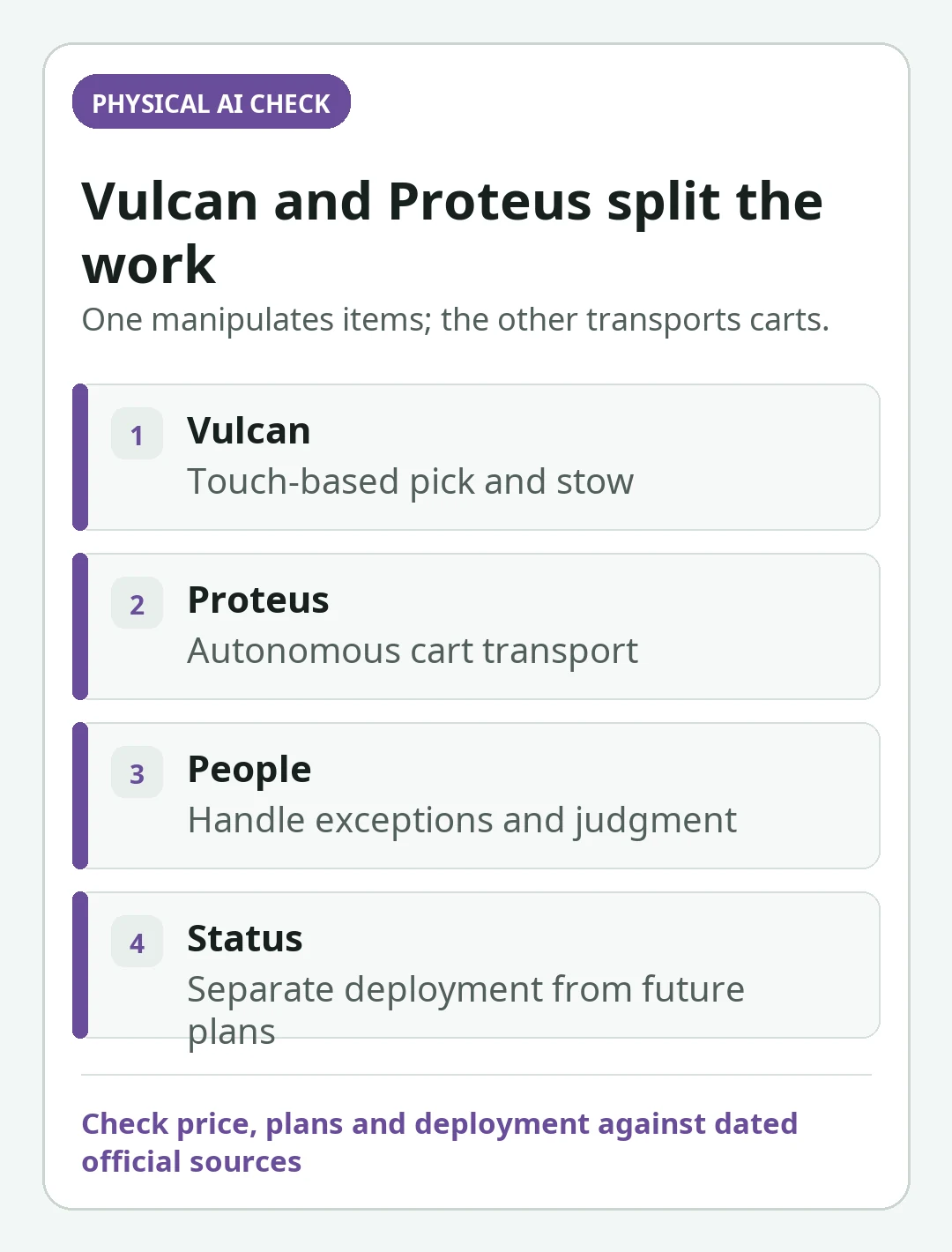
Amazon Vulcan and Proteus do not compete for the same job. Vulcan is Amazon's first robot with a sense of touch and uses force feedback, vision and suction tooling to pick and stow items in inventory pods. Proteus is Amazon's first fully autonomous mobile robot and moves carts through fulfillment-center spaces while navigating around people.
Their rollout status also differs. Vulcan was introduced in Spokane, Washington, and Hamburg, Germany, with expansion planned over several years. Amazon's June 2026 Proteus update says the current Proteus was operating in 25 U.S. fulfillment centers. Natural-language task direction and movement across a wider range of facilities belong to the next-generation Proteus program being piloted in labs, with European deployment planned for the first half of 2027—not to every Proteus currently in service.
Vulcan manipulates inventory; Proteus transports carts
Vulcan works at the storage interface. Its tooling can sense contact force while a camera and suction system help it reach into fabric-covered inventory pods, identify an item and pick or stow it. Proteus works at the movement layer. It travels through facilities, gets under compatible carts and transports material between work areas.
That division is the clearest way to compare them. Vulcan reduces difficult high and low reaches and automates a portion of item handling. Proteus reduces repeated cart movement. A warehouse may benefit from both because manipulation and internal transport form consecutive parts of one flow. The warehouse picking robot guide explains why a picking station and a mobile transport system need different evidence.
| Question | Amazon Vulcan | Amazon Proteus |
|---|---|---|
| Primary job | Pick and stow individual items in inventory pods | Move carts and material through facilities |
| Core interaction | Camera, suction and force-feedback end tooling contact items | Autonomous mobile navigation engages and carries carts |
| Human handoff | Requests help for item types it cannot handle | Operates around people while moving work between stations |
| Physical AI problem | Tactile manipulation in clutter | Safe navigation and material transport |
| External purchase status | No public Amazon sales offer or price | No public Amazon sales offer or price |
Vulcan's 75 percent figure refers to item types
Amazon says Vulcan can handle about 75 percent of the item types stored in the facilities where it works, at speeds comparable to employees. The denominator is item types. It is not 75 percent of all warehouse work, 75 percent of fulfillment volume, a 75 percent success rate or a promise that every compatible item is handled without an exception.
For unsupported or uncertain items, Vulcan can ask a person to tag in. That exception path is part of the system, not evidence that a worker has been removed from the workflow. A useful evaluation should record coverage by SKU and packaging cohort, successful picks and stows, human-assist rate, damage, cycle time and recovery after a failed grasp. The robot tactile sensor guide provides context for what contact sensing can and cannot establish.
Current Proteus and next-generation Proteus need separate labels
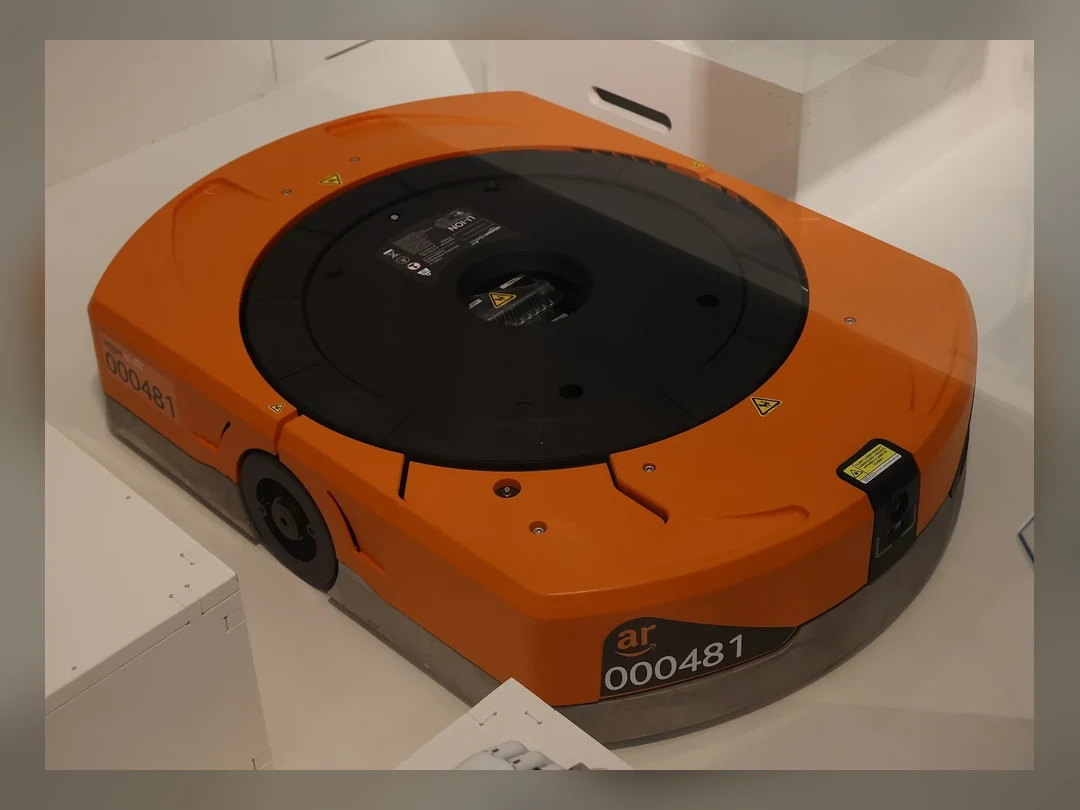
The current Proteus is an operating autonomous mobile robot that moves carts through fulfillment centers and can navigate around employees. Amazon's June 2026 update says it was active in 25 U.S. fulfillment centers and describes carts weighing close to 400 kilograms. Those are deployment facts about the existing system.
Amazon separately describes a next-generation Proteus designed to take natural-language task directions and move across more areas of fulfillment centers and delivery sites. That capability is being designed and piloted in laboratories, with deployment in Europe planned for the first half of 2027. It should not be written as a fleet-wide capability of today's 25-site deployment.
| System or claim | Official status on August 6, 2026 | Do not infer |
|---|---|---|
| Vulcan | Introduced in Spokane and Hamburg; broader U.S. and European expansion planned over years | Deployment in every Amazon facility |
| Current Proteus | Operating in 25 U.S. fulfillment centers as of June 4, 2026 | Natural-language control on every unit |
| Current Proteus cart movement | Amazon describes carts close to 400 kg | A public payload specification for every future model and cart |
| Next-generation Proteus | Designed and piloted in labs; Europe deployment planned for first half of 2027 | Completed rollout or guaranteed schedule |
| Commercial availability | Internal Amazon operational systems; no public external sales route | A unit price, API or third-party purchase option |

Touch helps Vulcan detect contact, not understand every object
Force feedback gives Vulcan information that vision alone cannot provide, such as whether the tool is pressing against a neighboring item or the pod. Amazon describes this sensing as a way to make picks and stows in confined spaces and to reach high and low pod locations that can be ergonomically difficult for employees.
The remaining challenge is long-tail inventory. Flexible bags, transparent packaging, fragile items, tangled products and uncertain suction surfaces can require different strategies. Coverage should therefore be reported by item cohort and task direction—pick versus stow—rather than as one global percentage. Human escalation, safe withdrawal and accurate inventory updates are part of successful manipulation.
Proteus changes material flow more than item handling
Proteus carries carts between zones; it does not replace the item-level grasping performed by Vulcan. Its operational measures should include transport requests completed, travel time, wait time, blocked-path recovery, cart-engagement success, congestion and safe interaction with people. The AMR versus AGV guide explains the navigation distinction without assuming that autonomy eliminates traffic engineering.
At multiple sites or large fleets, dispatch policy becomes part of throughput. A robot can be locally fast while the system queues at a station, charger or narrow aisle. The multi-robot task allocation guide shows why work assignment, resource contention and exception recovery should be measured at the flow level.
People remain in the control, exception and improvement loops
Amazon describes Vulcan asking an employee for help when it cannot confidently handle an item. People also load, maintain, monitor and improve the surrounding process. Proteus is designed to navigate around people, which changes how transport work reaches employees rather than creating an empty warehouse.
A responsible deployment analysis should identify who responds to robot requests, clears damaged packaging, isolates equipment, corrects inventory, recovers a cart and approves restart. Ergonomic benefit should be measured against the specific high, low or repetitive motions that change. Safety and work design remain site responsibilities even when the underlying robot has operated elsewhere.
Evaluate the combined workflow instead of searching for a robot winner
Vulcan and Proteus are complementary layers: one handles items at storage, the other moves aggregated material. The business question is whether their handoffs reduce total order time, difficult manual reaches, walking, queueing and damage. A faster local cycle can simply move the bottleneck to another station if the complete flow is not measured.
Amazon has not published external unit prices, customer APIs, third-party availability or a universal ROI for either system. Other operators should treat the systems as evidence of architecture and deployment direction, not as products they can order. For an internal automation decision, use a physical AI proof of concept with representative inventory, traffic, human exceptions and end-to-end order metrics.
Frequently asked questions
What is the main difference between Amazon Vulcan and Proteus?
Vulcan manipulates individual items inside inventory pods using vision, suction and force feedback. Proteus is an autonomous mobile robot that moves carts through facilities. They address picking or stowing and material transport, respectively.
Does Vulcan automate 75 percent of all Amazon warehouse work?
No. Amazon says Vulcan can handle about 75 percent of item types in the facilities where it works. That is not 75 percent of all work, volume or a universal task-success rate, and people handle unsupported items.
Does every Proteus robot understand natural-language instructions?
No. Natural-language task direction is described for a next-generation Proteus being designed and piloted in labs, with European deployment planned for the first half of 2027. The current deployed Proteus should not automatically be assigned that capability.
Official sources checked
- Amazon: Vulcan robot uses touch to pick and stow
- Amazon: Proteus expansion and next-generation plans
- Amazon: Robotics systems in fulfillment centers
- Amazon: Ten years of Amazon Robotics
Last checked: August 6, 2026