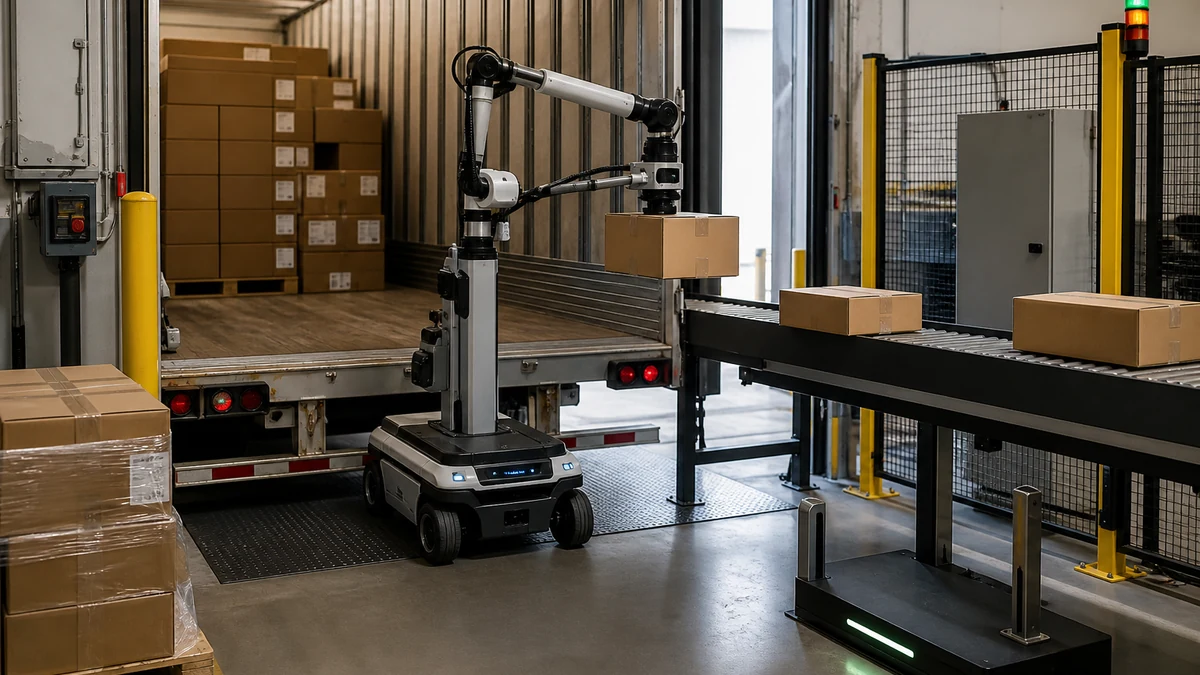
The Boston Dynamics Stretch page does not publish a current numerical list price; buyers are directed to Contact Sales. The quote must be configuration-specific because Trailer Unload and Case Pick are different operating packages. They share a 23-kilogram case limit and an up-to-16-hour runtime claim, but their robot weight, charging figures, workflow and published performance measures are not interchangeable.
Trailer Unload removes cases from trailers or containers, while Case Pick transfers warehouse cases to order pallets. The Case Pick brochure describes Orbit integration and a WMS-agnostic Case Pick API. The value case therefore depends on the real case mix, doors or aisles served, exception labor and integration—not a single robot price. Use the warehouse picking robot guide to define the task boundary before requesting a quote.
Stretch pricing is quote-only and the configuration comes first
The official Stretch product and solution pages route commercial inquiries to sales without stating a purchase, lease or subscription number. They also do not publish a standard price for installation, Orbit, WMS integration, support, training, spares or a service-level agreement. An old media number or an assumed Robotics as a Service rate cannot replace a dated Boston Dynamics proposal.
Start the request with the workflow: Trailer Unload, Case Pick or a separately scoped combination. Then ask sales to itemize hardware, end effectors, charging equipment, software, Orbit, integration, site work, commissioning, training, support, freight, taxes and optional services. If a lease or managed offer is proposed, compare its responsibility boundary with the Robotics as a Service contract guide.
| Price question | Public answer | Required procurement evidence |
|---|---|---|
| Robot purchase price | No numerical public list price | Dated, configuration-specific vendor quote |
| Lease or subscription rate | No standard public rate in the cited materials | Contract term, payment schedule, ownership and return conditions |
| Orbit and WMS integration price | Not publicly itemized | Software, connector, implementation and support line items |
| Installation and service | No universal public bundle | Site survey, commissioning, training, warranty, SLA and spare-parts scope |
Trailer Unload and Case Pick specifications must stay separate
Both configurations are built around moving cardboard cases, but their published numbers describe different jobs. The Trailer Unload brochure states 600 to 800 cases per hour. That company-stated rate should not be assigned to Case Pick, multiplied by 16 hours to promise a shift total, or treated as a guaranteed rate for every trailer and case mix.
Case Pick instead publishes reach, speed, aisle, pallet-towing and WMS details. Its official brochure specifies rectangular cardboard cases sealed with tape or glue, at least 15 centimeters in two dimensions and no more than 91 centimeters in any dimension. Packaging outside that envelope needs explicit validation.
| Specification | Trailer Unload | Case Pick |
|---|---|---|
| Primary job | Unload cases from trailers and containers | Pick cases and build order pallets |
| Maximum case weight | 23 kg / 50 lb | 23 kg / 50 lb |
| Published throughput | Company-stated 600–800 cases per hour | No universal public cases-per-hour figure in the cited brochure |
| Runtime | Up to 16 hours | Up to 16 hours |
| Charge to 90% | Typically 2 hours | 1 hour 45 minutes with the listed fast charger |
| Robot weight | 1,300 kg | 1,500 kg |
| Footprint | 1 × 1.25 m | 1 × 1.25 m |
| Configuration-specific values | 5–45°C; specified trailer, container and telescopic-conveyor types | 5–45°C; 3.2 m vertical reach, 1.95 m horizontal reach, 2 m/s and 3 m minimum aisle |
Trailer Unload performance depends on the inbound case stream
The 600-to-800-case hourly figure is useful as a vendor reference point, but a deployment model needs the distribution behind it. Case weight, crush damage, leaning stacks, transparent wrap, irregular voids, trailer geometry, temperature, door availability and the handoff conveyor can change sustained throughput and intervention demand.
Measure productive time rather than multiplying the headline rate by the maximum runtime. A shift model should subtract charging, trailer changes, blocked conveyors, human exception handling, resets, inspections and planned maintenance. Record median and lower-percentile throughput by trailer type, plus the proportion of cases that require a person. The robot uptime, MTBF, MTTR and OEE guide helps keep availability and rate from being collapsed into one optimistic number.
Case Pick adds pallet movement, case rules and aisle geometry
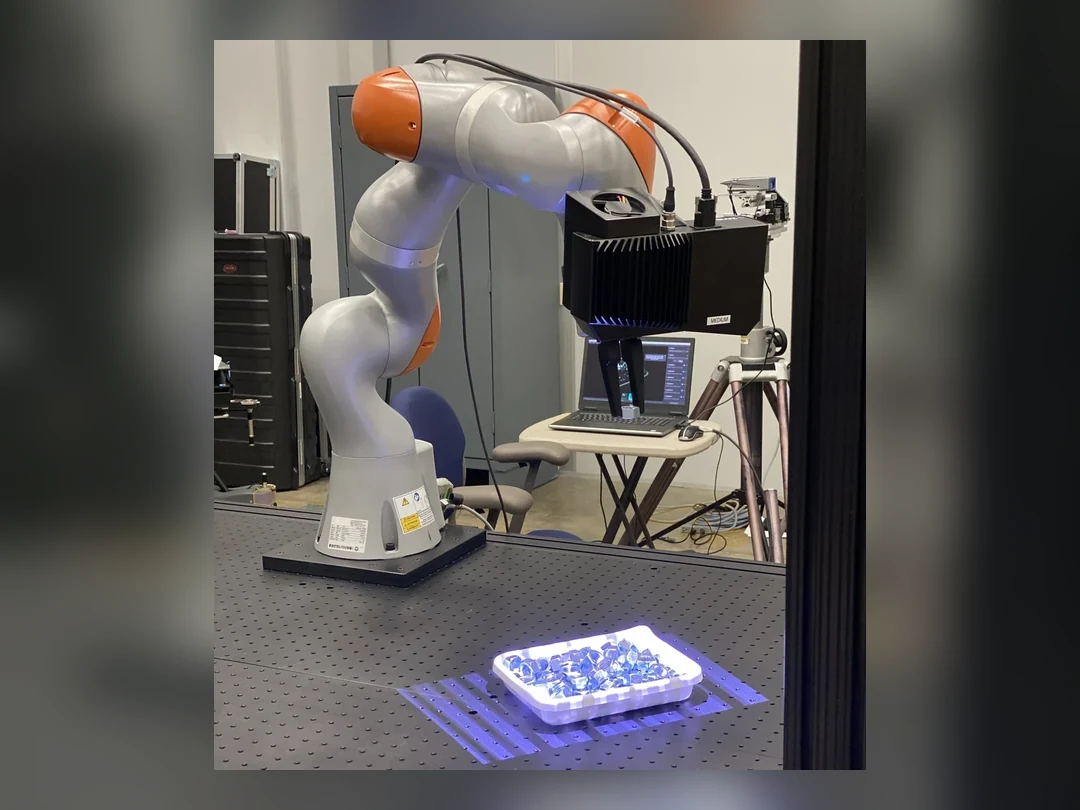
The Case Pick configuration can tow a pallet load of up to 1,300 kilograms and reaches 3.2 meters vertically and 1.95 meters horizontally. The listed robot speed is 2 m/s, and the brochure calls for a minimum three-meter aisle. Those dimensions need to be checked against rack faces, intersections, floor condition, pedestrian routes and the actual pallet-handling process.
Boston Dynamics says Stretch can work in existing infrastructure and does not require preprogramming every box type. That reduces one type of engineering effort; it does not mean every carton, rack and aisle is automatically compatible. Use a representative sample that includes the smallest and largest cases, difficult surfaces, damaged packaging and mixed-SKU pallets. For adjacent perception and grasp issues, see the bin-picking AI guide.
Orbit and the Case Pick API connect work to the WMS
Boston Dynamics describes Orbit as the fleet and site software layer, with dashboards, live views and system integrations. For Case Pick, Stretch scans case barcodes and sends task updates through Orbit, while the Case Pick API is described as WMS-agnostic. This means the interface is not limited to one WMS brand; it does not mean integration occurs without mapping, configuration or testing.
Define which system owns the order, pallet, location and completion state. Specify duplicate-message handling, barcode failure, inventory mismatch, task cancellation, network loss and recovery after a manual exception. Validate authentication, audit logs, timestamps and retry behavior in a test environment before production. A WMS connector is complete only when physical case movement and digital inventory state reconcile under both normal and fault conditions.
A deployment should pass site, task, integration and safety gates
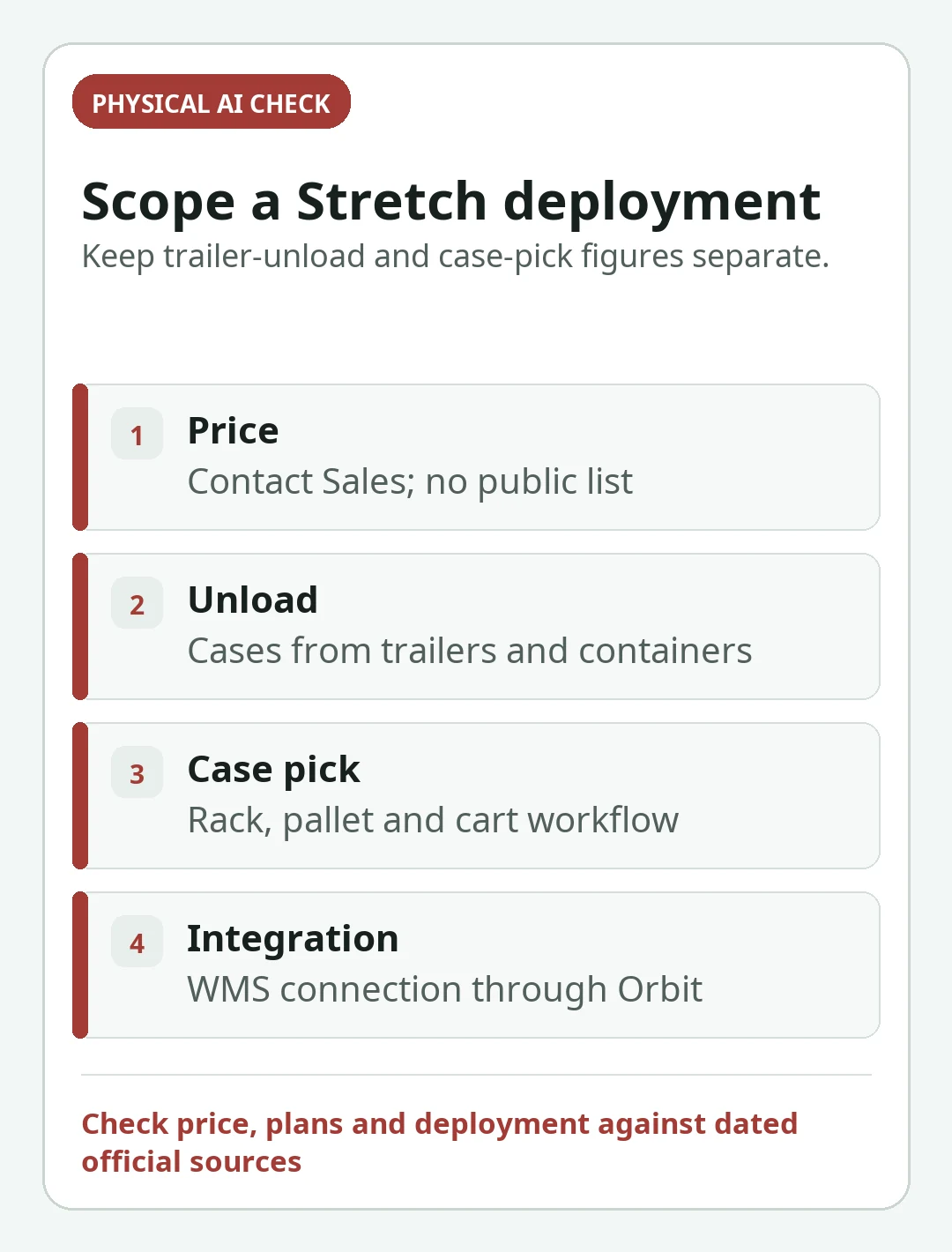
The first gate is a site survey covering floor loading, dock or aisle geometry, power, network, environmental limits, human traffic and emergency access. The second is a task trial using the real case distribution. The third is an integration trial that proves barcode, order, completion and exception states across Stretch, Orbit, conveyors and the WMS.
The final gate is operational acceptance over representative shifts, including restarts, blocked paths, damaged cases and staffing changes. Risk assessment remains application-specific even when the robot is a commercial product. Define protective measures, stop behavior, access control and restart ownership with the robot functional safety guide and the site's safety team.
Request a quote that exposes throughput and integration assumptions
Send Boston Dynamics the number of doors, trailers or pick aisles, operating hours, case-size and weight distributions, packaging exceptions, target throughput, pallet rules, conveyor interface, WMS, network policy and support location. Ask which configuration and charger meet the duty cycle and whether the proposal includes Orbit, APIs, commissioning, training and acceptance testing.
Ask for measured success criteria: sustained throughput by case cohort, intervention rate, damaged-case handling, charge schedule, availability, recovery time and digital inventory accuracy. Run the decision through a staged physical AI proof of concept. A quote becomes comparable only when the vendor and buyer agree on the same workload, exclusions and evidence window.
Frequently asked questions
How much does Boston Dynamics Stretch cost?
Boston Dynamics does not publish a current numerical Stretch list price in the cited official materials. Buyers need a configuration-specific quote covering Trailer Unload or Case Pick, charging, Orbit, WMS integration, installation, support and delivery.
Does Stretch always unload 600 to 800 cases per hour for 16 hours?
No. Boston Dynamics states 600 to 800 cases per hour for the Trailer Unload configuration and up to 16 hours of runtime. The hourly rate is not a universal Case Pick rate or a guaranteed full-shift total; real results depend on case mix, handoffs, interruptions and charging.
Is Boston Dynamics Stretch plug-and-play with any WMS?
The Case Pick API is described as WMS-agnostic and Orbit provides APIs and webhooks, but implementation still requires mapping, authentication, exception logic and end-to-end validation. WMS-agnostic does not mean integration-free.
Official sources checked
- Boston Dynamics: Stretch product page
- Boston Dynamics: Stretch Case Pick solution
- Boston Dynamics: Stretch Case Pick brochure
- Boston Dynamics: Stretch Trailer Unload brochure
- Boston Dynamics: Orbit
Last checked: August 6, 2026